

It’s late February. Your email is quiet, interviews are done, and you’re staring at your ERAS/NRMP screen with a half-finished rank list that you keep reordering every 20 minutes. One minute Program A is #1. Then you remember a weird vibe on interview day and suddenly Program C jumps up. You’re not confused because you lack information. You’re confused because you have too much of it, and none of it feels organized.
Here’s the fix: before you hit “Certify,” you need to revisit a focused set of questions that actually matter for your life, training, and sanity. Not vague “where did I feel good?” stuff. Concrete, decision-driving questions.
I’m going to walk you through those questions, how to use them, and where applicants reliably screw this up.
1. Training Quality: “Will This Program Actually Make Me Good At My Job?”
This comes first for a reason. Residency is not a vibe retreat. You’re training to safely practice medicine.
Ask yourself, for each program:
Will I see the right volume and variety of patients?
Think:- Are they a tertiary/quaternary referral center, community, or hybrid?
- Will you see bread-and-butter plus enough complex cases?
- Is anything obviously missing (trauma, OB, sick ICU, peds, procedures)?
How strong is the clinical autonomy?
You want graduated responsibility, not “scut monkey forever” or “sink or swim with no supervision.”
Revisit:- What did residents say about intern autonomy vs senior autonomy?
- Who actually runs the team: residents or attendings?
- Did anyone hint at “we can’t touch anything without an attending” or the opposite “we’re basically unsupervised at night”?
How do graduates do after residency?
Ask yourself:- Where have the last 3–5 years of grads gone? Fellowship match? Jobs?
- Do they get into the fellowships you care about (or similar caliber if not exact)?
- For non-fellowship careers: are people getting jobs where they want to live?
If you’re debating between two programs, and one clearly trains stronger clinicians with better outcomes for graduates, that should matter more than whether you liked their coffee bar.
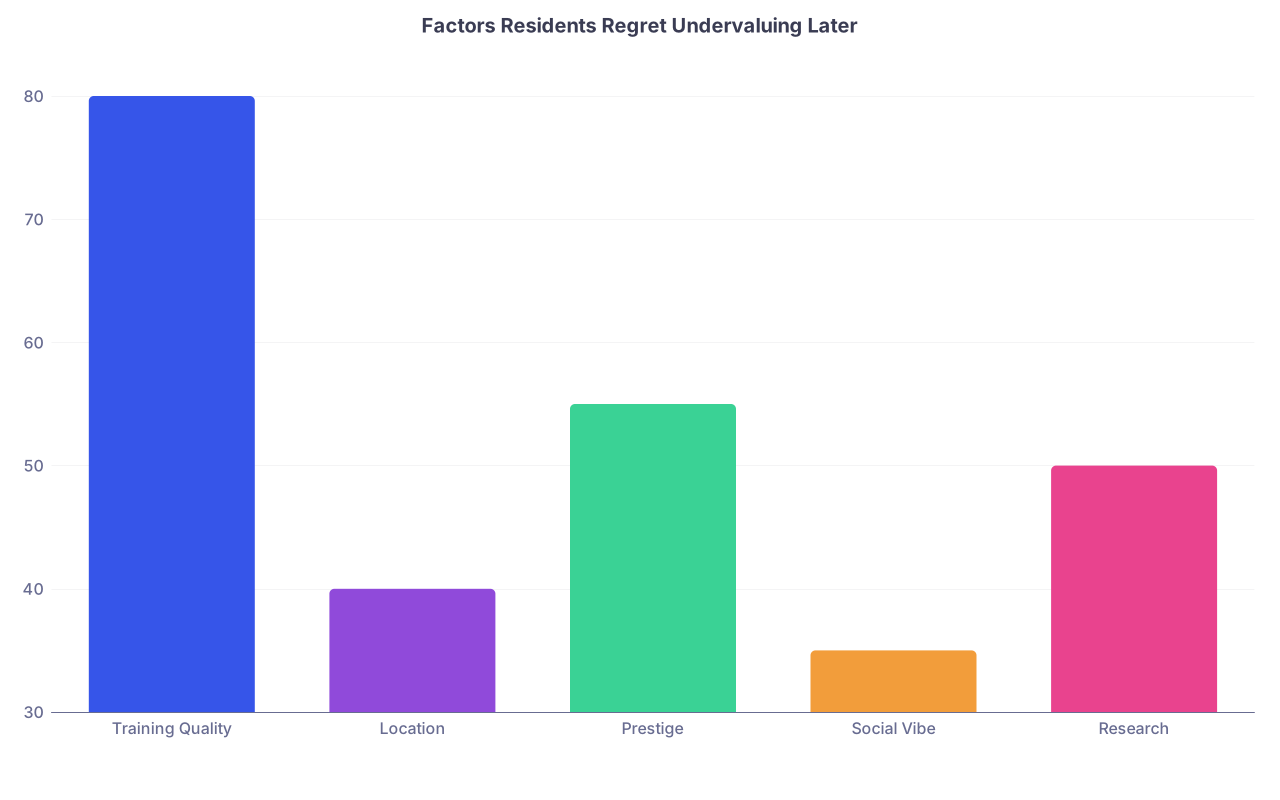
| Category | Value |
|---|---|
| Training Quality | 80 |
| Location | 40 |
| Prestige | 55 |
| Social Vibe | 35 |
| Research | 50 |
2. Fit and Culture: “Can I Survive Here For 3–7 Years Without Burning Out Or Losing My Mind?”
Yes, culture is overused as a buzzword. It’s also real.
Go back and ask:
Did residents seem like people I’d actually want as colleagues?
Not “were they nice for 30 minutes on Zoom.” Instead:- Did they joke with each other? Or look cautious around faculty?
- Did anyone actually admit what’s hard at the program, or was it all brochure-speak?
- Did they have lives outside medicine, or did everyone flex about 90-hour weeks?
How honest were they about weaknesses?
Strong sign: “Our ED is chaotic and documentation is rough, but our PD is actively fixing X and Y, and here’s what changed this year.”
Weak sign: “We’re a family! Everything is great! No issues!” That’s not real.What did your gut say about safety, equity, and respect?
Ask yourself bluntly:- Did you see diversity in residents and faculty, especially in leadership?
- Did anyone hint that URM, IMG, DO, or parent residents struggle for support?
- Was there a vibe of genuine respect for nurses/staff? Or hierarchy and intimidation?
If you’re imagining a horrible night shift and you can’t picture a single resident there you’d trust to have your back, that’s a red flag.
3. Program Leadership: “Do I Trust The People Running This Place?”
Programs rise and fall on leadership. Period.
Revisit these:
Program Director (PD): What did they actually say, not just how they smiled?
Ask yourself:- Did the PD talk about resident well-being in concrete terms (e.g., “we removed 24-hour calls last year”)? Or just say “we care about wellness”?
- Could the PD clearly articulate what they’re proud of and what they’re actively changing?
- Did residents seem to like and trust the PD, or just tolerate them?
Responsiveness to feedback.
On interview day, did you hear any version of:- “Residents gave feedback about X, and here’s exactly what we did”?
That’s gold. Programs that evolve are safer bets than shiny but rigid ones.
- “Residents gave feedback about X, and here’s exactly what we did”?
Stability.
- Any recent PD turnover? Chair turnover? Big hospital mergers?
- If leadership is new, do you like the new direction, or are you gambling?
I’d rank a slightly less prestigious but clearly resident-centered, responsive PD above a household-name program run by ghosts.
4. Lifestyle, Schedule, and Support: “What Will My Actual Day-To-Day Life Look Like?”
Do not rank based on the one social event dinner. Rank based on ordinary Tuesdays.
Ask these:
Schedule and workload:
- What are average duty hours? Are they always “right under 80” or usually 55–65?
- How intense are nights and call? How many weeks of nights per year?
- Are there true golden weekends or just marketing speak?
Non-clinical support:
- Is there decent ancillary staff (pharmacists, RTs, social work, case managers)?
- Do residents keep saying “documentation is killing us” or “we’re putting in all the orders and doing all the transport”?
- Any scribes, APPs, or night float structures that lighten the load?
Pay, benefits, and basic life logistics: Look at:
- Salary vs local cost of living
- Parking (yes, really), food options on nights, childcare help, insurance quality
- GME policies on parental leave, sick days, mental health support
| Factor | Program A | Program B |
|---|---|---|
| Avg inpatient census (PGY1) | 8–10 patients | 16–18 patients |
| Night block weeks/year | 4 | 8 |
| Resident salary (PGY1) | $63,000 | $58,000 |
| City cost of living | Moderate | High |
| In-house social work | 24/7 | Daytime only |
You don’t need perfect conditions. But you do need a life that isn’t structurally unsustainable.
5. Location and Personal Life: “Can I Actually Live Here And Still Be A Human?”
Everyone pretends they’ll choose “the best training” no matter what. Then by PGY2 they’re miserable in a city they hate, far from everyone they care about.
So, revisit honestly:
Do I want or need to be near specific people?
Spouse/partner. Kids. Sick family. These are not “soft factors.” They affect whether you crash or stay stable.Can I afford to live decently there?
- If the city is expensive, what will your real take-home look like after rent, loans, parking, etc.?
- Are you fine with roommates for years, or do you need some privacy?
Will I have access to non-work things that keep me sane?
- Outdoor space, gyms, religious communities, cultural communities, dating pool, whatever actually matters to you.
If location is the only thing you care about, you’re underweighting training. But if you ignore location, you’re underweighting your mental health. You need balance.
6. Career Goals: “Does This Program Set Me Up For What I Actually Want Next?”
You don’t need a 10-year plan. But you should know the next 3–5 years.
Revisit:
Do I want fellowship? Academic career? Community practice?
- If fellowship: have they matched people into your intended field?
- If you want academics: are there research mentors and protected time, or is that fiction?
- If you want community: do grads get solid jobs locally or regionally?
How is the program’s reputation where you want to go?
Ranking “big name” for clout in places that don’t care about that brand is overrated. What matters is:- How program letters are perceived in your specialty’s fellowship world
- How alumni networks function (do they pick up the phone for you?)
Mentorship quality.
- Did you meet anyone you’d actually want as a mentor?
- Are there 1–2 attendings in your area of interest, or none?
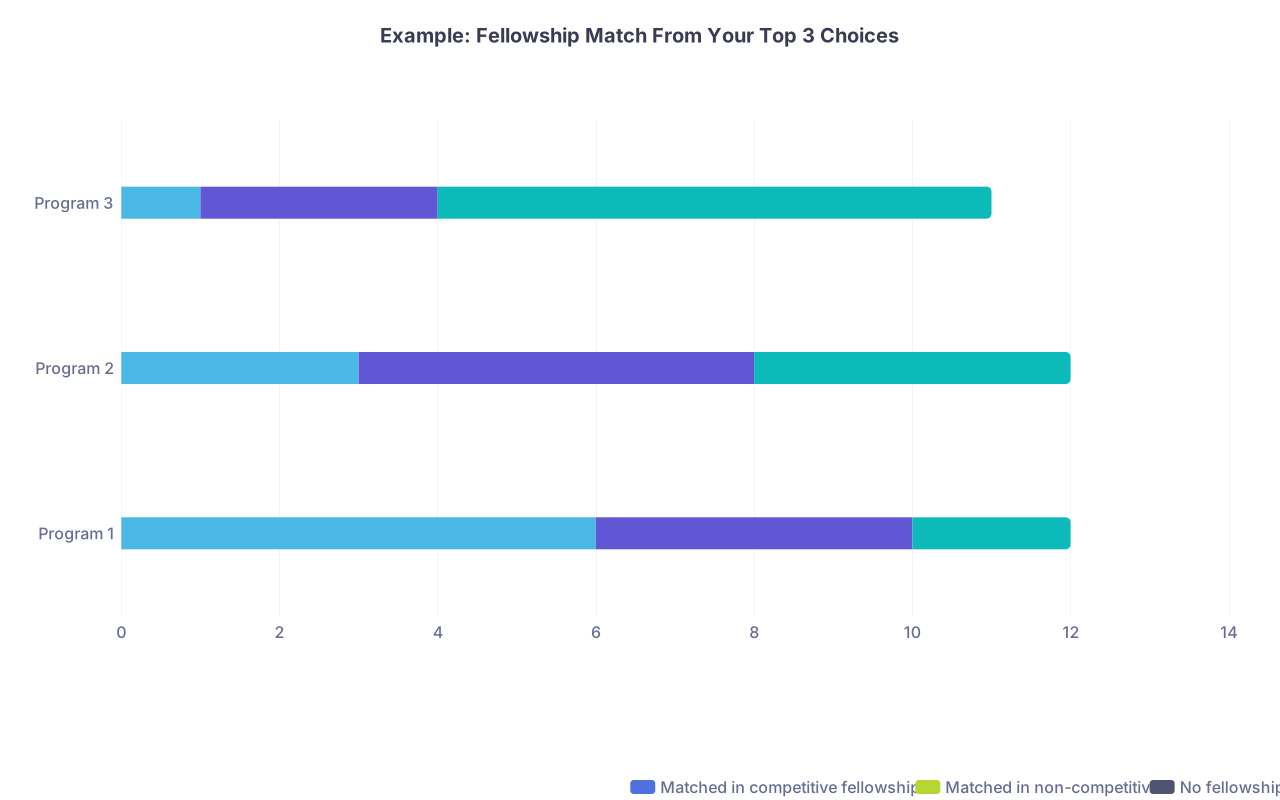
| Category | Matched in competitive fellowships | Matched in non-competitive | No fellowship |
|---|---|---|---|
| Program 1 | 6 | 4 | 2 |
| Program 2 | 3 | 5 | 4 |
| Program 3 | 1 | 3 | 7 |
7. Red Flags: “What Am I Trying To Talk Myself Out Of?”
Every year, people bury major concerns under “but it’s prestigious” or “everyone loves that program.”
Ask yourself, bluntly for each program:
Did anything feel off?
Examples I’ve seen:- Residents looking scared with attendings in the room, then suddenly honest the second faculty left
- Off-the-record comments like “Yeah, the hours are… rough” accompanied by dead eyes
- No women or URM residents in leadership. At all.
Did anything contradict itself?
- PD: “We deeply value wellness.”
- Residents: “We have no backup when someone is sick. People come in with COVID.”
Is there active or recent probation, scandal, or major turnover?
Yes, programs recover. Some thrive. But you’re taking on risk. Make sure you want that trade.
You should not build your list out of fear. But you also should not gaslight yourself about glaring problems.
8. The Tiebreaker Framework: How To Order Similar Programs
You’ll probably end up with 2–4 programs that feel “basically equal.” Here’s a simple sequence to sort them, in this order:
- Which program will make me the strongest clinician for my intended career?
- Where did I feel the most respected and safe as a learner and person?
- Which program has leadership I trust to protect residents and keep improving?
- Where can I have a life outside the hospital that won’t self-destruct my mental health?
- For true ties: which city, which community, and which everyday life do I want?
If still tied after that, flip a coin and pay attention to your reaction. If the coin lands on Program B and your immediate thought is “ugh…”, that’s your answer.
9. How To Actually Use These Questions Without Spiral Notebooks And Tears
Here’s a concrete process you can do tonight:
List your top 8–10 programs.
Don’t overwork the entire list. Focus on where the decisions actually matter.Create a quick scoring grid for each program (0–2 or 1–5 for each of these):
- Training quality
- Culture and resident support
- Leadership trust
- Lifestyle/feasibility
- Career alignment
- Location/personal life
Fill it in fast, based on your gut and your interview notes.
Don’t overthink decimals. This is to clarify your instincts, not to generate a perfect number.Write one sentence per program: “Why is this NOT #1?”
That question is brutal but clarifying. It forces you to identify each program’s main weakness.Order based on training + culture first.
Only then use location and lifestyle to break ties.

| Step | Description |
|---|---|
| Step 1 | Start: All interviewed programs |
| Step 2 | Identify realistic top 8-10 |
| Step 3 | Score on training, culture, leadership, lifestyle, career, location |
| Step 4 | Eliminate clear bottom options |
| Step 5 | Ask: Where will I become strongest clinician? |
| Step 6 | Ask: Where did I feel safest and most respected? |
| Step 7 | Adjust for personal life and location |
| Step 8 | Finalize order |
| Step 9 | Certify rank list |
| Step 10 | Compare remaining 3-5 |
Once you’ve done that, stop rearranging daily. Obsessive shuffling the last 72 hours rarely improves decisions. It just spikes anxiety.
FAQs
1. Should I ever rank a “big name” program higher just for prestige, even if I liked a smaller place more?
Only if that “big name” clearly advances your specific goals more: better fellowship matches in your niche, stronger mentorship in your field, or notably superior training. Prestige for its own sake is overrated. You will care more about day-to-day culture, support, and your mental health than the name on your badge by about month three of intern year. Prestige is a tiebreaker, not the core driver.
2. If I have a partner, how much weight should I give to their needs vs my ideal program?
More than most people admit. A miserable partner in a city they hate can make residency exponentially harder. You’re not choosing a vacation; you’re picking a 3–7 year life chapter. If a slightly “less shiny” program gives you both a workable life, that is often the smarter long-term move. I’d put it this way: do not sacrifice essential parts of your shared life for marginal training differences.
3. How many “reach” programs should I put at the top of my list?
As many as you genuinely prefer, regardless of competitiveness. The Match algorithm favors your preferences, not your pessimism. If your gut #1 is a reach but you’d absolutely rather be there than anywhere else, put it #1. The only bad move is ranking programs in an order driven by “where I think I can match” instead of “where I want to train.”
4. What if a program felt great on interview day, but I’ve heard mixed or bad rumors from residents at other places?
Treat rumors as a signal to investigate, not a verdict. Revisit your own data: What did residents there say when faculty weren’t around? Did they admit problems and show how they’re fixing them? Did anything feel off to you? If your personal experience and multiple independent reports line up negatively, push that program down. If your experience was strong and rumors are vague, give more weight to what you saw firsthand.
5. I’m still stuck between two very similar programs. What’s one concrete thing I can do to break the tie?
Email or message a current resident at each program with 2–3 specific questions: “What’s the hardest part of intern year there? What’s one thing you’d change if you could? Would you choose the same program again?” The tone and honesty of those replies will often tell you more than any brochure. Then sit down, imagine opening your Match Day envelope with Program X vs Program Y, and notice which one you’re hoping to see.
Today’s next step: pull out your interview notes, pick your top 5 programs, and answer one single question for each: “Why isn’t this #1?” Write that sentence down. You’ll be surprised how quickly your real rank order starts to reveal itself.


