

You’ve finished your last interview. Your suitcase is finally back in the closet. And now you’re staring at the NRMP screen, blinking cursor on an empty rank list, asking yourself:
“How many programs do I actually need to rank to have a real shot in a competitive specialty?”
You’ve heard everything:
- “Just rank everywhere you interview.”
- “If you have 12–15 programs you’re safe.”
- “My friend matched with 4. My other friend ranked 25 and still didn’t match.”
Let’s cut through the noise. I’ll give you actual numbers, where they come from, and how to decide your personal “safe” range instead of guessing.
Quick Answer: Target Ranges By Competitiveness
Here’s the blunt version first. These ranges assume you’re applying in a competitive or very competitive specialty (think dermatology, plastic surgery, orthopedic surgery, ENT, neurosurgery, integrated vascular, IR, etc.).
| Applicant Type | Specialty Competitiveness | Safer Rank Range |
|---|---|---|
| Strong US MD | Very competitive | 12–18 |
| Average US MD | Very competitive | 15–25 |
| US DO / IMG | Very competitive | 18–30+ |
| Strong US MD | Moderately competitive | 10–15 |
| Average US MD | Moderately competitive | 12–20 |
Now, context:
- Below ~10 ranks in a very competitive field = you’re taking a meaningful risk unless you’re clearly top-tier (AOA, big-name letters, strong research, great interview feedback).
- 12–15 ranks is a reasonable floor for most US MDs in competitive fields.
- 20+ ranks is where most average applicants in the most competitive specialties start to breathe a little easier.
The reason is simple: more ranks = higher probability that the algorithm finds at least one mutual fit. The NRMP has shown this for years in their “Charting Outcomes” and “Match Data” PDFs.
How the Match Algorithm Treats Your List (And Why Length Matters)

| Step | Description |
|---|---|
| Step 1 | You Rank Programs |
| Step 2 | NRMP Algorithm Starts |
| Step 3 | Tries Your #1 |
| Step 4 | You Tentatively Match at #1 |
| Step 5 | You Displace Lower-Ranked Applicant |
| Step 6 | Try Next Program on List |
| Step 7 | Unmatched |
| Step 8 | Program Filled? |
| Step 9 | Program Prefers You to Someone? |
| Step 10 | More Programs Ranked? |
Key point:
The algorithm maximizes your preferences, not the programs’. It will walk down your list until it finds the highest one that will take you.
So what kills people in competitive specialties isn’t “ranking the wrong way.” It’s not ranking enough places where you’re realistically in the game.
No extra credit for “loyalty” or “short list confidence.” The algorithm doesn’t care how sure you feel about your top five. If they don’t want you, it just keeps checking down. If you run out of programs, you’re unmatched.
The Data: Where Match Probability Jumps
In competitive fields, the NRMP data show a few consistent patterns:
US MDs in competitive specialties:
- Big jump in match rate from 1–5 ranks up to 8–12 ranks
- Gradual improvement beyond that, then plateau
DOs and IMGs in competitive specialties:
- Need more ranks at baseline to reach similar match probabilities
- Often don’t hit a practical “plateau” until 18–25+ ranks
You’ll never get a 100% guarantee. But you can avoid obvious self-sabotage like going into neurosurgery with 6 ranks and “good vibes.”
Step-by-Step: How Many Programs YOU Should Rank
Forget generic averages. Here’s how to build your personal target.
1. Start From Your Specialty’s Baseline
Quick rough grouping:
Very competitive (top tier)
Dermatology, plastic surgery, neurosurgery, ortho, ENT, integrated vascular, integrated IR, integrated CT, sometimes urology.Moderately competitive
EM (varies by year), anesthesiology, OB/GYN, radiology, some IM subspecialty prelims/categoricals at big academic centers.
For very competitive specialties, start with these baseline targets:
- US MD, strong app: aim for 12–18
- US MD, average app: 15–25
- DO or IMG: 18–30+ if you can get that many interviews
For moderately competitive specialties, your floor can be a bit lower:
- Strong US MD: 10–15
- Average US MD: 12–20
- DO/IMG: 15–25
If you’re below those numbers, you’re in “high-risk” territory, and you need to be honest about Plan B.
2. Adjust for Your Application Strength
Rank length isn’t in a vacuum. It depends heavily on where you actually stood in this cycle.
Be honest about these:
- Step 2 CK score (or COMLEX, plus how programs see it)
- Research (especially for derm, plastics, neurosurg)
- Class rank / AOA / school reputation
- Letters from known people in the field
- Interview feedback / vibes (did people explicitly say “we’d love to have you”? Or did it feel lukewarm?)
Here’s how I’d adjust:
If you’re clearly above average for your specialty (top-quartile scores, strong research, strong school, multiple interviewers telling you “you’ll do great wherever you go”):
You can live closer to the lower end of the suggested ranges.If you’re average for the specialty:
Stay squarely in the middle of the ranges.If you’re below average / red flags (low score, gap, fail, limited interview numbers):
Push toward the upper end or beyond, and seriously consider:- Adding an advanced + prelim back-up combo
- Having a genuine different specialty back-up if you’re very under-interviewed
3. Look at Your Interview Count
You can’t rank what you didn’t interview.
Let’s say you’re going into orthopedics:
- 6–8 interviews:
You’re in real danger. Rank all, but also:- Consider dual-app planning (if not too late)
- Go heavy on SOAP prep
- 10–12 interviews:
This is light but not doomed. You should rank every single one. Don’t get fancy. - 14–18+ interviews:
This is solid. Rank all of them. You’re mostly fine unless there are major red flags.
This part is simple:
If you’re in a competitive specialty, rank every program you’d be willing to attend. All of them.
No exceptions. There’s zero benefit to voluntarily shrinking your safety net.
4. Stop Over-Optimizing the Order, Under-Optimizing the Length
People spend absurd amounts of time thinking “Should Program A be #3 or #4?” and not enough time thinking “Why am I stopping at #9?”
Your priorities should be:
- Make a list that reflects your true preference order.
- Make that list long enough that you’re not relying on the top 3–5 working out.
- Don’t play mind games like:
- “If I rank them lower, they’ll be more likely to take me.” (False. Programs don’t see your rank order.)
- “If they’re my #1, I should tell them, and that guarantees me a spot.” (It doesn’t.)
The algorithm doesn’t care about your feelings. It rewards accurate preference + enough volume. That’s it.
Common Bad Strategies (Don’t Do These)
1. The “Short List = Confidence” Myth
“I only ranked 6 derm programs because I know they liked me.”
I’ve seen this story. I’ve also seen those people in SOAP scrambling for prelim medicine. Programs are not as predictable as your ego thinks. Faculty change their minds. New applicants appear. Someone with a 260 and 10 derm pubs walks in the door late.
If you’d rather train somewhere than go unmatched, that place should be on your list.
2. The “Geography Purist”
“I don’t want to leave the West Coast, so I only ranked 8 West Coast ENT programs.”
Fine. That’s a reasonable life decision. But it’s a choice to accept higher unmatched risk, not a strategy. Don’t pretend both can be true:
- “I must stay in this region”
- “I must match this year in this specialty”
You usually get one of those, not always both, especially in hyper-competitive fields.
3. The “I’m Too Good for Safety” Move
Some applicants refuse to rank lower-tier programs because they think it reflects poorly on them.
Reality: matching into a “mid-tier” program and doing an amazing fellowship is far better than:
- Going unmatched, then scrambling into a field you never wanted
- Losing a full year and re-applying with a big “unmatched” flag on your record
You’re not “too good” for an actual residency position. The alternative may be no position.
Special Cases: Advanced + Prelim / Transitional Years
For competitive fields like radiology, anesthesiology, neurology, PM&R that often use an advanced (PGY2) + prelim/TY (PGY1) setup, you effectively have two rank lists:
- One for the advanced programs (your specialty)
- One for the prelim/TY year
Here’s the rule:
Don’t be casual about the prelim list. You shouldn’t have 18 rads ranks and 3 prelim ranks.
For prelims:
- Strong US MD: aim for 8–12+ prelim/TY programs ranked
- Average/Below average/DO/IMG: 10–15+ prelim/TY programs
You don’t want to match advanced rads and then be stuck in SOAP begging for an intern year. That’s not fun.
For DOs and IMGs in Competitive Fields
Here’s the harsh part: you often need more of everything to reach similar odds.
If you’re a DO or IMG going into derm, ortho, ENT, etc., you should be thinking:
- Every single interview is gold
- Rank every single program you’d go to
- Very realistic target:
- 18–25+ ranks if possible
- If you only have 5–10 interviews, SOAP/fallback planning isn’t optional
And do not buy into the fantasy that “my mentors said they loved me, so I’m fine with a short list.” They may love 30 other people too.
How to Decide When to Stop Adding Programs
Here’s the sanity check:
You’re safe to stop adding programs when all of these are true:
- Your list length is at or above the recommended range for your situation (specialty + applicant type).
- Every program below that point is somewhere you’d honestly be unhappy enough that:
- You’d rather go unmatched + SOAP + maybe re-apply
than - Train there for 3–7 years.
- You’d rather go unmatched + SOAP + maybe re-apply
If that’s real, not just pride talking, then ok—stop.
But if the real truth is: “I wouldn’t love it but I’d rather match there than scramble into prelim medicine,” then it belongs on your list. Full stop.
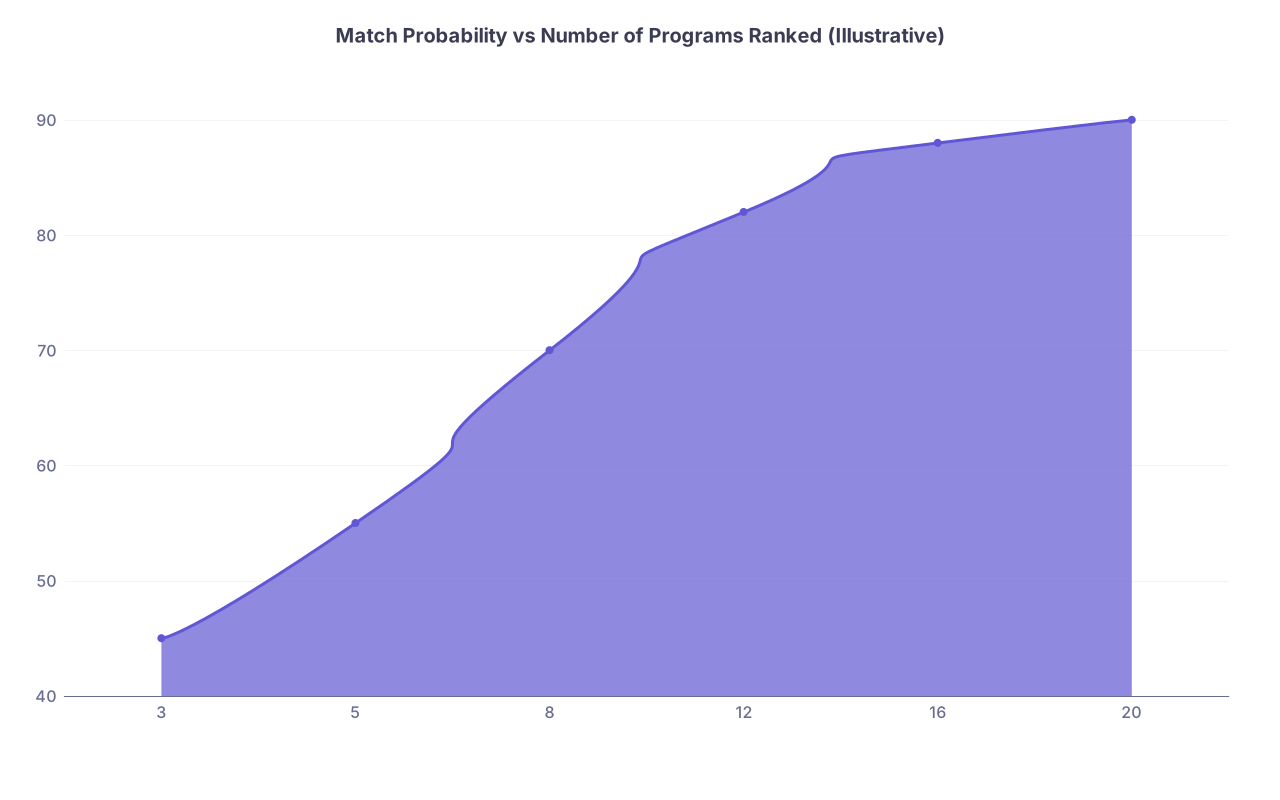
| Category | Value |
|---|---|
| 3 | 45 |
| 5 | 55 |
| 8 | 70 |
| 12 | 82 |
| 16 | 88 |
| 20 | 90 |
Concrete Example: What This Might Look Like
Say you’re a US MD going into plastic surgery.
- Step 2 CK: 248
- Research: 1 year, 4 pubs, one in a decent journal
- School: mid-tier MD
- Interviews: 14 plastics programs
What I’d tell you:
- Rank all 14 plastics programs.
- Don’t remove a place just because it’s “not academic enough” unless you’re sincerely willing to go unmatched over it.
- If you really felt horrible vibes at one program (legit toxicity), fine, drop that single outlier. But recognize that every dropped program increases your risk a bit.
You end up with:
- 13–14 ranks in a very competitive specialty
- You’re solidly within the safer zone
Same applicant with 8 interviews? Totally different posture:
- Rank all 8
- If you don’t want to risk going unmatched, you should have been dual applying or planning a backup from the beginning
- At this point, your rank length can’t fix a low interview count—but it can keep you from making it worse by being picky
Bottom Line Rules You Can Steal
If you remember nothing else, remember these:
Competitive specialty? Under 10 ranks = risky.
Unless you’re truly a superstar, don’t pretend otherwise.Rank every place you’d rather go than SOAP or re-apply.
Pride doesn’t beat the algorithm.Your “safe number” depends on three things:
Competitiveness of specialty + your strength + interview count.Prelim/TY lists matter.
Don’t pair 20 advanced ranks with 3 prelims.Stop when the trade-off is truly “I’d rather go unmatched than go there.”
If that’s not honestly true, it belongs on your list.
FAQ (Exactly 5 Questions)
1. Is there such a thing as ranking too many programs?
Functionally, no. The algorithm doesn’t punish long lists. The only real downside is emotional: scrolling through 30 names can feel overwhelming. But from a match perspective, more ranks only help, as long as every place on the list is somewhere you’d genuinely attend.
2. Do programs see where I ranked them on my list?
No. Absolutely not. Programs never see your rank order. They only see whether you matched with them or not. So don’t play mind games like ranking a program higher or lower to “send a message.” The only thing that matters to the algorithm is your true preference order.
3. Can I match if I only have 5–7 interviews in a competitive specialty?
Yes, it’s possible, but it’s higher risk. If that’s you, the correct move is to rank all of them and go into Match Week with SOAP and backup plans ready. Don’t make it worse by trimming your list because of geography, prestige, or ego.
4. Should I leave a program off if I had a bad interview day there?
Ask yourself one question: “Would I rather go unmatched than train there?” If the answer is truly yes—because of serious red flags like abuse, blatant toxicity, or deal-breaker personal factors—leave it off. If the interview was just awkward or underwhelming, keep it on. An awkward interview is not worth risking no match.
5. If I dual-applied, how do I split my rank list?
Rank programs exactly in the order you’d want to go. Don’t separate by specialty. If you’d rather be at a solid IM program than unmatched trying again for ENT, then that IM program should appear above some ENT programs. The algorithm doesn’t care about categories; it just walks down your single list in order.
Open your draft rank list right now and count how many programs are on it. Then compare that number to the ranges above for your specialty and situation. If you’re under the safer range, your job today is simple: identify every program you’d still be willing to attend and add them back on.


