

You absolutely need a different rank strategy for advanced and categorical spots—or you’re gambling with going unmatched without realizing it.
Most people treat advanced (PGY-2) and categorical lists basically the same: “Just rank what I like in order.” That’s how you accidentally match a PGY-2 spot with no PGY-1. Or match a prelim in a city where you have zero advanced options. Or end up “stuck” doing a prelim you never wanted, with no guarantee of the specialty you care about.
Let’s clean this up.
Step 1: Know What You’re Dealing With (Categorical vs Advanced vs Prelim)
Quick definitions so we’re talking about the same thing:
- Categorical = Includes PGY-1 + all later years in one program. Example: Categorical Internal Medicine, Categorical Pediatrics, General Surgery (most), Psychiatry.
- Advanced = Starts at PGY-2; you must separately secure a PGY-1. Example: Radiology, Anesthesiology (some), Neurology (often), Derm, PM&R, Radiation Oncology.
- Preliminary (Prelim) = One-year PGY-1 spot only (usually medicine or surgery). Designed to pair with an advanced spot—or be a one-year transition.
Here’s the critical point:
Categorical = one match decision.
Advanced + prelim = two matches that need to line up in time and location.
That changes your entire rank strategy.
| Aspect | Categorical | Advanced + Prelim |
|---|---|---|
| Number of rank lists | 1 | 2 (main + supplemental) |
| Needs pairing | No | Yes (PGY-1 + PGY-2) |
| Risk of partial match | Low | High if ranked poorly |
| Geographic complexity | Moderate | High |
| Use of NRMP couples logic | Not needed | Used between advanced & prelim ranks |
Step 2: How the NRMP Actually Treats These (The Part People Misunderstand)
You don’t rank “programs” in one big list when you’re going for advanced + prelim. You actually submit:
- A Main Rank Order List (ROL):
- Categorical programs
- Advanced programs (PGY-2)
- Supplemental ROLs:
- Prelim programs linked under each advanced program
The algorithm tries to match you to the highest thing on your main list. If that’s an advanced position, it then looks at that advanced program’s linked supplemental list to find a prelim for your PGY-1.
If you don’t rank prelims correctly under that advanced program? You can match the advanced spot and have no PGY-1. That’s not hypothetical—I’ve seen it happen.
Here’s a clean mental model:
- Main list answers: “Where do I want to do my main specialty training?”
- Supplemental prelim lists answer: “If I get into this advanced program, where will I do my intern year?”
You do NOT mix prelims randomly on your main list “just in case.” That’s how you break the logic.
Step 3: Categorical Rank Strategy – Simple, But Don’t Be Dumb
For categorical-only applicants, strategy is straightforward:
- Rank programs in your true order of preference.
- Ignore guessing “where you’ll match.” You can’t outsmart the algorithm.
- Don’t skip a program you actually like because you think it’s a “reach.” That only hurts you.
You only really need to think strategically about:
- Balancing reach vs safety programs
- Geographic priorities
- Program vibe and training quality
If you’re only applying categorical, you don’t need a “special” strategy. You just need an honest one.
Step 4: Advanced + Prelim Strategy – Where It Actually Gets Tricky
When you add advanced positions, the game changes. Now you’ve got three risks:
- Match advanced, don’t match prelim → you must scramble (SOAP) for a PGY-1.
- Match prelim, don’t match advanced → you do a prelim year with no guaranteed PGY-2.
- Match both, but in cities that make your life miserable (commuting, moving twice, partner issues, kids, etc.).
So yes, your strategy must be different.
Core principle
Every advanced program on your list should have a realistic, thoughtful prelim plan attached to it. Not vibes. Not hope. A plan.
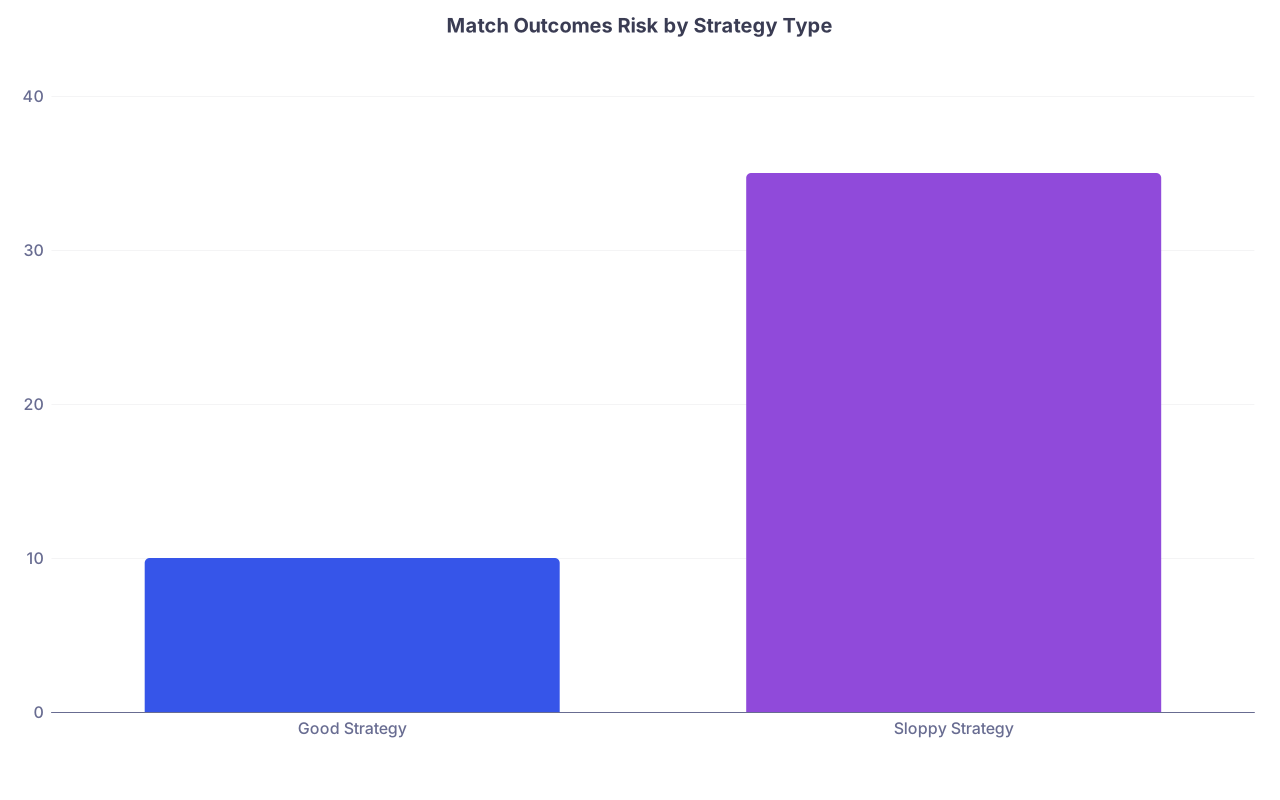
| Category | Value |
|---|---|
| Good Strategy | 10 |
| Sloppy Strategy | 35 |
(Think of these numbers as relative risk of ending up partially matched or with a bad pairing. Not exact NRMP stats—just reality from what I’ve seen.)
Step 5: How to Build Your Main List When You Have Both
Here’s how I tell people to think about a mixed list (categorical + advanced):
First, decide your true priorities:
- Are you 100% committed to an advanced specialty (e.g., Radiology, Derm)?
- Or would you be equally happy with a categorical fallback (e.g., Categorical IM)?
Then, build your main rank list in this order:
- Top-choice categorical programs (if you’d prefer those over any advanced).
- Then advanced programs in your true order of preference.
- Finally, any backup categorical programs you’d be okay with if you don’t match advanced.
Or flip that if advanced is clearly your top priority:
- Advanced #1
- Advanced #2
- Categorical fallback #1
- Categorical fallback #2, etc.
You cannot be “polite” or “strategic” here. The system is already strategic. Your job is to be honest.
Step 6: How to Build Supplemental Lists for Advanced Programs
This is the part almost everyone underthinks.
Each advanced program can (and usually should) have its own supplemental prelim list. They don’t have to be identical.
For example, suppose you’re ranking:
- Advanced Radiology – City A
- Advanced Radiology – City B
- Advanced Anesthesiology – City C
A good setup:
- Under Advanced Radiology – City A:
- Prelim Medicine – same hospital
- Prelim Medicine – nearby hospital in same city
- Transitional Year – same metro area
- Strong prelim in nearby region you’d actually tolerate
- Under Advanced Radiology – City B:
- Prelim Medicine – same hospital
- Prelim Surgery – same hospital (if you’re okay with it)
- Transitional Year – same city
- Under Advanced Anesthesia – City C:
- Prelim Medicine – same hospital
- Transitional Year – same city
- Prelim Medicine – nearby city
Key rules:
- Top of each supplemental list = “If I match this advanced spot, what’s my absolute favorite PGY-1 option that pairs with it?”
- Tail of each list = “Realistic but less ideal PGY-1s I’d still accept to not end up unmatched for PGY-1.”
Do NOT throw in random prelims in distant cities you’d hate “just to have more options.” The algorithm doesn’t care that you “wouldn’t really want that.” If it’s ranked, you’re saying yes.
Step 7: Avoiding the “Bad Pairing” Scenarios
Some pairing scenarios are just bad. Here’s what I’d strongly avoid:
- PGY-1 and PGY-2 in cities that are far apart and both expecting you in clinic late in the year / early in the next.
- Prelim in a toxic, malignant environment just because “it’s famous.”
- An intern year with commute + call schedule that will wreck your mental health before your actual field starts.

Practical filters when you’re deciding which prelims to rank under each advanced program:
- Geography: Same city or easy commute only.
- Culture: Talk to interns. Is this one of those “we eat our young” prelim years? If so, think twice.
- Schedule: Some prelims are brutal surgical sweatshops. Others are chill transitional years. Rank in the order that fits you and your goals.
Step 8: Do I Ever Rank Prelims on My Main List?
Yes—but very intentionally.
You only rank standalone prelims on your main list if:
- You’d genuinely prefer “just a prelim year + reapplying” over being unmatched at all, and
- You’re okay not having a guaranteed advanced spot after that year.
This is basically you saying: “Worst case, I do a year of prelim and try again.” That can be smart if:
- You’re aiming at a super competitive specialty (Derm, Rad Onc, etc.)
- Your app is borderline and a strong prelim year could help you reapply.
But don’t do this:
- Throw a dozen random prelims at the bottom of your main list “just so something happens.”
If you’d rather go fully unmatched than end up at Program X for a miserable year… don’t rank Program X. Ever.
Step 9: What If I’d Be Happy With Either Categorical or Advanced?
This is common: people applying to, say, Advanced Anesthesia or Radiology but also ranking Categorical IM as a backup.
Here’s the decision rule:
- Ask yourself: “Would I rather be a radiologist/anesthesiologist with a mediocre prelim…
OR an internist at a solid categorical program where I stay long-term?”
If you’d always prefer the advanced specialty, even with a worse prelim, rank all your advanced options first, with their prelims built smartly under each. Then your categorical IM backups afterward.
If you’d genuinely be just as happy or happier being a full-time internist in a great categorical program, then certain categorical IM programs should be ranked above some advanced options.
You don’t get points for loyalty to a field. Rank based on the future you actually want to live.
Step 10: Special Red-Flag Situations Where Strategy Really Matters
A few high-risk patterns where you absolutely need to be careful:
Couples matching + advanced spots
You now have a three-body problem: your advanced, your prelim, your partner’s program. This is where careful geographic pairing on each supplemental list matters massively.Limited prelim options in a city
If your dream advanced program is in a city with 1–2 prelims and they’re hyper competitive, you need solid alternative advanced options elsewhere with more prelims available.You didn’t get many interviews
If you have:- 3 advanced interviews
- 3 prelim interviews
- 5 categorical interviews
You cannot act like you have 20 of each. Rank every program you’d accept. Stretch your prelim lists under each advanced program carefully. Avoid fantasy thinking.

| Step | Description |
|---|---|
| Step 1 | List all Categorical & Advanced |
| Step 2 | Rank Categorical only by preference |
| Step 3 | Decide if Advanced is top priority |
| Step 4 | Rank Advanced first on main list |
| Step 5 | Mix Categorical & Advanced by true preference |
| Step 6 | Build supplemental prelim lists under each Advanced |
| Step 7 | Optionally add standalone prelims at bottom |
| Step 8 | Advanced interviews? |
Step 11: Common Dumb Mistakes (Don’t Do These)
I’ve seen these over and over:
Ranking prelims higher than advanced spots on the main list “just to be safe.”
That does not make you safe. It just makes it more likely you’ll match only a prelim.Making one generic prelim list and linking it to every advanced program without thinking about geography.
Result: Advanced in City A, prelim in City Z. You’re miserable for a year.Not using all available ranks “because it looks desperate.”
The algorithm doesn’t care. Rank every program you’d actually accept.Letting someone else (partner, parent, advisor) effectively write your list.
They won’t live your life. You will.
FAQ: Advanced vs Categorical Rank Strategy
1. If I really want an advanced specialty, should I still rank categorical programs?
Yes, if there are categorical programs you’d genuinely be okay doing long-term. They’re your insurance policy. But put them after your advanced options if your priority is the advanced specialty.
2. Can I match an advanced spot without matching a prelim?
Yes, it’s possible. If that happens, you must find a PGY-1 year outside the Match (e.g., through SOAP or later openings). That’s stressful. Protect yourself by building strong, realistic supplemental prelim lists under every advanced program.
3. Should I rank the same prelim programs under all my advanced programs?
Only if they make sense geographically and logistically with each advanced program. It’s fine to reuse prelims across multiple supplemental lists, but don’t blindly copy–paste. You may want them in a different order depending on the advanced program’s location.
4. Is it safe to rank a standalone prelim at the bottom of my main list?
It’s “safe” only if you’d rather have a prelim year with no guaranteed PGY-2 than go unmatched entirely. For some people, that’s smart. For others, it’s a trap they regret. Decide that consciously, not by default.
5. How many programs should I rank for advanced + prelim?
As many as you reasonably can while still being okay working there. For advanced: every program you’d actually attend. For prelims: several under each advanced program, especially local ones, plus any you’d accept if other prelims don’t work out. The more realistic combinations you give the algorithm, the less likely you are to end up partially matched or scrambling.
Key points: Advanced and categorical spots do not use the same ranking logic. Advanced spots require paired planning with prelims, using smart supplemental lists. And your main list should always reflect your actual future priorities, not what you think programs want to see.


