

What if the “safe” decision to push community programs to the bottom of your rank list quietly destroys the career options you think you are preserving?
Let me be blunt: a lot of final rank lists are built on ego, rumors, and half‑baked assumptions about academic prestige. And one of the biggest casualties? Community programs that would have given you better training, more responsibility, and more realistic long‑term options than the shiny “academic” name you are chasing.
You are about to make decisions that affect the next 10–40 years of your life. Do not screw this up because someone in your MS2 small group said, “I’d never go to a community program.”
The Core Myth: “Community = Settling, Academic = Options”

The most dangerous belief I see: “If I want any shot at competitive fellowships or an academic career, I must match at a big‑name academic program. Community is for people without options.”
This is wrong. Not just slightly off. Completely misleading for many specialties and many applicants.
Here’s the problem. People mash three different ideas into one lazy sentence:
- Academic hospitals do more research.
- Some top fellowships care a lot about research.
- Therefore you must train at an academic residency or your career is over.
Reality is uglier and more nuanced:
- A strong community program with high volume, solid board pass rates, and supportive PD can absolutely send people to competitive fellowships.
- A “name brand” academic program with chaotic education and minimal mentorship can easily leave you burnt out, average, and uncompetitive.
- Many residents never actually follow through on the “I might want cards / GI / critical care / ortho / heme‑onc” fantasy. They discover they love general practice, hospitalist work, or lifestyle specialties.
Under‑ranking community programs “just because they are community” is how you end up unmatched, scrambling, or stuck somewhere miserable that looked impressive on paper.
Let me spell out the main ways this specific mistake haunts people long term.
Mistake #1: Confusing Prestige with Training Quality
You are not applying for a three‑year Instagram bio. You are applying for training.
There is a nasty, quiet trap: people rank an academic name over a clearly stronger community training environment—then complain they “never get to do anything” as interns.
I have seen:
- Internal medicine interns at mid‑tier university programs who barely touch central lines or manage ventilators because fellows and subspecialty teams do everything.
- Community IM residents running the ICU at 2 a.m., managing vasopressors, ventilators, and crashing patients—with faculty backup that actually teaches.
Which one is more valuable if you want to be a strong hospitalist or critical care applicant? It is not the one with the pretty logo.
Before you shove all community programs into your bottom tier, ask:
- Who actually manages the patients—residents or fellows?
- What is the procedure volume for residents, not just the institution?
- What are the board pass rates and where have recent grads gone?
If the community program has excellent board pass rates and places graduates into solid fellowships or good jobs every year, under‑ranking it below an unknown, chaotic “academic” program is a long‑term mistake.
A quick comparison
| Factor | Typical Academic Pitfall | Typical Community Strength |
|---|---|---|
| Autonomy | Overrun by fellows | Residents are primary operators |
| Procedures | Competition with subspecialists | Resident-driven procedures |
| Teaching | Variable, depends on faculty interest | Often PD-driven, resident-focused |
| Research | More infrastructure, less protected time | Less infrastructure, more flexibility |
| Name recognition | Stronger nationally | Stronger locally/regionally |
If your actual job will be caring for patients, not giving grand rounds at MGH, training quality matters more than brand. Under‑ranking programs that train you well because they do not sound fancy is how you sabotage your future competence.
Mistake #2: Ignoring Match Risk Because of Ego
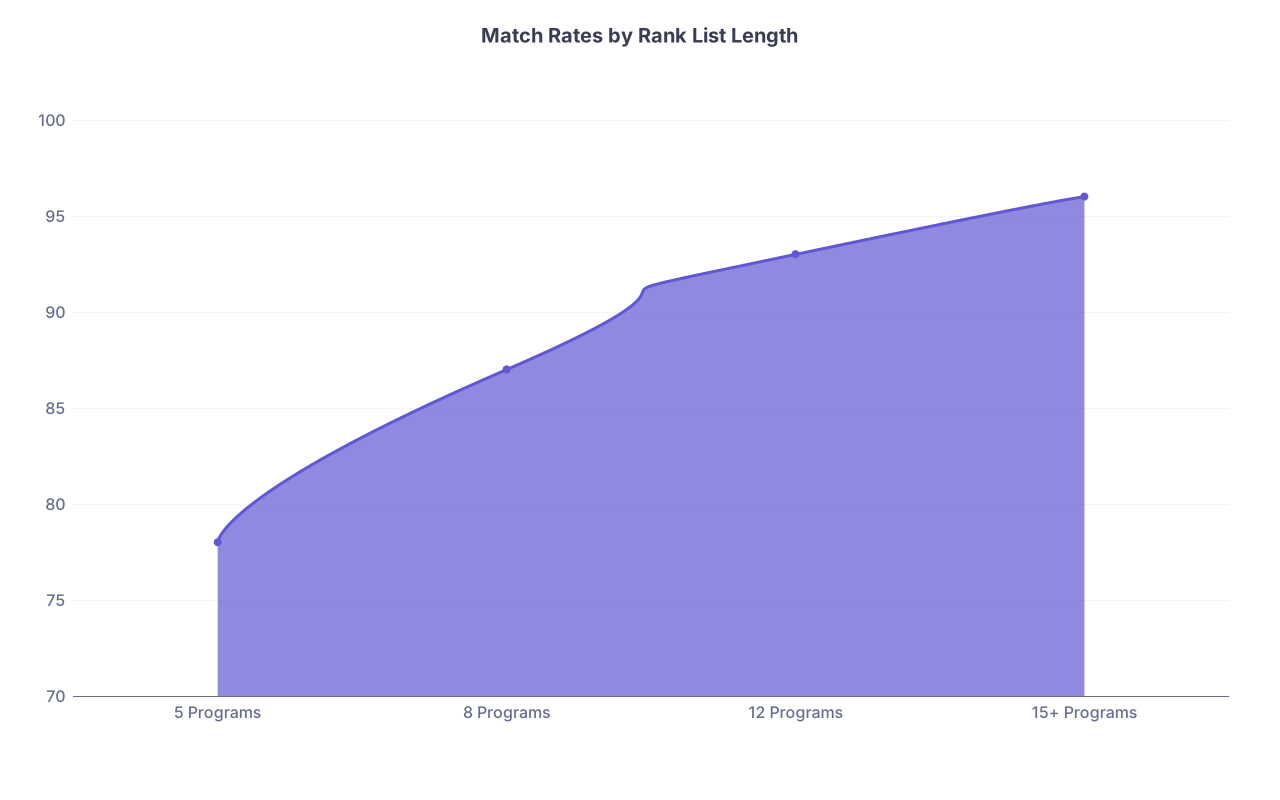
| Category | Value |
|---|---|
| 5 Programs | 78 |
| 8 Programs | 87 |
| 12 Programs | 93 |
| 15+ Programs | 96 |
Another common disaster: students with decent but not stellar stats rank only “top” academic places high, then toss a couple of community programs at the bottom as a fig leaf. On paper, their list is long. In reality, they have under‑ranked their true safety options.
Here is how that blows up:
- You interview at 12 places.
- You “cannot picture yourself” in the 3 solid community programs that were enthusiastic about you.
- You rank them below 7 aspirational academic programs that liked you enough to interview, but are flooded with stronger applicants.
- Match Day: you drop all the way to #11 or #12—maybe a program you barely researched, or you end up unmatched.
I have watched this exact story play out. More than once.
If a community program is:
- Stable,
- Has decent outcomes, and
- You would rather train there than go unmatched
…it does not belong near the bottom just because it is “community.”
Let me be harsh for your own good: you cannot posture your way into a match. The algorithm favors your preferences, yes, but only when the programs also want you. Under‑ranking realistic fits in favor of dream programs that are extreme reaches is not ambition. It is self‑sabotage.
Mistake #3: Not Understanding Which Specialties Truly Require Academic Pedigree
Some specialties and fellowships really do care more about academic pedigree and research:
- Dermatology
- Plastic surgery
- Some academic cardiac, GI, heme‑onc programs
- Certain competitive surgical fellowships
If you are dead‑set on one of these, thought it through, and realistically competitive (not just fantasizing), then sure: academic environment might matter more.
But most residents are in specialties where:
- Clinical performance,
- Strong letters, and
- Board scores
matter more than institutional branding alone.
For example:
- Hospitalist jobs: plenty of groups love graduates from high‑volume community programs because they know those residents actually ran the service.
- Primary care: community experience, continuity clinic quality, and patient communication skills matter a lot more than whether you rotated at a “top 10” center.
- Many fellowships: PD phone calls and strong letters from attendings who know you well often outweigh name alone.
The mistake is making everyone live by the rules of the 5% who are realistically headed for hyper‑competitive academic tracks.
If you are not already deep into research, networking with big‑name mentors, and building a clearly competitive portfolio, do not rank every academic program above community ones under the fantasy that “maybe one day I will want to be a world‑famous researcher.” That is not strategy. It is procrastination in decision form.
Mistake #4: Underestimating How Much Fit and Support Affect Your Long‑Term Career

| Step | Description |
|---|---|
| Step 1 | Program Fit |
| Step 2 | Resident Wellbeing |
| Step 3 | Performance & Evaluations |
| Step 4 | Fellowship/Job Options |
| Step 5 | Mentorship Quality |
The program that looks “most impressive” to outsiders may not be the program where you actually thrive.
I have seen residents at mid‑tier community programs who:
- Have PDs that know them by name and aggressively support their fellowship applications.
- Get multiple practice boards, mock interviews, and personalized feedback.
- Are protected when life events happen—illness, family emergencies, pregnancy.
And I have seen residents at prestigious academic centers who:
- Are anonymous workhorses in a massive system.
- Get generic, lukewarm letters because no one really knows them.
- Burn out and start underperforming because the support structure is nonexistent.
Fellowship PDs and hiring groups can spot a resident who had strong mentorship and consistent performance from a mile away. They do not care that your coat said “Associate Hospital of Big‑Name University” if your letters are weak and your interview is flat.
Under‑ranking community programs where you felt welcomed, supported, and seen—because “I should push myself toward more competitive places”—is often a long‑term career hit. The right environment brings out your best work. The wrong one slowly grinds it down.
Mistake #5: Not Looking at Actual Outcomes Data
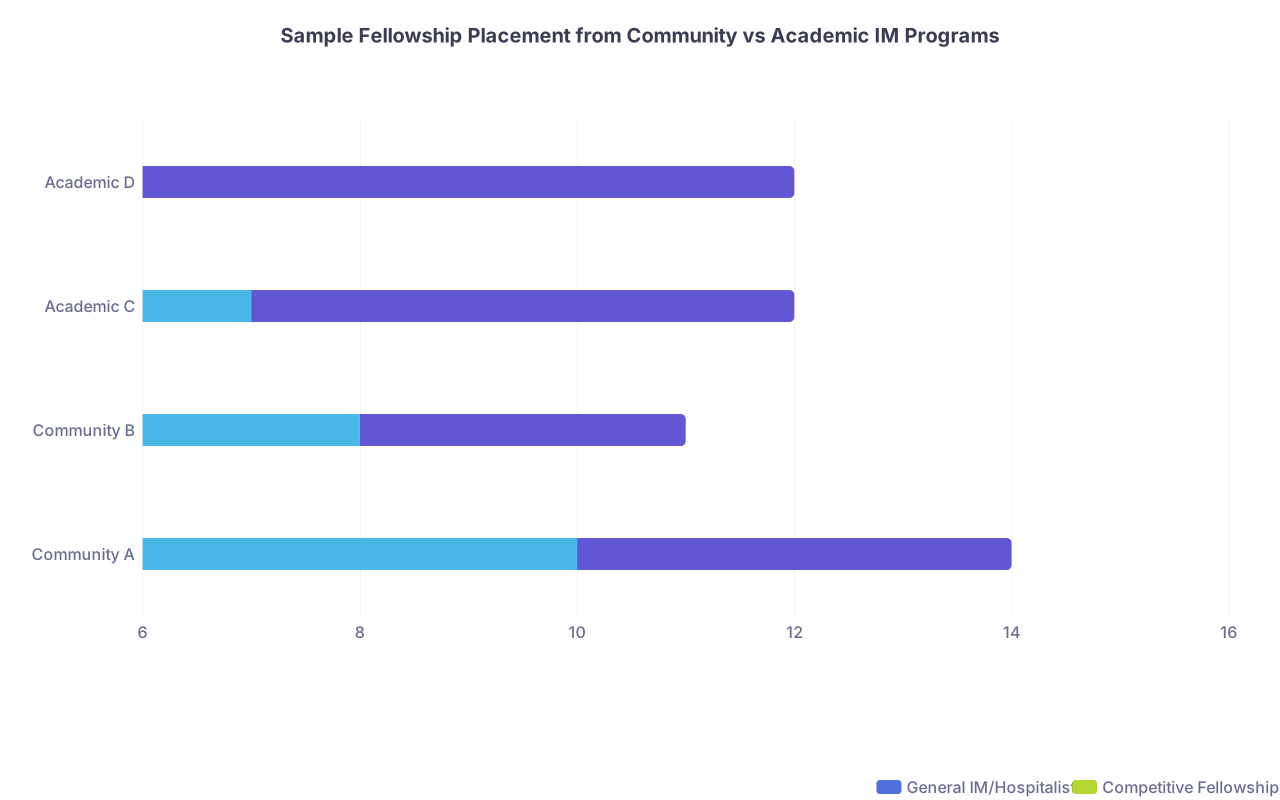
| Category | General IM/Hospitalist | Competitive Fellowships |
|---|---|---|
| Community A | 10 | 4 |
| Community B | 8 | 3 |
| Academic C | 7 | 5 |
| Academic D | 6 | 6 |
Here is where people get lazy. They say things like:
- “X is just a community program, you cannot get cards out of there.”
- “Y is a university program, you can do anything from there.”
Then you actually look at data (when it is available):
- Community Program A: sends one or two residents a year to cards, GI, pulm/crit; several to solid hospitalist jobs at desirable hospitals.
- Academic Program B: mostly hospitalist placements; occasional fellowship at mid‑tier institutions; no recent matches to the “big‑name” places you imagined.
Outcome data you should be looking at:
- Board pass rates over several years.
- Fellowship match lists (not one cherry‑picked year).
- First jobs of graduates (hospital type, location).
- Retention of faculty—high turnover is a red flag.
The mistake is assuming the word “university” in the program name automatically translates to better outcomes. It does not. Plenty of “university‑affiliated” programs exist in name only.
If a community program openly shows you strong board pass rates, stable leadership, and a track record of graduates getting what you want (fellowship or job type), under‑ranking it for a weaker academic program is exactly the kind of subtle long‑term error you only realize when you are applying for your next step.
Mistake #6: Forgetting Location, Network, and Real Life

You are not just choosing a three‑year line on your CV. You are choosing:
- A geographic region.
- A referral network.
- A set of attendings and colleagues who can open (or close) doors for you.
Community programs frequently have powerful local influence. In many regions:
- The community hospital is where most private practice groups and non‑academic positions are sourced from.
- The attendings at that hospital run or strongly influence hiring for half the jobs in the area.
- The alumni network is heavily concentrated locally, which is exactly where you want to work.
Under‑ranking such a program because “I want options” while you secretly know you want to stay in that city or region is self‑defeating. You are pushing away the very network that would make your long‑term life easiest.
Also: life outside work matters. A community program in a city where you have support systems, lower cost of living, and realistic home ownership options may beat a “prestige” program in a city you hate, where every rent payment makes you resent your career choice.
People underestimate how much resentment and financial stress bleed into burnout, performance, and career satisfaction. You will not make rational long‑term decisions if you are exhausted, broke, and miserable.
Mistake #7: Over‑Correcting for Med School Insecurity
Some of you are carrying med school prestige baggage. Maybe you went to a DO school, Caribbean, or a lower‑ranked MD school. The temptation is strong:
“I already started from behind. I need an academic residency to ‘fix’ that.”
I understand the urge. I have heard it a hundred times.
But here is the quiet trap: you may overweight the “fix my CV” fantasy and underweight where you can actually excel and build a strong track record. A few realities:
- A stellar performance at a strong community program with PDs who believe in you beats a mediocre performance at a big‑name place where you struggled to stand out.
- Some academic programs are politely “using” you to fill service needs and will not seriously invest in your development.
- Some community PDs are hungry to prove their residents can match at top fellowships and will go to bat for you much harder.
If your primary motivation for ranking an academic program over a community one is shame about where you went to med school, stop. That is an emotional decision, not a strategic one.
Look forward: which place sets you up to be objectively excellent by the end of residency? That is the program that will actually “fix” your trajectory.
How to Rank Community Programs Intelligently (Without Romanticizing Them)

| Step | Description |
|---|---|
| Step 1 | Program on your list |
| Step 2 | Rank low or omit |
| Step 3 | Rank below stronger options |
| Step 4 | Rank in top/middle group |
| Step 5 | Rank cautiously but above only if desperate tier |
| Step 6 | Would I rather match here than go unmatched? |
| Step 7 | Training & Outcomes strong? |
| Step 8 | Good fit & support? |
I am not telling you to blindly rank every community program high. Some are under‑resourced, poorly run, or toxic. You avoid those.
But do this systematically instead of by label:
Ask yourself, honestly:
“If I matched here, would I be okay? Would I rather come here than scramble or go unmatched?”
If the answer is yes, that program belongs somewhere above your “only if desperate” tier.Evaluate training and outcomes:
- Board pass rates.
- Procedure/clinical volume.
- Fellowship and job placement relevant to your goals.
Weigh mentorship and culture:
- Did residents look exhausted or supported?
- Did leadership seem protective of residents or of the hospital?
- Did they talk concretely about how they help underperforming residents improve?
Consider your realistic competitiveness:
- Are you actually in range for the very top academic places you are worshipping?
- Or are you gambling, hoping one reaches on you?
Rank in tiers, not by labels:
- Top: places (academic or community) where you would be very happy and well‑trained.
- Middle: acceptable, safe, decent training, you could live with it.
- Bottom: only if the alternative is SOAP or reapplying.
Community programs that meet your needs and want you strongly often belong in the top or middle tiers, not as an afterthought at the bottom.
Quick Reality Check: Where Community Shines vs Where to Be Cautious
| Scenario | Community Likely Strong | Community Caution Flags |
|---|---|---|
| Goal | General practice, hospitalist, many fellowships | Hyper-competitive academic subspecialty |
| Volume | High resident-run service | Low census, heavy APP coverage |
| Support | Engaged PD, stable faculty | Constant leadership turnover |
| Data | Transparent outcomes, good boards | No data, evasive answers |
If a community program clearly falls into the “strong” column, under‑ranking it below multiple shaky academic programs is exactly the type of mistake that looks smart to your classmates and stupid to future‑you.
FAQs
1. Can I still get a competitive fellowship from a community residency?
Yes, if the community program has a track record of sending residents into fellowships and you perform well. You will need:
- Strong letters from well‑known or respected clinicians.
- Good board scores and solid in‑training performance.
- Some scholarly work, which can be case reports, QI, or smaller projects.
The key is to pick a community program that already has graduates in the fellowships you want. If they have never sent anyone to your target specialty in the last 5–10 years, that is a red flag if your goal is highly competitive.
2. Is it better to be average at a big academic program or a star at a community program?
For most people, it is better to be a star at a strong community program. PD calls and letters from attendings who genuinely know and admire you carry more weight than lukewarm letters from big‑name places. The exception: ultra‑elite academic careers where lab pedigree and specific mentors matter more than almost anything. That is a narrow path, and if you are on it, you already know.
3. How do I tell if a community program is “good enough” to rank high?
Look for concrete signs:
- Consistently high board pass rates.
- Graduates getting fellowships or jobs that you would be happy with.
- Reasonable workload described by residents, not just leadership.
- A PD who speaks specifically about your goals, not in clichés.
If you see these and would rather match there than risk going unmatched, that is a program you should not bury at the bottom.
4. What if I am torn between location (community) and prestige (academic)?
Decide which failure you will regret more:
- Being in a less desirable city but having excellent training and support, or
- Living in a favorite location with weaker training or hostile culture.
For many, training and support win, especially if you only plan to live there for 3–5 years. But if you have major life anchors (partner job, kids in school, visa constraints), location can’t be treated as a minor factor. Just do not let prestige automatically trump everything else.
5. Should I rank every program where I interviewed?
No. If there is a program—community or academic—where you would genuinely rather go unmatched than spend years of your life there, do not rank it. But be honest with yourself: are you reacting to trivial things (older EMR, not‑fancy cafeteria), or serious issues (toxic culture, poor outcomes, dangerous workload)? Do not use “I could not see myself there” as code for “it is community and my classmates would judge me.”
If you remember nothing else:
- Community vs academic is a lazy binary. Training quality, outcomes, and fit matter more than the label.
- Under‑ranking strong community programs wildly increases your risk of a bad match or no match at all.
- Your future career depends more on how well you train and who will vouch for you than on whether your badge says “university.” Rank accordingly.


