

You just finished a Zoom interview with a residency program you’ve never visited in person. No pre-interview dinner, no hospital tour, no chance to “feel the vibe” in the hallways. And now you’re staring at your rank list thinking:
“Is it actually okay to rank this place #1 when I’ve only seen it through a screen? Am I missing something huge?”
Here’s the blunt answer:
Yes, it is absolutely okay to rank a program highly – even #1 – after a virtual-only interview. People have matched that way, been happy, and gone on to be excellent residents. But you can’t do it blindly. You need a clear framework so you’re not gambling your training on a good Zoom day.
Let’s walk through how to do this like an adult, not like someone who got catfished by a glossy virtual interview.
The Core Rule: Rank by Where You’ll Thrive, Not How You Visited
The Match doesn’t care how you evaluated a program. It only cares about the order you submit.
There are three questions that matter way more than “Was this in-person or virtual?”:
- Can I get the training I need here?
- Can I live my actual life here (on my salary, with my support system, under this workload)?
- When I think about matching here, do I feel dread…or relief?
If a program that you only saw virtually scores well on those three, you’re not crazy to rank it high. You’re being rational.
The mistake I see: people artificially lower virtual-only programs on their rank list just because they never set foot there. That’s emotional, not strategic. And it can absolutely hurt you.
What You Lose With Virtual – And How To Compensate
You do lose a few things with virtual-only interviews. Don’t pretend you don’t. Just compensate for them deliberately.
You miss:
- Hallway culture: how people actually interact when faculty aren’t “on.”
- True resident body language: side-eye, exhaustion, or genuine camaraderie.
- Physical layout: how spread out things are, call rooms, workrooms, actual clinic space.
- City/neighborhood vibe: commute, safety, what the area feels like after dark.
So you need to patch those holes. Here’s how.
1. Get Unfiltered Resident Data (This Is Non‑Negotiable)
If you’re going to rank a program highly after a virtual-only impression, you need real resident voices. Not just the residents handpicked for interview day.
Do this:
- Ask for contact info: Email the coordinator or PD, “Could I reach out to a couple of current residents (preferably a PGY‑1 and PGY‑3+) to ask some follow-up questions?”
- Use alumni: Ask your school or home department if any alumni are there. They’re often more honest.
- Be surgical with your questions. Try things like:
- “What’s something you wish you’d known before ranking this program?”
- “Is there anything people only discover after starting?”
- “On your worst days, what’s usually making things bad – workload, culture, admin?”
- “If you had to rank again, would you still put this program where you did?”
If two or three residents all say, “I’d totally come here again,” you can trust that more than a fancy virtual tour.
2. Do a Real-Life City/Location Check (Even If You Can’t Visit)
You don’t need to fly there. But you do need to stop pretending location is a throwaway detail.
Residents underestimate how much the non-hospital hours will affect their happiness. Commute, rent, safety, groceries, day care, partner’s job – they’re not minor.
At minimum:
- Google Maps the commute from realistic housing areas to the hospital at rush hour.
- Check rent for 1–2 bedroom apartments within 20–30 minutes of the hospital.
- Look up crime heat maps or “best neighborhoods near [hospital name].”
- Ask residents: “Where do most of you live? How’s the commute and safety?”
- If you have a partner/kids: ask specifically about jobs, schools, and childcare.
If the reality of living there makes you physically tense, don’t ignore that. But if the city seems livable and residents aren’t fleeing, virtual vs in-person doesn’t change much.
3. Pressure-Test the Training: Bread and Butter, Not Brochure
Virtual interviews are great at buzzwords: “autonomy,” “collegial,” “innovative,” “cutting-edge.” All of that is wallpaper. You care about:
- Case volume
- Autonomy and graduated responsibility
- Fellowship or job placement
- How they treat struggling residents
Here’s how to test a virtual-only program on training quality:
Ask residents:
- “Are there any rotations where you feel undertrained or underexposed?”
- “Where do grads tend to go — community jobs, academics, fellowships? Any struggles matching competitive fellowships?”
- “Do seniors actually run the show on nights or are attendings doing everything?”
- “Have residents ever left the program or been pushed out? What happened?”
Ask faculty/PD:
- “How has the program changed in the last 3–5 years, and what’s next?”
- “What kind of resident thrives here vs struggles?”
- “If a resident is struggling in one area (e.g., speed, procedural skill), what structured support do you actually provide? Any examples?”
You don’t need a building tour to hear if the training is solid. You need specificity and consistency in answers.

| Step | Description |
|---|---|
| Step 1 | Virtual-Only Interview Program |
| Step 2 | Rank Lower or Not at All |
| Step 3 | Rank but Not at Top |
| Step 4 | Safe to Rank Highly |
| Step 5 | Training Strong? |
| Step 6 | Resident Culture Healthy? |
| Step 7 | Location/Life Situation Reasonable? |
When a Virtual‑Only Program Should Be Ranked High
Here’s when I’d be comfortable telling you: yes, you can absolutely put this virtual-only place at or near the top.
You have:
- Consistent, honest resident feedback that’s more positive than negative
- Clear training strengths that match your goals (community vs academic, procedure-heavy vs more cognitive, strong fellowships vs pure clinical jobs)
- A location you and/or your support system can realistically tolerate (or even like)
- Reasonable call schedules and benefits compared with your other options
- No glaring red flags: recent mass exodus of residents, probation, angry whispers about toxic leadership
If that sounds like your program, then lowering it just because you never walked their hallways is a bad strategy. You’re punishing a program for a logistics limitation, not a quality problem.
When You Should Be Very Careful Ranking a Virtual‑Only Program High
Red flags hit harder with virtual-only interviews because you have fewer ways to verify.
Be cautious if:
- Residents seem rehearsed or vague
“We’re like a family” repeated 10 times, but no one answers, “What’s something you’d change?” with specifics. - Nobody will speak with you 1:1 after interview day
That’s weird. Good programs are not afraid of you talking to their people. - They dodge every question about:
- Resident attrition
- Duty hours violations
- Recent major leadership changes
- Major hospital mergers or financial issues
- You notice contradictions:
- Faculty says residents have tons of autonomy; residents privately say they’re micromanaged.
- PD says “we never violate duty hours,” but residents joke about “creative logging.”
If you can’t resolve these contradictions with a couple of follow-up conversations, that’s not a program you rank #1 off a Zoom call. Maybe you keep it on your list, but you don’t bet your future on it.
Comparing Virtual vs In‑Person Programs on Your List
You’re probably not ranking in a vacuum. You have a mix: some you visited physically, some were fully virtual.
Here’s the truth: your brain will be biased toward places you physically saw. You had more sensory data, maybe you liked the residents at dinner, the campus was pretty. That doesn’t mean they’re actually better for you.
Use a simple decision matrix so you’re not just ranking by vibes.
| Factor | Virtual-Only Program | In-Person Program |
|---|---|---|
| Training strength (1-5) | ||
| Resident culture (1-5) | ||
| Location/life fit (1-5) | ||
| Call schedule/rigor (1-5) | ||
| Career outcomes (1-5) |
Score each on a 1–5 scale. Don’t overthink it. Then look at totals.
If your virtual-only program is consistently scoring higher than the shiny in-person one, but you’re hesitating just because it was on Zoom? That’s your bias talking, not your judgment.
How Program Directors Actually View This
PDs know a lot of you will rank them highly without ever stepping foot on campus. That’s reality now. They’re not insulted by it.
Most of them care about this:
- Did you show genuine interest in the interview and follow-up?
- Do you understand what kind of program they are (high-volume county vs cushy suburban; research-heavy vs pure clinical)?
- Are you ranking them in a way that makes sense for your stated goals?
They are not sitting there thinking, “Well, they never visited in person, so they aren’t serious.” That was 2015 thinking. Not 2026 reality.
What they do notice is when applicants clearly didn’t do their homework and then are shocked post-match. You can avoid that by doing the behind-the-scenes work now.
Practical Script: How to Sanity‑Check a Virtual‑Only Top Choice
If you’re seriously thinking about ranking a virtual-only program in your top 3, run this quick process:
Email the coordinator:
“Thank you again for the opportunity to interview. I’m strongly considering ranking [Program] highly and would love to speak briefly with a current resident (PGY‑1 and/or PGY‑3+) to better understand the day-to-day resident experience.”Talk to at least 2 residents. Ask:
- “What’s been your hardest rotation here and why?”
- “Has anything surprised you about this program, good or bad?”
- “If you could change one thing, what would it be?”
- “Would you choose this program again knowing what you know now?”
Double-check your life logistics:
- Sample rent search
- Commute reality
- Partner/family situation
- Support system (anyone within 1–2 hours? or totally alone?)
Compare it side-by-side with at least 2 other programs using the simple scoring table above.
If, after all of that, it still comes out at or near the top? Then you can rank it high without regret.
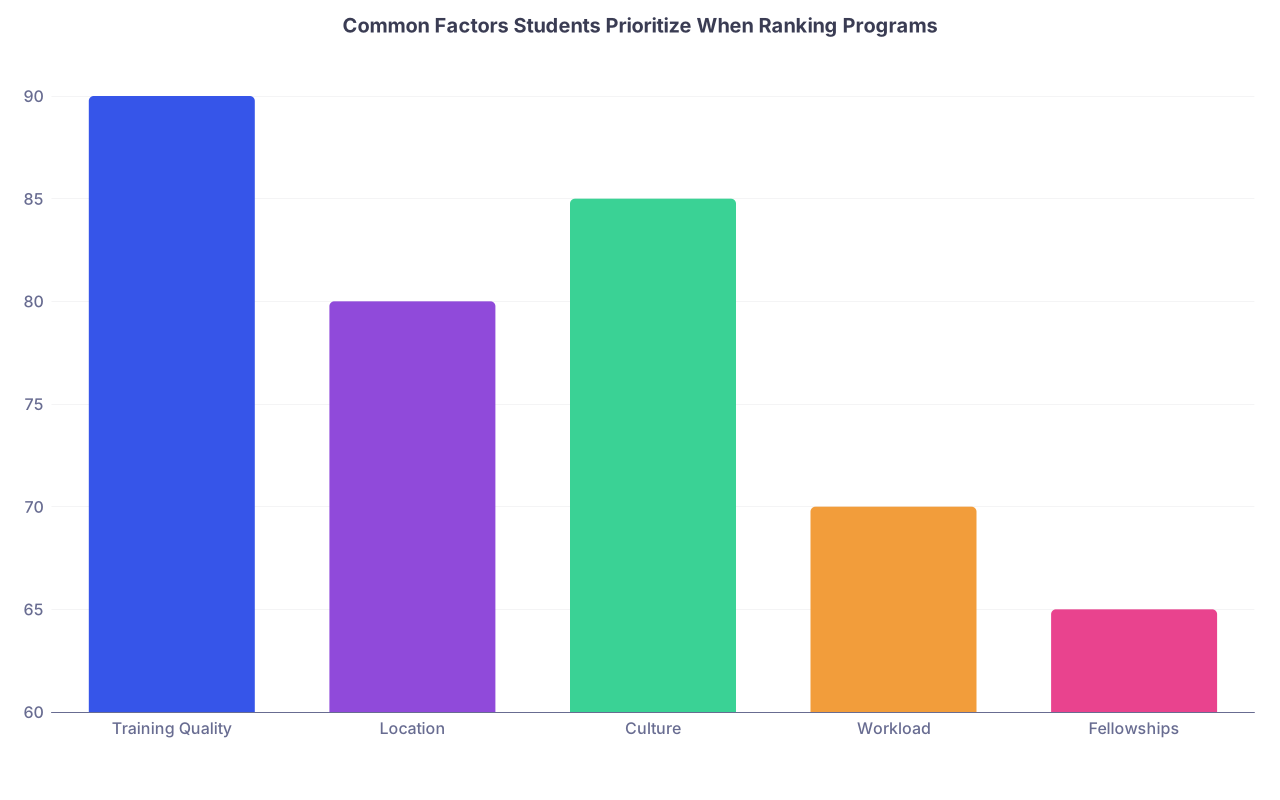
| Category | Value |
|---|---|
| Training Quality | 90 |
| Location | 80 |
| Culture | 85 |
| Workload | 70 |
| Fellowships | 65 |
The Short Version: Virtual Isn’t the Problem. Blind Ranking Is.
Virtual interviews are here to stay. People will match into great programs they never physically visited. People will also match into bad fits they did visit in person.
The problem isn’t the medium. It’s whether you:
- Got honest resident data
- Tested your life logistics
- Assessed training quality beyond buzzwords
- Checked for real red flags instead of just hoping for the best
If you’ve done that work and a virtual-only program still feels right? Rank it where it belongs. Even #1.
If you feel like you’re gambling and hoping the glossy interview wasn’t a mirage? Don’t put that in your top slot. Hope is not a ranking strategy.

FAQ: Virtual‑Only Interviews and Ranking Programs
1. Is it okay to rank a program #1 if I’ve only had a virtual interview there?
Yes. If you’ve confirmed strong training, decent culture, and a livable location through resident conversations and basic research, it’s completely reasonable to rank a virtual-only program #1. The Match doesn’t care how you interviewed; it cares where you’d actually want to train.
2. Should I avoid ranking a program highly if I couldn’t visit the city?
No, but don’t be lazy about it. You should still do a “virtual visit” of the city: maps, rent, commute, safety, schools (if relevant), partner job market. Talk to residents about where they live and how their actual lives feel outside the hospital. If the lifestyle seems workable and everything else lines up, not visiting in person isn’t a dealbreaker.
3. What’s the biggest risk of ranking a virtual-only program too high?
The biggest risk is discovering post-match that something you could have uncovered with better questions is a bad fit: toxic culture, chronic understaffing, unrealistic workload, or a city you hate living in. That’s not a virtual problem. That’s a due-diligence problem. You lower this risk by talking to multiple residents, including non-handpicked ones, and asking about what they’d change and what the worst parts of the program are.
4. How many residents should I talk to before ranking a virtual-only program highly?
Aim for at least 2–3, at different levels (e.g., one intern, one mid-level, one senior). If they mostly agree on strengths and weaknesses, that’s reassuring. If their stories don’t line up at all, you need to figure out why before putting that program in your top spots.
5. If I’m torn between an in-person program and a stronger virtual-only program, which should I rank higher?
Rank the one that better fits your actual priorities: training quality, career goals, culture, and life outside medicine. Don’t let “but I visited this one” be the deciding factor. If, on paper and from conversations, the virtual-only program is clearly stronger, it deserves to be higher on your list.
6. What’s one question that cuts through the fluff when talking to residents?
Use this: “Knowing everything you know now, would you still choose this program again, and would you still rank it where you did?” Then stay quiet. Most residents will give you a very honest, nuanced answer. If they hesitate, qualify heavily, or flat-out say no, take that seriously.
Action step for today:
Pick your top 2–3 virtual-only programs. Email each coordinator asking to speak with one or two current residents, then draft 5 specific questions you’ll ask them (including “What do you wish you’d known before matching here?”). Don’t touch your final rank list until you’ve had those conversations.


