

What if you actually matched at your dream program—but an NRMP technicality sent you somewhere else?
If that sounds dramatic, that is because it is. I have watched it happen. Not to careless people. To careful, type‑A, checklist-obsessed applicants who misunderstood one NRMP rule or clicked one wrong box on their rank list.
You are probably worried about interviews, letters, and personal statements. Fair. But at this phase—RESIDENCY MATCH AND APPLICATIONS—the silent killer is not your CV. It is how you use (or misuse) the NRMP system.
Let me walk you through the mistakes that quietly blow up otherwise solid applications.
1. Trusting “Common Sense” Instead of NRMP Contract Language
The NRMP is not a vibes-based system. It runs on a very specific algorithm and strict rules baked into a binding contract you accepted when you registered. If your understanding of the match rules comes from older residents “explaining how it works,” you are already in danger.
Some of the worst misunderstandings I have seen:
- “If I rank a ‘reach’ program first, I might not match at my safer places.”
- “Programs get offended if you rank them low. They can see the order.”
- “I should rank programs where I ‘fit’ realistically as number one, not my dream.”
All wrong. And not just harmlessly wrong—they change how you build your rank list in a way that can absolutely cost you positions.
The algorithm is applicant-proposing. Translation: it tries to get you the highest program on your list that will take you, without punishing you for aiming high. The NRMP has repeated this in writing for years, yet every cycle, students behave as if programs can “see” their rank order and retaliate. They cannot.
The real danger is not that the algorithm is unfair. The danger is that you do not believe it, and you self-sabotage.
2. Designing Your Rank List to “Please” Programs
The number one conceptual error: ranking programs based on what you think they want instead of what you want.
You see it every year:
- Applicant gets a strong “We will rank you highly” email from Program A.
- Applicant loves Program B more. But now panics: “If I rank B #1 and they do not take me, will I lose A too?”
- Applicant moves A to #1 “to be safe.”
Outcome: they match at Program A and will always wonder if they would have matched at B. That is not the system failing you. That is you failing to trust the rules.
The NRMP algorithm does this, simplified:
- Tries to place you at your #1, if they have a spot and ranked you.
- If not, moves to #2.
- Continues down your list until you either fit somewhere or you do not match.
Your rank list does not tell Program A you “love them less” because you put them #2. They never see your order. They only see their own list.
The technical mistake: letting informal communication override the only thing that matters legally—the certified rank list.

Red flag behaviors:
- Changing your #1 because a program “showed you more love.”
- Moving a program up just because they offered a second look or social.
- Downgrading a program you liked because they were “quiet” after interview day.
You are not building a gratitude list. You are building a legally binding preference order. Treat it that way.
3. Misunderstanding Categorical vs Preliminary vs Advanced Ranks
This is where technical misreads become catastrophic.
You are applying to:
- Categorical programs (e.g., Categorical Internal Medicine, Categorical General Surgery)
- Preliminary year programs (e.g., Prelim Medicine, Prelim Surgery, Transitional Year)
- Advanced positions (e.g., Dermatology, Radiology, Anesthesiology, PM&R, some Neuro)
Different rules apply. If you do not understand how they interact in the NRMP system, you can literally match to nothing when you could have matched somewhere.
The brutal error with advanced positions
If you rank advanced positions (that start at PGY-2) without a realistic and properly ranked list of preliminary/TY backup options, you can easily:
- Match into an advanced program but fail to match into a PGY-1 year
- Or worse, not match at all when you could have matched prelim-only
The system allows you to create supplemental rank order lists for advanced programs. Many applicants ignore or misuse these.
Here is the catch: if you do not build those supplemental lists correctly, the algorithm will not magically pair you with the best prelim slot. It will follow your structure exactly as entered.
| Position Type | Example | Typical Technical Pitfall |
|---|---|---|
| Categorical | Categorical Internal Med | Ranking few programs, overconfidence |
| Preliminary | Prelim Surgery | Forgetting to rank enough backups |
| Transitional | TY at community hospital | Ignoring compatibility with advanced |
| Advanced | Dermatology, Radiology | Not using supplemental rank lists well |
If you are unsure how your list works with advanced + prelim/TY, you should build a mock example on paper and trace what happens if you match at each advanced program. If you cannot explain exactly which intern year you land in each scenario, your list is not safe.
4. Misusing Supplemental Rank Order Lists (SROLs)
These are the dark horse of match disasters. SROLs look optional and benign. They are not.
For each advanced program you rank, you can attach a supplemental rank order list of PGY-1 programs you are willing to pair with that specific program. That seems friendly and customizable. It is also easy to break.
Common mistakes:
- Using one tiny SROL for multiple advanced programs without enough prelim options
- Putting only “dream” TYs on your SROL and almost no realistic prelims
- Assuming that “I ranked some prelims on my main list, so I am safe”
No. Not necessarily safe.
Scenario I have actually seen:
- Applicant ranks 5 Derm advanced programs.
- Adds one SROL with only 2 “amazing” TY programs.
- Does not rank additional prelim programs adequately on the primary list.
- Matches to Derm Program #3.
- Fails to match to either TY on the tiny SROL.
- Result: Matched PGY-2 without a PGY-1 year. Now in Supplemental Offer and Acceptance Program (SOAP) chaos, begging for an intern year.
Could they have matched a solid prelim spot if they had ranked more and in a safer order? Yes. But the system did exactly what they told it to do.

| Step | Description |
|---|---|
| Step 1 | Rank Advanced Program |
| Step 2 | Use SROL for PGY-1 |
| Step 3 | Use Main List PGY-1 Ranks |
| Step 4 | Matched Both Years |
| Step 5 | Need SOAP for PGY-1 |
| Step 6 | Has SROL? |
| Step 7 | Match PGY-1? |
If this flow looks complicated, good. It is. That is why “I will figure it out the week before the deadline” is a bad plan.
5. Ranking Too Few Programs: Quiet Overconfidence
People rarely think of this as a “technical” error. It is.
The NRMP publishes data. It is not subtle about it. For many specialties, the match rate climbs steeply as you rank more programs. Yet strong applicants still:
- Rank 6–8 programs in a competitive field
- Call it “being intentional” or “not wasting time”
- Then act shocked on Monday of Match Week
Overconfidence is not just emotional. It is procedural. You lock it into the system by submitting a short rank list.
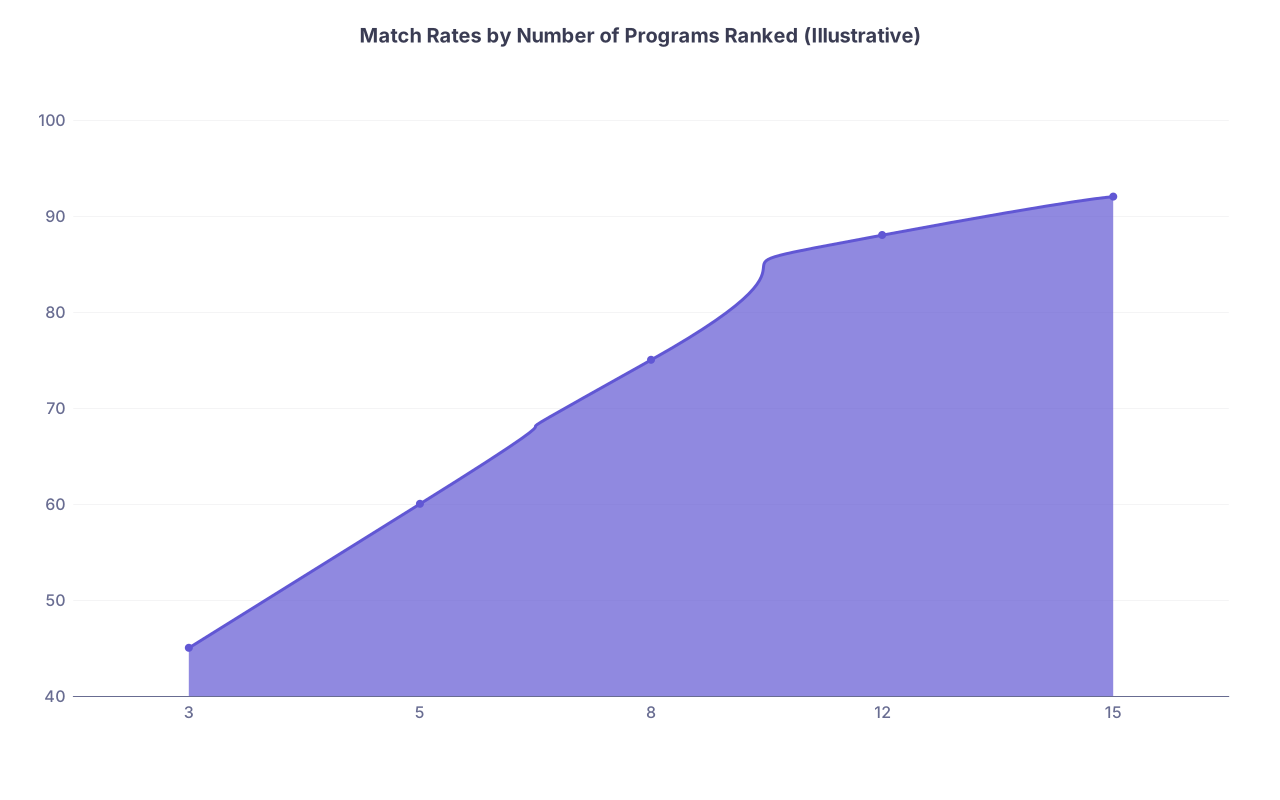
| Category | Value |
|---|---|
| 3 | 45 |
| 5 | 60 |
| 8 | 75 |
| 12 | 88 |
| 15 | 92 |
These numbers are illustrative, but the pattern mirrors real NRMP Charting Outcomes data: more programs ranked means a higher probability of matching, up to a point.
The mistake is not trusting one or two “verbal assurances” and building your rank list around them. Programs over-interview. Their “we love you” does not override their love for the other 200 people they interviewed.
One more subtle error: ranking only “prestige” locations and leaving out decent community programs that would train you well. If you are in a competitive specialty and you are not a superstar on paper, a short, top-heavy list is Russian roulette.
6. Ignoring Couples Match Technical Complexity
Couples Match multiplies your risk if you do not understand the mechanism. It is powerful and fair—but unforgiving.
Here is what couples routinely mess up:
- They underestimate the combinatorial explosion of joint ranks.
- They rank only a handful of paired options.
- They misunderstand that you can (and often should) rank combinations where one partner is unmatched / in a prelim as a deliberate but lower-choice outcome.
In couples match, you are not just ranking Program A and B. You are ranking ordered pairs:
- (Partner 1 at Program X, Partner 2 at Program Y)
- (Partner 1 at Program X, Partner 2 unmatched)
- (Partner 1 unmatched, Partner 2 at Program Y)
You must explicitly tell the system which trade-offs you are willing to accept. If you do not, the algorithm will never give you something you did not rank, even if you would have happily taken it in real life.

Technical traps:
- Refusing to include any pairs where one partner is at a less desirable program than they “deserve” on paper
- Having a very short list of geographic combinations because “We only want to be in 2 cities”
- Not carefully checking that every listed combination is actually acceptable, leading to unintentional outcomes
If you are couples matching in a competitive specialty, a short, inflexible list is the fastest route to at least one of you going unmatched.
7. Misunderstanding the Binding Nature of the Match and SOAP Rules
Another rule people misread: The match is binding. When you certify that rank list, you are signing a contract. NRMP enforces it.
Common fantasies:
- “If I do not like where I matched, I will just decline and scramble elsewhere.”
- “If I get a better offer after the match, I can switch.”
- “If a program seems toxic after I match, I can just back out.”
If you violate the match agreement, NRMP can bar you from future matches, flag you for states and hospitals, and your medical school can face consequences. Programs can also be sanctioned for violating their side of the contract. This is not a friendly suggestion system. It is regulated.
Same with SOAP. People assume:
- “I can half-try in the main match and make SOAP my backup.”
- “I’ll just see what is available in SOAP and make decisions then.”
SOAP is not a relaxed second chance. It is compressed, competitive, stressful, and limited. Many specialties do not have open spots at all. You do not “plan” to use SOAP. You plan to avoid needing it by building a robust primary rank list.
8. Deadlines, Certification, and Last-Minute Changes
The NRMP gives you a clear certification deadline. Missing it is not a soft mistake. It is terminal.
Technical errors I have personally seen:
- Applicant thought they certified but actually only saved (no green “certified” indicator).
- Applicant created multiple versions of their list, edited the wrong one, and certified an out-of-date order.
- Applicant tried to re-certify after the deadline, assuming there was some grace period. There is not.

| Step | Description |
|---|---|
| Step 1 | Draft initial list |
| Step 2 | Review against preferences |
| Step 3 | Check categorical vs prelim vs advanced |
| Step 4 | Verify couples/SROL logic |
| Step 5 | Save and log out |
| Step 6 | Log in next day with fresh eyes |
| Step 7 | Confirm final order |
| Step 8 | Click Certify |
| Step 9 | Verify green certified status & date |
If your entire four-year effort depends on this list, you owe it more than a rushed click five minutes before the deadline.
9. Believing Program Communication Changes the Rules
Let me be blunt: pre‑match communication is noisy, unregulated, and often misleading.
Statements like:
- “We will rank you highly.”
- “You are a very strong candidate for us.”
- “We expect you will match here if you rank us first.”
None of these change the rules of the NRMP algorithm. They also do not bind the program to anything. Some are even skirting NRMP communication guidelines.
I have seen applicants rearrange their entire rank list around a single flattering email. Then get burned because the program had 80 “very strong” candidates and only 10 spots.
The NRMP algorithm does not care what was said on virtual socials, what was whispered by a chief resident, or what you “felt” on interview day. It cares about:
- Your certified list
- Their certified list
- And the matching algorithm
You can appreciate the compliments. Just do not let them override the only safe rule: rank in your true order of preference.
10. How to Bulletproof Your NRMP Rank List (Without Overcomplicating It)
Let’s strip it down to the essentials to avoid technical ranking mistakes that cost positions.
Do this:
Write out, on paper or in a document, the true order of where you would want to train if all offers were guaranteed. No algorithm. No strategy. Just preference.
Translate that list into your NRMP rank list for categorical programs.
If you have advanced positions:
- Build clear supplemental lists.
- Include enough prelim/TY programs, not just dream ones.
- Double-check that every advanced program has a realistic path to an intern year.
If you are couples matching:
- Sit down together and enumerate combinations explicitly.
- Include “less ideal but acceptable” combos before any pair that includes “unmatched” if you would genuinely prefer that.
- Commit to a longer list than feels comfortable.
Check technical details:
- Program codes match what you think they are.
- You did not confuse similarly named programs or campuses.
- You have no “placeholders” still sitting on the list that you never meant to rank.
Certify. Log out. Log back in another day and confirm:
- The order still reflects your true preferences.
- Everything is still marked certified with the correct date.
You cannot game the NRMP algorithm. You can only misuse it. Your job is not to be clever. It is to be accurate and honest about what you want—within the structure the NRMP actually uses, not the mythology residents pass around.
FAQ (Exactly 3 Questions)
1. If I rank a “reach” program first, can that make me miss out on safer programs lower on my list?
No. Provided you rank enough programs, putting a reach program first cannot harm you. The algorithm will try to place you at your first choice; if that program does not have a spot for you, it moves down your list and considers your next choices as if they were first. The only way you “miss out” is by not ranking enough realistic programs in total.
2. Should I change my rank list based on programs telling me I am “high on their list” or “very competitive”?
You should not. Those statements are non-binding and often given to many applicants. Your rank list must reflect where you genuinely want to train, in order, regardless of what programs say. Letting informal communication override your true preferences is one of the most common and damaging ranking mistakes.
3. How many programs should I rank to stay safe?
There is no single number, but the pattern is clear: more is safer up to a reasonable point, especially in competitive specialties. Use NRMP’s Charting Outcomes data for your specialty and applicant profile, then err on the side of including every program where you would be willing to train. The technical mistake is under-ranking due to overconfidence or pride, then relying on SOAP as a backup.
Open your current rank list (or draft it if you have not started) and ask one hard question: “If every program ranked me highly, is this still the exact order I would want?” If the answer is anything but a confident yes, fix it now—before the system locks in a mistake you cannot undo.


