

It’s late January. You and your partner finally finished interviews. There’s a shared Google Sheet with color codes, notes, rumored call schedules, and that one program your aunt swears is toxic.
You open the NRMP Couples Rank screen for the first time. You see that grid. The combinations. The “paired ranks.” Your heart sinks.
You thought you understood the couples match. Then you realize: you can’t just “rank your lists and link them.” The way you build this thing can screw both of you. Badly.
Let me walk you through the mistakes that blow up couples’ matches every year—because I’ve watched couples do this in real time, and some of them are still dealing with the fallout.
Mistake #1: Treating the Couples Match Like Two Separate Rank Lists
This is the foundational error. If you get this wrong, everything else is built on sand.
You are not doing “two normal rank lists that the algorithm just keeps together.” That’s not how it works.
When you couples match, the algorithm is looking at pairs of choices. Not what you like individually in isolation.
A simplified view of what it evaluates:
Couple’s Rank #1:
You: Program A #1
Partner: Program X #1Couple’s Rank #2:
You: Program A #1
Partner: Program Y #2Couple’s Rank #3:
You: Program B #2
Partner: Program X #1
…and so on.
If you just rank programs on your own, then try to “link” them later, you’ll miss combinations you’d actually accept. Or worse—you’ll create combinations you wouldn’t accept but accidentally ranked.
How to avoid this
You need two layers of thinking:
- Individual preference list (what you’d rank if you weren’t coupled).
- Joint grid of acceptable combinations (what’s actually OK for both of you together or apart).
Most couples only do #1. Then they discover late that they never actually discussed:
- Is “NYC + 90-minute train ride away” ok?
- Is “one person at a strong program, the other at a weaker one” ok?
- Is “same hospital but one in prelim, one in categorical elsewhere” ok?
If you skip the combination discussion, your final couples list is basically random.
Do not touch the NRMP ranking screen until you’ve built a rough combination grid on paper or spreadsheet. It will feel tedious. It is. Do it anyway. The pain of that is far less than the pain of a disastrous match.
Mistake #2: Only Ranking “Ideal” Same-City / Same-Hospital Pairs
This one is brutal. You see it every year:
Couple says, “We’ll only rank same-city options; we’re not doing long-distance.”
Then March comes. They match… to nothing. At all.
The logic failure here: couples match is already harder than matching solo. If you restrict your list to only:
- Same city, and
- Certain-tier programs, and
- Certain lifestyles
You’re shrinking an already-small overlap into almost nothing.
The too-short “fantasy list”
I watched one couple:
- EM applicant, very average stats
- Derm applicant, mid tier
- Only ranked combinations in 3 major cities they liked
- Refused to rank “one matches, one doesn’t” pairs
They ended up:
- She: Unmatched in Derm, SOAP into a prelim year
- He: Matched EM at a program he could have had even if she had matched elsewhere
- Relationship: loaded with resentment because they played “all or nothing” and got nothing for one of them
If they’d allowed “one strong, one average” or “same region, neighboring cities,” she probably still doesn’t match Derm—but they might have avoided SOAP chaos and had more options together geographically.
How to avoid this
You don’t have to rank things you truly could not live with. But do not confuse “suboptimal” with “unacceptable.”
Ask yourselves:
- Would we truly rather both SOAP or be unmatched than do 1–2 years long distance?
- Would we truly rather both give up our top specialty than one of us match and the other scramble?
- Are we saying no to a combination because it’s bad… or because our egos are bruised?
Your list should include tiers:
- Dream same-hospital / same-city combos
- Solid “same city but different hospitals”
- Acceptable “same region, feasible commute or weekend travel”
- Safety “one matches, one safety / prelim / different region we can tolerate”
Most couples never even create tiers 3–4. That’s the mistake.
Mistake #3: Refusing to Rank Asymmetric Outcomes (“One Matches Stronger Than the Other”)
The couples match is not a joint fantasy package. It’s a compromise machine. And compromise usually means someone gets slightly better, someone slightly worse, than their solo ideal.
The red flag pattern I see:
- One partner is extremely competitive (e.g., ortho with 260+ or strong home support).
- The other is average or weaker in a competitive field or a less desirable geographic preference.
- They insist on “balanced” outcomes where both match at similarly prestigious programs in the same city.
Translation: they’re throwing away realistic good fits to preserve a fake sense of equality.
Reality check
Rank lists that only include “prestige-balanced” combinations are fragile. The algorithm doesn’t care about your sense of fairness. It only cares about what’s on the list.
If you refuse to rank things like:
- Person A at a “top-tier” program, Person B at “mid-tier but still decent” in same city
- Person A at a great program, Person B at a safe but less ideal nearby program
You are saying, “We would rather both of us miss out on our realistic best options than tolerate a perceived imbalance.”
That sounds noble in January. It feels idiotic in March if one of you is unmatched or in SOAP when they didn’t have to be.
How to avoid this
You need to be brutally honest—with yourselves and with each other:
- Who has more leverage in this process (scores, letters, specialty)?
- Where can that leverage actually help the other person (same city, same hospital, nearby institution)?
- Where is your pride sabotaging viable combos?
I’ve seen smart couples say:
“We’ll rank combos where one of us is at a ‘name’ program and the other at a more average place in the same city, because real life day-to-day matters more than matching prestige.”
They’re right. The mistake is pretending that prestige symmetry is non-negotiable.
Mistake #4: Not Understanding How “Unmatched / Any Program” Rows Work
The couples match has a dangerous-looking option:
“Unmatched” + “Program X” (and vice versa).
People either:
- Never use it (out of fear), or
- Use it badly and end up furious with the algorithm
Here’s the point:
Those “Unmatched + Program” combinations are how you allow an outcome where one person matches and the other doesn’t—on purpose—at specific places.
If you never rank them, you are telling NRMP: “We only want to match if we both match somewhere on the list.”
That’s how couples both end up unmatched when at least one could have matched individually.
The subtle trap
Imagine this:
- You: strong IM applicant
- Partner: borderline for Ortho
- You list combinations only where both of you match somewhere. No “Unmatched + Your Program Safe” rows.
- Result: they don’t match Ortho anywhere; therefore none of the pairs are viable; therefore you also don’t match, despite being rankable at multiple IM programs.
You both go into SOAP. You hate your life.
And then you discover you could have matched at your IM #1 easily if you’d created rows like:
- You: IM #1
Partner: Unmatched
That’s not NRMP’s fault. That’s your list design.
How to avoid this
First decide this as a couple:
- Are we OK with one person matching while the other does not, if the match is at certain programs?
If yes, then build that explicitly:
- For each “must-have” program for one of you, consider a few rows at the bottom of your list that say:
[Person A: Program X, Person B: Unmatched]
But do not sprinkle these randomly near the top of your list. They belong low, after every combination where both match somewhere you can tolerate.
The mistake isn’t using “Unmatched + Program” rows; the mistake is either never using them or using them without clear priority logic.
Mistake #5: Confusing “Long List” With “Smart List”
Some couples proudly say, “We have 300 combinations. We’re covered.” No, you’re not. You’re just tired.
A bloated, messy list is dangerous because:
- It often contains combinations you did not truly discuss.
- It sneaks unacceptable options so low you forget they’re even there.
- It gives you false comfort instead of real strategy.
A common pattern:
They set a rule: “We’ll just combine every program we interviewed at for both of us—that maximizes options.”
Then they discover in March that they matched to a tiny town one of them actively disliked but forgot they had ranked as a low, throwaway combination.
They say, “We thought that would never actually happen.”
Yes. People always think the low combinations will magically self-delete. They don’t.
How to avoid this
You want intentional length, not mindless length.
Every row on your combined rank list must pass three tests:
- We both know this combination exists.
- We’ve both explicitly said, “We would choose this over SOAP.”
- We can both name at least one upside of this combination (not just “well, at least we’re technically matched”).
If you can’t look at a row and immediately justify why it’s above “both going to SOAP,” it shouldn’t be there.
I’d rather see a couple with 40 serious, vetted combinations than 300 random ones built by algorithmic pairing of every program with every program.
Mistake #6: Letting One Partner Quietly Sacrifice Everything
The “silent martyr” problem.
You will not see this on Reddit or in advising offices, but I’ve watched it happen:
- One partner is terrified of being the reason the other doesn’t get what they want.
- They say, “It’s fine, rank your dream city / dream specialty high; I can be happy anywhere.”
- They never actually list their own red lines.
- The final list heavily favors one person’s priorities, while the other pretends it doesn’t bother them.
Then they land at a program or city the “martyr” secretly hates. And that comes out later. Usually when they’re exhausted on night float wondering how they ended up there.
How to spot this
If your conversations sound like:
- “Whatever, I don’t care, you pick.”
- “Your specialty is more competitive, let’s just optimize for you.”
- “I can adjust; it doesn’t matter.”
That’s not compromise. That’s avoidance. And it’s a recipe for resentment down the line.
How to avoid this
Each of you needs to do this privately first:
- Write a personal rank list as if you were not couples matching.
- Mark 3–4 “non-negotiables” (deal-breaker cities, programs, or living situations).
- Mark 3–4 “strong preferences but flexible” items.
Then compare—not to win, but to see the real starting point. Your final list should show clear footprint from both sets of preferences.
If, during this process, one person keeps saying, “I have no non-negotiables,” push on that. Nobody has zero preferences. They’re just scared to voice them.
The big mistake is thinking a one-sided sacrifice will magically feel okay just because you “agreed” at the time.
Mistake #7: Ignoring Program Signals About Couples
Some programs love couples and are explicit: “We’re very couples-friendly; we try to make it work.” Others… aren’t.
What I’ve seen couples do wrong:
- Rank combinations high assuming that both departments at the same institution will coordinate… when nobody actually said they would.
- Ignore that one PD was lukewarm or dismissive about the couples match question.
- Overvalue vague “We’ll see what we can do” statements.
Read the signals honestly
Green flags:
- PD or APD says directly: “We’ve matched couples successfully before. We coordinate with X specialty here.”
- They can name couples in current or recent classes.
- They ask for your partner’s name, specialty, and where they interviewed.
Yellow/red flags:
- “Well, we treat everyone individually. We don’t really do special consideration.”
- No evidence of prior couples.
- Awkward pause when you mention couples match.
If you put a lot of weight on a combination where one or both programs gave off red flags, you’re building on fantasy.
How to avoid this
On your spreadsheet, add a simple column: “Couples-friendly? Y / N / ?”
If a combination depends on a clearly non-couples-friendly program bending over backward for you, that combo should probably slide down the list. Or off it.
Mistake #8: Failing to Separate “Life Priorities” From “Medical Twitter Priorities”
Too many couples build their list for an imaginary audience:
- Chasing prestige to impress classmates
- Overweighting fellowship opportunities they may never actually pursue
- Ranking “name-brand” cities that would make real life miserable (cost, family support, commute)
Then three months into intern year they realize:
- They never see each other because of commute / call patterns
- They’re far from any support system
- The “sexy” city is unaffordable on PGY-1 salaries
You’re not matching as co-authors of a New England Journal paper about your careers. You’re matching as two humans who have to live actual daily lives.
How to avoid this
Sit down and rank these, together:
- Cost of living
- Proximity to family / support
- Commute time from where you’d realistically live
- Schedule intensity (especially if one specialty is brutal)
- Weather / lifestyle deal-breakers
- Fellowship needs (for each of you)
Then cross-check your top-ranked combinations against that list. If you find yourself saying, “Well, this combo is awful for basically everything except prestige,” it probably needs to move down.
The trap is building a list that looks good on paper to other people but bad in your actual life.
Mistake #9: Waiting Until the Last Week to Actually Build the Couples List
People massively underestimate the logistics of building, checking, and re-checking a couples list.
I’ve seen this too often:
- They spend weeks talking in vague terms: “We like Boston,” “We’d be happy in Chicago.”
- Two days before the deadline, they open the NRMP screen for the first time.
- Panic. Someone brute-forces combinations late at night.
- No one double-checks the final list line by line.
Then in March, they realize:
- Program names were mistyped.
- Rows are out of order.
- They forgot an entire city’s combinations.
- Or they ranked a combo much higher than they meant to.
How to avoid this
Timeline that actually works:
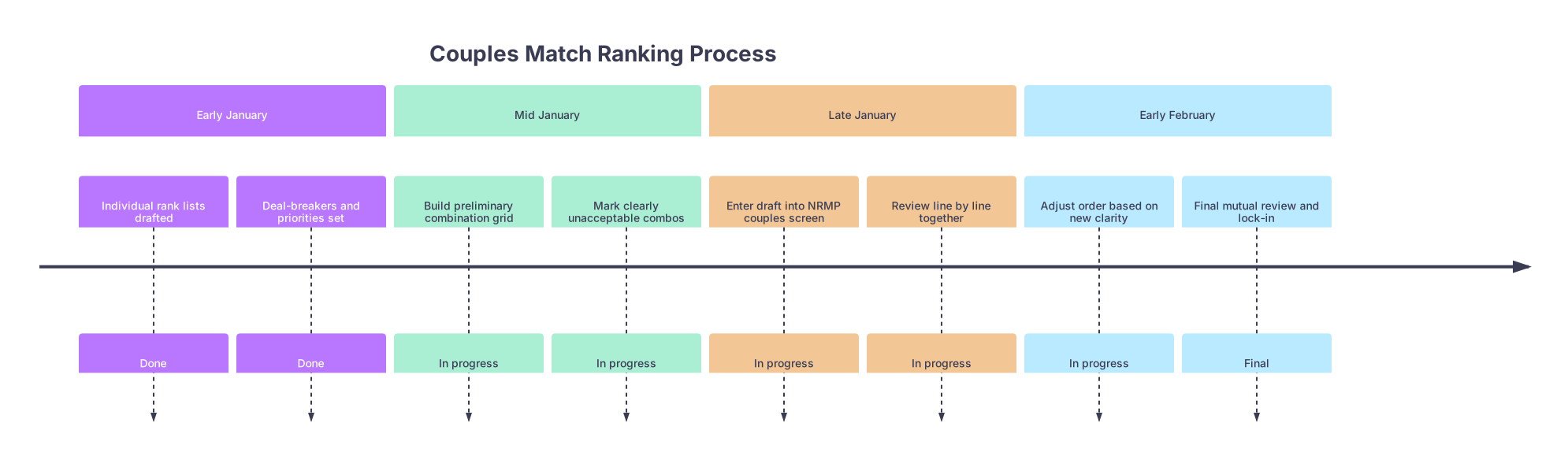
| Period | Event |
|---|---|
| Early January - Individual rank lists drafted | Done |
| Early January - Deal-breakers and priorities set | Done |
| Mid January - Build preliminary combination grid | In progress |
| Mid January - Mark clearly unacceptable combos | In progress |
| Late January - Enter draft into NRMP couples screen | In progress |
| Late January - Review line by line together | In progress |
| Early February - Adjust order based on new clarity | In progress |
| Early February - Final mutual review and lock-in | Final |
Do not be the couple doing this at 11:30 PM on deadline day.
Mistake #10: Not Planning for Specialty-Specific Realities
Some specialties play very differently in the couples match. Ignoring that leads to mismatched expectations.
A few examples:
Competitive surgical / derm / rad onc spouse + primary care spouse
→ The competitive partner might have serious geographic leverage. The primary care partner usually has more program volume. That’s a specific dynamic to work with, not ignore.One person in SOAP-risk specialty (e.g., Ortho, ENT, Derm with marginal stats)
→ You cannot treat that list like IM or Peds. You need realistic SOAP and “plan B” thinking baked into your rankings.One person categorical, one person prelim / transitional
→ You can’t act like both are choosing 3–7 year destinations. The prelim person’s next move is already another match.
The mistake is assuming, “We’re both just applicants; the system treats us the same.” It doesn’t.
A Simple Comparison: Smart vs Risky Couples Lists
| Area | Smart Approach | Risky Approach |
|---|---|---|
| List length | 40–120 vetted combos | 200+ brute-force combos |
| Asymmetric outcomes | Explicitly allowed low on list | Completely banned or unplanned |
| Geography | Tiers of city/region flexibility | Only dream cities ranked |
| “Unmatched” rows | Used carefully near bottom | Never used or randomly scattered |
| Review process | Built early, double-checked line by line | Thrown together last minute |
Key Takeaways (Do Not Skip These)
- The couples match ranks combinations, not individuals. If you don’t build and vet combos intentionally, the algorithm will happily give you something you never truly agreed to.
- Don’t play “all or nothing.” Over-focusing on perfect same-city, prestige-balanced outcomes is how couples end up with both partners in SOAP when at least one could have matched well.
- Every row on your list must be something you both would honestly choose over going unmatched. If you cannot defend a combination out loud, it doesn’t belong on your list.


