

What happens if you match a preliminary year 1,000 miles away and forget to rank a compatible advanced position… or worse, rank them in the wrong order?
If that question makes your stomach drop, good. That means you’re still in time to avoid some of the most painful, avoidable disasters in the NRMP Match.
This is the land of prelim vs. categorical vs. advanced. And it is full of hidden traps. I’ve watched strong applicants blow up their entire training path because they misunderstood one rule about linked ranks, or assumed the algorithm would “figure it out.” It will not.
Let’s walk through the ranking errors that actually ruin plans, not the cosmetic ones people argue about on Reddit.
First: Know the Game Pieces or You Will Misplay Them
Before we talk mistakes, you need a crystal-clear mental model of the three common types of positions. If you are fuzzy on this, you are already at risk.
| Position Type | Years Covered | Common Specialties | Needs Separate PGY? |
|---|---|---|---|
| Categorical | PGY-1 to completion | IM, Peds, FM, Psych | No |
| Preliminary | PGY-1 only | IM prelim, Surgery prelim | Yes, needs PGY-2+ |
| Advanced | PGY-2+ only | Radiology, Anesthesia, Derm, Neuro | Yes, needs PGY-1 |
- Categorical: Start to finish. Intern year plus all later years at one program. Example: Categorical Internal Medicine.
- Preliminary: One-year internship only. You must secure something for PGY-2 and beyond elsewhere.
- Advanced: Starts at PGY-2. Assumes you already have (or will get) a PGY-1 year somewhere.
Here’s the first dumb-but-deadly assumption: “If I rank a prelim and an advanced, the system will try to pair them automatically.”
No. You must build that pairing explicitly with supplemental rank order lists (SROLs) and linked ranks. If those two phrases are unfamiliar, you’re not ready to certify your list.
Mistake #1: Treating Prelim + Advanced Like a Categorical Program
I see this every year: A future radiologist, anesthesiologist, or dermatologist ranks a gorgeous advanced program and a couple of prelims and thinks, “I’m set either way.”
No.
If you are in a specialty that requires a separate intern year (radiology, anesthesia, derm, ophtho, PM&R, neuro – yes, even the “advanced” ones you think are special), you have to match:
- An advanced position (PGY-2+), and
- A preliminary or transitional year (PGY-1)
And those two do not magically “group” in the main list.
Common dangerous beliefs:
“If I match at an advanced program, they’ll help me find a prelim.”
Sometimes they will. Often they will not. And the NRMP doesn’t care about that handshake promise.“If I match a prelim but not an advanced, I can just re-enter the Match from there.”
Technically true. Practically miserable. You become the PGY-1 trying to re-apply off-cycle with worse timing and more chaos.
The error: Ranking advanced and prelim programs in a single main list without using supplemental lists. That is not how pairing works. You will not control which prelim goes with which advanced. You might match an advanced program without any prelim at all.
You must use supplemental lists to tell the algorithm:
“If I match to THIS advanced program at spot #1, THEN look at THIS list of prelims, in THIS order.”
You do not want to learn that rule from an NRMP support email in March.
Mistake #2: Misusing (or Ignoring) Supplemental Lists
Now we get to the technical landmine: the supplemental rank order list (SROL).
If you match to an advanced position, your supplemental list for that program is where the algorithm goes next to find you a PGY-1 spot. If you did not build it correctly, you will either:
- Get paired with a prelim you hate, or
- Not get any PGY-1 spot at all
Both outcomes are avoidable.
Here is the basic logic using a simplified flow:

| Step | Description |
|---|---|
| Step 1 | Main Rank List |
| Step 2 | Check other ranks |
| Step 3 | Go to SROL for that Advanced |
| Step 4 | Match Prelim + Advanced |
| Step 5 | Match Advanced ONLY |
| Step 6 | Match Advanced? |
| Step 7 | Prelim on SROL available? |
See that last box? “Match Advanced ONLY.” That is the nightmare scenario: You matched your dream radiology spot. You have no PGY-1. You now enter the SOAP fight club or scramble for an off-cycle internship somewhere.
Common SROL mistakes:
Not creating SROLs at all
You rank advanced programs but never build associated prelim lists. The algorithm has nowhere to look for your PGY-1.Building one generic SROL and assuming it applies to all advanced programs
Each advanced program can have its own SROL. If you reuse one without thinking, you may end up paired with a prelim logistically impossible for that advanced spot (different region, impossible commute, or start date misery).Not ranking enough prelims on the SROL
You list only 1–2 prelims “you like.” Then you act surprised when hundreds of other people also liked those and they fill above your rank. You need depth on those lists.Mixing transitional year and prelim spots blindly
Transitional years are usually cushier, more competitive, and sometimes poorly aligned with your advanced program’s needs. Blindly mixing them can create schedule conflicts you do not discover until July.
The protective move:
For each advanced program on your main rank list, build a separate, thoughtful SROL with:
- Multiple prelim / TY options,
- Realistic geographic and logistical fit,
- An order that reflects your actual preferences if that specific advanced position hits.
Mistake #3: Ranking Prelim Spots Too High on the Main List
This one is subtle and ugly.
I’ve seen applicants put a “backup” categorical or prelim position high on their main list without realizing what happens if that backup fires before an advanced + SROL combination.
Example scenario:
- You want Anesthesia (advanced) above all, but you also “like” a categorical Internal Medicine position.
- Your main list looks like this (simplified):
- Categorical IM – State Hospital
- Advanced Anesthesia – Prestige U
- Advanced Anesthesia – Regional Med Center
And you have great prelim SROLs built under #2 and #3.
Here is the problem: If the algorithm can match you to #1 (Categorical IM), it will. Then it stops. It will never reach the anesthesia programs below. Your dream specialty dies because you “safely” put a categorical backup higher.
The bigger conceptual mistake: mixing goals.
If your true priority is: “I will do Anesthesia if at all possible; only if I genuinely cannot match Anesthesia will I do categorical IM,” then your ranking should reflect that. That means every anesthesia option (advanced + SROL) you find acceptable should sit above any categorical IM fallback.
The algorithm cares about your order. It does not care about your feelings about “backup vs priority.” If something is higher, it is treated as your truer preference.
Do not accidentally tell the Match you prefer your backup.
Mistake #4: Splitting Yourself Across Unlivable Geographies
Here is a real scenario I watched up close:
- Applicant matches an advanced Radiology position in a major West Coast city.
- Their prelim SROL includes prelim IM programs all over the country, in this approximate order:
- Prelim IM – Same City Academic
- Prelim IM – Midwest Community
- Prelim IM – East Coast University
They do not match the same-city academic prelim (#1). They end up matched to Radiology on the West Coast and prelim IM in the Midwest. Thousands of miles apart. One year in the Midwest, then a cross-country move a year later.
Technically “it worked.” They had both PGY-1 and PGY-2+. Practically it wrecked their life logistics: spouse’s job, housing, moving costs, social support. They admitted later they had not understood the implication of ranking that Midwest prelim so high on the SROL.
The rank list is not just about prestige. It is a contract with your future self’s geography and sanity.
If you are going to mix prelims and advanced programs across regions, be brutally honest:
- Would you actually be willing to move twice in 12 months?
- Could you afford that?
- What does this do to a partner, kids, or visa issues?
If the answer is “No, that would be miserable,” then those pairs should not appear together in your ranked structure. Rank with your real life in mind, not your fantasy-life tolerance.
Mistake #5: Assuming the Algorithm “Tries to Help You”
The algorithm is not your advisor. It is a ranking machine.
Two dangerous fantasies:
“The algorithm will try to pair my advanced and prelim in the same city.”
No, it will try to respect the highest combination in the order you gave it, following the rules it has. Geographic common sense is not part of that.“If I forget to rank a prelim below an advanced, the system will warn me or block me.”
It will not. The NRMP interface will not protect you from poor judgement or lack of understanding. It assumes you read the instructions.
Protection here is knowledge, not hope. You should be able to explain out loud:
- For each advanced program in my list, what prelims can I be paired with?
- What exact order will the algorithm consider those possibilities?
- What happens if none of those prelims are available?
If you cannot answer those three precisely, you are not done building your lists.
Mistake #6: Confusing Categorical vs. Advanced for the Same Specialty
One more subtle trap: some specialties offer both categorical and advanced tracks at the same institution. Example: Anesthesia or Neurology at the same hospital might offer:
- Categorical Anesthesia (PGY-1–4)
- Advanced Anesthesia (PGY-2–4, requires separate PGY-1)
I have seen applicants:
- Rank the advanced program high,
- Forget they also wanted the categorical track, or
- Mix them haphazardly, producing weird priority signals.
Worse, they assume the categorical version is “the same but easier.” Sometimes it’s not. Some institutions actually prefer categorical candidates or train them differently.
The real hazard: You mistakenly rank an advanced track above a categorical track even though you do not want the hassle of a separate prelim year if you can avoid it.
If your true preference at Hospital X is:
- Categorical Anesthesia (all-in-one)
- Advanced Anesthesia (if I must do a separate prelim)
Then your rank list must reflect that exact order. Many people accidentally reverse it out of prestige bias (“advanced looks more competitive”) or misunderstanding.
You never want to realize on Match Day you actually preferred the option you ranked lower.
Mistake #7: Too Few Backup Plans (or Too Many Garbage Ones)
Another pattern: extremes.
Some applicants rank only 1–2 prelims on an SROL because “I don’t want to end up miserable,” and others rank 20 prelims they barely researched “for safety.”
Both are mistakes.
Too few prelims: You dramatically increase the chance that you match an advanced program but not a prelim (or vice versa). Then you are in SOAP chaos trying to assemble a last-minute PGY-1.
Too many garbage prelims: You end up spending one of the hardest years of your life in a malignant service-heavy program you ranked purely out of fear, with terrible teaching and zero support. Burnout before PGY-2 is real.
You need a curated depth of prelims and TYs:
- Enough that you are unlikely to end up unmatched at PGY-1
- Not so many that you are ranking hospitals you would dread going to
Most serious advanced applicants I have seen succeed had something like:
- 5–10 realistic, vetted prelim/TY options per major region they were seriously considering
- Clear internal rules like “I will not rank more than X nights-heavy prelims” or “I refuse to move twice in 1 year”
Fear is not a strategy. Neither is magical thinking.
Mistake #8: Ignoring Step Timing, Visa, or Contract Gotchas
This is the boring administrative stuff that people ignore until it detonates.
If you are applying to a mix of categorical, prelim, and advanced positions, check for:
Step 2 CK requirements:
Some prelims or categorical spots require a Step 2 score before rank list certification. Some advanced programs are more flexible. If your Step 2 is at risk, ranking order should reflect who can actually rank you back.Visa sponsorship (if applicable):
Some prelims sponsor visas; some advanced programs do not, and vice versa. Having a visa-friendly prelim but a visa-hostile advanced program is not helpful if the latter will never rank you.Contract incompatibilities:
Rare but real: calendar mismatch, off-cycle starts, or weird institutional rules that make a specific prelim + advanced combo impossible. Programs know about these; you often do not.
I have seen an IMG applicant match a prelim that offered J-1 but rank an advanced program that would not even interview J-1s. They discovered the mismatch later. Predictably painful.
You must verify basic compatibility for any prelim/advanced combinations you are seriously counting on.
Mistake #9: Rushing Certification Without a Dry Run
Far too many applicants click “Certify” after quickly sorting programs by gut feeling and mild panic.
You should force yourself through at least one serious “simulation” of your list:
- Print your main rank list and all supplemental lists. Yes, on actual paper.
- Starting from the top, simulate different match scenarios:
- “What if I match #1 advanced – what prelim do I get?”
- “What if I do not match any advanced – where do I end up?”
- “What if I match this categorical relatively low – am I actually okay with that?”
- For each outcome, ask:
“Is this a future I can accept, or did I accidentally over-rank something?”
This is not overkill. You are effectively choosing the next 3–7 years of your life. A one-hour dry run is not too much.
Visualizing How People Misallocate Their Lists
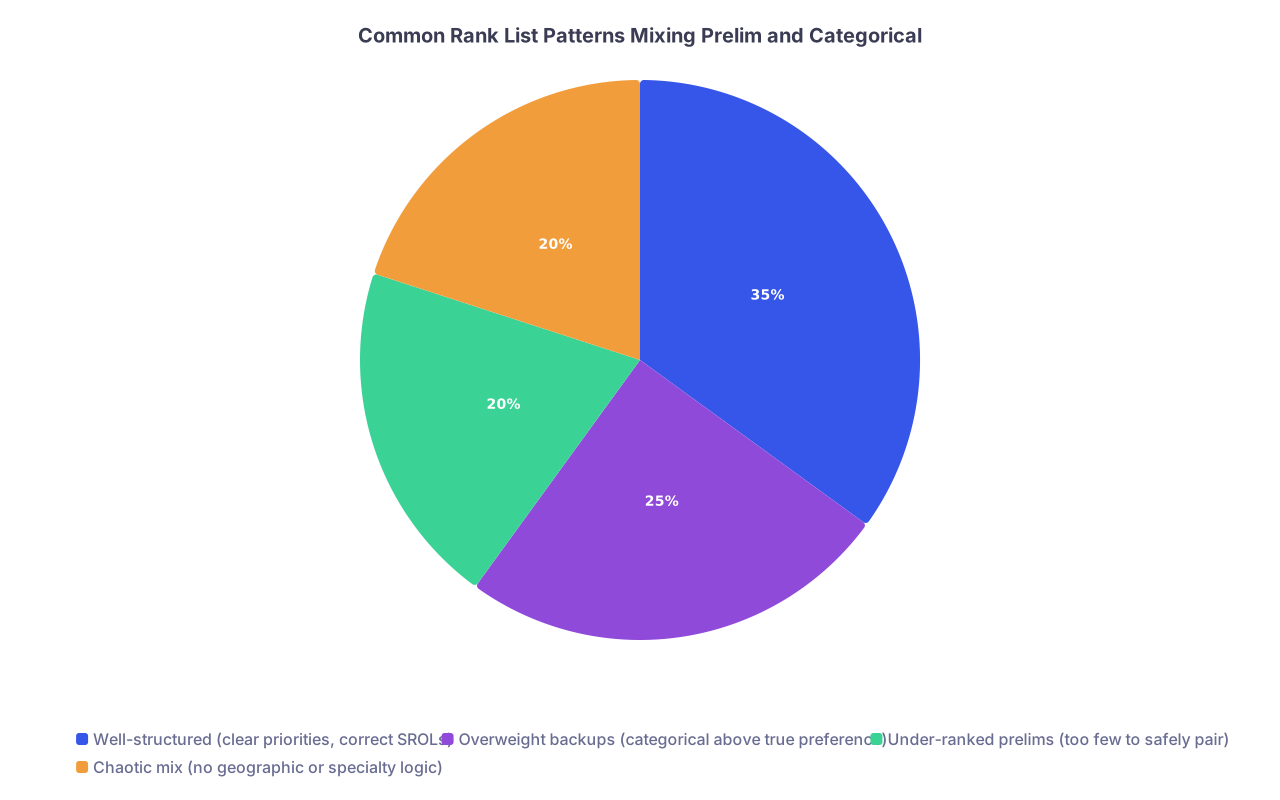
To give you a sense of how often people skew their ranks in risky ways, imagine a rough breakdown like this (these are illustrative, not official NRMP data):
| Category | Value |
|---|---|
| Well-structured (clear priorities, correct SROLs) | 35 |
| Overweight backups (categorical above true preference) | 25 |
| Under-ranked prelims (too few to safely pair) | 20 |
| Chaotic mix (no geographic or specialty logic) | 20 |
You want to be in that first slice. People in the other three categories are usually the ones writing regret posts later.
Mistake #10: Letting Other People’s Anxiety Rewrite Your Priorities
Final trap: committee by group chat.
You will get advice from:
- Seniors who matched 5 years ago under slightly different rules
- Residents in your specialty who never had to juggle prelim years
- Classmates who read one SDN thread at 2 a.m. and now think they are experts
If you let their fear override your own rational preferences, you will build someone else’s rank list.
I have watched applicants who knew they did not want to move twice, or who hated pure medicine prelims, gradually talk themselves into ranking multiple medicine prelims across the country as “backups” because everyone else was doing it.
There is a line between prudent backup planning and self-betrayal. Crossing it is how people end up in programs they resent from Day 1.
Your rank list is a statement of what you genuinely prefer among realistic outcomes. Not what a terrified group text thread prefers.
One More Structural View: How to Pair Things Safely
If you like seeing the structure laid out, here is how a safer mixed list tends to look conceptually (simplified):
| Main Rank Position | Type | What Happens Next |
|---|---|---|
| #1 | Advanced A | Goes to SROL A for prelim options |
| #2 | Advanced B | Goes to SROL B for prelim options |
| #3 | Advanced C | Goes to SROL C for prelim options |
| #4 | Categorical X | Match complete if reached |
| #5 | Categorical Y | Match complete if reached |
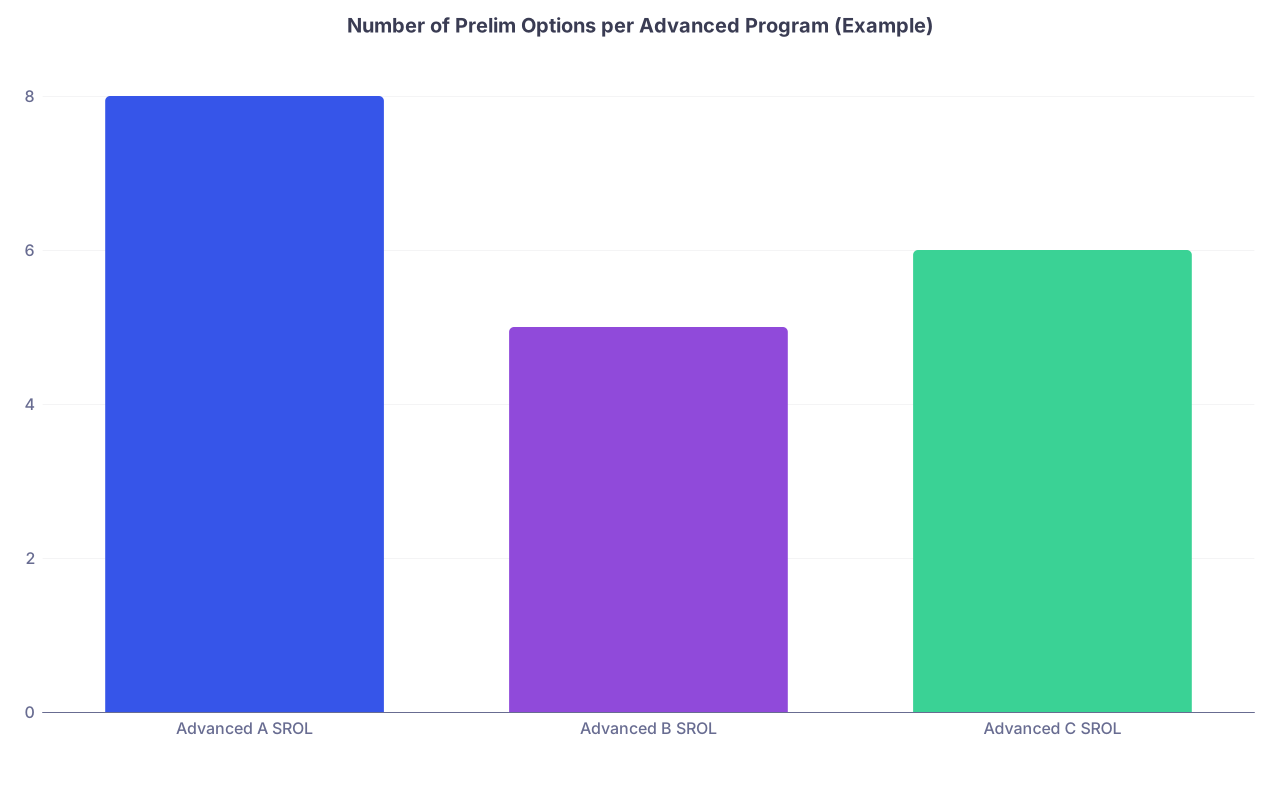
And for each advanced program (A, B, C), their SROLs might look like:
| Category | Value |
|---|---|
| Advanced A SROL | 8 |
| Advanced B SROL | 5 |
| Advanced C SROL | 6 |
Enough depth to be realistic. Not so many random programs that you ignore quality and fit.
Your Very Next Step (Do This Today)
Do not just “remember” this. Use it.
Open your NRMP account or your rank list spreadsheet right now and do one concrete thing:
Mark every program on your list with one of three labels: C (categorical), P (prelim), A (advanced).
Then, for every “A” on that list, write — in plain language — which prelims you are willing to pair it with and in what order.
If you cannot do that easily for even one advanced program, you have work to do before you certify.


