

The most common bad rank list I see is not incompetent. It is hijacked by family pressure.
The Mistake: Turning Your Rank List Into a Family Project
Let me be blunt: if your rank list reflects your parents’ anxiety more than your own judgment, you are playing roulette with the next 3–7 years of your life.
Not theirs. Yours.
I have watched smart, capable applicants:
- Rank a toxic program #1 because it is “20 minutes from mom.”
- Drop their best academic fit because “grandma will be devastated if you move.”
- Choose a city they hate because a partner threatened to break up if they moved.
Six months later, those same people are calling co-residents at 2 a.m. saying, “I made a huge mistake. I knew I didn't want this program.”
They did not listen to themselves. They listened to pressure.
You can care about family. You should. But outsourcing the core decision about where you will train is a serious, avoidable error.
Here is how that mistake happens—and the boundaries you need to set now before you submit your list.
How Family Pressure Quietly Rewrites Your Priorities
, Wrong specialty interest](https://cdn.residencyadvisor.com/images/articles_svg/chart-main-drivers-of-rank-list-regret-6340.svg "Main Drivers Of Rank List Regret")
| Category | Value |
|---|---|
| Family pressure | 40 |
| Lifestyle misfit | 25 |
| [Program culture](https://residencyadvisor.com/resources/residency-ranking-strategy/ignoring-program-culture-fit-the-rank-list-mistake-youll-regret-pgy1) | 25 |
| Wrong specialty interest | 10 |
People imagine rank list mistakes are about misjudging program “prestige” or case volume. No. The most emotionally destructive ones are about ignoring your own needs.
Family pressure usually sneaks in through a few predictable doors.
1. The “Good Child” Trap
You hear:
- “After everything we sacrificed, you’re leaving us?”
- “We thought you wanted to stay close.”
- “Your cousin stayed near home and she’s doing fine.”
This is not information. This is guilt.
The trap is subtle. You start adjusting your list “just a little”:
- You bump the local mediocre program up a couple of spots.
- You drop the far-away academic powerhouse a couple of spots.
- You tell yourself, “They are all decent; does the order really matter that much?”
Yes, the order matters. Once you start sliding programs around to manage someone else’s feelings, the logic of your list degrades rapidly.
2. The “Emergency Backup Caregiver” Myth
You tell yourself:
“I need to be close in case something happens to my parents.”
I have heard this line from dozens of applicants. Here is what they often discover:
- Residency gives you very little flexibility to act as a dependable caregiver.
- Being 30 minutes away vs. 3 hours away matters less than your schedule and call burden.
- A malignant program in your hometown will make you useless to everyone, including your family.
Choosing a bad training environment so you can theoretically help in a crisis is like buying a car you hate because it is closer to the mechanic. Backwards.
If your parents’ health is already fragile, you need a real plan (support network, finances, home health, siblings’ roles), not magical thinking that “being nearby” fixes everything.
3. The Partner Ultimatum
Another classic:
“If we cannot stay in this city, I do not know if this relationship will work.”
If your partner has never experienced residency, they often wildly underestimate what you are signing up for. I have seen people:
- Choose a geographically convenient program that is clinically weak.
- Give up on their top specialty fit to stay in one city.
- Ignore their own gut because “we agreed we wouldn’t do long distance.”
Result? Two years later:
- They break up anyway.
- You are stuck in a program that never fit you in the first place.
A relationship that demands you sabotage your training is already waving a red flag. Strong relationships can negotiate distance and sacrifice. Fragile ones hide behind ultimatums.
What You Actually Control: A Reality Check

Before you start trying to keep everyone happy, you need to be crystal clear on one thing: what you do and do not control.
You control:
- The honest ranking of programs in your true order of preference.
- Whether you gather real data (resident experiences, case logs, call schedules).
- How much access to your decision-making process you give to other people.
- Whether you present your rank list as a negotiation or as a final decision.
You do not control:
- Where you match once you submit that list.
- Your parents’ or partner’s feelings about your choice.
- Whether extended family “understands” medical training.
- Whether relatives see your decision as “ungrateful.”
Stop trying to control other people’s emotional reactions. That is the fastest way to corrupt your own judgment.
The Match algorithm is designed on a brutal principle: it acts on your preferences, not your parents’. If your true preferences are buried under other people’s expectations, the algorithm cannot save you.
Boundary #1: Decide First, Then Share (Not the Other Way Around)
The biggest process mistake I see is this: people workshop their rank list with family before they have a stable internal version.
So the list is still wet cement. And they invite people to stomp all over it.
Flip the sequence.

| Step | Description |
|---|---|
| Step 1 | Program Research |
| Step 2 | Personal Draft List |
| Step 3 | Refine With Mentors |
| Step 4 | Finalize Internal List |
| Step 5 | Optionally Share With Family |
| Step 6 | Family Edits Core Priorities |
| Step 7 | Confused, Compromised List |
| Step 8 | Healthy Path? |
You want your list to be mostly final before it meets your family’s opinions. That means:
- Research programs.
- Rank them based on:
- Fit with your learning needs.
- Program culture.
- Career goals.
- Reasonable lifestyle factors.
- Stress-test the list with mentors and residents, not relatives.
- Then, if you want, present a near-final list to family as a decision, not an invitation to design your life.
The key line you must avoid:
“What do you think I should do?”
Once you ask that, do not be surprised when they answer strongly. And then you feel pressured to obey.
Boundary #2: Define “Non‑Negotiables” And Communicate Them Clearly
You need a short, explicit list of what is not up for debate. Otherwise, every conversation turns into open season on your priorities.
Common non‑negotiables I have seen residents use:
- “I will not rank programs that have a reputation for malignant culture.”
- “I will not choose a program with inadequate training in my chosen fellowship path.”
- “I will prioritize my safety and mental health over proximity.”
- “I will not rank any program highly solely because it is close to home.”
Write your own list. Three to five items. Short and brutal.
Then communicate them to your family directly:
“Before we talk about where I might match, I want you to know my ground rules. I am not going to choose a program that is unsafe, malignant, or weak in my field, even if it is closer to home. Training quality and my well‑being come first.”
You are not asking for agreement. You are stating terms.
That one move alone filters out a lot of manipulative commentary.
Boundary #3: Separate Information From Pressure
Family can actually be helpful—when they stick to facts. The problem is when they slip into fear, obligation, or judgment.
Your job is to separate:
Useful information:
“Rent is much higher in City A than City B.”
“We could visit twice a year if you are in City C.”Pressure and guilt:
“If you move that far, you will never see your grandparents again.”
“We sacrificed everything and now you abandon us?”
You want to invite the first and shut down the second.
Lines you can use:
- “I appreciate concrete information. But I am not going to make this decision based on guilt or fear.”
- “That sounds like you are afraid of losing contact. Let us talk about how we will stay close, not about changing my rank list.”
- “I hear that you are sad about the idea of me being far away. I am sad too. I am still prioritizing my training.”
Do not defend endlessly. A short, firm response is enough.
Boundary #4: Protect The Actual Mechanics Of The List
Here is a mistake that seems small but is extremely corrosive: letting people see your entire rank order and comment line‑by‑line.
You do not need to show them the full list.
| Approach | Risk Level |
|---|---|
| Share general regions you ranked (e.g., West Coast, Midwest) | Low |
| Share 2–3 likely cities without numbers | Low |
| Share top 3 programs only, already finalized | Medium |
| Let family see and edit full rank list before submission | Very High |
| Ask family to help decide between programs you barely know | High |
Protect the mechanics:
- Keep the exact order mostly private.
- If you share anything, share categories:
- “I have several strong options in the Northeast, one in the Midwest, a couple in the South.”
- Share the “why,” not the “what number”:
- “Program X has outstanding mentorship for the fellowship I want.”
If you do show a portion of the list, present it as final:
“I wanted you to see my decision, not to negotiate it. These are my top choices, in this order.”
Not:
“What do you think of this order?”
Boundary #5: Do Not Fabricate “Compromise” That Actually Hurts You
I see applicants invent fake compromises:
- They rank their true #1 program lower to “show” their family they tried.
- They move a hometown program artificially high “just in case it makes them feel better.”
- They keep an obviously malignant local program on the list as a “peace offering.”
This is not compromise. This is self‑sabotage.
The only “compromise” that matters in the Match is the literal list you submit. You are not brainstorming preferences; you are building a binding contract that can lock you into a bad environment for years.
Real compromise looks like:
- More frequent visits or FaceTime.
- Planning extended stays during elective months.
- Negotiating long‑distance logistics with a partner.
- Asking siblings to share more responsibility for aging parents.
Fake compromise is quietly rearranging your list and pretending the training cost is minor.
When relatives say, “Can you just bump the local program a little higher?” what they are really saying is, “Risk your career and mental health a little more for my comfort.”
You need to be willing to say no.
If You Are The First Doctor In The Family
First‑gen physicians are especially vulnerable here. Your family often has:
- No realistic understanding of residency hours or stress.
- Inflated expectations about income, prestige, and flexibility.
- Deep emotional investment in the story of “we raised a doctor.”
So when you say, “I might move across the country for training,” they hear:
- “I am leaving you for good.”
- “Your sacrifices do not matter to me.”
- “I am becoming someone you do not recognize.”
You cannot fix all of that. But you can educate just enough to reduce panic.
Explain plainly:
- “Residency is a fixed training period, usually 3–7 years. It is not permanent.”
- “My schedule will be extremely intense. Being near you physically does not mean I will be free to help as much as you imagine.”
- “Choosing strong training now protects my ability to be stable and helpful later.”
You may still get tears, anger, or silence. That does not mean your decision is wrong. It means they are going through their own adjustment.
Do not mistake their discomfort for evidence you should sacrifice your training.
Watch For These Red‑Flag Phrases
If you start hearing these, you are in the danger zone:
- “We did not do all this for you to just leave us.”
- “Any good child would stay close.”
- “If you cared about us, you would rank here first.”
- “Your career is important, but family is more important.”
- “Why even have a family if you are just going to be gone?”
These are not thoughtful concerns. These are emotional weapons.
Your response does not need to be dramatic. Something like:
“I am not going to make my rank list based on guilt. I love you, and I am still choosing the best place for my training. Both can be true.”
Then exit the conversation if it continues in circles.
A Simple Pre‑Submission Checklist
Right before you certify your list, ask these questions alone, not in a group chat:
- If nobody else had an opinion, would this still be my order?
- Did I move any program up or down purely to reduce conflict with family or a partner?
- Am I keeping any clearly bad‑fit program on my list as an emotional concession?
- Does my top choice reflect where I honestly want to train, or where people want me to say I want to train?
- If I matched at each program on my list, could I look myself in the mirror and say, “I chose this” rather than “they chose this for me”?
If your answers reveal that your list is contaminated by pressure, you still have time to fix it—until you hit “certify.”
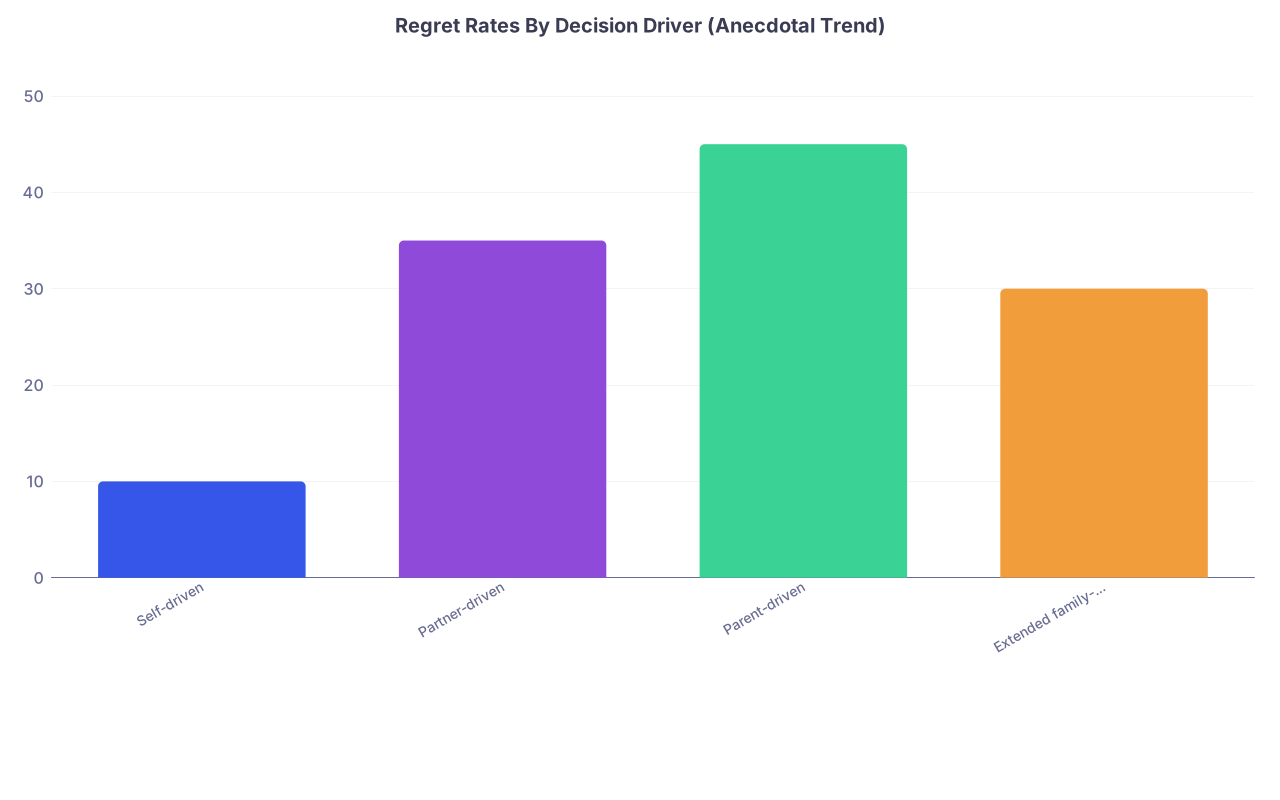
| Category | Value |
|---|---|
| Self-driven | 10 |
| Partner-driven | 35 |
| Parent-driven | 45 |
| Extended family-driven | 30 |
I have watched over years: people whose rank lists were truly self-driven still have stress, but much less regret. The ones who let family run the show often carry a quiet resentment that leaks into everything.
Your Life, Your Call
Family pressure in the residency match is not a side issue. It is one of the biggest hidden threats to a sane, coherent rank list.
You are not just picking a city. You are picking:
- Who trains you.
- How you are treated when you make mistakes at 3 a.m.
- Whether you burn out or grow.
The people who love you most do not always understand that. They see their loss, not your reality.
Your job is not to prove you are grateful. Your job is to choose well, so you actually survive and thrive long enough to pay that gratitude forward.
Set the boundaries now. Decide first. Protect your list. Let other people have their feelings without letting them own your future.
FAQs
How much should geography for family actually matter in my rank list?
It can be one factor, but it must not override core training quality and program culture. Being near family is useful when the program is at least a reasonable fit. It becomes dangerous when you start justifying clear red flags—malignant leadership, poor education, miserable residents—simply because it is “close to home.” A good rule: only let geography break ties between already solid options, not redeem a clearly inferior one.
What if my parents are financially supporting me and threaten to pull help if I move away?
That is coercion, not support. You may need to plan for financial independence sooner—budgeting tightly, taking on more loans, or reducing lifestyle expectations. Mentors, financial aid offices, and even social workers can help you brainstorm alternatives. Trading away your training environment for short‑term financial comfort usually backfires; a damaged career is much more expensive than higher loan balances.
How do I handle a partner who absolutely refuses to consider long distance?
You have to decide which is non‑negotiable: your training needs or their demand. Start with a clear conversation about what residency actually looks like—hours, stress, limited flexibility—and why a strong program matters. Explore options: couples match where feasible, aiming for the same region, time‑limited distance with specific visit plans. If, after that, your partner still insists you choose geography over your own judgment, you are not choosing between “relationship vs selfishness.” You are choosing between a sustainable career and appeasing someone who does not respect what you are facing. That is a hard truth, but it is better faced before you lock in your rank list.


