

It’s late January. Your interview season is basically done. Two programs rise to the top of your mind, and every time you try to rank one over the other, your cursor just hovers. You flip them. Then flip them back. You start imagining “what if I regret this for the next 3–7 years?”
Here’s how you stop spinning and make a clear, defensible choice.
Step 1: Admit They Are Not Actually Equal
They feel equal. They are not equal.
I’ve watched students swear two programs were “identical” and then, when pushed, say things like:
- “Well, Program A definitely seemed happier.”
- “Program B’s fellowship match was stronger.”
- “I kind of hated the city for Program A, but the training seemed great.”
Equal is usually code for: “I have not forced myself to choose what matters most.”
So first, accept this: you’re not choosing between “good vs bad.” You’re choosing between “good vs good.” That makes it emotionally harder, but intellectually simpler. Your job now is to:
- Pick your top 2–3 primary decision criteria.
- Score each program only on those.
- Tolerate the discomfort of not optimizing every single variable.
If you try to optimize everything, you’ll optimize nothing.
Step 2: Define Your Top 3 Priorities (Not 15)
You probably have a messy list in your head: location, prestige, call schedule, fellowship, partner job, family, cost of living, wellness, etc.
That’s too much. For a tie-break, you need three.
Here’s a simple exercise that works:
Write down all the things you care about. Then ask, for each item:
“If Program X was amazing in every other way but weak on this one thing, would I still be okay going there?”
If the answer is “yes,” cross it off. What survives this test becomes your real filter.
Common top-3 sets I see:
Long-term academic career:
- Fellowship/placement track record
- Research mentorship and protected time
- Name recognition in your niche (not generic “prestige”)
Lifestyle & well-being focused:
- Culture and resident happiness
- City fit (support system, partner, kids, cost of living)
- Schedule realities (call, nights, commute)
Still undecided on long-term plans:
- Broad, solid clinical training
- Mentor richness (multiple attendings you could see yourself emulating)
- Flexibility (electives, moonlighting, diverse alumni paths)
Once you’ve got your three, everything else is noise for purposes of choosing #1 vs #2.
Step 3: Turn “Vibes” Into Harder Data
You’re not ranking vibes. You’re ranking programs.
Take your two programs and build a quick comparison. Something like this:
| Factor | Program A | Program B |
|---|---|---|
| Resident happiness (your sense) | 8/10 | 9/10 |
| Fellowship outcomes in your area | Strong | Excellent |
| City fit for you/partner/family | 7/10 | 9/10 |
| Call schedule (PGY-2) | Q4 | Q3 |
| Cost of living | Medium | High |
Then, weight according to your top three priorities.
For example, if you care most about:
- City fit, 2) Resident culture, 3) Fellowship placement
You might mentally assign:
- City fit – 40%
- Culture – 35%
- Fellowship – 25%
Do you need an actual spreadsheet? Sometimes yes. I’ve watched very rational people stare at a simple weighted score and finally say, “Fine. B comes out ahead. I just didn’t want to admit it.”
If the numbers pull clearly one way, respect that.
Step 4: Pressure-Test the Decision with Two Questions
Now you have an initial lean. Time to stress-test it with two simple questions:
Question 1: “If I don’t match at this #1, how will I feel?”
Imagine you rank Program A first, B second.
If you match at B, will you think:
- “Honestly, I’m okay with that. I liked B a lot.”
or - “Damn. I really wanted A. I might always wonder.”
Your emotional regret forecast is a legitimate data point. Not the only one. But if your brain screams one way here, listen.
Question 2: “If both programs were in the same city, which would I pick?”
Strip out the location noise, just for a moment.
If both programs were across the street from each other, which would you choose based on:
- Faculty and mentorship
- Residents you’d be working with
- Clinical training structure
- Support and culture
If the answer is immediate but uncomfortable (“I’d pick the one in the city I like less…”), then at least you’ve clarified what you’re trading: environment vs training.
You’re allowed to choose either. Just do it knowingly.
Step 5: Look Hard at Resident Happiness and Culture
People underweight this. Then regret it.
I’ve seen ultra “prestige-focused” students end up in:
- Malignant cultures where yelling is normalized.
- Programs with chronic understaffing and no backup on bad nights.
- Places where PGY-3s say things like, “No one here knows I have a kid.”
Red flags from interview day and socials often come back to haunt people. Ask yourself:
- Did residents seem genuinely relaxed or just “on message”?
- Did anyone complain in a real, honest way you could relate to — or was it cult-level positivity?
- When you asked, “What would you change about the program?” did you get a real answer?
If one program’s residents felt like “my people” and the other felt stiff, that’s not trivial. Your peers shape your daily life way more than the name on the badge.

Step 6: Brutally Honest Reality Check on Location
You don't need to pretend location doesn’t matter. It does. A lot.
Ask yourself:
- Do I have a partner whose career is tied to one specific place?
- Do I have kids or dependents who will be massively affected by cost of living / proximity to family?
- Is there a city where I know my mental health will be significantly worse? (Social isolation, weather, politics, whatever actually matters to you.)
If you’re 50/50 on training quality, and one city gives you:
- Built-in support system
- Cheaper rent and easier life
- A partner who isn’t miserable or unemployed
Then choosing that program isn’t “selling out.” It’s smart. Burnout doesn’t care how good the fellowship match list looked on paper.
Step 7: Clarify Your Career Direction — Enough to Choose
You don’t need a 20-year plan. You do need a rough direction.
Different goals change the tie-breaker:
If you’re aiming for a hyper-competitive fellowship (Derm, Ortho, GI, Cards, etc.):
Fellowship match lists, PD support, research infrastructure, and reputation in that subspecialty matter more. I’ve watched people who were “probably” academic end up very grateful they picked the place that regularly sends residents to major fellowships.If you’re leaning community practice:
You want a program that turns out confident, autonomous graduates who aren’t dependent on a tertiary center for every decision. High volume. Bread-and-butter cases. Attendings who actually let you run the list as a senior.If you’re truly unsure:
Pick the place that maximizes your optionality. That usually means strong general training, diverse alumni careers, and flexible electives, not necessarily the biggest brand name.
When you line these up against your two programs, one usually pulls ahead.
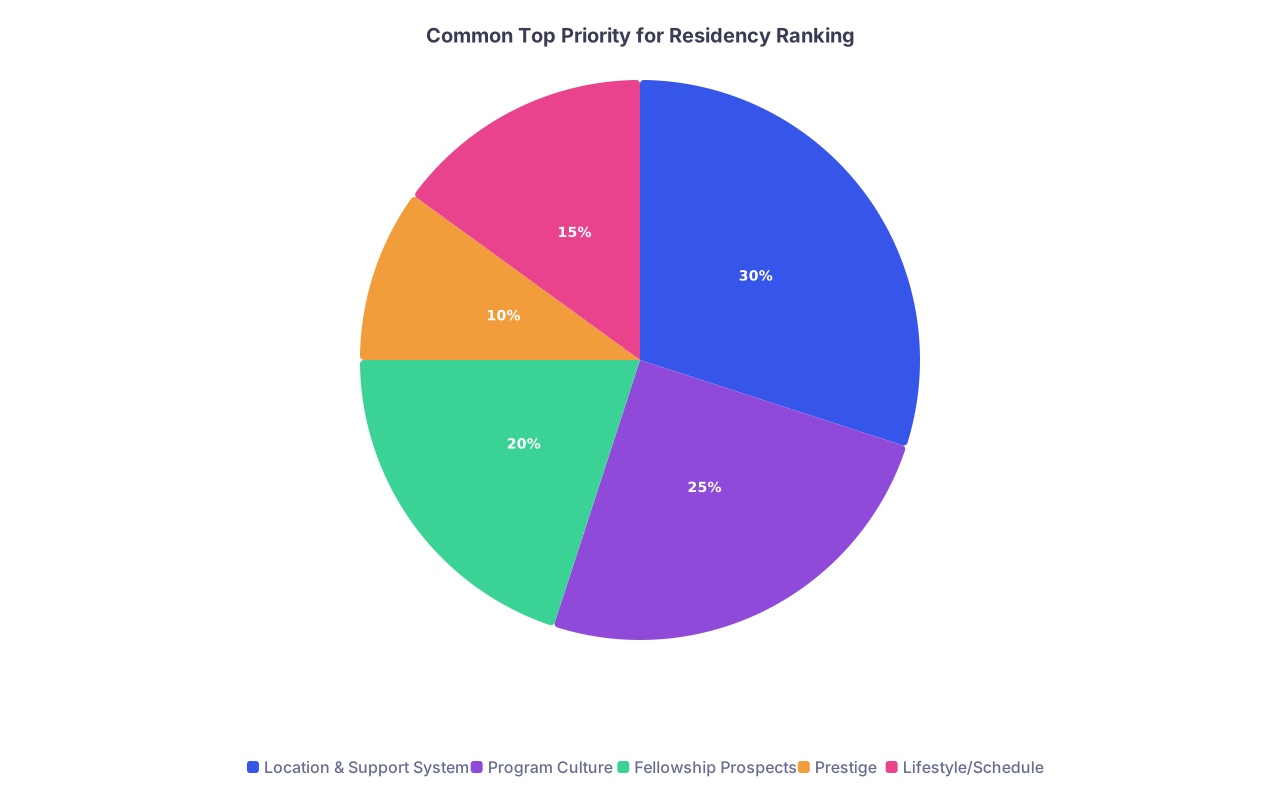
| Category | Value |
|---|---|
| Location & Support System | 30 |
| Program Culture | 25 |
| Fellowship Prospects | 20 |
| Prestige | 10 |
| Lifestyle/Schedule | 15 |
Step 8: Use a Simple Tie-Break Framework (If You’re Still Stuck)
If you’ve done all this and it still feels tied, use this hierarchy to break it:
- Resident culture and support (do you feel safe and backed up?)
- Clinical training quality (will you be competent and confident?)
- Long-term career alignment (fellowships, research, breadth)
- Location and life outside the hospital
- Prestige/name
If two programs are equal on the first three (rare) and differ on 4–5, go with the place you see yourself actually living, not the one you think impresses people more at parties.
If everything on that list feels equal, then blunt answer: either is fine, flip a coin, and commit emotionally. You’re over-optimizing a decision where both outcomes are good.
Step 9: Sanity-Check with One Outside Person (Not Ten)
Going down the opinion rabbit hole is how you end up more confused.
Pick one trusted person who knows you and the specialty:
- A mentor in your field who actually listens, not just projects their own choices.
- Or a senior resident/fellow you clicked with at one of the programs.
Ask a very specific question:
“Given what you know about me and these two options, is there one you’d lean toward — and why?”
The “why” matters more than their final answer. You’re not outsourcing the decision. You’re checking that you’re not missing a glaring future consideration.
If four different random attendings give four different answers, that’s normal. It means the choice is actually close — not that you’re about to ruin your life.

| Step | Description |
|---|---|
| Step 1 | Two Programs Feel Equal |
| Step 2 | Define Top 3 Priorities |
| Step 3 | Compare Programs on Those Only |
| Step 4 | Rank That #1 |
| Step 5 | Pressure-Test with Regret & Same-City Questions |
| Step 6 | Weigh Culture, Location, Career Direction |
| Step 7 | Either is Fine: Choose & Commit |
| Step 8 | Clear Winner? |
| Step 9 | Still Tied? |
| Step 10 | Still Truly Equal? |
Step 10: Once You Decide, Stop Re-Deciding
At some point, you pick.
When you do, stop re-running the simulation every night. That’s just self-inflicted stress. You’re not going to “logic” your way into certainty; that’s not how future life decisions work.
A few rules once you set your #1:
- Do not keep polling people. You’ll just collect contradictory input.
- Do not stalk Reddit/SDN threads about “Which is better: X or Y?” They don’t know your life.
- Do not rewrite your rank list every 48 hours. NRMP lets you change it. That doesn’t mean you should.
You made a structured, thoughtful decision. That already puts you ahead of most applicants, who rank based on vague prestige and weird interview “vibes” alone.

Quick Example: Walking It Through
You’re choosing between:
- Program A: Mid-sized city, strong name, brutal call but wild clinical volume, residents seemed tired but proud, excellent fellowship matches.
- Program B: Smaller name, big city near your family, residents seemed happy, schedule more humane, fellowship matches solid but not flashy.
Your top priorities (after actually sitting down and thinking):
- Resident culture and support
- Proximity to family/support system
- Reasonable path to a solid fellowship (but not necessarily top 5)
You score them:
- Culture: A = 6/10, B = 9/10
- Support system: A = 5/10, B = 10/10
- Fellowship prospects: A = 9/10, B = 7.5/10
Weighted, B probably wins for you. Yes, A looks stronger on paper. But for the person you are, and the life you want, B is the better #1.
Rational people pick B in that scenario and do very well. I’ve seen it repeatedly.
FAQ (Exactly 6 Questions)
1. Should I email programs to “express strong interest” or “tell them they’re my #1”?
No. NRMP is very clear about not making commitments or asking for them. Telling multiple programs they’re your #1 is dishonest and pointless. Rank in your true order of preference. If you genuinely want to send a brief thank-you/update because something has changed, fine — but do not treat this like college admissions yield protection. The Match algorithm favors the applicant’s preferences, not who you email.
2. How much should prestige matter if two programs seem equal?
Less than most students think. Prestige is a noisy proxy for a few real things: research, subspecialty visibility, certain fellowship doors opening a bit easier. If you’re dead set on a very competitive academic path, then yes, it should be in the conversation. But prestige should almost never outrank resident culture, city fit, and whether you’ll actually survive and grow for 3–7 years. A “less famous” place where you thrive will beat a big name where you’re miserable.
3. What if my gut and my logical analysis disagree?
You listen to both, but you don’t mindlessly obey either. If your analysis says Program A is better for your top priorities but your gut keeps pulling toward B, ask: is my gut reacting to something real (like how I felt around the residents) or something shallow (like being dazzled by a fancy hospital atrium)? If, after picking it apart, your gut is pointing to a real, durable factor (like family support), I’d give that a lot of weight.
4. How much should I care about fellowship match lists?
Care about patterns, not one flashy year. Look at 3–5 years if possible. Do they regularly send people into the fellowships or practice types you might want? Are those outcomes for “superstars only” or fairly typical seniors? If you’re undecided on fellowship, all you really need is: do residents from here get solid fellowships when they want them, and do others land good jobs without fellowship? That level of match data matters; obsessing over “no one matched MGH Cards in the last 2 years” usually doesn’t.
5. What if I truly, honestly would be thrilled with either program?
Then say that out loud and believe it: you cannot screw this up. Put one #1 and the other #2, maybe after a coin flip where you secretly root for a side. If even after the flip you don’t care which wins, that’s your answer: both are genuinely good fits. The Match is not a trap designed to expose the “wrong” choice; it’s a sorting mechanism. When both outcomes are good, you don’t need a perfect answer, just a final one.
6. Is it risky to rank a “reach” program #1 over a safer but still good option?
No. That’s not how the algorithm works. You should rank programs in the exact order you want them, regardless of how “competitive” they feel. If your “reach” program doesn’t rank you highly, the algorithm just moves down your list to the next one. You do not lose your chance at Program B by ranking Program A higher. The only time this becomes an issue is if your #1 is a terrible fit for you personally, not because it’s too “strong” a program.
Bottom Line
Two programs feel equal because both are good, not because the choice doesn’t matter.
Force yourself to pick your real priorities, turn vibes into structure, and then make a clean call.
Once you’ve chosen your #1, stop re-deciding. Your energy is better spent finishing strong in medical school and walking into July ready to learn, not still second-guessing a decision you already made well.


