

You’re staring at your rank list. Two columns pulled up: “Lifestyle / Vibes” on one side, “Fellowship Match” on the other. You keep scrolling through program websites, PD emails, and unhelpful Reddit threads trying to answer one question:
“If I care most about getting a competitive fellowship, how should I rank these programs?”
Here’s the answer you’re actually looking for.
Step 1: Get Clear On What “Fellowship Opportunities” Really Means
Most people use “fellowship opportunities” as a vague buzz phrase. You cannot afford to be vague.
When you say you care most about fellowship, you usually mean one (or more) of these:
Matching into a competitive subspecialty
Think cards, GI, heme/onc, PCCM, interventional, certain surgical fellowships, derm path, etc.Matching at a top-tier academic institution
Even if your residency is mid-tier or community-based, you want doors open at name-brand places.Having options if you change your mind
Maybe you think it’s cards now, but you might pivot to hospitalist, heme/onc, or ICU.
You need to prioritize which of those matters most.
If your main goal is: “I want the highest probability of matching a competitive fellowship anywhere,” your ranking strategy is one thing.
If your goal is: “I want to do cards or GI at a top-10 academic place specifically,” your strategy is stricter and sometimes riskier.
Step 2: What Actually Predicts Strong Fellowship Outcomes
Most applicants obsess over the wrong metrics. Program “prestige” is not one thing. It’s a bundle of factors, and some matter much more for fellowship than others.
Here’s what actually moves the needle.

1. Fellowship Match Track Record (Real Data, Not Vibes)
If you care about fellowship, this is your starting point.
You want to know:
- How many residents each year apply to your target fellowship?
- How many match, and where?
- Are they matching into competitive programs or mainly local, less competitive spots?
Many programs publish recent fellowship match lists. If they do not, ask directly on interview day or via follow-up email:
- “For the last 3–5 graduating classes, where have residents matched for [cards/GI/etc.]?”
- “Of residents who applied to [subspecialty], what proportion typically match?”
If a program dodges this or gives only vague feel-good answers, that’s a red flag.
2. Strength of the Subspecialty Division You Care About
You’re not matching to “Internal Medicine” or “General Surgery” as a whole. You’re matching into a subspecialty run by a specific division.
You should ask:
- Are there in-house fellowships in your target field (cards, GI, ICU, etc.)?
- How many fellows do they take per year?
- Do they take their own residents regularly, or almost never?
- Is the division research-productive?
- Are there recognizable national names on faculty in that specialty?
Programs with strong in-house fellowships and a culture of taking their own residents give you an obvious path.
Programs with no in-house fellowship but great connections can still work well, but you’re relying heavily on letters and networking.
Step 3: The Real Ranking Hierarchy If Fellowship Is #1
Let me be blunt: if you truly care most about fellowship outcomes, your rank list should follow a pretty simple hierarchy.
| Rank Priority | Program Type | Fellowship Advantage |
|---|---|---|
| 1 | Strong academic, in-house fellowship, known match success | Highest |
| 2 | Solid academic or hybrid, some in-house, decent match lists | High |
| 3 | High-volume community with strong academic ties | Moderate |
| 4 | Pure community, variable exposure and letters | Lower |
| 5 | New/unknown programs, no track record | Risky |
Tier 1: Strong Academic + In-House Fellowship + Proven Track Record
These are your “maximize probability” options.
Characteristics:
- University-based or large academic affiliate
- Robust in-house fellowship in your target field
- Residents routinely matching cards/GI/onc/PCCM/etc.
- Strong research infrastructure and mentorship
If you’re dead-set on a competitive fellowship, these programs should sit at the top of your list, even if the city isn’t your favorite or the call schedule is rough.
Tier 2: Solid Academic or Hybrid Programs With Good Match Lists
Think strong regional academic centers, big university-affiliated community programs, VA-heavy hybrids.
They may not be household names nationally, but:
- They consistently send residents into good fellowships
- They have at least some in-house subspecialty fellowships
- They provide real research opportunities and mentorship
These can be excellent choices if top-tier university programs aren’t in reach or you’d rather live in a certain city.
Tier 3: High-Volume Community Programs With Good Connections
Some community programs produce excellent fellows because:
- They have very high clinical volume
- Faculty are well-connected (often trained at major centers)
- They give residents real responsibility and strong letters
But there’s more variability here. If you’re relying on this path, you need to be the top-performing resident, aggressively seek mentorship, and usually build your own research profile.
Tier 4–5: Pure Community, New, or Unknown Programs
Can you still match a good fellowship from here? Yes. People do it.
Is it harder? Also yes.
If fellowship is truly your highest priority, these should sit lower on your rank list unless you have strong personal reasons and a stomach for risk.
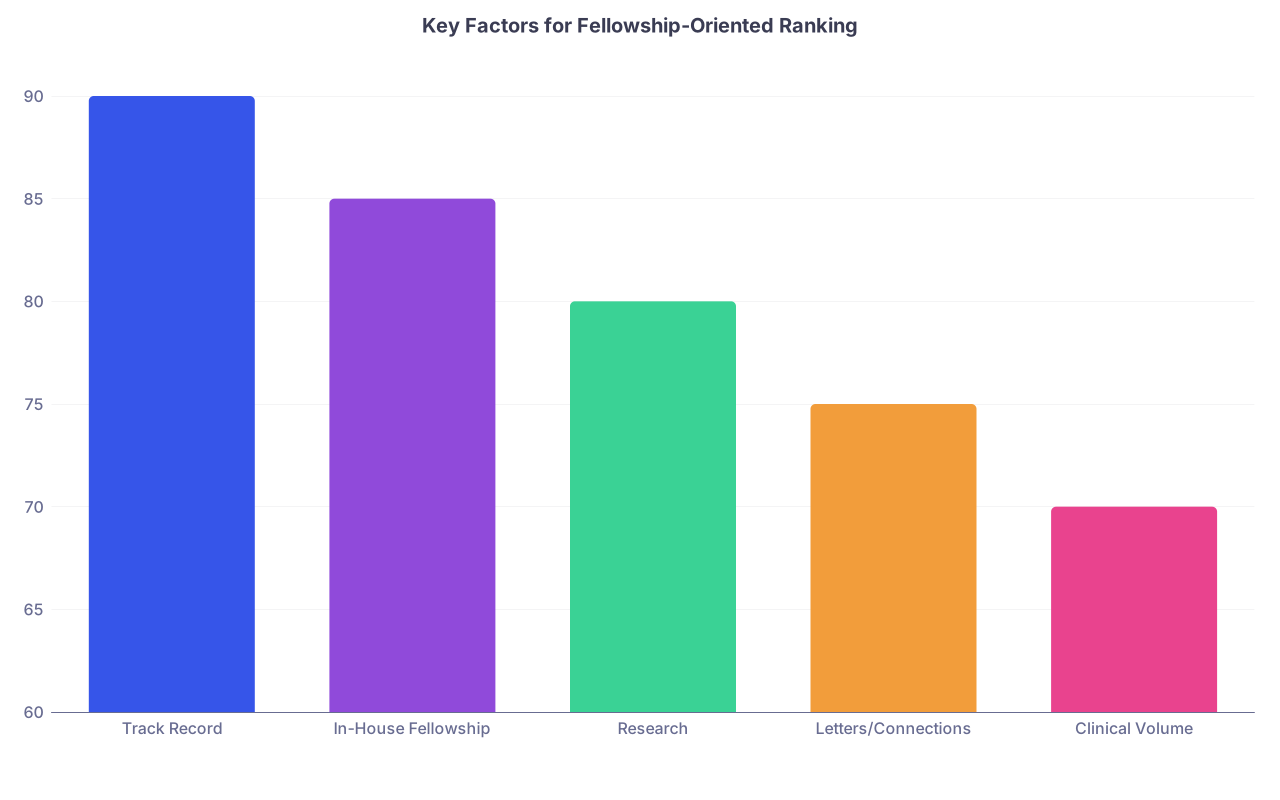
Step 4: Evaluating Programs Using a Fellowship-First Lens
Here’s how to actually compare programs A vs. B when you’re about to rank and your brain is fried.
| Category | Value |
|---|---|
| Track Record | 90 |
| In-House Fellowship | 85 |
| Research | 80 |
| Letters/Connections | 75 |
| Clinical Volume | 70 |
Use This Framework: The “Fellowship 5”
When you look at each program, score them (mentally) from 1–10 on:
- Fellowship match track record
- Strength and accessibility of in-house fellowship
- Availability and practicality of research
- Quality and clout of letters/connections
- Relevant clinical volume and autonomy
If Program A is an 8–10 on all five, it goes above Program B that’s a 5–7, even if B is in a cooler city or has better food stipends.
Red Flags If You Care About Fellowship
These should push a program down your list:
- No one can tell you where recent grads matched for subspecialty
- Very few residents pursue fellowship at all (unless that reflects preferences)
- Minimal or fake research (“Yeah you can totally do research here” with no actual projects, infrastructure, or mentors)
- Subspecialty attendings too overwhelmed to mentor
- Culture of “just get through residency” rather than professional development
Step 5: How Much Weight To Give Location, Lifestyle, and “Fit”
You still have to survive three to seven years. Misery helps no one match a fellowship.
Here’s the honest balance:
If your fellowship goal is extremely specific and competitive
(e.g., GI or cards at a top-20 academic center), you should accept some trade-offs in location and lifestyle for a clearly stronger program.If your goal is “any solid fellowship in this field”, you can allow lifestyle, support, and geographic preferences to break ties between programs with similar fellowship strength.
Concrete rule of thumb:
- If Program A is clearly one full tier above Program B in fellowship outcomes, rank A higher even if B feels slightly nicer lifestyle-wise.
- If they’re in the same tier, use lifestyle, support, and gut fit to break the tie.
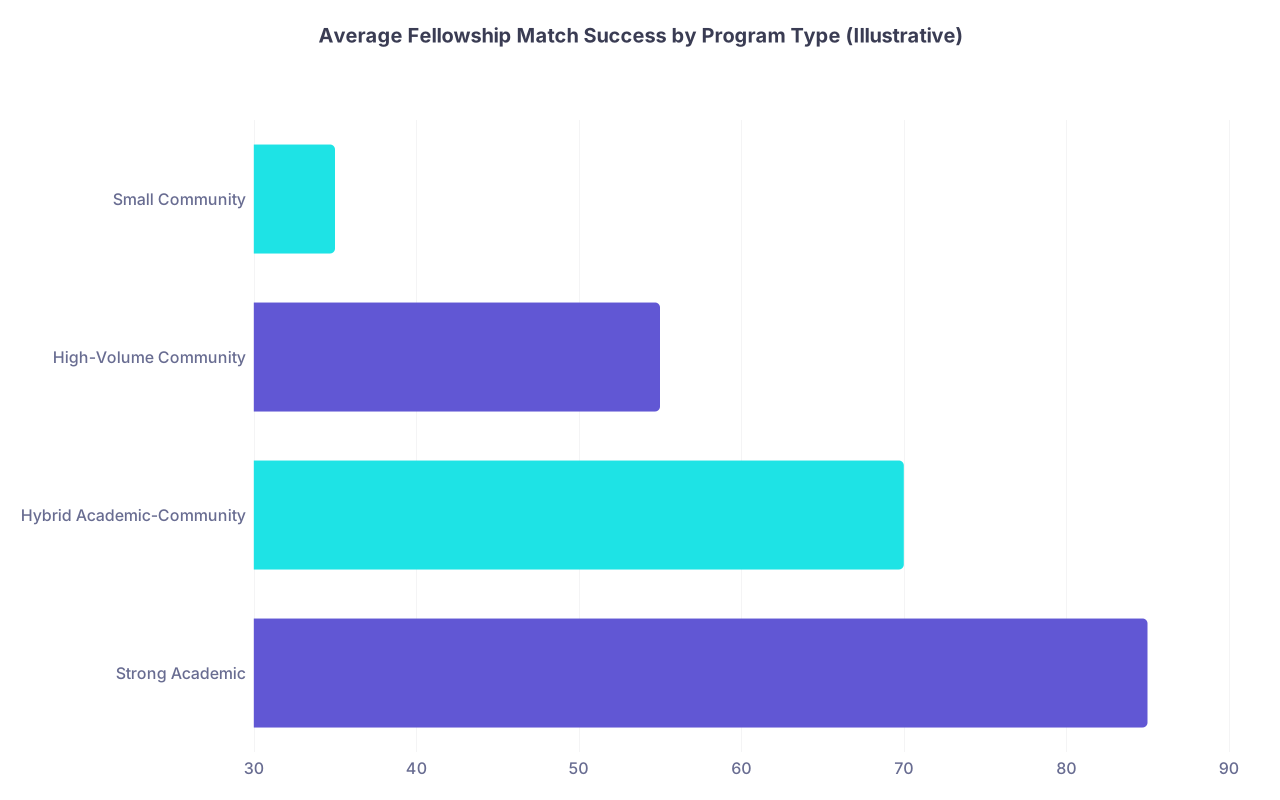
Step 6: Academic vs Community – What If I’m Split?
People over-simplify this: “Academic = fellowship, community = no fellowship.” That’s lazy thinking.
Here’s the real picture.
| Category | Value |
|---|---|
| Strong Academic | 85 |
| Hybrid Academic-Community | 70 |
| High-Volume Community | 55 |
| Small Community | 35 |
Academic Pros (for Fellowship)
- Built-in research
- More subspecialty faculty
- In-house fellowships (often)
- Name recognition
Academic Cons:
- You can be one of many fellowship-aspiring residents competing for the same letters and projects
- Some departments are so busy they don’t have time to mentor
Community Pros (for Fellowship)
- More opportunities to stand out clinically
- Closer relationships with attendings → stronger letters
- Sometimes surprisingly strong subspecialty connections
Community Cons:
- Often fewer structured research options
- May not have in-house, high-visibility fellowships
- Program name alone may not open doors; your performance must carry you
If you choose a community program but care deeply about fellowship, you must go in with a plan: be top tier clinically, aggressively seek mentors, and create your own research/visibility.
Step 7: How High to Rank Dream / Reach Programs
You’ll have some programs on your list where you think: “Fellowship outcomes are amazing, but will I be crushed here?”
Be realistic but not timid.
Rank “reach” programs above safer but clearly weaker programs if:
- You’re reasonably confident you can be middle-of-the-pack or better
- The fellowship pipeline is significantly better
- The culture does not sound malignant
However, if a program is known for a toxic environment, zero support, and everyone is burned out, that can hurt fellowship chances too. Burned-out residents don’t publish, don’t network, and sometimes barely survive.
So don’t confuse “hard-working and demanding” with “pathologic and malignant.” The former can be fine if you have support and structure. The latter undermines your actual goal.
Step 8: Practical Ranking Order Examples
Let’s walk through some common situations.

Scenario A: Cards-Oriented Applicant
Programs:
- Program 1: Big university, in-house cards fellowship, multiple residents to top-20 cards annually, high-volume CCU, strong research, medium lifestyle.
- Program 2: Nice mid-size university-affiliated community, one or two residents to cards each year, limited research, great location.
- Program 3: Pure community, very small number of residents have ever matched cards.
If you truly care most about cards fellowship:
Rank: 1 > 2 > 3.
Program 1 even if 2 is in your dream city.
Scenario B: Not 100% Sure on Fellowship vs Hospitalist, But Leaning
Programs:
- Program 1: Rigid, research-heavy academic center, somewhat unhappy residents, excellent GI/onc/cards match lists.
- Program 2: Solid hybrid program, reasonable research, strong mentorship, residents generally happy, decent but not spectacular match lists.
- Program 3: Cushy community program, very happy residents, almost no one does fellowship.
If you’re leaning fellowship but not locked in:
Rank: 1 vs 2 depends on your risk tolerance and personality.
If you can thrive in intensity and are okay with some pain for 3 years → 1 above 2.
If you worry you’ll shut down in a high-pressure environment → 2 might be the smarter long-game choice.
But 3 goes last if fellowship truly matters.
Step 9: What To Actually Ask Residents and Faculty
When you’re information-gathering, stop asking, “Is this a good program for fellowship?” Too vague. Everyone will say yes.
Ask:
- “How many residents in the last 3 years applied to [subspecialty], and how many matched?”
- “Where have people matched recently in [subspecialty]?”
- “Who are the main mentors for residents interested in [field]?”
- “How early can you get involved in research here?”
- “Does the [subspecialty] division typically take your own residents into fellowship?”
- “Are there residents who aimed for fellowship and didn’t match? What do you think made the difference?”
You’ll quickly sort programs that truly support fellowship from those that just talk about it.
Step 10: Final Filter – Your Likely Performance at Each Program
One more hard truth: your personal performance will matter more than the program label.
A mid-tier academic or hybrid program where you’re a top-25% resident with strong letters and 2–3 decent publications will likely set you up better than a hyper-elite name-brand where you’re invisible and exhausted.
So when you rank:
- Imagine yourself at each place. Where can you realistically excel?
- Where can you see yourself asking for letters without hesitation?
- Where do you believe you’ll actually do the research you keep promising yourself you’ll do?
That’s your final tiebreaker.

FAQ (Exactly 7 Questions)
1. Should I always rank the most “prestigious” program first if I care about fellowship?
No. Rank the program where you’re most likely to build a strong fellowship application: strong letters, meaningful research, solid clinical performance. Sometimes that’s the fanciest name. Sometimes it’s the slightly less famous place where you’ll stand out and be supported.
2. Is it possible to match a competitive fellowship from a pure community program?
Yes, but it’s harder and more dependent on you. You’ll need to be a top performer, hustle for mentorship, and often create or import research opportunities yourself. It’s doable; it’s just more work and more risk. If fellowship is your top priority, community-only programs should generally rank below strong academic/hybrid options.
3. How much does having an in-house fellowship matter?
A lot. In-house fellowships mean more exposure, easier networking, and a built-in path if they like you. Programs whose fellowships regularly take their own residents give you a major advantage. That said, strong residents at places without in-house fellowships can still match well externally, especially with good letters and research.
4. If a program doesn’t publish its fellowship match list, is that a bad sign?
Not automatically, but it’s a yellow flag. Some smaller or less web-savvy programs just don’t update websites. The key is how they respond when you ask. If they can tell you specific recent matches and seem proud of them, fine. If they stay vague or change the topic, assume the track record isn’t good.
5. How big a deal is research for fellowship?
For competitive fellowships—cards, GI, heme/onc, PCCM, advanced procedures—it matters a lot. You don’t need Nature papers, but you should have something: abstracts, posters, QI projects, retrospective studies. The more academic the fellowship you want, the more research matters. Programs that cannot realistically support any scholarly work are a real handicap.
6. What if I’m genuinely not sure I want a fellowship but I might?
Then you choose flexibility. Favor programs that have: (1) solid fellowship match history, (2) some research infrastructure, and (3) a resident-friendly culture. That way if you decide to chase fellowship, you can. And if you don’t, you’re not miserable for three years at a hyper-academic place you never needed.
7. Bottom line: what are the top 3 things I should prioritize when ranking for fellowship?
One: programs with a clear, recent track record of matching residents into your target fellowship. Two: strong subspecialty divisions (ideally with in-house fellowships) and accessible mentors. Three: an environment where you can realistically excel enough to earn standout letters and build a modest but solid scholarly portfolio.
Two key points and you’re done:
- Rank by fellowship outcomes and support, not just by name or vibes—track record, in-house fellowships, mentorship, and research access are your core filters.
- Put yourself where you can perform at your best; the “strongest” program on paper is useless if you’re too overwhelmed, invisible, or unsupported to build the application you need.


