

It’s mid-January. Your last interview just ended. You’ve got a notes file full of program names, faculty you met, random details about resident wellness and call rooms. Your group chat is buzzing about “thank-you email templates” and whether saying “you’re my #1” is a good idea.
And now you’re staring at a blank email draft, wondering the thing nobody answers honestly:
Does any of this actually move you up the rank list?
Let me tell you what really happens. Not the sanitized “professionalism matters” line. The actual way PDs, coordinators, and faculty use (and ignore) your emails when they build their lists in February.
The uncomfortable truth: emails rarely save you, but they can absolutely hurt you
Most applicants secretly believe one of two myths:
- Post‑interview emails don’t matter at all; or
- The right “I’ll rank you #1” love letter can rescue a mediocre interview.
Both are wrong.
Here’s what I’ve watched in real rank meetings:
A program director walks into the conference room with a spreadsheet of 80–200 applicants. Interview impressions and faculty scores are already there. Step scores, class rank, letters, all baked in.
Then there’s a tiny column labeled something like “Post‑int contact” or “TY / intent.” Three options, if anything:
- “TY” (sent reasonable thank you)
- blank (did nothing)
- “FLAG” (something off – weird, pushy, dishonest, unprofessional)
That column rarely makes someone. But it absolutely breaks a few.
You do not climb 40 slots because you sent a poetic thank-you. You can drop 40 slots because you sounded manipulative, spammed people, or lied about your intentions.
So the real game is this:
Use emails to avoid hurting yourself, and to slightly nudge where you fall inside a tier you’re already in.
Not glamorous. But that’s reality.
How programs actually track post‑interview contact
Let’s pull back the curtain.
Some programs literally print your emails and stick them in your folder. Some have the coordinator paste notes into the applicant’s ERAS file. Others don’t track anything at all beyond, “Yeah, they sent something decent.”
At a mid-tier IM program, the PD kept a very simple table:
| Applicant Tier | Email Behavior | Typical Effect |
|---|---|---|
| Top 20 | Normal thank-you | No change / tiny bump |
| Middle 60 | Thoughtful brief | Tie-breaker boost |
| Bottom 20 | Overly aggressive | Dropped or removed |
At a competitive surgical subspecialty I’ve seen something harsher: the PD literally had the coordinator mark any “problematic” emails with a red dot on the spreadsheet. During the rank meeting, anything with a red dot was either moved down or quietly cut.
No one is ranking you higher because you quoted their latest paper. But if you email three attendings and the PD and the chair with four variations of “you’re my #1,” people roll their eyes. Residents talk. That stuff reaches the PD.
What different specialties really care about
Different worlds, different expectations.
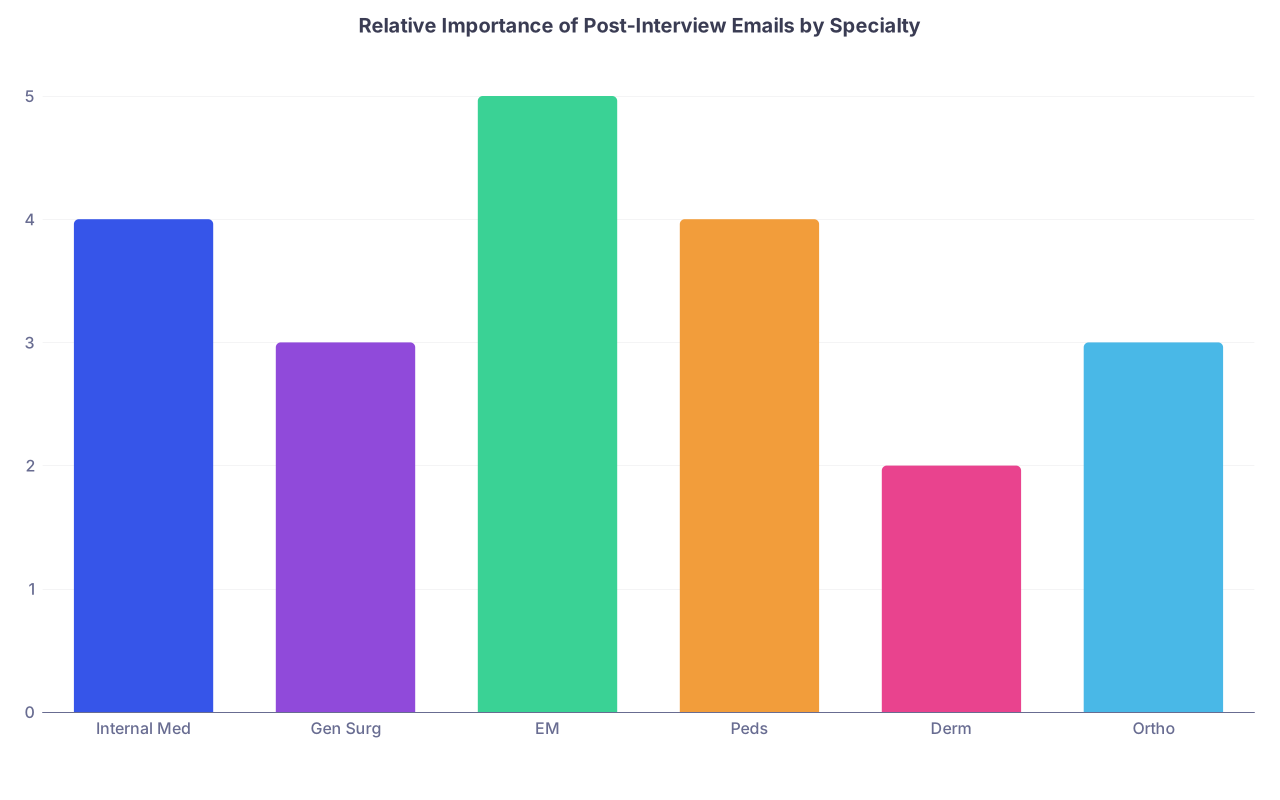
| Category | Value |
|---|---|
| Internal Med | 4 |
| Gen Surg | 3 |
| EM | 5 |
| Peds | 4 |
| Derm | 2 |
| Ortho | 3 |
(Scale 1–5: 5 = relatively more attention to emails, 1 = barely noticed. This is reality, not brochure-speak.)
Internal Medicine / Pediatrics
They see a ton of applicants. Most send something. Programs are used to it.
Emails here function mostly as:
- A soft professionalism check. Did you spell the PD’s name correctly? Did you write like an adult or like a text?
- A tie-breaker when they’re stuck between several very similar people.
At a large university IM program, I watched the PD say, three times in one meeting:
“Between these two, I remember [Name] followed up with that thoughtful note about our QI curriculum. Let’s put them slightly higher.”
Not from #70 to #5. From #34 to #29. That kind of movement.
Emergency Medicine
EM tends to pay more attention to:
- Consistency between your SLOE comments, your interview demeanor, and your communication after.
- Whether you’re actually serious about them or just mass‑applying.
Some EM PDs admit your “you’re my top choice” email can bump you a tiny bit if they already liked you and you’re in the competitive cluster. But they can also smell canned nonsense.
I’ve heard an EM PD say outright: “If I see the same ‘safety-net mission’ sentence eight times, it counts as zero.”
Surgery (especially competitive fellowships and subspecialties)
They’re not softies about this. They see over-eagerness as a liability.
One surgical PD I know has a very simple rule:
- Polite, one‑time thank you: fine.
- Anything that feels like lobbying: minus points.
In their words: “If you’re already this needy as a student, I do not want you as my 3 AM intern.”
Derm, plastics, ortho – similar vibe. They’re not scoring your gratitude. They’re screening your judgment.
The three types of post‑interview emails and what they actually do
There are really three buckets:
- Basic thank-you
- “Signal of interest” email
- “You’re my #1” or intent email
Each plays differently.
1. Basic thank‑you email
This is the safest, most neutral currency. Almost no one gets penalized for sending a short, sane thank-you.
What faculty really see from these:
- You can write a clear, professional message.
- You remembered something specific about the conversation.
- You aren’t socially oblivious.
At many programs, this is the baseline expectation. No bonus, just avoids looking disengaged or odd.
Here’s the part no one tells you: a noticeable minority of faculty do not read these closely. They open, scan for tone, and archive in under 10 seconds. So agonizing over every adjective is a waste of your cortisol.
What will get noticed:
- Getting their name/title wrong.
- Long, rambling paragraphs about your “lifelong dream.”
- Obvious copy‑paste errors (“I loved hearing about your EM program” sent to a surgery PD).
2. “Signal of interest” email (“I’m ranking you highly”)
These are trickier.
From the PD side, these get sorted into:
- Genuine, specific, believable
- Vague / generic fluff
- Desperate
When do they help?
When you’re already in the “we like this person” bucket and they aren’t sure if you’d actually come.
I’ve seen this play out:
Applicant A – great interview, strong file, but from another region, no tie to the city.
Applicant B – very similar, from in‑state, told them clearly they’d be ranking the program highly because of partner/family.
Both in the same tier. B ends up 5–10 spots higher because the program reads that as a higher chance of matching and staying.
Not because of the email quality. Because of the information conveyed.
What won’t work:
- Sending the same “I will fit perfectly with your culture of teaching and innovation” line to 15 programs.
Faculty recognize template language. You are not the first person to use “culture of collegiality and excellence.” They roll their eyes and ignore it.
3. “You’re my #1” / intent emails
This is the radioactive one.
Some programs still love them. Others explicitly hate them. Many pretend not to care but quietly keep track.
Here’s the behind‑the‑scenes reality:
- A decent number of PDs keep a private list of applicants who explicitly said, “You are my #1.”
- They do not fully trust this. They know multiple people lie every year.
- But when they’re building the middle of their list (the “maybe we’ll match them, maybe not” zone), they sometimes push true-intent people slightly higher.
I’ve seen this move someone from #35 to #24. That can be the difference between matching there or sliding to your next program.
Now the dark side: PDs also keep a mental (or literal) list of people who lied.
When programs cross‑match stories at meetings or compare with colleagues, the same applicant’s name comes up:
- Told Program X they were #1.
- Told Program Y the same.
- Matched at Program Z.
Once your name lives in that category – “the student who lied to multiple programs” – faculty remember. For fellowship. For letters. For jobs.
You may not think they talk. They do.
So my stance is blunt:
If you say “You are my #1,” it should be one program. And it should be true.
What happens in actual rank meetings with your emails
Picture the rank room.
Printed lists. Spreadsheet projections. Snacks that have been sitting too long. PD, APDs, a few key faculty, residents.
There’s a rough ordering already done based on application + interview. Now they’re fine-tuning.
Here is the level at which emails come up:
- “We liked #18, #19, #20. Any reason to move one up?”
Resident: “#19 emailed me about the night float system, seemed genuinely interested and asked good questions.”
PD: “Okay, bump #19 slightly above.”
Or:
- “We’re at the edge of our list. Who do we cut from the bottom 15?”
Faculty: “I’d take off [Name]. They sent me a really pushy note basically asking where they were on our list. Gave me a bad vibe.”
Nobody is sitting there saying, “This email was beautifully written – move them to the top 5.” But they are using those interactions as a tiebreaker and as a proxy for judgment.
For the data‑minded: think of it as this kind of tiny weighting.
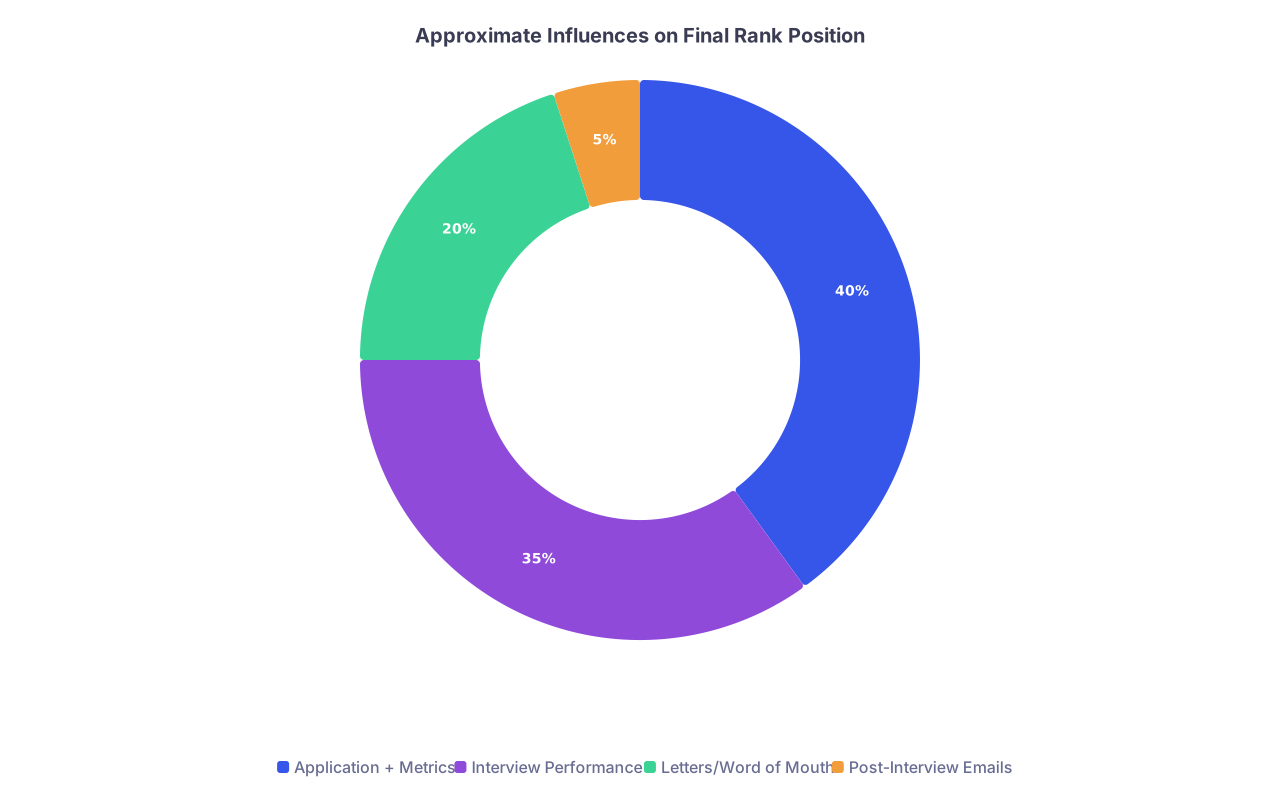
| Category | Value |
|---|---|
| Application + Metrics | 40 |
| Interview Performance | 35 |
| Letters/Word of Mouth | 20 |
| Post-Interview Emails | 5 |
Five percent doesn’t sound like much. Until you realize the difference between #18 and #32 is often only a few flimsy percent.
When not emailing is actually safer
Everyone assumes “more contact = more interest = good.” That’s wrong.
There are three common mistakes that hurt people more than silence would have.
1. Sending way too many emails to the same program
PDs talk about this behind closed doors with a particular tone: “frequent flyer.”
Examples I’ve seen:
- Thank‑you email → follow‑up a week later to “re‑emphasize interest” → another a month later saying “just wanted to reiterate”
- Emailing the PD, the associate PD, multiple interviewers, the coordinator, and a random faculty whose paper you skimmed
The reaction is not “how dedicated.” It’s, “This person’s judgment is off. Residency will be exhausting.”
2. Fishing for rank information
Any version of:
- “Can you share where I stand on your list?”
- “Am I still being considered highly?”
- “If I rank you #1, will I match there?”
Most PDs are contractually obligated not to disclose specifics. Put them in a corner, and they’re annoyed. They will be vague, and now you’re that applicant who ignored the NRMP rules.
I’ve heard one PD literally say: “Anyone who asks that is signaling to me they either didn’t read the rules or don’t think they apply to them. Neither is reassuring.”
3. Overconfident or inappropriate tone
Overly casual:
- “Hey Doc, thx for having me, I’d totally vibe with your crew.”
Overly emotional:
- Four paragraphs of your life story when you already discussed it fully on interview day.
Overly presumptive:
- “I look forward to joining your program next year.”
Again: judgment test. Not creativity contest.
What a “high-yield” email actually looks like
You do not need poetry. You need clean, targeted, low‑friction communication.
Here’s the structure that consistently plays well with PDs and faculty:
- Short subject line: “Thank you – [Your Name], [Specialty] Applicant”
- One sentence thanking them for their time / the interview day.
- One concrete detail you appreciated or something specific you learned about the program.
- Optional one line about continued interest.
- Simple closing with your name, med school, AAMC ID.
Not more. Not less.
For a true “you’re my #1” note to the PD (and only one program):
- Explicit, but not dramatic. “I intend to rank [Program] first on my list.”
- One or two specific reasons that make sense based on your file/background.
- No conditions. No “if I match here…” fantasies.
- No copying in half the faculty.
I’ve watched PDs read these in under 30 seconds and say, “Noted.” That’s the goal.
The timeline: when to actually send what
Most smart applicants over‑time this. They treat it like some delicate tango. It’s not.
Here’s how the timing usually plays out in the real world:
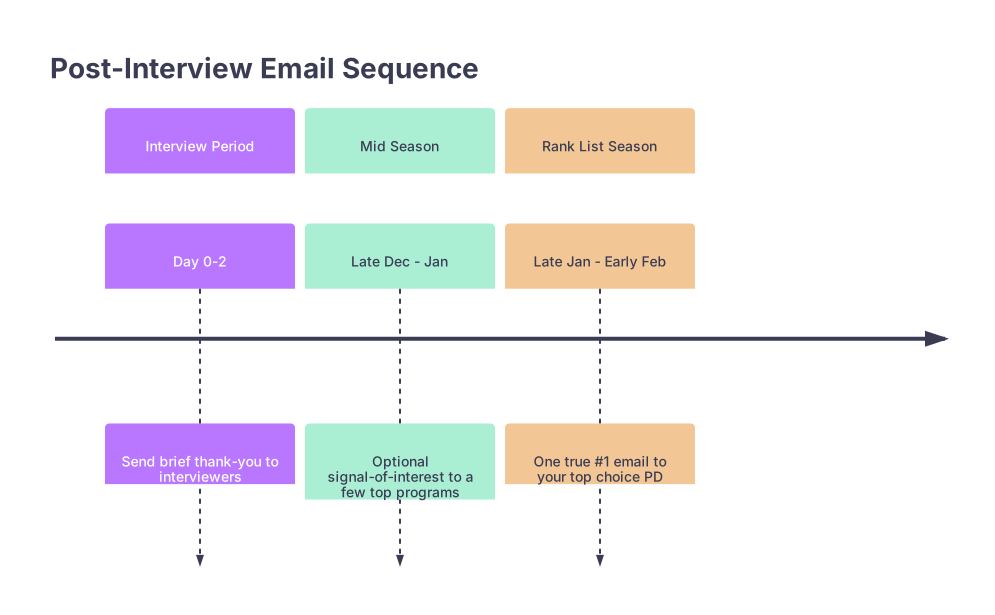
| Period | Event |
|---|---|
| Interview Period - Day 0-2 | Send brief thank-you to interviewers |
| Mid Season - Late Dec - Jan | Optional signal-of-interest to a few top programs |
| Rank List Season - Late Jan - Early Feb | One true #1 email to your top choice PD |
You don’t win extra points sending a thank‑you six hours after your interview. This isn’t Amazon Prime responsiveness. Within 24–72 hours is fine.
The more meaningful emails (signals of interest, true #1) you want closer to when PDs are actually finalizing ranks. Not so early they forget. Not so late they’ve already locked the list.
Strategy by where you stand
You’re not all playing the same game. What you should do depends on how you honestly think you performed.
If you crushed the interview at a program you love
Your main risk is overdoing it.
- Send standard thank‑yous.
- Later in the season, if it’s truly your #1, send that single clear intent email to the PD.
- Then stop. Let your performance stand.
Over‑messaging here only gives them reasons to doubt your maturity.
If you were solid but not spectacular at multiple places
This is where emails can matter a little.
- Thank‑yous to all.
- A short, honest interest note to a few top‑tier programs you’d be thrilled with, without lying. “I plan to rank your program highly because…” is enough.
- One true #1 email where it’s actually true.
You’re using emails as tie‑breakers and as signal boosters in that mushy middle zone.
If you think you underperformed at a place
Do not try to fix a bad interview with a long apology / explanation email. I have never seen that work.
A neutral, professional thank‑you is fine. Anything beyond that comes off as damage control and reminds them of the weak interview again right before rank meetings.
If you really believe something major misrepresented you (extreme outlier situation – illness, family emergency, tech catastrophe), that’s a different conversation and usually better handled by your dean or advisor reaching out, not you sending a nervous novel.
FAQ – The three questions you’re probably still asking
1. Is it worse to send no thank‑you emails at all?
For most programs, not fatal. But here’s the nuance.
If you send nothing to anyone, some faculty quietly interpret that as mild disinterest or social flatness. That usually doesn’t tank you, but in close calls, the student who seemed genuinely engaged – including in follow‑up – can edge ahead.
So I’d send something. Brief, clean, once. Absences rarely help you.
2. What if I already told two programs they’re my “top choice”?
Then your goal shifts from “game the system” to “minimize long‑term damage.”
You cannot unsend. You also should not start sending retractions. That just creates more screenshots.
Accept that you made a poor strategic call, rank in the true order you want, and do not repeat that pattern in fellowship. People remember names and stories. Do not reinforce their impression by being inconsistent again later.
3. Do programs blackball people for lying about rank intentions?
Some do, in a limited way. Most don’t “blackball” in the Hollywood sense. But here’s what actually happens:
- PDs bring up names of applicants in future cycles with a quiet warning attached.
- When letters/reference calls happen, that reputation shadows you: “Yeah, solid clinically, but we had some honesty concerns during the Match.”
- Your future PD may hear the story and trust you less at baseline.
So yes, your “little white lie” about ranking can follow you further than you think. The world of academic medicine is small, and PDs gossip like anyone else.
Years from now, you won’t remember the exact wording of the emails you sent after interviews. You will remember whether you handled this phase like a professional adult or like someone scrambling for shortcuts.
Post‑interview emails aren’t magic keys. They’re just one more piece of data about who you are to work with at 3 AM on a bad call night. Treat them that way – honest, restrained, and sane – and they’ll never hurt you, and they might quietly help when it counts.


