

Historical fill rates are the most underused weapon in residency ranking strategy. Every year, applicants obsess over vibes, opinions, and Reddit threads, while the hard numbers quietly predict who is going to match and who is going to scramble.
If you are not using NRMP historical fill data to structure your rank list, you are guessing. And the match punishes guesswork.
The good news: the NRMP publishes exactly the kind of trend data you need—by specialty, by program type, and sometimes by applicant type. The bad news: most people look at one table, say “wow, ortho is competitive,” and stop there.
Let’s not do that.
1. What “Fill Rate” Actually Tells You (And What It Does Not)
The data is straightforward:
- Fill rate = (Positions filled in the Match ÷ Positions offered) × 100%
The NRMP publishes this annually in the “Results and Data” report. But the power is not in a single year’s number. The value is in trends across 5–10 cycles.
Used correctly, fill rate helps you estimate three critical things:
- How risky a specialty is overall.
- How vulnerable individual programs are to going partially unfilled.
- Where an applicant like you (US MD vs DO vs IMG, Step/COMLEX profile) is most likely to actually land.
Used incorrectly, it lulls you into false security (“FM always fills, I’m fine”) or false panic (“this program filled 100% last year, no chance”).
You need to distinguish:
- Specialty-level competitiveness – e.g., Derm vs Psych vs IM.
- Program-level stability – does a given program fill all positions every year, or does it randomly drop into SOAP?
- Applicant-type dynamics – how much a specialty depends on IMGs, DOs, or lower-score applicants to fill all positions.
Let me be blunt: a 99–100% fill rate for a specialty year after year means the specialty has almost no slack. If you rank that specialty short, you are asking to go unmatched.
2. Reading NRMP Fill Data Like a Strategist
The average applicant looks at one number: “Specialty X filled 98% of positions.” That is a headline, not a strategy.
You should be looking at at least three layers of data:
- 5–10 year specialty-level fill trends
- Categorical vs preliminary / advanced fill behavior
- US MD vs DO vs IMG contribution to fills
To make this concrete, consider a simplified snapshot across four specialties.
| Specialty | 2020 Fill Rate | 2024 Fill Rate | % Positions Filled by US MD Seniors (2024) |
|---|---|---|---|
| Internal Med | 99% | 99% | 44% |
| Orthopedic Surg | 99% | 100% | 86% |
| Family Med | 96% | 93% | 31% |
| Psychiatry | 99% | 99% | 60% |
These are stylized numbers, but they match real patterns:
- IM: High total fill, but relatively low US MD proportion → lots of DOs and IMGs are filling the gap.
- Ortho: Near 100% fill and very high US MD proportion → brutal for everyone else.
- FM: Slight drop in total fill, with heavy non–US MD reliance → more slack; programs may SOAP.
- Psych: Very high fill and high US MD proportion → increasingly competitive but not yet “ortho-level insane.”
That mix matters when you decide how deep to rank.
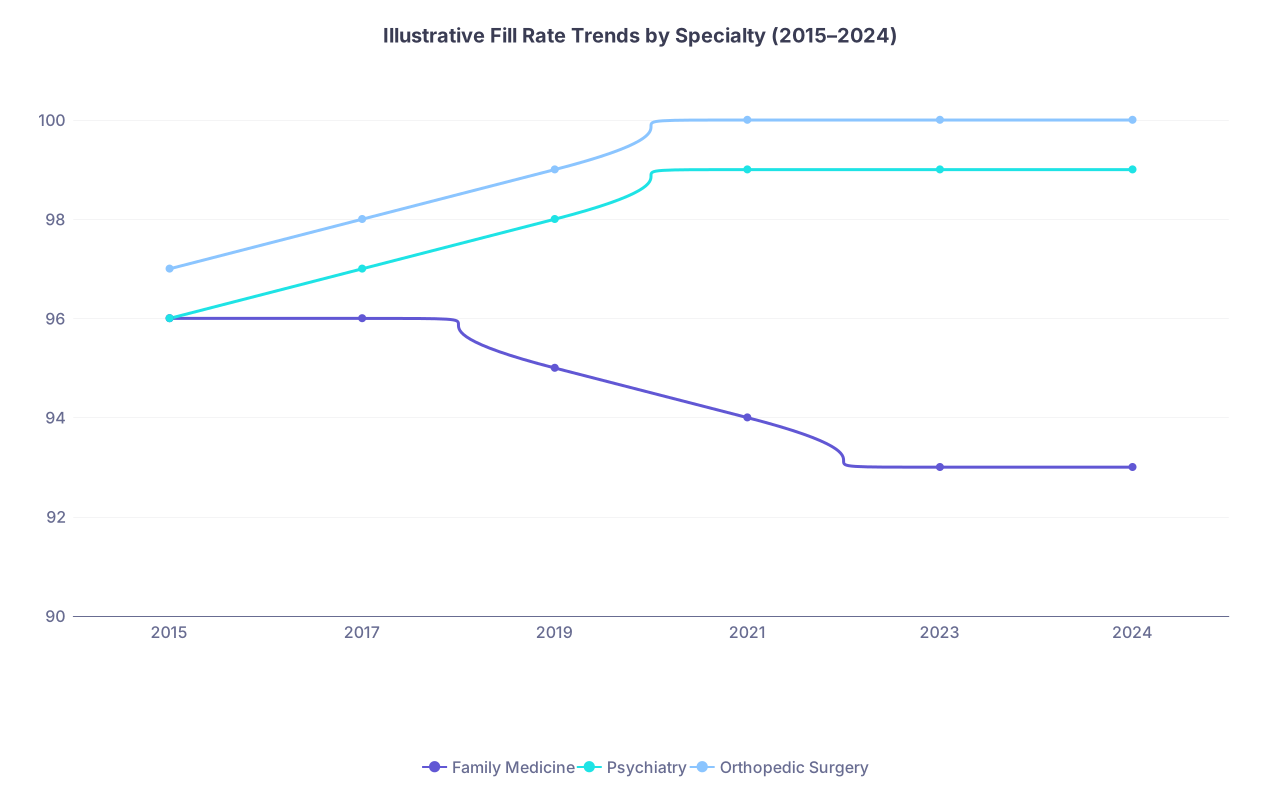
Now visualize trend tension over time.
| Category | Family Medicine | Psychiatry | Orthopedic Surgery |
|---|---|---|---|
| 2015 | 96 | 96 | 97 |
| 2017 | 96 | 97 | 98 |
| 2019 | 95 | 98 | 99 |
| 2021 | 94 | 99 | 100 |
| 2023 | 93 | 99 | 100 |
| 2024 | 93 | 99 | 100 |
What this kind of plot tells you:
- FM: Mild downward drift → more unfilled positions, more SOAP activity.
- Psych: Upward to near-saturation → it is not “backup Psych” anymore.
- Ortho: Ceilinged at 99–100% → everyone is fighting for essentially fixed seats.
If you are ranking FM, you can afford a bit more preference optimization. If you are ranking Ortho, you cannot.
3. How Historical Fill Rates Connect to Match Probability
The match is not random. The NRMP has published multiple “Charting Outcomes” reports showing clear correlations:
- Higher Step 2 / COMLEX 2 scores → more contiguous ranks → higher match probability.
- Specialty fill rate and average number of ranks per matched applicant move together.
At a structural level, think of it this way:
- If a specialty has a 100% fill rate, every seat is spoken for by someone who put that program rankable. There is no slack.
- If a specialty has a 90–95% fill rate, 5–10% of positions are failing to find a match in the main algorithm. Those are your “pressure release valves.”
The consequence: in ultra-high-fill specialties, your margin for error in rank length and program choice approaches zero.
Here is a simplified illustration tying fill rate to the minimum sensible rank list length for a US MD senior aiming at that specialty as a primary choice. These are stylized but reflect NRMP patterns.
| Specialty Fill Level | Typical Matched US MD Seniors' Rank Count | “Safer” Rank Count Target |
|---|---|---|
| 100% | 12–18 | 15–20+ |
| 97–99% | 10–15 | 12–18 |
| 93–96% | 8–12 | 10–15 |
| <93% | 6–10 | 8–12 |
You do not need to memorize the exact numbers. The pattern is the point:
High-fill specialty → rank deeper, and include a wide range of program tiers.
Lower-fill specialty → you get more room to optimize for fit and geography.
Now layer in a concrete specialty comparison.
4. Building a Rank Strategy: Competitive vs Less Competitive Fields
Imagine three applicants:
- Applicant A: US MD, Step 2 = 255, applying Ortho (very high fill).
- Applicant B: US DO, strong clinicals, applying Psych (high fill, trending up).
- Applicant C: US MD, Step 2 = 232, dual-applying IM and FM (high but not absolute fill).
The underlying fill behavior of their target specialties should change how they structure their lists.
Applicant A – Ortho (near 100% fill)
In a specialty like Orthopedic Surgery, historical fill is essentially 99–100% every year. US MD seniors dominate. That combination means:
- Very few programs ever go unfilled.
- SOAP is not a meaningful Plan B for Ortho itself.
- Rank list depth is non-negotiable; 15–20 categorical ranks is normal for a serious applicant.
For an applicant like this, the data-driven structure looks like:
- Rank 1–5: Dream / high-tier programs where stats are at or above the median.
- Rank 6–15+: Solid mid-tier and some “safety” programs that still historically fill 100%.
Notice the twist: in fully saturated specialties, even “safety” programs fill 100%. The concept of safety is relative—mostly about slightly lower Step medians, more IMG presence, or less desirable locations.
If this applicant ranked only 8–9 programs because they “felt good about their interviews,” they would be ignoring the brutal math of a fully saturated market.
Applicant B – Psych (high but not absolute fill, rising trend)
Psychiatry has moved from a softer backup field to a highly popular one. Fill rates have risen and stabilized near 99%.
Interpretation from the numbers:
- Nearly all positions fill in the Match.
- There is still slightly more diversity in applicant types and program tiers than in Ortho.
- SOAP is not a reliable safety net if you aimed exclusively at Psych.
For a DO applicant, historical data will also show you:
- Percentage of seats filled by DOs.
- How many unfilled Psych positions remain after the match.
The rational structure:
- Build a list with at least 12–15 programs.
- Include multiple lower-tier, community-based, or geographically less popular sites that regularly rank DOs and sometimes have slightly more IMG representation.
If fill rates for Psych keep trending up, the “old advice” of 8–10 programs is obsolete. The data has already moved on.
Applicant C – IM and FM (high fill but with slack)
Internal Medicine and Family Medicine look less scary on paper:
- Total fill is high but not 100%.
- Substantial contributions from DOs and IMGs.
- More positions overall → bigger denominator, more slack.
Here is where you can actually exploit fill-rate differentials.
A common pattern I have seen:
- IM categorical: 97–99% fill, especially in desirable metros.
- FM categorical: 92–95% fill, with consistent SOAP activity in some regions.
If Applicant C dual-applies:
- Rank IM categorical programs first (where they truly want to be), with a realistic 10–15 ranks depending on competitiveness.
- Then rank a set of FM programs that historically either:
- Fill, but have lower US MD percentages, OR
- Occasionally go unfilled (a sign that they may rank more broadly or be location-challenging).
Historical FM fill softness is not a failure of the specialty. It is your buffer. The data says: if you include them, you increase your overall match probability substantially.
5. Program-Level Fill Volatility: Your Hidden Advantage
Specialty-level fill rates are the big picture. Program-level volatility is where strategy lives.
Go through three years of NRMP Program Results (or the “Results and Data” supplemental tables) and map for your applied programs:
- Did this program fill all positions each year?
- If not, how often did it go partially unfilled?
- Are there patterns (location, new programs, highly IMG-heavy institutions)?
This matters more than most people recognize.
Programs fall into three rough buckets:
- Ironclad fills – 100% filled for the last 5+ years, usually with a high proportion of US MD seniors (or DOs for some fields).
- Semi-stable – usually fill, but have 1–2 stray unfilled positions in some years.
- Volatile – new, geographically unattractive, or chronically under-filled.
You want a healthy mix across your rank list, especially if you are not a top-of-the-pile applicant.
Here is how you convert that into actual decisions:
- Top of your list: Ironclad programs where you had strong interviews and meet or exceed their historical applicant profile.
- Middle: Semi-stable programs, often mid-tier or less desirable locations, which still usually fill but show the occasional gap.
- Bottom: Volatile programs that somewhat regularly hit SOAP but still provide accredited training in your specialty.
Volatile does not necessarily mean low quality. Sometimes it just means “nobody wants to live in that city” or “program is new and under the radar.” The data only tells you they have room each year. You still have to vet them for training quality.
6. Applicant Type and Fill: Where You Fit in the Numbers
The NRMP does not just show total fill; it breaks down who is doing the filling:
- US MD seniors
- US MD graduates (previous years)
- DO seniors and grads
- US citizen IMGs
- Non-US citizen IMGs
This is where you stop treating fill rate as generic and start personalizing it.
For example, consider a simplified set of 2024-style patterns (illustrative but realistic):
| Specialty | Total Fill Rate | % US MD Seniors | % DO (Seniors+Grads) | % IMGs (US + Non-US) |
|---|---|---|---|---|
| Ortho | 100% | 86% | 10% | 4% |
| Psych | 99% | 60% | 18% | 22% |
| IM | 99% | 44% | 23% | 33% |
| FM | 93% | 31% | 30% | 39% |
If you are:
- A US MD with strong scores → Ortho, Psych, IM, FM all see a lot of people like you.
- A DO → FM and IM clearly welcome large numbers of DOs; Psych is friendly; Ortho is selective.
- An IMG → FM and IM have meaningful IMG presence; Ortho is almost closed; Psych is in the middle.
You do not rank in a vacuum. You rank inside these distributions.
If you are an IMG applying Internal Medicine:
- You should prioritize programs and regions where IMG percentage in the fill is historically high.
- You should be cautious about over-ranking programs with near 100% fill and very low IMG representation. The numbers say they have not needed applicants like you in the past.
This is how you make fill rate data conditional on your own profile.
7. Turning Data into a Concrete Rank List Plan
Let me spell out a process that I have watched work consistently for applicants who treated this like an optimization problem and not a vibes contest.

| Step | Description |
|---|---|
| Step 1 | Download NRMP Results & Charting Outcomes |
| Step 2 | Identify Specialty-Level Fill Trends |
| Step 3 | Classify Your Specialty: Saturated, High, Moderate Fill |
| Step 4 | Pull Program-Level Fill History for Your Interviewed Sites |
| Step 5 | Annotate Programs: Ironclad, Semi-Stable, Volatile |
| Step 6 | Overlay Applicant-Type Data for Your Profile |
| Step 7 | Set Target Rank Count Based on Specialty Fill |
| Step 8 | Construct Draft Rank List Balancing Preference and Risk |
| Step 9 | Stress-Test: Remove Top 3&10, Check if You Still Match Reasonably |
Key steps where fill rates actually change your behavior:
Classify your specialty
- 99–100% = saturated → you need depth and some humility.
- 96–98% = high fill → sizable risk if you under-rank.
- <96% = moderate → more flexibility, but do not get cocky.
Set a rank-count floor based on that category. For a saturated specialty, anything under 12–15 ranks for a US MD (or even more for DO/IMG) is playing roulette.
Deliberately include programs with slightly weaker fill stability at the lower third of your list, provided they still meet your baseline for acceptable training.
Stress-test your list. Ask: “If I somehow do not match at my top 5 or 8, does the remaining list still include enough semi-stable and volatile programs to realistically absorb me?” If the answer is no, go back to the NRMP tables and add more.
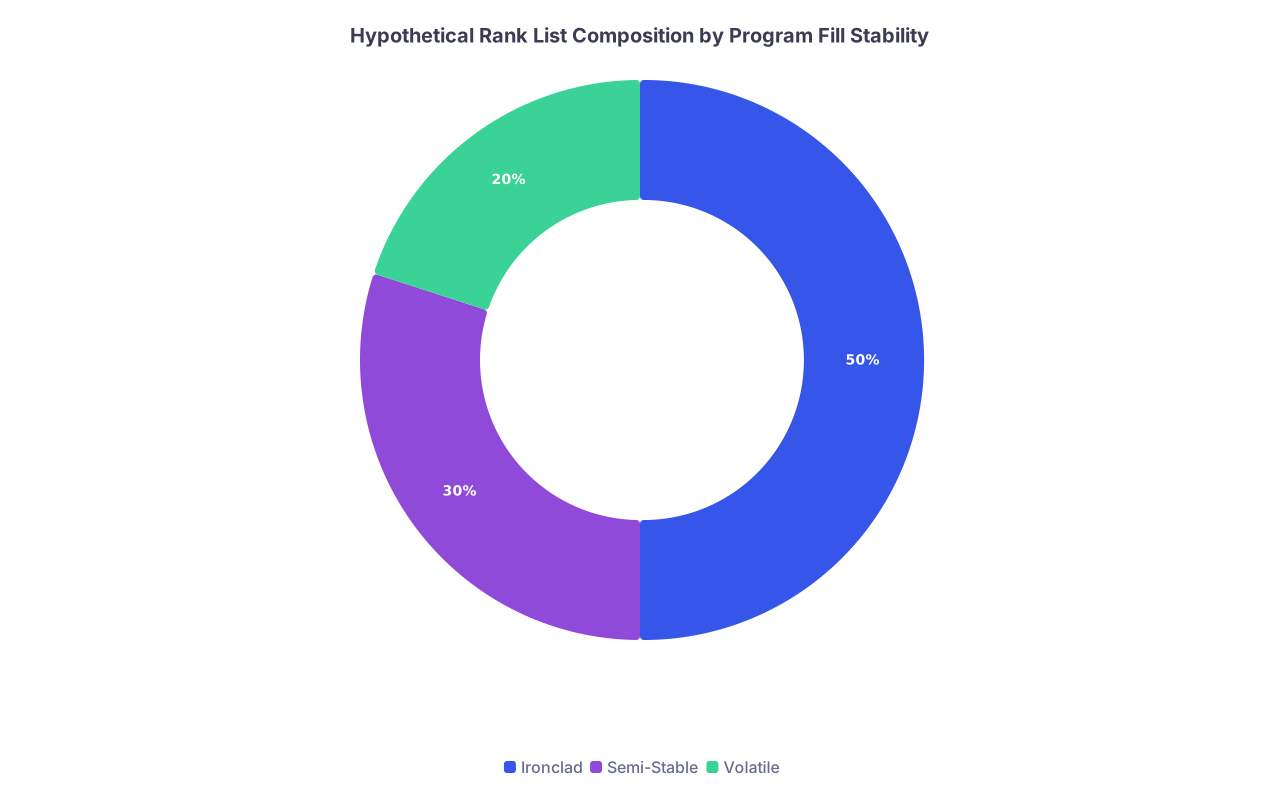
To keep your thinking honest, visualize your personal exposure.
| Category | Value |
|---|---|
| Ironclad | 50 |
| Semi-Stable | 30 |
| Volatile | 20 |
If your donut looks like 80–90% “ironclad” for a saturated specialty, you are running a high-risk list, even if you feel good about the interviews. The algorithm cannot create seats where none exist.
8. Common Mistakes the Data Would Have Prevented
Let me translate a few statements I have heard from unmatched applicants into data errors:
“Everyone loved me on interview day.”
→ Ignored: Specialty has 100% fill, program has 5 positions, they interviewed 60 people, and your scores were below their historical median.“I ranked 9 programs in Ortho, that should have been enough.”
→ Ignored: NRMP data showing matched applicants in Ortho usually rank 12–18 programs, and unmatched ones often rank significantly fewer.“I thought FM was a backup, I ranked only 4 FM programs after my IM list.”
→ Ignored: FM is not a monolith; some regions and programs now have >98% fill. You picked four in highly desirable cities with high historical US MD/DO representation.“I’m an IMG, but I ranked mostly academic IM programs that looked prestigious.”
→ Ignored: Their historical IMG contribution was near zero, and most IMGs matching IM were in community or IMG-heavy hospitals.
All of these were predictable from fill-rate and applicant-type data before rank lists locked.
9. How Much Weight Should Fill Rate Get vs. “Fit”?
Data does not care about your “fit” essay.
You should care about both. But I am going to be blunt:
- For saturated specialties, fill rate and match probability data should be the backbone of your strategy. You can layer fit on top, but you cannot ignore the baseline math.
- For moderately competitive fields with some slack, you can give more weight to fit, geography, and personal priorities—but still within a data-informed structure.
Reasonable weighting:
- Competitive, high-fill specialty: 60–70% decisions anchored in data (fill rate, your stats vs medians, IMG/DO friendliness), 30–40% in subjective fit.
- Less competitive or slack specialty: 50/50 or even 40/60 in favor of fit, as long as your total rank count remains above the safety floor.
Ranking “for happiness” is only rational if you match. Historical fill patterns tell you how likely that is.
Final Takeaways
- Historical fill rates are not trivia; they are a probability map. High, stable fill equals low slack and high risk if you under-rank.
- Your specialty’s fill pattern and your applicant type together dictate how deep and how diversified your rank list must be.
- A smart rank list blends preference with program-level volatility—ironclad at the top, semi-stable and volatile (but acceptable) programs at the bottom—to let the NRMP algorithm work in your favor instead of against you.


