
Your kids’ school zone matters more than your favorite program’s name.
If you’re a parent ranking residency programs, you’re not just matching a trainee to a hospital—you’re matching an entire family to a city, a commute, and a school district. Most residents learn this the hard way, when they’re already stuck with a 4:30 a.m. alarm, a 35‑minute commute, and a kindergartener melting down because you moved them mid-year. You do not want to be that story.
Let’s walk through how to build a smart, location‑sensitive rank list when you’ve got kids in school. Concrete, tactical, no fluff.
Step 1: Decide Your Non‑Negotiables For Your Kids
Before you obsess over program tiers and fellowship rates, you need to answer a harder question: what’s truly non‑negotiable for your kids?
You cannot optimize for everything. You’re not getting: elite schools + 10‑minute commute + lowest COL + dream program + big city nightlife. Pick your pillars.
For most resident parents, the realistic pillars look like this:
- Max acceptable commute (door‑to‑door)
- School stability (minimizing moves/grade changes)
- Type of schooling (public, charter, private, homeschooling/pods)
- Proximity to backup childcare / family help
- Basic neighborhood safety
Write this down. Literally. Not in your head.
Example of a reasonable “family constraints” list for a PGY‑1 with a 6‑year‑old and a 3‑year‑old:
- Commute: 35 minutes one-way max by car or public transit
- Schools: Public or charter; no mid‑semester changes unless absolutely forced
- Housing: 2‑bed minimum, in same district as elementary school
- Non‑negotiable: No areas with obvious violent crime issues; must have daycare within 20 minutes of hospital
Now that list becomes your filter. Programs that blow up multiple constraints go lower, no matter how “shiny” they are on paper.
Step 2: Understand the Tradeoff Triangle: Program – Housing – Schools
The painful truth: you are rarely going to get “great program, cheap housing, great schools” all in the same zip code.
Most families end up in one of these patterns:
| Pattern | Program Distance | Housing Cost | School Quality |
|---|---|---|---|
| Hospital Core | Short | High | Mixed/Variable |
| Near Best Schools | Medium-Long | High | High |
| Middle Ground | Medium | Medium | Medium |
| Far Suburb | Long | Lower | Mixed |
You need to decide which pattern you can actually live with when you’re on nights, pre‑rounding at 5 a.m., and your partner (if you have one) is solo with bedtime.
Here’s what I’ve seen work best for resident parents:
- With a strong co‑parent and/or family support: You can tolerate a slightly longer commute to live in a stronger school district.
- Single parents or partner with an intense job: Shorter commute usually wins, even if schools are “fine but not perfect.” Your availability for your kids trumps a few API score points.
Do not chase an “A+” school rating if it means you never see your kids awake.
Step 3: Research Schools Like You Research Programs
Most applicants spend 40+ hours analyzing residency programs and about 40 minutes on school districts. Backwards.
Here’s how to do it right, in a focused way.
3.1 Choose your main school info sources
Skip the glossy district websites as your primary source. They’re marketing.
Use a mix of:
- State Department of Education report cards
(test scores by subgroup, graduation rates, student-teacher ratios) - School rating sites (GreatSchools, Niche)
— ignore single composite scores, read the written reviews and sub-scores - Local Facebook parent groups or Reddit city subs
— this is where you see real complaints: bullying ignored, high teacher churn, chaos in the office, special ed issues - School/district calendars
— you need to know start dates, weird days off, breaks that don’t align with daycare, etc.
3.2 Focus on the factors that actually affect your daily life
Do not get lost in statistical weeds.
For a resident parent, the key school questions are:
How early and late is care available?
Is there before‑school care? After‑school programs? Are there waitlists?How strict are attendance and tardy policies?
You will have days when you’re post‑call and someone oversleeps. Some schools are flexible; some will harass you.How is bussing handled?
Will your kid be on a bus for 60 minutes each way? Is there an option for car drop‑off that fits around your pre‑round or clinic times?How does the school handle behavior and bullying?
Check parent discussions. “Great scores but administration doesn’t respond to bullying” is a red flag.What’s the special education / 504 process like?
Critical if your child has any learning differences. Some districts are cooperative; others fight every service.
These factors matter more to your quality of life than whether the school is rated 8/10 vs 9/10.
Step 4: Map Commute + School + Call Schedule Together
Most people look at commute in isolation. You cannot afford that. Your reality is:
Hospital hours + call schedule + school hours + traffic patterns.
Let’s be concrete.
You need to sit down and do three things for each program city:
- Choose 1–3 likely neighborhoods where you’d live (based on school and rent).
- Run actual commute times:
- Morning between 5–7 a.m. (pre‑rounds, early ORs)
- Afternoon between 4–7 p.m. (clinic ending late, sign‑out variances)
- Overlay school hours and extended care.
Then ask:
- Can someone realistically get the kid to school and you to the hospital without panic every morning?
- If you’re on call and your partner works 9–5, who does pickup? Is there a backup? A neighbor? Aftercare?
- What happens on snow days / half days / weird professional development days?
Here’s a mental model:
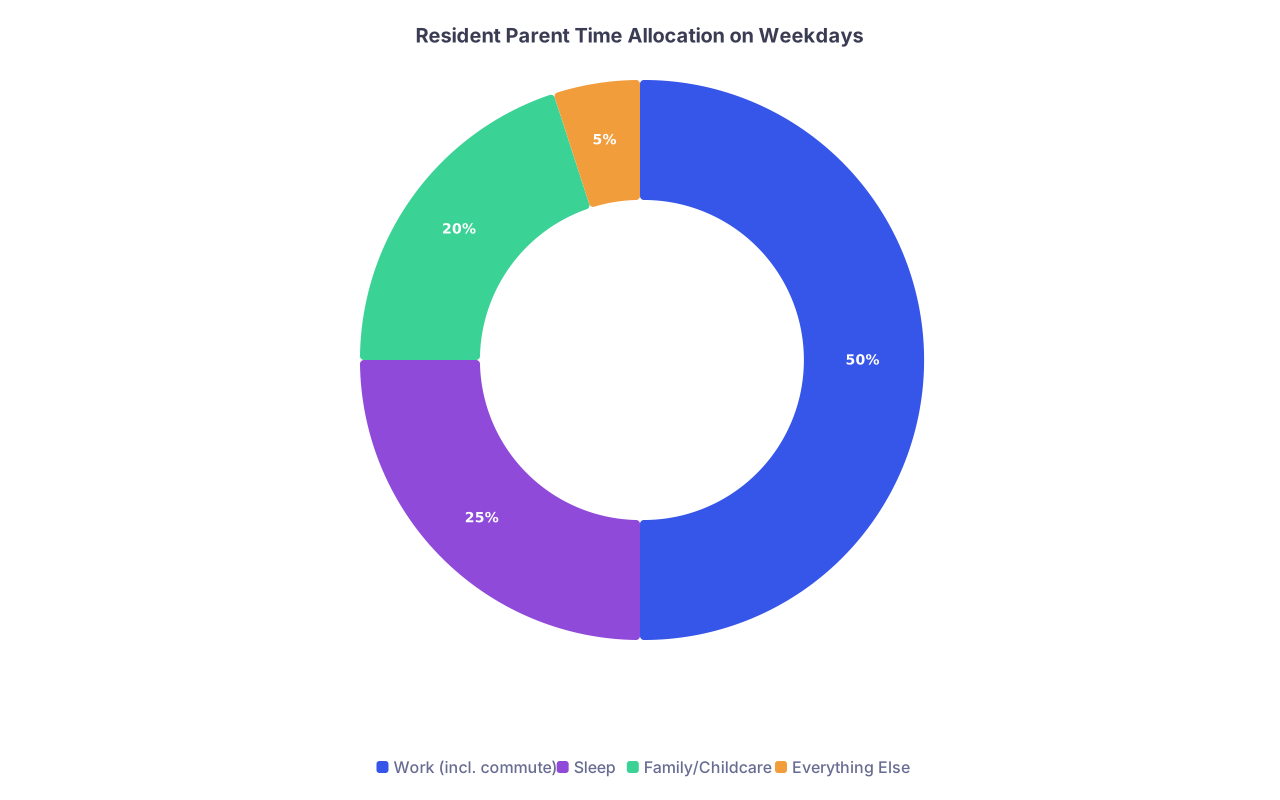
| Category | Value |
|---|---|
| Work (incl. commute) | 50 |
| Sleep | 25 |
| Family/Childcare | 20 |
| Everything Else | 5 |
If “Work (incl. commute)” eats more than half the day, your logistical margin for school chaos drops to near zero. That’s how families crack.
Step 5: Rank List Strategy When You Have Kids
Now we’re at the part everyone cares about: how does this affect your actual rank list?
You’re not re‑building ERAS. You’re re‑ordering programs based on family‑relevant reality.
5.1 Build three internal tiers for yourself
Not what NRMP calls them. Your own.
- Tier A: Programs where BOTH the training and family logistics are clearly workable
- Tier B: Programs where training is strong but family life is a stretch, not impossible
- Tier C: Programs where your family would be constantly underwater, but you’d go rather than go unmatched
You still rank all programs you’d be willing to attend. But inside those boundaries, you sort based on your internal tiers.
5.2 How to break ties between similar programs
Two IM programs in similar cities, similar reputations. Which goes higher?
Use a simple tie‑breaker checklist:
- Shorter realistic commute from “likely” school neighborhoods?
- Better access to before/after‑school care or reliable daycare?
- Family support proximity (grandparents within driving distance, etc.)?
- Flexibility of scheduling culture (does anyone ever switch shifts for kid emergencies, or is that taboo)?
- Call schedule intensity (q4 in-house vs home call, etc.)?
If a program wins 3/5 of those, it goes above the other—even if its name is slightly less shiny.
5.3 When to drop a program way down (or off)
There are situations that look “prestigious” but are miserable with kids:
- Program is in a city where safe, kid‑friendly housing + good schools = 60+ minute one‑way commute.
- No childcare near the hospital, and your partner works hours similar to yours.
- Residents openly say, “We are here 80–90 hours every week, no exceptions,” and every parent at the program looks completely wrecked.
In those cases, if you have alternatives, I’d drop that program substantially. Fame does not get your kid to school on a snow delay when you’re already post‑call.
Step 6: Handling Different Kid Ages & Situations
Not all “kids in school” are the same problem. The age and situation matter.
Elementary school (K‑5)
Biggest issues:
- Before/after‑school care
- Emotional stability with moves
- Early bedtimes vs your late shifts
Recommendations:
- Prioritize stable, warm schools over “top‑ranked” pressure cookers.
- Minimize mid‑year moves if possible, especially in K‑2.
- Shorter commute is particularly valuable here; you’ll be doing bedtime while exhausted.
Middle school (6‑8)
Biggest issues:
- Social environment + bullying
- Changing schools at a high‑drama age
- Activities (sports, music) and transportation to them
Recommendations:
- Do deeper social climate research—this is the age where toxic school culture hurts.
- If possible, avoid changing schools right at 6th grade and again at 9th. One transition is plenty.
High school (9‑12)
Biggest issues:
- Credits transferring if you move
- College prep resources
- Stability for extracurriculars and standardized tests
Recommendations:
- Strong argument for NOT moving a high schooler if you can possibly avoid it.
- If you must, prioritize districts that handle mid‑high‑school transfers decently (talk to counselors if possible).
- For a PGY‑1 with a 10th grader, I’d seriously consider ranking programs near your current school higher even if they’re “less impressive.”
Kids with IEPs or special needs
This changes the whole equation. School district quality in special education becomes a primary factor.
Non‑negotiables here:
- District with a reputation (from actual parents, not administrators) for honoring IEPs
- Reasonable access to specialists and therapies in the area
- Ability for one parent to attend IEP meetings without retaliatory nonsense from the program (you’ll need some flexibility)
I’ve watched resident parents of autistic kids choose “mid‑tier” programs in states with robust special‑ed law culture and be much, much happier than they would’ve been in more famous programs in hostile districts. They were correct.
Step 7: Using Interviews & Second Looks Wisely (With Kids in Mind)
You don’t walk into a PD’s office and say, “I only care about school zoning.” But you can gather key intel without sounding checked out.
During interviews, ask residents:
- “Do any of you have kids in school? Where do you live? How has that been?”
- “How supportive is the program when people need to handle kid emergencies—daycare closed, school nurse calls, etc.?”
- “What neighborhoods are most common for residents with families?”
If they hesitate. If parents are silent. If the one resident with kids looks like a ghost and says, “It’s… do‑able,” while staring into the distance—log that.
On a second look (or even just a solo trip), walk the actual neighborhoods you’d consider. Drive from “likely rental area” to the hospital at a realistic time. Visit a playground and eavesdrop on parent chatter. That beats any website.
Step 8: Financial Reality Check: Can You Even Afford the “Good” School Area?
People forget the money piece. The nice district with the “9/10” rating often comes with $600–$800/month higher rent. On a resident salary, that is not trivial.
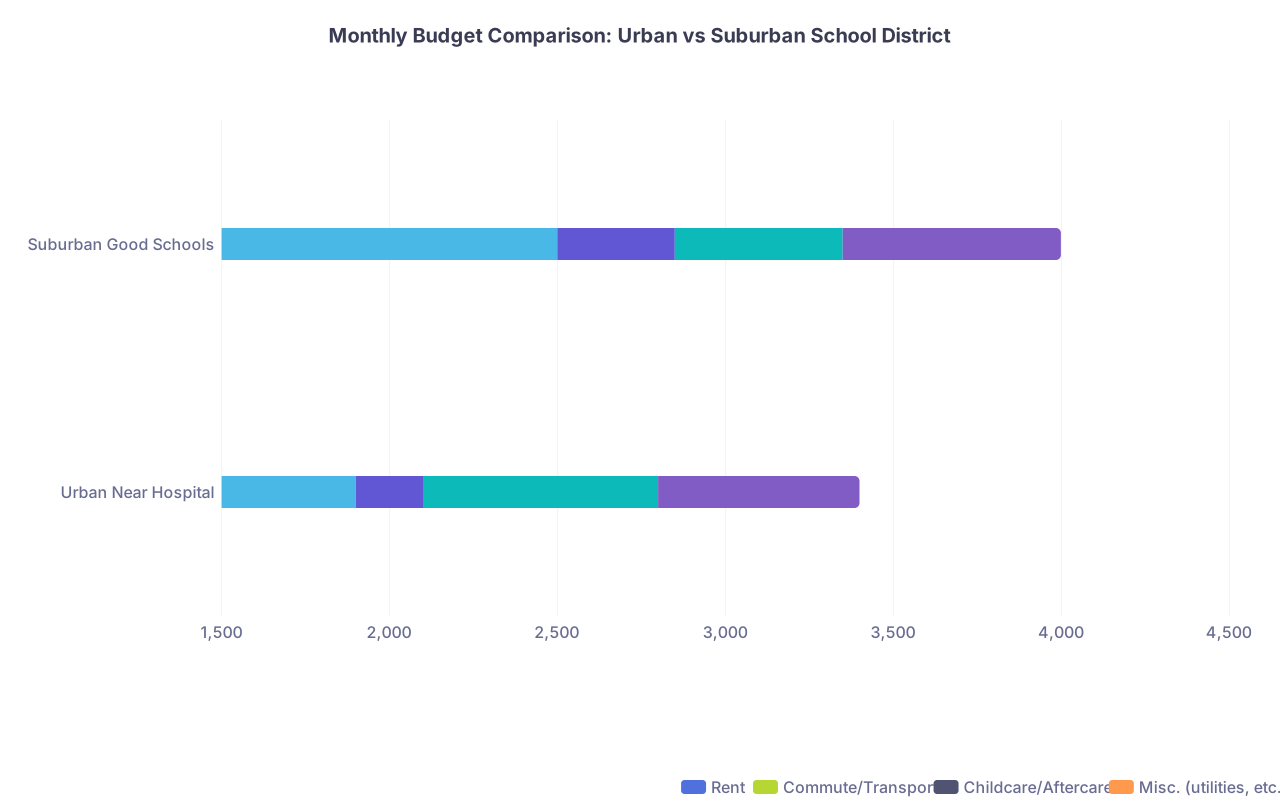
| Category | Rent | Commute/Transport | Childcare/Aftercare | Misc. (utilities, etc.) |
|---|---|---|---|---|
| Urban Near Hospital | 1900 | 200 | 700 | 600 |
| Suburban Good Schools | 2500 | 350 | 500 | 650 |
You need to see whether the “good schools” suburb actually breaks your budget once you:
- Add higher rent
- Add gas or train passes
- Factor in parking at the hospital
- Consider longer daycare hours (because of longer commute)
Sometimes the supposedly “worse” district with okay schools and shorter commute leaves you with enough money and time to actually be present with your kids and pay for tutoring or activities. That’s a better trade than chasing a test score index.
Step 9: Planning for the Entire Residency, Not Just PGY‑1
You’re not matching for a year. You’re matching for three to seven, depending on specialty and fellowships.
Use a simple future‑state timeline:
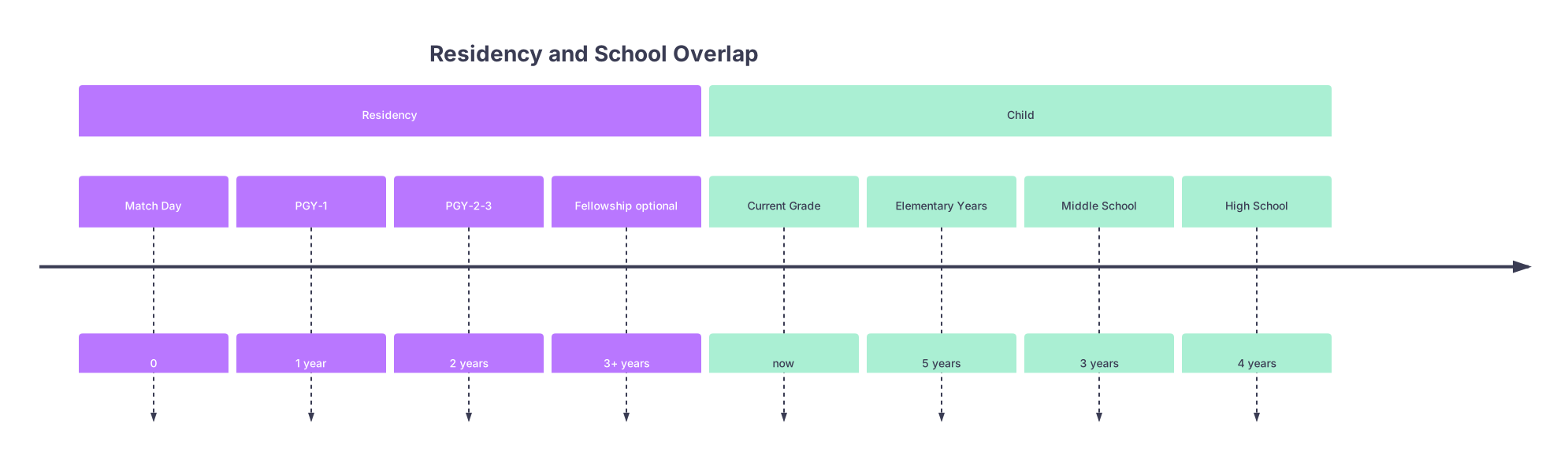
| Period | Event |
|---|---|
| Residency - Match Day | 0 |
| Residency - PGY-1 | 1 year |
| Residency - PGY-2-3 | 2 years |
| Residency - Fellowship optional | 3+ years |
| Child - Current Grade | now |
| Child - Elementary Years | 5 years |
| Child - Middle School | 3 years |
| Child - High School | 4 years |
Ask:
- Will my child be starting kindergarten, middle school, or high school during residency? Where do I want that to happen?
- Do I plan to stay in this city for fellowship/attending, or is this a 3–4 year stop?
- Would moving twice (for residency then again for fellowship/attending) wreck my kid’s school stability?
Sometimes, the best move is:
Rank higher the place where you’re more likely to land a job and just stay, even if the residency itself is slightly less glamorous. One move is better for kids than three.
If You’re Already Boxed In: Limited Geography, Limited Options
Some of you do not have the luxury of broad geographic choice:
- Divorce or custody agreements that lock you to an area
- Elderly parents nearby you’re helping care for
- Kids in specialized schools/therapies that don’t exist elsewhere
In those cases, your main lever is intra‑city strategy:
- Rank within driving distance of your current home and school first.
- Consider moving closer to the hospital but keeping the same district if feasible.
- Work your childcare network like it’s a second job—backup babysitters, neighbors, church/mosque/synagogue connections.
You may end up ranking every program in one metro area, even some you don’t love. That’s fine. Just know where each would land you in terms of commute and schools, and order accordingly.
Quick Example: Two Programs, Different Family Outcomes
Program A: Big‑name academic center, downtown, famous nationally.
- Nearest “good” schools: 35–45 minutes away by car in normal traffic
- Rent in those suburbs: $2,400+ for a 2‑bed
- Residents routinely work 70–80 hours/week
- No on‑site daycare
Program B: Solid regional program, not famous, smaller city.
- Several “good enough” schools 10–20 minutes from hospital
- Rent: $1,600–1,800 for a 2‑bed
- Typical load 55–65 hours/week
- Hospital daycare with extended hours
If you’re single, no kids, ambitious for academic subspecialty, Program A might easily go first.
If you’ve got a 7‑year‑old and a partner who also works? You rank Program B above Program A without apology. You’ll still get trained. Your child will still get into college (if they even want to). But your family has a fighting chance of not exploding.
That’s the entire point of a location‑sensitive strategy.
FAQs
1. Should I tell programs during interviews that I’m ranking based heavily on my kids’ schools?
You can mention that you have a family and care about stability, but I wouldn’t frame it as “I’m ranking you based on school zoning.” Instead: “I’m really interested in programs where residents with families feel supported and can realistically be present for their kids.” Then ask specific questions about resident parents’ experiences.
2. Is it ever worth splitting the family (I go to one city, kids stay with other parent elsewhere)?
Sometimes it’s legally or logistically necessary, especially with custody arrangements or highly specialized schooling. But it’s rough. If you consider this, treat it as a last‑resort structure and be very honest about mental health, travel costs, and how often you’ll realistically see your kids. If you have any viable programs within reach of your kids’ current home, they deserve serious priority.
3. How much weight should I give program prestige vs. family factors?
If the difference in training quality is modest but the difference in family feasibility is huge, you prioritize the family. Objectively. A slightly easier fellowship path is not worth three years of chaos, exhausted co‑parents, and kids constantly in crisis. I’d only let prestige override family factors when the alternative programs are genuinely weak or unstable.
4. What if my partner is also applying to residency (dual‑physician couple with kids)?
Then you’re playing on “hard mode.” Your constraints multiply: two commutes, two call schedules, one set of kids. In this case, compressing geography (same hospital or nearby institutions), reliable childcare near at least one hospital, and family/friend support become critical. Often the best play is to accept a slightly less ideal program for one person so both can be in the same city with manageable lives.
5. Is homeschooling or online school a realistic workaround during residency?
For some families, yes—but it’s usually not realistic if the resident is the primary teacher. Homeschooling works better if you have a non‑resident parent with flexible hours and genuine interest in teaching, or if you’re using a structured online program with significant external support. Do not treat homeschooling as an “easy” escape from bad schools; it’s its own major workload and can be incompatible with 60–80‑hour weeks.
Key points, stripped down:
- Rank lists with kids in school must prioritize commute + school stability + childcare over prestige.
- Research schools and neighborhoods with the same intensity you use on program websites, then map them directly to your actual schedule and budget.
- Future‑proof your choice over the full residency span; do not mortgage your family’s sanity for a slightly fancier program name.