
How to Rank After Failing a Step Exam but Still Getting Interviews
What do you do when you’ve failed a Step exam, somehow still landed interviews… and now you’re staring at the NRMP screen wondering, “Am I about to rank my way into going unmatched?”
Let me be blunt: you are not in a normal ranking situation. The usual “just rank in order of preference and trust the algorithm” advice is incomplete for you. Not wrong—just incomplete. You have more risk than the average applicant. You can still match, and match well, but you have to play this smarter than the “straight-A, first-try Step” crowd.
Here’s how.
Step 1: Get Real About Your Risk Profile
Before you touch your rank list, you need a cold, unsentimental assessment of where you actually stand.
You’re in one of these common buckets:
| Profile | Description |
|---|---|
| P1 | Step 1 fail, later pass; Step 2 pass, average or below-average score |
| P2 | Step 1 pass; Step 2 fail then pass |
| P3 | Step 1 and Step 2 passes, but one is barely above minimum and multiple attempts |
| P4 | IMG or DO with any Step failure but solid clinical letters |
| P5 | Step failure plus red flags (leave of absence, professionalism issue) |
Which one are you? Pick, don’t rationalize.
Now, here’s the harsh part: if you failed a Step exam, many programs filtered you out. The ones that still interviewed you fall into a few categories:
- They didn’t screen aggressively and only noticed later.
- They noticed and truly don’t care much (rare, but real).
- They noticed and care a lot, but liked the rest of your file enough to give you a shot.
- They’re desperate for candidates and will take risks others won’t.
Your job now is to figure out which is which and rank accordingly.
Step 2: Interpret What Your Interviews Actually Mean
Not all interview invitations are equal. With a Step failure, an interview is not always proof that “they love you.” Sometimes it just means “you cleared our chaos filter this year.”
Look back at each interview and ask three questions.
1. How did they talk about your failure (if at all)?
If they brought it up directly:
Best-case vibe:
“You had a Step 1 failure, then a strong Step 2. Walk me through what changed.”
Tone: curious, not accusatory. They’re open to your story.Neutral:
“I see you had to repeat Step 1. How did that impact your approach to studying?”
They’re checking for insight and maturity, not condemning you.Red-flag tone:
“So… what happened with that Step exam?” with raised eyebrows, long pause, or repeated grilling.
If you felt like you were on trial, that program is probably not eager to push your file strongly.
If they never mentioned it:
- In some fields (like family med or psych in certain regions), that can actually mean they honestly don’t care that much.
- Or they just don’t read files deeply. Which sounds bad, but can make them less picky statistically.
2. Did you see or sense other people there with obvious red flags?
You’re looking for hints that they routinely “take chances”:
PD or APD says lines like:
“We like to look at the whole applicant, not just board scores.”
“We’ve had residents who started with academic struggles and did great here.”Current residents casually say things like:
“Yeah, a bunch of us didn’t have the highest scores, but this place really focuses on fit and growth.”Or you notice several IMGs, DOs, or non-traditional residents, especially in a historically competitive program. Something’s going on—they’re flexible somewhere.
3. Did they hint at their board cutoffs or policies?
Some programs quietly give away their culture:
- “We do not rank anyone with more than one Step failure.”
- “We require all residents to pass boards on the first attempt; we screen heavily for that.”
- “The committee was impressed that you bounced back after that exam.”
If you heard that first line about “do not rank anyone with more than one failure” and you have one failure—yes, they still might rank you, but you’re playing uphill. That program should not be at the very top of your list unless you have very strong counter-signals (PD loves you, explicit reassurance, etc.).
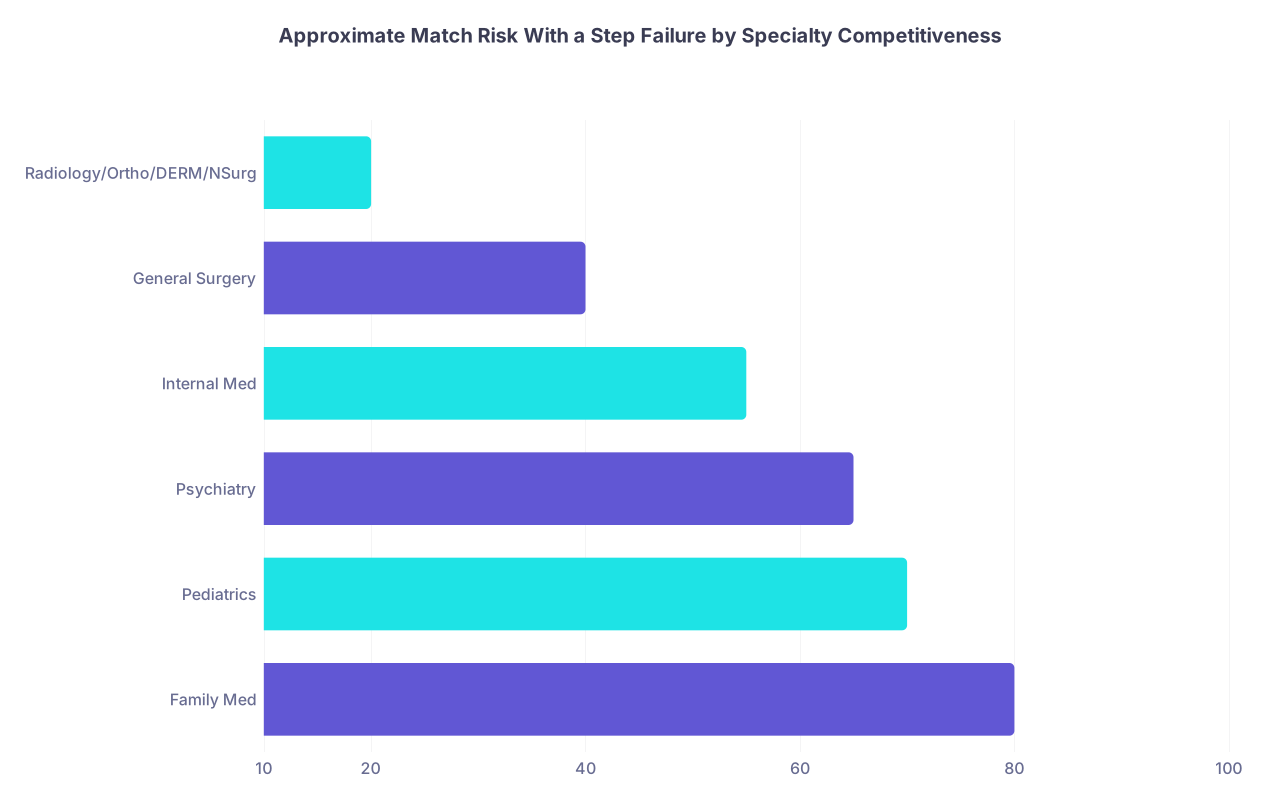
| Category | Value |
|---|---|
| Family Med | 80 |
| Pediatrics | 70 |
| Psychiatry | 65 |
| Internal Med | 55 |
| General Surgery | 40 |
| Radiology/Ortho/DERM/NSurg | 20 |
(Values represent a rough “match chance if you interviewed at 8–12 programs and rank them all,” assuming at least one Step failure. This isn’t exact data; it’s reality-based ballpark from what I’ve seen.)
Step 3: Forget “Dream Program” Ranking; Think “Probability-Weighted”
The NRMP line—“Always rank programs in your true order of preference”—is correct only under one assumption: your rank order has no effect on whether programs rank you.
For the average applicant, that assumption holds. For you, with a Step fail, it’s shakier. Some programs are less likely to actually rank you or rank you high enough to matter.
So your ranking strategy has to mix:
- Where you want to go
- Where you’re likely to be ranked high enough
- How many interviews you actually have
Rough interview count reality check
- 5 or fewer interviews in a moderately competitive specialty with a Step failure → you are in a high-risk group.
- 6–10 interviews in less competitive specialties (FM, psych, peds, IM community programs) → you can still match with smart ranking.
- 12+ interviews, even with a failure → you probably will match somewhere, but you still need to be strategic about which “somewhere.”
If you have:
- 3 interviews total: you do not get to be picky. You rank all three, in honest preference order, yes, but you should also be mentally preparing a SOAP plan.
- 8–12 interviews: this is the sweet spot where ranking strategy matters but doesn’t require panic. You can balance risk and preference.
Step 4: Classify Each Program Before You Rank
You’re going to give each program a category tag based on two dimensions:
- How much you want to be there.
- How realistically they’ll rank you high enough to match there.
Let’s use three simple buckets for “likelihood they’ll rank you decently”:
- Green:
Programs that clearly accept Step failures, or strongly signaled they like you as a person. - Yellow:
Neutral; they didn’t hate you, but nothing about interview day screamed “you’re our top choice.” - Red:
Programs that felt judgmental about your failure, or explicitly told you they’re strict on scores.
Then track “preference” separately: High, Medium, Low.
It’ll look something like this:
| Program | Preference | Likely To Rank You? |
|---|---|---|
| University A | High | Red |
| Community B | High | Green |
| University C | Medium | Yellow |
| Community D | Low | Green |
| University E | High | Yellow |
Now you’re starting to see the problem: your favorite program might also be a red-risk for ranking you.
Step 5: Build a Tiered Rank List, Not a Fantasy One
Here’s the structure that works well for applicants with a Step failure.
Tier 1: “Reach but worth it” programs (top 2–4 slots)
These are places you genuinely love—even if your chance is lower. They might be academic programs with strong reputations, or locations that matter for family reasons.
Conditions to put them here:
- They didn’t openly write you off in the interview.
- You didn’t get the sense that your failure was a deal-breaker.
- You’re okay with a slightly higher risk of sliding to lower choices to include them.
Example:
- Program 1: University IM in your home city (High preference, Yellow likelihood)
- Program 2: Prestigious academic program that loved your research (High preference, Yellow likelihood)
You can put a “Red-likelihood” dream program at #1 if it’s life-changing for you, but I’d personally cap those at 1–2 max, not five in a row.
Tier 2: “Strong match chances that you like” (the bulk of your list)
This is where you protect yourself from going unmatched.
These should be:
- Green or Yellow likelihood
- High or Medium preference
You might not get your vanity goal here, but you get a life you can live with and a specialty you trained for.
Example mid-section:
- Community Program A (High preference, Green)
- University-affiliated community Program B (Medium preference, Green)
- Community Program C in a good city (Medium preference, Yellow)
Tier 3: “Safety net but acceptable” programs (bottom third)
These are your lower-preference, higher-likelihood programs. They go last, but they still go on the list.
These are often:
- Far from home
- Smaller or less well-known hospitals
- Programs with weaker reputation but historically fill their spots with IMGs, DOs, or people with red flags
You don’t rank programs you truly wouldn’t attend. But be honest—is it really worse than SOAPing into something random, or sitting out a whole year?
If you have a Step failure and fewer than ~10 interviews, dropping “I could live with it but hate the location” programs from your list is usually a luxury you can’t afford.

| Step | Description |
|---|---|
| Step 1 | List All Programs |
| Step 2 | Classify Preference: High/Med/Low |
| Step 3 | Classify Likelihood: Green/Yellow/Red |
| Step 4 | Top 2-4 = High Pref, mix of Green/Yellow, maybe 1 Red |
| Step 5 | Top 1-2 = High Pref likely to rank you |
| Step 6 | Middle: Green/Yellow you like reasonably |
| Step 7 | Bottom: Green safeties you can tolerate |
| Step 8 | Interviews >= 8? |
Step 6: Factor in Specialty Competitiveness and Backup Logic
If you failed a Step exam and still got interviews in a competitive specialty (ortho, derm, rads, neurosurg, ENT), your situation is fragile. Many people in your shoes go unmatched in that specialty the first try.
So your ranking behavior should depend on whether you also interviewed in a less competitive backup specialty.
Scenario A: Competitive specialty only, 5–8 interviews
Say you’re an ortho applicant with a Step 2 fail, then pass, and you got 6 ortho interviews and 0 backup interviews.
Your realistic options:
- Rank all 6 ortho programs.
- Prepare emotionally and practically for SOAP into prelim surgery or a transitional year.
- Decide in advance: If you don’t match, will you reapply ortho or pivot to something else next cycle?
In this scenario, you do rank purely in preference order because you have no same-year specialty backup list.
Scenario B: Competitive specialty + backup specialty
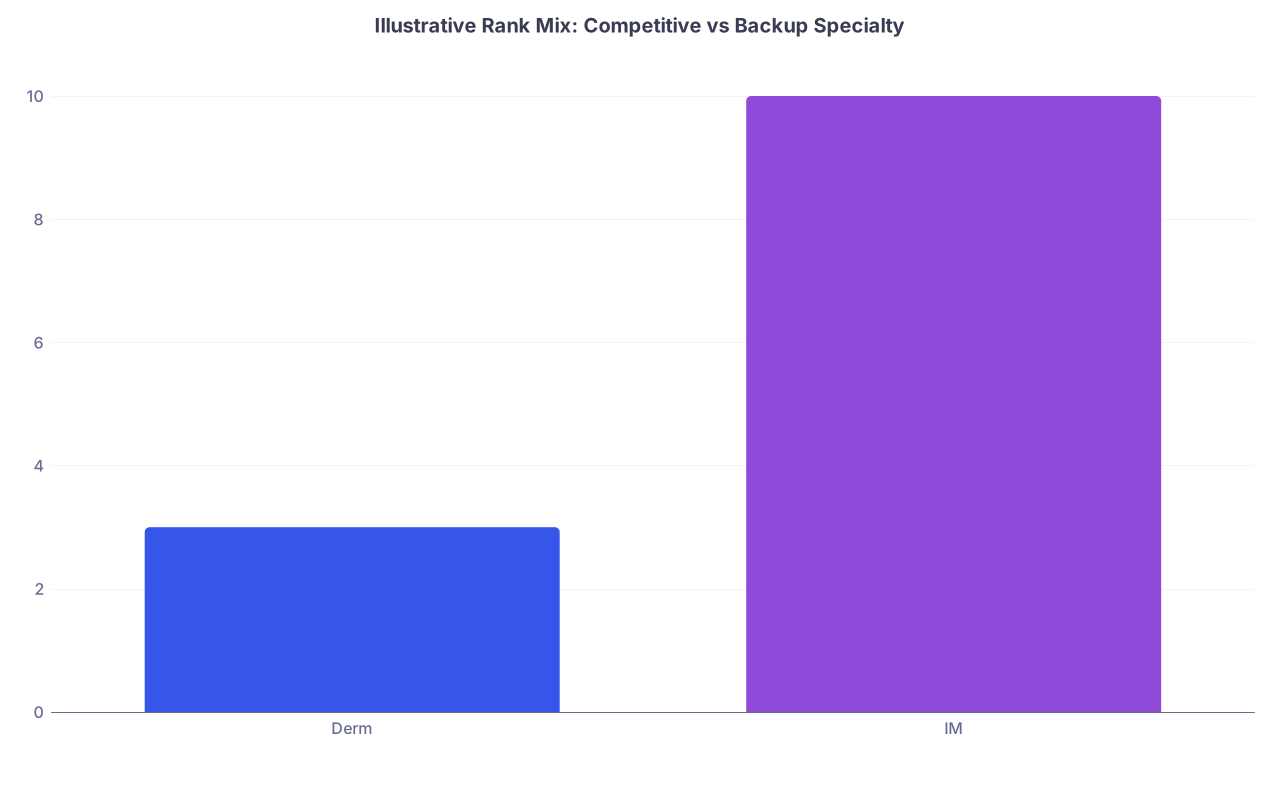
You applied derm + IM as backup, with a Step failure. You got:
- 4 derm interviews
- 9 IM interviews
If your main goal is “must match this year,” your rank list should be dominated by IM programs. You can:
- Put your top 1–2 derm programs at the very top if they’re genuinely realistic (and not obvious long shots).
- Then immediately shift to IM programs, ordered by the same Tier 1–2–3 logic above.
- If your file in derm is obviously weak (Step failure, no derm research, lukewarm derm letters), putting all 4 derm interviews above any IM interview is more gambling than strategy.
| Category | Value |
|---|---|
| Derm | 3 |
| IM | 10 |
(Example: 3 derm programs at the top, then 10 IM programs, all ranked.)
Step 7: Use Signals from Programs Themselves — Carefully
You will overinterpret every email you get in late January and February. Everyone does.
Reality:
- Generic “We enjoyed meeting you” mass emails → ignore for ranking decisions.
- Personalized outreach from PD or APD (“We think you’d be a great fit here” with specific references to your interview) → that matters.
- Programs are increasingly cautious with explicit “you will be highly ranked” language because of NRMP rules, but subtext exists.
What I’ve seen actually correlate with stronger ranking:
- A PD calls or emails you personally, mentioning specific things: your story, your growth after failure, your fit with their culture.
- A faculty interviewer reaches out and says, “I advocated for you at the committee; we’d love to have you.”
Is that a guarantee? No. But if you’re splitting hairs between top slots, those programs can safely move higher—especially if they’re in your Green or Yellow likelihood group.
Step 8: Do Not Self-Sabotage with “Fairness” Thinking
I’ve heard this line too many times:
“I don’t want to rank Program X highly because I bombed that interview. It would feel unfair if I somehow matched there over a place where I did better.”
This way of thinking is garbage for your situation.
You don’t know how your interview actually rated. You don’t know which programs will tank you for the Step failure versus those that quietly don’t care. You also don’t “take away” a spot from someone more deserving by ranking higher. The algorithm doesn’t work like schoolyard picking.
Your job is simple:
Rank in the order that best balances:
- Where you’d genuinely rather train.
- Where you have a realistic shot of being ranked well, given your Step history.
- Your tolerance for going unmatched vs. matching in a less-ideal program.
Not “where you think you deserve to match” after a failure. This isn’t about moral desert; it’s about outcomes.
Step 9: SOAP and “What If I Don’t Match?” Planning (Quietly, Before Rank Day)
If you have a Step failure and:
- fewer than 8 interviews in a moderately competitive field, or
- any interviews at all in a highly competitive field with no backup…
…you’d be irresponsible not to think through SOAP now. Quietly.
I don’t mean expect to fail. I mean reduce chaos if it happens.
Do this before rank submission:
- Talk, off the record, with a trusted advisor (PD, dean, mentor) about your realistic risk.
- Decide your order of preference if you had to SOAP:
prelim IM vs. prelim surg vs. TY vs. non-prelim FM/IM/psych etc. - Have your documents ready: updated CV, generic but solid personal statement for a backup specialty.
This planning doesn’t change how you rank, but it changes how panicked you’ll be if things go south.

Step 10: Concrete Ranking Examples For Your Situation
Sometimes you just need to see it.
Example 1: Step 1 fail, strong Step 2, IM applicant, 9 interviews
You have:
- 3 University IM programs (liked you but drilled the Step fail)
- 4 Community IM programs that didn’t care much about Step
- 2 University-affiliated community IM programs, neutral tone
Classify:
- University #1: High preference, Yellow likelihood
- University #2: High preference, Red likelihood (they seemed bothered)
- University #3: Medium preference, Yellow
- Community #1: High preference, Green
- Community #2: Medium preference, Green
- Community #3: Medium preference, Green
- Community #4: Low preference, Green
- Univ-affiliated Comm #1: Medium preference, Yellow
- Univ-affiliated Comm #2: High preference, Green
A rational rank list:
- University #1 (High / Yellow)
- Univ-affiliated Comm #2 (High / Green)
- Community #1 (High / Green)
- University #3 (Medium / Yellow)
- Univ-affiliated Comm #1 (Medium / Yellow)
- Community #2 (Medium / Green)
- Community #3 (Medium / Green)
- University #2 (High / Red) – still include; maybe they surprise you
- Community #4 (Low / Green)
You’re not throwing away your shot at University #1, but you’re not stacking three possibly unforgiving university programs at the very top either.
Example 2: Psych applicant, Step 2 fail then pass, 7 interviews
Programs:
- 2 University psych programs (one in your home region)
- 3 community psych programs in decent cities
- 2 small-town psych programs you didn’t love
If one of those community programs clearly embraced your story (“We’ve had residents with bumps who thrived here”), that’s a Green, and it belongs in your top 3 unless the location is unworkable.
You might rank:
- University Home Region (High / Yellow)
- Community Big City #1 (High / Green)
- Community Big City #2 (Medium / Green)
- University Other City (Medium / Yellow or Red)
5–7. The remaining community/small-town programs in descending order of preference.

Step 11: When to Ignore Me and Just Rank by Preference
There is one scenario where you can basically act like the Step failure isn’t there for ranking purposes:
- You have 12+ interviews
- In a less or moderately competitive specialty (FM, IM, psych, peds)
- With at least a few explicit or strongly implied positive signals from programs
In that context, the algorithm’s protection is strong enough that “rank in true preference order” really is the safest guidance. You’re very likely to match somewhere, and your micro-optimizations won’t move the needle much.
If that’s you, your Step failure is a historical footnote, not the central problem. Rank based on where you want to live and train, with only mild adjustment for programs that clearly hated your fail story.

| Stage | Activity | Score |
|---|---|---|
| Exam | Fail Step | 1 |
| Exam | Retake and Pass | 3 |
| Application | Get Some Interviews | 4 |
| Application | Worry About Ranking | 2 |
| Match | Submit Rank List | 3 |
| Match | Match Day | 5 |
Final Thoughts: What Actually Matters
You are not doomed. I’ve seen plenty of residents with Step failures become the strongest people in their class. But you can’t rank like your record is spotless.
Three things to keep in your head:
Do not treat all interviews as equal. Some programs clearly tolerate or even embrace “non-perfect” candidates. Those belong higher. The ones that made you feel like a criminal for failing? Push them down.
Protect yourself with a strong middle and bottom of the list. It’s not about pride. It’s about matching this year into a program you can live with, instead of gambling everything on two shiny academic names who may never rank you high.
Plan for SOAP quietly, even if you never need it. Thinking through your worst case doesn’t make it happen; it just makes you less vulnerable if it does.
Rank list work is not about punishing yourself for failing a Step. It’s about being strategic with the second chance you’ve already earned: the interviews in front of you.