
One emotionally loaded interview day can mess with your head—but it rarely ruins your Match.
Let me say that upfront because I know exactly what’s happening in your brain right now. You’re replaying every interview. Every awkward pause. Every compliment. Every time you almost cried in the hotel bathroom between sessions. And now you’re terrified that one really good or really bad emotional day is about to hijack your entire rank list.
You’re not crazy. This does happen. Your brain lies to you during rank-list season. A lot.
But the Match algorithm? It doesn’t care that you loved the free coffee at Program A or that the chief resident at Program B reminded you of your toxic senior from third year. It only cares about your rank order. And you have way more control over that than it feels like right now.
Let’s untangle the mess.
The Brutal Truth: Your Feelings On One Day Are Unreliable Data
Here’s the core problem: interview days are emotional landmines, not objective sampling tools.
You’re sleep-deprived, over-caffeinated, probably mildly dissociated, and trying to make life decisions based on:
- 6–8 hours of curated content
- A handful of residents (who may or may not represent the majority)
- Your own mood, hunger level, and imposter syndrome that day
And then there’s the cognitive trap: your brain glues the emotional “vibe” of that day onto the entire program.
Had a bad interview right after a parking nightmare and a missed breakfast? Your brain: “This program is cold, disorganized, and I didn’t fit.”
Had your best interview right after a solid night’s sleep and a good breakfast burrito? Your brain: “These are my people. I’ll die if I don’t match here.”
Neither of those is fully reliable. They’re data, but they’re noisy as hell.
I’ve watched people:
- Rank a malignant program in the top 3 because “the PD was so nice to me”
- Tank a solid, supportive program because one tired resident seemed miserable
- Put their dream city 7th because their interview day happened to fall in the middle of a snowstorm
Your brain makes up stories. And those stories feel like truth. That’s the dangerous part.
What Actually Can Ruin Your Rank List (And What Can’t)
There are a few ways an emotional day can influence your list, but “ruin” is a strong word. Let’s separate catastrophic from annoying.
Things that do NOT truly ruin your Match outcome
- Ranking a solid program a bit lower because you were tired that day
- Over-ranking a program that’s still reasonably good, just maybe not perfect
- Small shuffles within your top 5 where all are viable, training-heavy, and supportive
- Letting “vibes” break a tie between similar programs
Those might bug you later. You might second-guess. But they usually don’t wreck your career.
Things that can cause real regret
- Putting a clearly toxic/malignant program high because you got love-bombed on interview day
- Tanking a program that fits your long-term goals because of one awkward interaction
- Ranking based almost entirely on emotion and almost zero on structure, training, and outcomes
- Ignoring huge red flags (abuse, no support, unsafe call, zero didactics) because “I just felt wanted there”
So the question isn’t “can one emotional day ruin everything?”
The better question is: “How do I stop that one day from overpowering the rest of my data?”
How Your Brain Specifically Sabotages You (And How To Fight Back)
I’m going to name the exact mental traps, because once you can name them, you can push back.
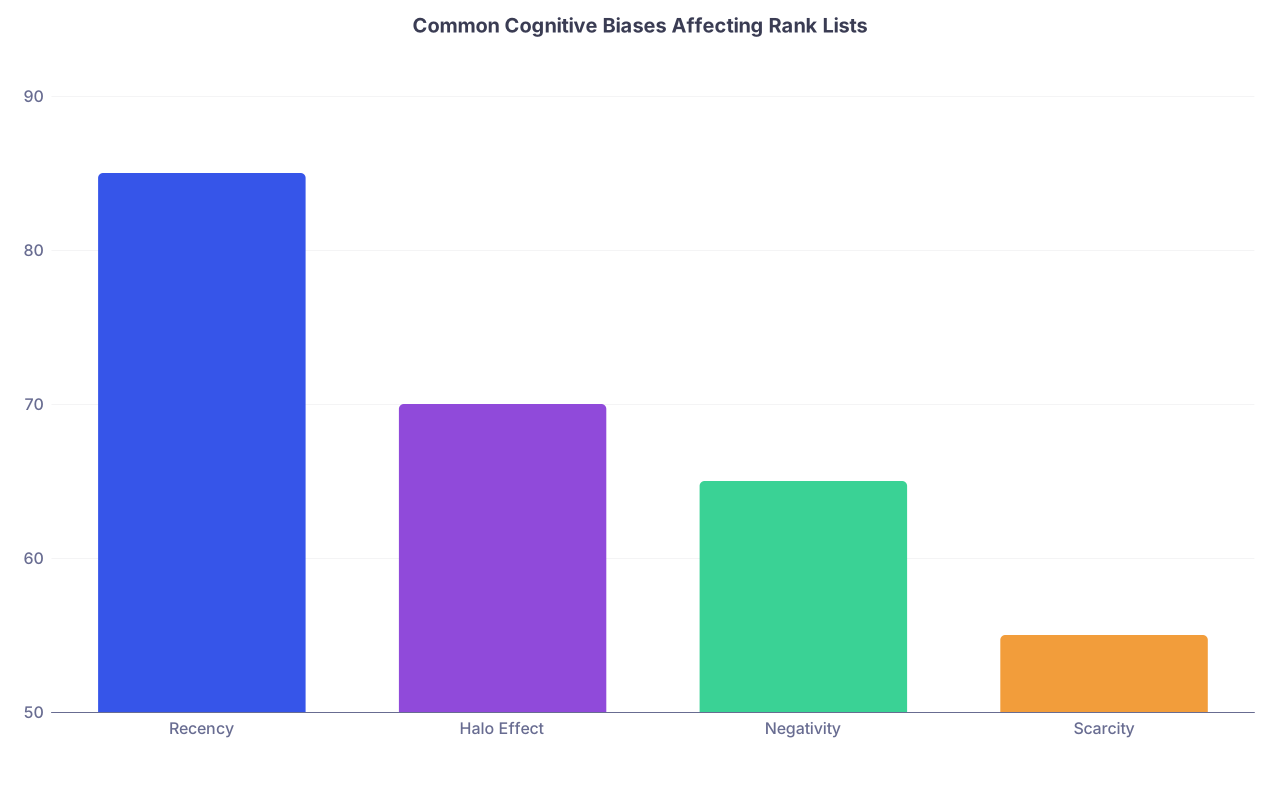
| Category | Value |
|---|---|
| Recency | 85 |
| Halo Effect | 70 |
| Negativity | 65 |
| Scarcity | 55 |
1. Recency bias
Last few interviews feel the “best” just because they’re freshest.
You: “The January programs were so much stronger than the November ones.”
Reality: you just remember them better. And you’re less rusty with your answers.
Counter move:
Force yourself to write a structured reflection the same day or night of each interview. If you didn’t do that, do a “memory refresh” now using emails, notes, and website details to resurrect earlier programs before you finalize your list.
2. Halo effect
One thing you loved or hated becomes the entire story.
- Loved: fancy new hospital, charismatic PD, great lunch, free hotel
- Hated: gloomy building, one rude resident, weird group dynamic in one breakout room
Your brain converts that into: “This place is amazing” or “this place is trash.”
Counter move:
Ask: “If I remove that one feature/interaction, what’s left?”
If you strip away the halo (or the shadow), is the curriculum strong? Do they graduate competent residents? Are call schedules humane-ish? Do they support fellowships if you want them?
3. Negativity bias
One bad moment dominates ten neutral or good ones.
You might have had 7 pleasant conversations and one awkward faculty who low-key grilled you about your Step score. Guess which one your brain keeps replaying at 2 a.m.
Counter move:
Force yourself to list at least 3 concrete positives and 3 concrete concerns for each program. If you can’t think of more than 1–2 actual negatives, that “awful” day may not have been so awful.
4. Scarcity / desperation thinking
“I have to put this place high or I might not match.”
This comes up especially after a rough season, low interview count, or no “prestige” invites. A program that felt lukewarm suddenly becomes “my only real shot.”
Counter move:
Remember how the algorithm works: you’re not punished for ranking reach programs higher. You don’t “lose” safer programs by being honest. You only lose if you rank based on fear instead of preference.
A Simple Framework So One Day Doesn’t Dictate Everything
Let’s be practical. You’re anxious and tired. You don’t need a perfect system. You need something that works well enough to keep your lizard brain from running the show.
Here’s one:
| Category | What To Look For |
|---|---|
| Training | Case volume, pathology, autonomy |
| Culture | Resident happiness, support, mentorship |
| Location | Cost of living, support system, safety |
| Outcomes | Fellowships, jobs, board pass rates |
| Lifestyle | Call, schedules, wellness, benefits |
Step 1: Separate feelings from facts
Take each program and do this on paper or a doc:
“Facts” column:
- Call schedule, patient population, fellowship match outcomes, board pass rate, city, cost of living, program size, specific rotations.
“Feelings” column:
- “I felt really seen by the PD.”
- “Residents looked exhausted.”
- “Everyone was awkward on zoom and no one asked me questions.”
Both columns matter. But they shouldn’t be weighted equally.
Step 2: Create a “non-negotiables” list
Not preferences. Non-negotiables. Things that, if missing, would make you resent training:
- Close to a partner / kids / support system
- Reasonable call (for that specialty)
- Not clearly malignant
- Visa support, if you need it
- Specific type of training (e.g., county safety-net vs private, level 1 trauma, etc.)
If a program fails 1–2 non-negotiables, it doesn’t matter how “warm” the interview day felt. It belongs lower. Maybe way lower.
Step 3: Then let vibes break ties
Once you’ve sorted programs based on big-picture fit and non-negotiables, then you’re allowed to use your emotional data.
If two programs are similar on:
- Training
- Lifestyle
- Location acceptability
And you just clicked better on one interview day? Fine. Rank that one higher. That’s rational, not emotional chaos.
Red Flags vs “Bad Vibes”: They’re Not The Same
This part matters, because sometimes what feels like “one emotional day” was actually your instincts picking up real problems.
Real red flags from interview days I’ve seen:
- Residents openly warn you: “Honestly, we struggle with support from leadership.”
- PD brags about “weeding out weak residents.”
- Nobody can answer “what do you do for fun outside of work?” because they seem to have no life.
- You hear stories of residents doing attending-level work unsupervised on night float.
- Multiple residents mention burnout, depression, or people leaving the program.
Those are not “I was just anxious that day.” Those are data. You should absolutely let that reshape your rank list.
Versus “bad vibes” that are often just noise:
- One uninterested resident on Zoom who looked at their phone a lot
- An awkward 5-second silence in an interview
- Someone mixing up your name (annoying, but not predictive of abuse)
- Weather sucked that day and you hated the city more because of it
Don’t ignore your gut about real toxicity. But don’t let your brain fake red flags just because you felt off that day.
But What If I Already Messed It Up?
This is the 3 a.m. thought, right?
“What if I already sent in my list and I was wrong and I’ll be miserable and it’s my fault forever.”
Here’s the reality no one says out loud: almost everyone thinks they messed up their list at some point before Match Day. Even people who later end up exactly where they’re supposed to be.
You’re making a massive decision with imperfect information. Of course it feels wrong. Of course your brain is trying to re-run every scenario and simulate every alternate universe.
But:
- The Match algorithm is designed to honor your true preferences, not punish your boldness
- Most ACGME-accredited programs will train you well enough to become competent
- Career happiness long-term is influenced by way more than your PGY-1 ZIP code
- People thrive in “backup” programs all the time and crash in “dream” ones
You might not build the “perfect” list. Nobody does. But you can absolutely build a good enough list that reflects more than how you felt on one random Tuesday in January.
And that’s usually enough.
A Quick Sanity Check Tool (If You’re Still Spinning)
Here’s a small mental exercise you can actually do tonight.

| Step | Description |
|---|---|
| Step 1 | List Programs by Gut Feeling |
| Step 2 | Check Non-Negotiables |
| Step 3 | Move Those Lower |
| Step 4 | Compare Training & Outcomes |
| Step 5 | Adjust Based on Training Fit |
| Step 6 | Use Vibes to Break Ties |
| Step 7 | Finalize Rank List |
| Step 8 | Any Program Fails Non-Negotiables? |
Then ask yourself three questions:
- If I matched at my #1, would I be relieved?
- If I matched at my #3, would I still feel okay about where I’ll train?
- Did I put any program higher than I’d be truly okay living in for 3–7 years?
If you answer yes, yes, and no (respectively), your list is probably a lot safer than your anxiety is telling you.
You Won’t Always Feel This Panicked About It
Right now everything feels permanent and high-stakes and irreversible. Like you’re one click away from ruining everything.
Fast forward two or three years. You’ll be complaining about night float, figuring out which attending terrifies you the least, and arguing about whose turn it is to admit the train wreck in bed 12. You’ll be living your residency, not obsessing over the exact position you put Program #4 and #5 in.
And weirdly, the emotional intensity of those interview days? It fades. You’ll remember flashes. Some comments. A resident who told a funny story. But that outsized emotional weight it has right now—this idea that one day could ruin your whole future—will shrink.
You’re not supposed to have perfect clarity right now. You’re supposed to make the best decision you can with the information you’ve got, protect yourself from obvious danger, and accept that some uncertainty is baked into this whole process.
Years from now, you’ll barely remember which day felt magical and which one felt off. You’ll remember the people you trained with, the patients who changed you, and the fact that you kept moving forward even when the stakes felt unbearable.