
What if you rank your true #1 first… and the algorithm somehow “wastes” your chances and you end up unmatched?
That’s the fear, right? That sick feeling that the NRMP Match algorithm is this mysterious black box that will punish you for being honest. That if you don’t “game” it, you’ll lose. That one wrong decision in your rank list ordering could screw up the next 3–7 years of your life.
You’re not crazy for thinking this. I’ve heard every version:
- “If I rank that reach program #1, will I lose my safer options?”
- “Should I rank the program that said they’ll rank me highly first, just in case?”
- “If I love a place but think they don’t love me back, am I being stupid ranking it high?”
- “Can the algorithm tell I’m being ‘too picky’ and punish me with a SOAP?”
Let me be really blunt:
The algorithm does not reward strategy games.
The only “strategy” it rewards is: rank programs in the true order you want them.
And any time you deviate from that because you’re scared, you’re actually increasing your risk of landing somewhere you don’t want… or scrambling.
How the Algorithm Actually Treats You (Not How Your Anxiety Says It Does)
Let’s talk about what the algorithm does in practice, in human language, not NRMP-speak.
The Match algorithm is applicant-proposing. Which means: it tries to get you the highest-ranked program on your list that also has a spot and is willing to take you.
It doesn’t get “offended” if your #1 doesn’t want you. It doesn’t penalize you for swinging high. It just… moves down your list.
Think of it like this:
- First, it assumes you get your #1 choice.
- If that program doesn’t have room for you (or likes other applicants more), it doesn’t say “welp, too bad.”
It says: “Okay, what’s next on your list?” - Then it tries #2. If that fails, it tries #3. And so on.
At every step, it’s trying to give you the best possible option according to your own list, not according to what’s “realistic,” not according to where you interviewed best, not according to who “likes you.”
Your brain is doing this:
“If I put a reach program first, I’ll miss out on safer ones.”
The algorithm is doing this:
“I’ll try the reach first. If that doesn’t work, I’ll try the safer ones the exact same way I would have if they were higher.”
You don’t lose anything by putting a reach higher. You only lose something when you artificially move it lower.
The Most Common Fear Scenarios (And Why They Backfire)
I’m going to walk through the exact horror stories people imagine. Because that’s usually what’s driving the temptation to “outsmart” the system.
1. “If I rank my dream program #1, I’ll blow my shot at my backup”
Scenario you’re probably picturing:
You love Program A (reach), like Program B (safer), and can live with Program C (safety). You tell yourself:
“If I rank A first and they don’t want me, I’ll somehow lose B, and I’ll end up at C… or unmatched.”
So you think:
“Let me be ‘smart’ and put B first. Just in case.”
What the algorithm actually does if you rank honestly:
Rank list: A > B > C
- It tries to place you at A.
- If A has you high enough on their list, you’re in. End of story.
- If not, you’re tentatively rejected there.
- Then it tries B.
- If B would have taken you at all, they’ll still take you here.
- If B also can’t take you, it moves to C, just like it would have if they were higher.
There is no scenario where ranking A first makes B less likely… if B would ever take you at all.
The only way you “lose” B is if you rank B below a program you actually like less, or below a program that won’t rank you at all and you run out of options. That’s not the algorithm. That’s you changing your order based on fear.
2. “This program basically promised to rank me high. Shouldn’t I rank them first to be safe?”
Ah yes. The famous “We’re ranking you highly” email. Or the “You’ll do very well here” wink. Or the “You’d be a good fit” comment that suddenly sounds like a binding contract at 2 a.m.
Here’s the ugly truth:
Programs say things. People interpret them as guarantees. The Match doesn’t care about any of it.
The algorithm doesn’t say:
“Oh, this PD sent a nice email, let me bump this applicant up.”
It only uses two things:
- Your rank list
- Their rank list
That’s it. The sweet talk doesn’t get coded in anywhere.
So if you love Program X but Program Y is the one reassuring you the most? And you panic and put Y first because they “feel safer”?
You’ve just:
- Given up a chance to end up at your true #1 (X)
- For a program you like less (Y)
- Based on words that do not get fed into the algorithm
It’s like picking a life partner based on who texted back faster, not who you actually want to spend your life with.
3. “Ranking honestly feels reckless. What if I go too ‘top heavy’ and end up unmatched?”
This one is real. Being unmatched is a very real fear. Especially in competitive specialties or if your application has some dings (low Step, failed exam, red flags, limited interviews, etc.).
But this is where people misunderstand what “honest ranking” means.
Honest ranking does not mean:
- Putting 10 hyper-competitive reach programs at the top
- Then not listing realistic programs at all
- Then acting shocked in SOAP
Honest ranking does mean:
- Every program you list is somewhere you’d actually attend if it were your only option.
- The order reflects how much you actually want them.
- You don’t push down realistic programs just because you’re “supposed” to chase prestige.
So if your list is:
- Crazy reach you interviewed at and loved
2–5. Solid mid-tier programs where you’re competitive
6–10. Safeties that are still acceptable to you
That’s an honest, safe rank list.
What’s unsafe?
- Leaving off safeties you’d be okay with because they bruise your ego
- Only ranking “dream” programs and pretending your application is something it’s not
- Ranking places you’d honestly hate above programs you’d be content at, just for status
The danger isn’t ranking a reach #1.
The danger is shortening your list, or misordering it, because you’re trying to act like a different version of yourself.
Why Dishonest Ranking Hurts You, Not the Algorithm
Let me be harsh for a second.
The algorithm doesn’t care if you’re miserable at the program you ranked first. It cares that it placed you according to your own list.
If you put a place you “should want” at #1 — prestige, location, pressure from mentors — and you get it… the algorithm chalks that up as a win.
You’re the one who has to live that residency. On those call nights. With those co-residents. With that leadership. In that city.
And yes, I’ve seen it:
- The person who ranked a “Top 10” program first over a solid, supportive mid-tier they actually loved.
They matched at the prestige place. Burned out. Hated the culture. Felt trapped. - The applicant who bumped a community program they adored down their list because they felt judged by classmates.
Matched at their “impressive” name-brand program. Spent PGY-1 fantasizing about switching. - The person who didn’t rank a program they were “too good for,” then went unmatched and SOAPed into something much worse than that “beneath me” option.
The algorithm is ruthless but fair. It gives you what you ask for.
The only defense you have is to be brutally honest about what you actually want and can live with.
A Quick Reality Check: How Risky Is Your Situation Really?
Sometimes the ranking anxiety is coming from a real place (few interviews, red flags, competitive specialty). Sometimes it’s just catastrophizing.
Here’s a simple snapshot to ground you:
| Situation | Risk Level | What You Should Do |
|---|---|---|
| 15+ interviews, non-competitive specialty | Low | Rank honestly, long list |
| 8–14 interviews, average applicant | Moderate | Rank honestly, include all acceptable |
| 5–7 interviews, weaker metrics | Higher | Rank **all** you’d attend, no ego cuts |
| 1–4 interviews, competitive specialty | Very High | Rank every program, prepare for SOAP |
| SOAP-eligible concerns (fails, gaps) | High | Get advisor input, maximize list |
This isn’t gospel, but it’s roughly how many advisors think.
The point: whatever your category, honest ordering still wins. Your risk level only affects how many programs you should rank, not whether you should reorder them based on guesses.
The One Thing You Should Be Strategic About
The only “strategy” that makes sense is this:
Don’t put any program on your list that you would truly rather go unmatched than attend.
Because if you match there and then tell yourself, “I would have rather SOAPed than come here,” that’s on you.
If there’s a program where:
- You felt unsafe
- You saw serious toxicity
- You’d be isolated (no support, terrible location for you, etc.)
- Your gut screamed no
You’re allowed to leave it off your list entirely. Even if someone told you “just throw it on for safety.”
Honest ranking includes being honest about your hard no’s. Not just your favorites.
Emotional Part: Why This Feels So Hard
Let’s admit the emotional part of this. Because logically, once you understand the algorithm, honest ranking is obviously right.
But emotionally? It feels like:
- You’re tempting fate if you put a big reach first.
- You’re being naive if you trust that programs will rank you reasonably.
- You’re irresponsible if you don’t “play the game” like everyone says.
There’s also this quiet, ugly thought some people have:
“If I don’t match at my dream place, I want to be able to say, ‘Well, I didn’t really try. I played it safe.’”
Self-protection. If you rank your true #1 first and don’t get it, it stings. You have to admit: “They didn’t want me enough.” That hurts.
So you hide behind “strategy.”
But hiding doesn’t change where you end up. It just adds regret.
You know what stings worse than not matching at your #1?
Matching at #3 and realizing you would have gotten #2, but you dropped it lower because you convinced yourself you “weren’t competitive enough” — and found out later they ranked you high.
I’ve watched that happen. It’s sickening.
How to Build Your Rank List Without Losing Your Mind
You want something concrete to do so you’re not just spinning.
Here’s a straightforward, anxiety-friendly process:

| Step | Description |
|---|---|
| Step 1 | List All Programs You Interviewed At |
| Step 2 | Cross Off Hard No Programs |
| Step 3 | Sort Remaining By Gut Preference |
| Step 4 | Reality Check With Advisor or Senior |
| Step 5 | Adjust Only If Gut Still Agrees |
| Step 6 | Enter Exact Order Into Rank List |
| Step 7 | Do Not Reorder Based on What Ifs |
You’ll notice there’s no box that says:
“Reorder based on who you think likes you most.”
Because you’re guessing. And your guesses are usually wrong.
Instead:
- Make a list of every place you interviewed.
- Cross off only the true hard no’s.
- For the rest, put them in order based on where you’d be happiest if everything else were equal.
- If you’re really anxious, have a trusted advisor look at your list and say, “Yep, this matches who you are,” or, “Here’s what I’d check in with yourself about.”
- Then lock it in. Close the tab. Stop rearranging.
Visualizing How Safe Honest Ranking Actually Is
If you’re a data brain, this might help.
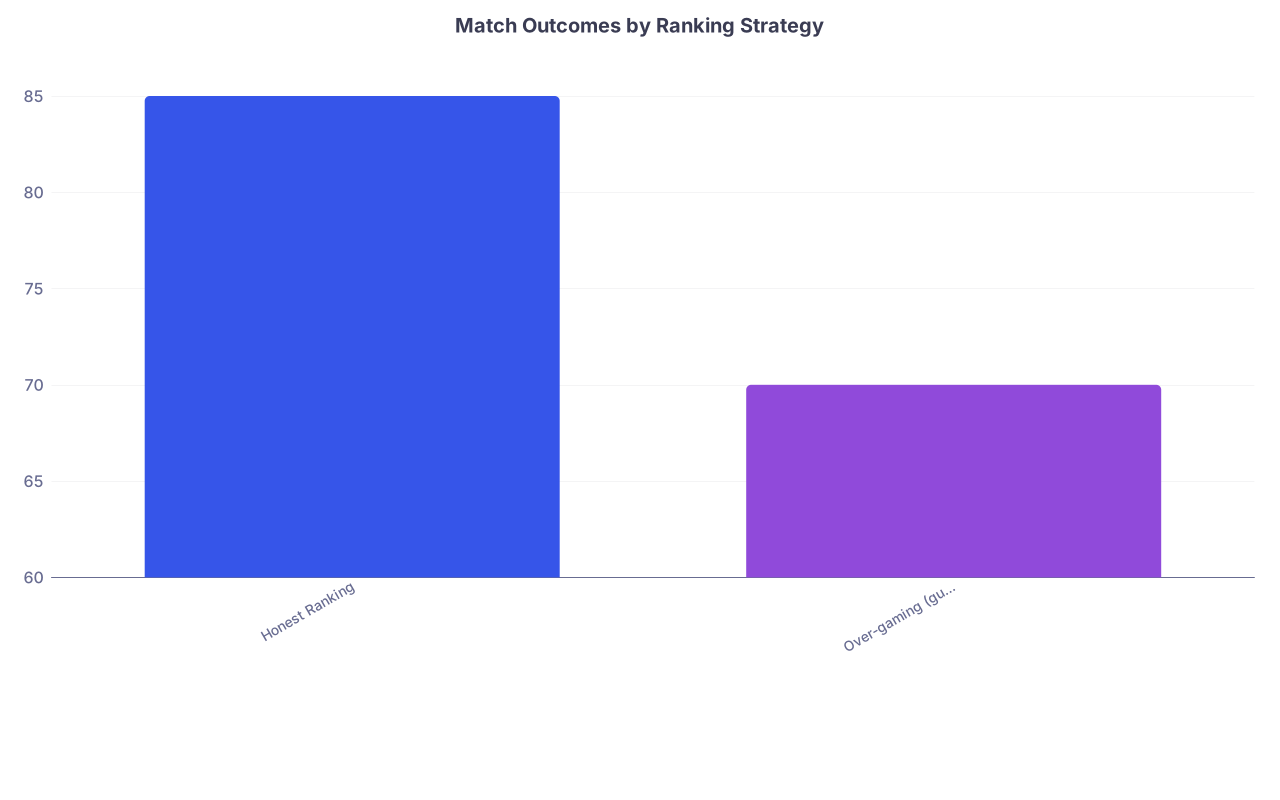
| Category | Value |
|---|---|
| Honest Ranking | 85 |
| Over-gaming (guessing program interest) | 70 |
These numbers are illustrative, not from a specific study, but they capture something admissions people see every year:
Applicants who rank honestly usually end up closer to their genuine top choices.
Applicants who try to game the system often slide lower than they needed to.
Because when you rank out of fear, you’re no longer asking: “Where do I actually want to be?” You’re asking: “How do I avoid disappointment?” And the algorithm can’t optimize against your fear. Only your list.
What You Can Actually Control
You cannot control:
- Where programs rank you
- Who else is in the applicant pool
- How many spots magically open up
You can control:
- Which programs you rank
- The order you put them in
- Whether that order reflects your real preferences
The whole system is already stacked in favor of programs. The one small structural protection you get is that it’s applicant-proposing. It’s literally biased toward your list.
Don’t voluntarily give that up.
FAQ: Honest Ranking and the Match (Exactly 5 Questions)
1. If I rank a super competitive program #1, will that hurt my chances at my realistic #2?
No. If your #1 can’t or won’t take you, the algorithm just moves to #2 and treats it as if it were your first choice. You don’t get “penalized” for trying the reach first. You only hurt yourself if you push your true favorite down the list based on fear.
2. Should I rank a program higher because they told me “we’re ranking you to match”?
Absolutely not. That email or comment doesn’t get plugged into the algorithm. Only their actual rank list does. If they like you enough, they’ll rank you highly regardless of where you rank them. Your only job is to order programs by where you honestly most want to go.
3. Is it risky to rank only a few programs where I’d be truly happy and leave off everything else?
Yes, that can be risky, depending on your situation. It’s fine to leave off true hard no’s. But if you’re in a competitive specialty or you don’t have many interviews, cutting “less ideal but still acceptable” programs from your list increases your unmatched risk more than ranking them low ever would.
4. Can programs see where I ranked them or if they were my #1?
No. Programs do not see your rank list order. They don’t know if you ranked them first or tenth. You gain nothing by flattering them with a higher rank, and you don’t harm any relationship by ranking according to your true preferences.
5. I’m terrified of regretting my list. How do I know when to stop changing it?
Use this test: Look at each pair of programs on your list. For every A above B, ask, “If I matched at B instead of A, would I feel a little disappointed?” If yes, A should stay above B. Once your list passes that gut check all the way down — and you’ve removed true hard no’s — stop. Enter it. Save. Log out. Any further changes are almost always anxiety, not wisdom.
Open your draft rank list right now.
Look at just your top three programs and ask yourself:
“If the algorithm guaranteed I’d match at any one of these, with zero risk, what order would I want them in?”
Put them in that order. Then, do the same for the rest of the list.