
You didn’t fail the Match. You survived a rigged-feeling game that was never built to care about your ego.
Let me just say the quiet part out loud: matching far down your rank list feels like failure. It feels like public proof that programs didn’t want you. It feels like, “Everyone else did better than me.” It feels like all the sacrifices bought you the discount version of your dream.
And you’re probably too embarrassed to say that to your classmates, because everyone is posting “SO GRATEFUL!!! #Blessed #FirstChoice” on social media like they didn’t spend months refreshing their email in a cold sweat.
So I’ll say it for you: matching at #8… or #15… or literally the last program on your list… hurts. It messes with your head.
But no, it does not mean you failed. Not mathematically. Not professionally. Not in how program directors see you.
Let’s drag this out into the light.
How the Algorithm Actually Treats You (Versus How Your Brain Thinks It Works)
The Match algorithm is applicant-favoring. Everyone says that. No one emotionally believes it.
Your brain thinks it works like:
“Top applicants match high; weaker applicants fall down their list.”
That’s wrong. That’s not how the algorithm behaves in real life chaos.
Super simplified: the algorithm tries to put you in the highest-ranked program on your list that also has a spot for you. The “rank number” you end up at isn’t a score. It’s a collision between:
- Where you ranked programs
- Where they ranked you
- How they ranked everyone else
- How every other applicant ranked their programs
It’s like trying to interpret your worth from where a single droplet of water lands in a thunderstorm.
To make this less abstract, imagine two applicants:
| Applicant | Rank List Position Matched | How Programs Saw Them (hypothetical) |
|---|---|---|
| A | #2 | Ranked mid-list at a very competitive top program |
| B | #12 | Ranked solidly mid-list at many mid-tier programs |
Applicant A matches at #2 and posts a humble-brag paragraph.
Applicant B matches at #12 and spends a week spiraling.
But you can’t conclude A is “better” than B. Sometimes, the applicant who matches at #12 had more interview invites and better scores—but their preferences clashed with how programs grouped their own lists.
The algorithm doesn’t care if a program was your dream, your backup, or an afterthought. It just cares about mutual ranking and seat availability. You falling to #12 means this:
- Programs you ranked higher didn’t simultaneously have an open slot and have you high enough to bump someone else.
- At #12, that program did.
It’s not a personal insult. It’s combinatorics.
The Shame Spiral: “Everyone Knows I Wasn’t Wanted”
Let’s be honest: the part eating you alive isn’t just “I matched low.” It’s “People will know I matched low.”
You’re imagining:
- Your classmates whispering, “Oh, that program? Kinda mid.”
- Faculty silently judging your potential.
- Residents in competitive specialties thinking you “couldn’t cut it.”
Here’s the ugly truth: by week two after Match Day, almost no one cares what number the program was on your list. They’re barely holding their own lives together.
Most people only remember:
- Where you matched
- What specialty you’re doing
- Whether you seemed happy or devastated on Match Day
That’s it.
Program directors? They never see your rank list. They don’t know if you ranked them #1 or #17. They literally can’t tell if they were your “safety” or your dream. They just see: “This person committed to us. They’re ours now.”
What you’re really dealing with is the internal story:
“I wasn’t chosen by who I really wanted. I was someone’s backup. I was second-tier.”
Painful? Yes. Evidence you failed? No.
Does Matching Low Ruin Fellowships, Jobs, or Your Future?
Blunt answer: No. Not by itself. But how you respond to it absolutely can.
Here’s what I’ve seen actually matter in residency:
- Your clinical performance
- Your reputation: reliable, teachable, not toxic
- Letters from attendings who can say, “This person is phenomenal”
- Any research/leadership/teaching you build during residency
- Your Step/board performance if still relevant in your field
Where you matched on your rank list? No one asks. Not for fellowship. Not for jobs. They care about:
Where did you train? What did you do there?
I’ve seen:
- Someone match at their “dream big-name place” and completely burn out, get neutral letters, and then struggle to land the fellowship they wanted.
- Someone match at a “mid-tier, farther down the list” program, crush it clinically, become chief resident, and walk into an elite fellowship.
Fellowship directors read:
“PGY-3 Internal Medicine, University of X. Outstanding letters, high professionalism, great evaluations.”
They don’t read:
“Matched this program #14 and cried about it for 3 months.”
To be brutally honest, programs and fellowships are too busy to care about your emotional backstory. They care about your output.
But What If I Hate Where I Ended Up?
That’s the real nightmare scenario in your head, right? Not just low on the list—but low and miserable.
Two things can be simultaneously true:
- You didn’t fail by matching far down your list.
- You still might land somewhere that isn’t a great fit for you.
Those are separate issues.
Most residencies are not cartoonishly awful. More often it’s:
- Not your preferred city
- Less academic than you wanted
- Heavier workload than advertised
- Culture that’s “fine” but not “home”
And most residents, after the initial shock, eventually build:
- A small group of people they trust
- Workarounds to get what they need (research, mentorship, electives)
- A path to the next step that works, even if it’s not glamorous
The people who actually get screwed aren’t the ones who matched low on their list. It’s the ones who decide:
“This place is beneath me. I’m going to half‑try and blame the program for everything.”
That attitude bleeds into your evals, your letters, and your daily life. You become the person no one wants on their team. And that can tank your future.
Matching somewhere that wasn’t your top choice isn’t a death sentence. Refusing to engage because it wasn’t your top choice… that’s the real danger.
The Numbers Problem: Why So Many People Match Lower Than They Expected
You’re probably also wondering: “But why me? Why did I fall so far down when I thought I was a decent applicant?”
Because the whole system is bloated with anxiety and over-application.
Look at what’s actually happening:
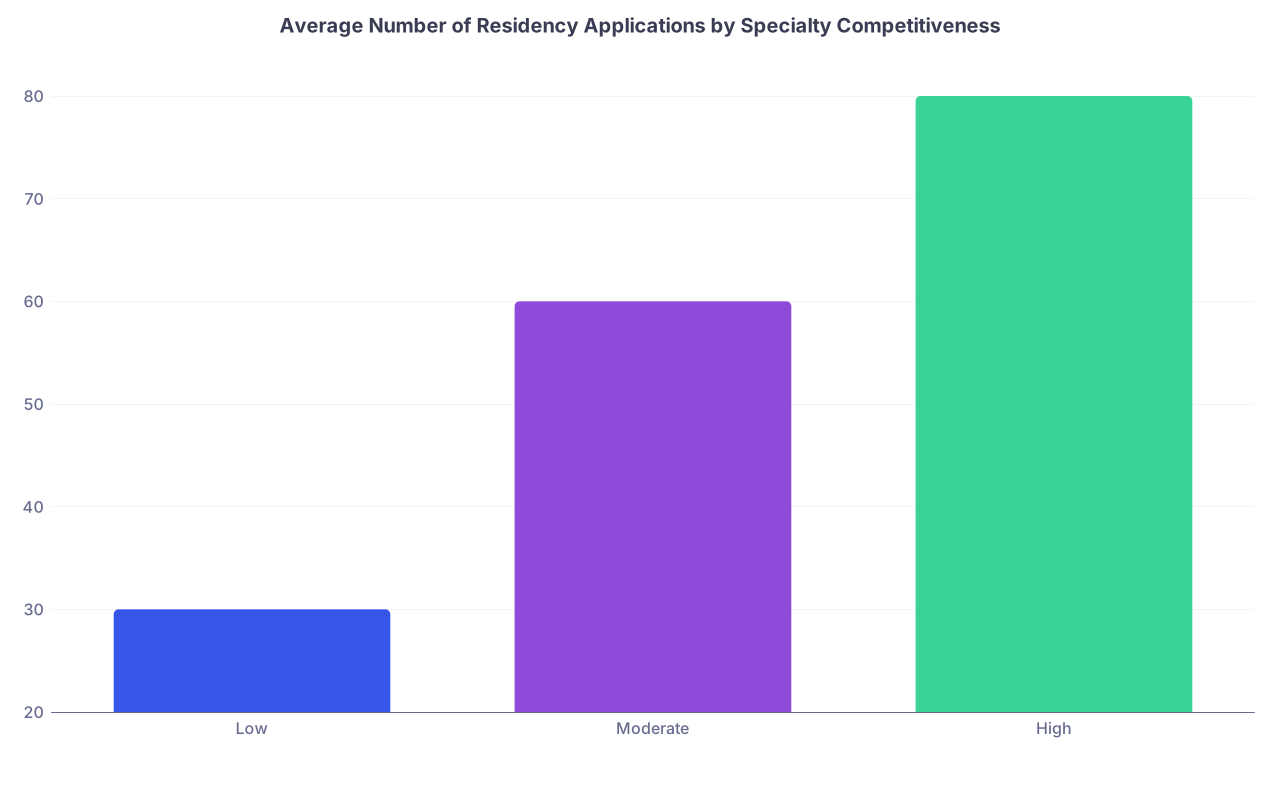
| Category | Value |
|---|---|
| Low | 30 |
| Moderate | 60 |
| High | 80 |
Applicants shotgun 50, 70, 100+ applications. Programs get buried. They use:
- Step scores
- Home/away rotations
- Research
- Random institutional preferences
…to batch people into tiers. Then within those tiers, tiny differences, timing, and pure chance affect your rank spot.
You may have been:
- In the middle of a huge blob of similarly strong applicants
- Slightly weaker on a single metric (Step 2, research, whatever)
- Coming from a lesser-known school where fewer faculty pick up the phone for you
None of that is “you’re bad.” It’s “you’re in a noisy, overloaded system where no one has time to know you as a full human.”
So your path didn’t curve elegantly to #1 or #2. It dropped to #9. Or #14. Or last.
Still matched. Still training. Still a physician.
The Match is binary: Did you match or not? Once you’re on the “matched” side, where exactly you landed stops mattering way faster than your brain wants to believe.
What You Can Actually Do Now (Instead of Just Ruminating)
None of this instantly erases the sting. You’re still going to have nights where you stare at the ceiling thinking, “What if I had just ranked X higher?” or “What if I hadn’t bombed that one interview?”
But here’s where you have some control again.
First, give yourself permission to grieve. You lost a version of your future you’d built in your head. That sucks. You don’t have to pretend you’re thrilled.
Then, over the next months, quietly start doing three things:
Mine the program for what it actually offers.
The name may not be shiny, but maybe it has crazy good hands-on experience, or tons of autonomy, or attendings who actually like teaching. Figure out where the hidden value is instead of obsessing over what it’s not.Find your people early.
One co-intern you can be real with is worth more than ten acquaintances at your hypothetical top choice. Shared suffering bonds people fast. Use that.Protect your reputation like it’s currency.
Show up prepared. Be humble. Own your mistakes. Ask for feedback. If someone says, “I love working with them,” that matters more than whether your Match result was “impressive.”
And if, after you’ve really tried, the program is actually toxic? Not “not perfect”—but really toxic?
Then yes, people transfer. It’s not common. It’s not easy. But it exists. You’re not trapped in hell with no exits.
A Quick Reality Check of the Alternative
Let’s flip the anxiety for a second.
Imagine you didn’t match. Imagine you were in SOAP or fully unmatched week. Scrambling for any spot. Redoing this entire year with the same anxiety plus a fresh layer of shame.
Would you really trade “matched at #15 on my list” for “unmatched”?
Honestly?
Most people who go through SOAP would’ve killed to be in your “I matched lower than I wanted” shoes. That doesn’t invalidate your disappointment—but it does reframe it.
You did not fail. You cleared a brutal hurdle that many, many smart, hardworking people don’t clear on the first attempt.
Your ego may have taken a hit. Your trajectory didn’t.

| Stage | Activity | Score |
|---|---|---|
| Match Week | Shock and Comparisons | 3 |
| Match Week | Private Disappointment | 4 |
| Early Residency | Overwhelmed but Learning | 4 |
| Early Residency | Finding Support System | 3 |
| Later Residency | Growing Confidence | 4 |
| Later Residency | Focusing on Next Step | 5 |
FAQ: Obsessive Questions You’re Probably Still Asking Yourself
1. Do programs know where they were on my rank list?
No. They never see it. They don’t know if you ranked them #1 or dead last. They get a list from NRMP that says, “These are your matched residents.” That’s it. Any story you’re telling yourself about them thinking you “settled” is you projecting, not them judging.
2. Will fellowship directors think less of me because my residency isn’t top-tier?
They’ll look at where you trained, sure—but then they’ll dig into what you did there. Think: letters, evaluations, board performance, research, leadership. I’ve seen people from non-brand-name programs match insanely competitive fellowships because their letters were glowing and they built a strong narrative. Prestige helps at the margins, but hustle and performance win.
3. Is it worth trying to transfer to a “better” program?
Sometimes. If the issue is geography (family, partner, health) or true toxicity, transfer can be reasonable. But if the primary reason is “I’m embarrassed this wasn’t high on my list,” that’s not a great foundation. Transfers are work, not guaranteed, and can create new instability. Build a year of solid performance first. Talk quietly with trusted mentors, not your entire group chat.
4. Should I tell people this program was far down on my list?
Honestly? No. There’s almost no upside to broadcasting that. You can say, “I’m excited to train at X” and still privately recognize it wasn’t your first choice. You don’t owe anyone your rank list. The people who need to know you’re struggling are close friends, family, and maybe a therapist—not your whole class or future colleagues.
5. Will I always feel this disappointed about where I matched?
Probably not. Early on, the emotional volume is at 10/10. You’re comparing constantly. By the middle of intern year, your brain is too fried to maintain that level of rumination. You’ll be focused on surviving call, not on “what # this program was.” For most people, the sting fades and is replaced with, “This is my place, these are my people, this is my reality.”
6. Bottom line—did matching far down my list mean I failed?
No. It means your expectations, preferences, and the chaos of a national algorithm didn’t line up neatly. You still got the one thing that matters: a residency position in your specialty. Your career will be built far more on what you do from now on than on where on a spreadsheet your program sat back in February.
If you remember nothing else:
- Matching low on your list is an ego bruise, not a career-ending disaster.
- Programs, attendings, and future employers care what you do in residency, not how high they were ranked.
- You didn’t fail the Match. You cleared it. Now the real work—and the part you actually control—starts.