

Post‑interview “love letters” matter far less than most applicants think—and in many programs they matter not at all.
Let me be blunt: a careful, honest rank list beats any follow‑up email theater. Program directors are not sitting in a dark office rearranging their rank lists because you wrote, “You’re my #1.”
You’re up against myths, peer pressure, and a cottage industry of “strategy tips” that sound clever and feel proactive—but are mostly noise. Let’s strip this down to how ranking actually works and where, if anywhere, love letters move the needle.
What Programs Actually Do After Interviews
First, the mechanics. If you do not understand this, love letters will feel way more powerful than they are.
Most programs use some version of this process:
- Interviewers score you (often on a rubric: academics, fit, communication, professionalism).
- Those scores and notes go to a committee.
- The committee meets—with a finite amount of time—and builds a rank list, usually in one or two big sessions.
- The list is certified in NRMP and then mostly left alone.
That’s the core. Where do love letters fit? Often, they don’t. They’re an afterthought at best.

| Step | Description |
|---|---|
| Step 1 | Interviews Completed |
| Step 2 | Interviewer Scores & Notes |
| Step 3 | Rank Committee Meeting |
| Step 4 | Preliminary Rank List |
| Step 5 | Minor Adjustments |
| Step 6 | Certify Rank List in NRMP |
Programs differ, sure, but here’s what I’ve seen and heard repeatedly from PDs, APDs, and chiefs across IM, EM, anesthesia, and peds:
- Some programs ignore post‑interview communication until after their list is done.
- Some skim emails but only use them as a tiebreaker among a small cluster of similar applicants.
- Some keep a “strong interest” column in their spreadsheet—but it’s one of many, not the main driver.
This is the first myth to kill: that love letters are a parallel track to the rank list. They’re not. At most, they’re a footnote to an already‑dominant file and interview performance.
What the Data and Surveys Actually Show
We do not have a randomized controlled trial of “love letter vs no love letter.” But we do have multiple NRMP Program Director Surveys and specialty‑specific surveys on what influences ranking decisions.
Consistently, what matters most:
- USMLE/COMLEX performance
- Clerkship evaluations
- Interview performance
- Perceived “fit”
- Letters of recommendation
- MSPE and transcript
Post‑interview thank‑you or “intent” communications sit near the bottom when they’re even listed.
Here’s a simplified snapshot, pulling from recent PD survey patterns (exact numbers vary by year and specialty, but the hierarchy is stable):
| Factor | Typical Impact on Rank | Frequency of Use by PDs* |
|---|---|---|
| Interview performance | High | Very common |
| USMLE/COMLEX scores | High | Very common |
| Clinical grades / MSPE | High | Very common |
| LORs from known faculty | Moderate–High | Very common |
| Research / scholarly activity | Moderate | Common |
| Demonstrated program fit | High | Very common |
| Post‑interview emails / letters | Low–None | Variable, often minimal |
*“Frequency of use” pulled from patterns seen in NRMP Program Director Survey trends and specialty surveys, not a single magic number.
Notice what’s missing? No box that says: “Student said we’re #1 → move up 15 spots.”
Because that’s not a systematic input. At most, it’s a nudge in a borderline tier.
Where Love Letters Might Matter (And Where They Clearly Don’t)
Let’s split this into three buckets: where they can actually influence something, where they’re minor and limited, and where they’re pure fantasy.
1. Real but modest influence: within a small tier
Some programs create tiers during rank meetings.
Example:
Tier 1: “We’d be thrilled to match these 20 applicants.”
Tier 2: “We’d like these 40.”
Tier 3: “We’re fine with these 60.”
Within a tier, especially Tier 2 or 3, there may be dozens of similar applicants. That’s the zone where a PD might say:
“She sent a specific, thoughtful email about why she likes our global health track, and Dr. X remembers her well—let’s put her above the others in this cluster.”
That’s not hype. I’ve seen it happen. But notice the scale: moving from #43 to #39. Not from #180 to #20. And it only works if:
- You already interviewed well.
- The committee liked you.
- You’re in realistic strike range for that program’s fill zone.
2. Mild signaling: confirming interest, not creating it
Sparse but direct interest can matter more in smaller or borderline programs—community hospitals, less competitive specialties, or newer programs that really worry about filling.
They might track:
- “Applicant gave strong signals of interest.”
- “Applicant said we’re top choice.”
- “Applicant didn’t respond to any outreach.”
But again, this usually refines an existing positive impression. It rarely rescues a bad interview or a weak application.
3. Fantasies: what love letters will not do
They will not:
- Turn a mediocre interview into a “must‑rank‑high” impression.
- Override glaring red flags in professionalism.
- Make a PD defy match ethics and promise you a position.
- Guarantee that a program ranks you to match if you rank them #1.
If you walked out thinking, “I bombed that interview, but I’ll craft the perfect letter,” you’re in magical thinking territory. The letter is not the fix.
The Ethical Mess: NRMP Rules and the Reality on the Ground
Now the uncomfortable part: the rules vs what actually happens.
NRMP policy is explicit:
- Programs may not ask you how you will rank them.
- Programs may not tell you how they will rank you.
- Both sides may send non‑binding expressions of interest, but they cannot offer or solicit guarantees.
So technically:
- “You are my #1 choice” is allowed.
- “If you rank me #1, I will rank you to match” is not.
- “We will rank you very highly” is wandering into a gray, usually frowned‑upon area.
The problem: applicants and programs lie or heavily imply.
I’ve listened to applicants say things like, “They basically told me I was ranked to match,” then not match there. I’ve seen programs say, “We’d be very excited to have you,” to 60 people. It’s meaningless when repeated at scale.
The key myth here:
“Programs are bound by what they say post‑interview.”
They’re not. You’re not. The algorithm does not care what anyone wrote or “promised.” It only cares about the rank lists.
Strategic Reality: What You Should Actually Do
If love letters are mostly noise, that does not mean you should ghost everyone and hope for the best. It just means you stop pretending these emails are some secret lever.
Here’s a rational, low‑BS approach.
1. Separate three things: courtesy, clarity, and desperation
There are three different behaviors people lump together:
- Standard thank‑you emails (courtesy)
- Genuine updates and clarification of interest (clarity)
- Over‑the‑top “I’ll die if I don’t match here” messages (desperation)
Only the first two are useful.
Basic thank‑you messages:
- Short, specific, and polite.
- Sent within a week of the interview.
- Reference 1–2 concrete aspects of the program or conversation.
- Don’t contain ranking promises you’ll later break.
These will not catapult you up the list, but they maintain a professional impression and keep your name anchored in a positive context.
Clarity emails (often later in the season):
- Sent to a small number of programs—ideally ones you’d genuinely be thrilled to match at.
- Update them on anything real: new publication, AOA election, chief nomination, significant accomplishment.
- Express sincere, specific interest, not fluff.
That’s not a “love letter.” It’s just you not being a black box.
2. One true “#1” email—if you can do it ethically
Here’s the controversial but honest stance: if there is one program that is absolutely your top choice and you are 100% certain you will rank it #1, a clear, sincere “you will be my #1” email is reasonable. Programs know applicants say this; some ignore it, some care in that small‑tier sense.
Rules for this:
- Only send it if it is actually true. Lying to multiple programs is garbage behavior. People remember.
- Make it specific: a short paragraph on why this place is best for your goals, not “great vibe, supportive culture.”
- Do not ask for a promise in return.
- Do not rewrite your entire rank list if they never respond.
If you’re not sure who your #1 is? Don’t send any “you’re my #1” messages. Stick to “very strong interest” language instead.
3. Stop trying to game the match with email tactics
The match algorithm favors the applicant’s true preferences. The danger is not that love letters are too weak; the danger is that their psychological pull makes you lie to yourself.
I’ve watched people do this:
- Get a warm fuzzy email from Program B.
- Panic that Program A (their actual dream) was “silent.”
- Move B above A on their rank list because “B seemed more interested.”
Then they end up at B for three to seven years thinking, “I compromised for vibes and emails.”
That’s backwards. Programs rank you based on their needs; you should rank them based on yours. If your #1 never emails you once and your #3 sends you a cupcake and a handwritten note, do not let pastry decide your future.
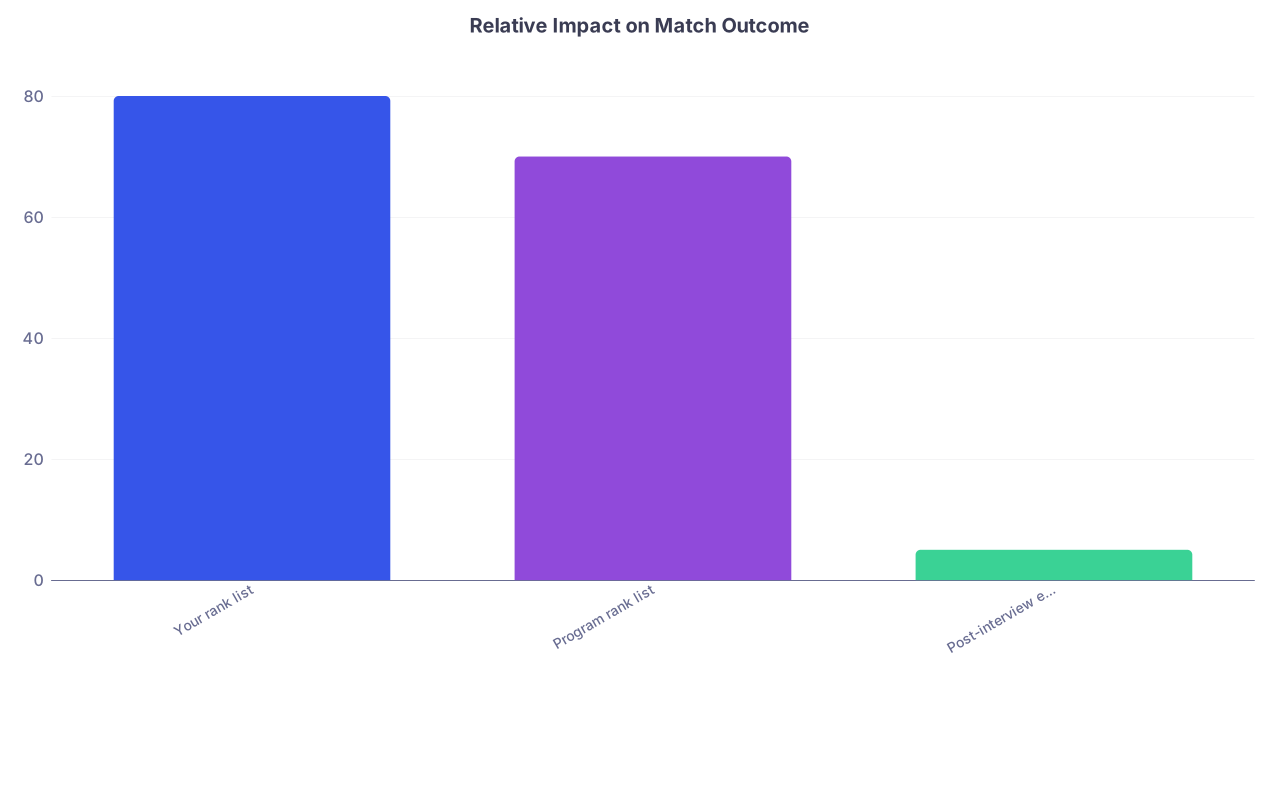
To visualize why email “interest” is a bad primary driver, compare it to what truly affects match outcome:
| Category | Value |
|---|---|
| Your rank list | 80 |
| Program rank list | 70 |
| Post-interview emails | 5 |
Those numbers aren’t literal percentages; they’re relative influence. Your ordered preferences and the program’s ordered preferences dominate. Emails are a barely visible nudge—if at all.
Common Myths About Love Letters—And Why They Persist
Let’s tackle a few specific myths that float through group chats and Reddit.
“If you don’t send a love letter, programs think you’re not interested.”
Reality: Many programs:
- Explicitly say “no post‑interview communication is needed or expected.”
- Are overwhelmed with email volume and hardly track it.
- Assume you’re interested enough because… you applied and interviewed.
If a program requires or heavily signals that follow‑ups matter, they’ll usually say so at the interview day or on their website. Otherwise, the default is: optional courtesy, not a hidden requirement.
“My friend sent a love letter and matched at that program, so it worked.”
Correlation, not causation.
More likely:
- They were already ranked in the matchable range.
- Their interview went well.
- The program liked their file.
- And yes, maybe the letter bumped them a couple of slots inside a tier that would have matched anyway.
No one has visibility into the counterfactual: the same application, same interview, no letter.
“Programs like to see commitment; they’ll rank you higher if they know you’re loyal.”
This is partly true in very specific scenarios:
- Smaller or less competitive programs that worry they’re a backup.
- Rural or community sites where retention and location commitment matter.
- Niche tracks where they want people invested in that path long‑term.
But even there, it’s not the love letter that convinces them. It’s your entire story: geography, past experiences, what you talked about on interview day. The email is just a sentence on top.
When to Skip the Love Letter Theater Completely
You’re allowed to opt out of the game. In several competitive academic programs, I’ve seen PDs state flatly:
“We don’t track post‑interview communication; it will not affect your position on our rank list.”
When you hear that, believe them. If they say it at the pre‑interview meeting or in follow‑up instructions, take the gift:
- Send a basic thank‑you if you want to be polite.
- Otherwise, spend your time actually thinking about your rank list and your life.
Also, if crafting these letters is causing distress, obsessing, or guilt (“Who do I tell I love them? How do I not hurt feelings?”), you can walk away. The mental cost is almost never worth the minuscule tactical benefit.
The Bottom Line: What Actually Matters
Strip out the noise and here’s where reality lands:
Post‑interview love letters have limited, often negligible impact on ranking. At best, they serve as a minor tiebreaker within a small tier of already competitive applicants. They don’t rescue weak files or bad interviews.
One honest, specific “you’re my #1” email can be reasonable—but only if it’s truly your #1. Anything else should stay in the lane of concise thank‑yous and genuine updates, not emotional bargaining or veiled demands.
Your true rank order list matters more than any email strategy. Rank programs in the order you actually want to train, independent of who emailed you back or who “seemed more interested.” The algorithm rewards honesty, not gamesmanship.
Do not let a handful of overwrought emails dictate three to seven years of your life.


