

Will Honest Rank Lists Get You Burned?
What if ranking your true #1 program actually hurts your chances of matching at your “safe” backup? That’s the paranoid script running in a lot of people’s heads in February.
You’ll hear this on every interview trail:
“Be strategic.”
“Don’t waste your top spot.”
“If you rank that reach #1, you might miss out on the place you’re ‘almost guaranteed’ to match.”
This is wrong. Not just theoretically wrong. Mathematically wrong. Empirically wrong. The actual NRMP data and the mechanics of the algorithm shred that fear.
Let me walk through what the matching data really says—and why “gaming” your list is one of the fastest ways to sabotage yourself.
How the Algorithm Actually Works (Minus the Fairy Dust)
The Match isn’t vibes. It’s code.
At a high level, the NRMP algorithm is applicant-proposing, which means it’s literally built to favor your preferences, not the programs’. Here’s the stripped-down version of what happens:

| Step | Description |
|---|---|
| Step 1 | Start with all applicants unmatched |
| Step 2 | Take an unmatched applicant |
| Step 3 | Propose to highest-ranked program not yet tried |
| Step 4 | Temporarily tentatively accept applicant |
| Step 5 | Compare to lowest-ranked accepted applicant |
| Step 6 | Accept new, reject lowest |
| Step 7 | Reject new applicant |
| Step 8 | Rejected applicant becomes unmatched |
| Step 9 | Applicant remains unmatched |
| Step 10 | Match completed |
| Step 11 | Program has open spot? |
| Step 12 | New applicant ranked higher? |
| Step 13 | Applicant has more programs on list? |
| Step 14 | More unmatched applicants? |
Key point: the algorithm tries to give you the highest possible program on your list that is willing to take you. It doesn’t punish you for “reaching.” It doesn’t “lock” you out of backups because you dared to dream.
The only way you “lose” by ranking a reach program high is if you could have matched there but chose not to rank it high. Which happens more than you’d think.
What the NRMP Data Actually Shows About “Honest” Lists
The NRMP doesn’t just publish a cute PDF once a year. They’ve got two documents that matter a lot here:
- The NRMP Program Director Survey
- The Charting Outcomes in the Match / Going Behind the Match analyses
And then there’s the core NRMP Match data and algorithm description.
Let’s talk numbers and patterns, not folklore.
1. Applicants overwhelmingly match high on their lists
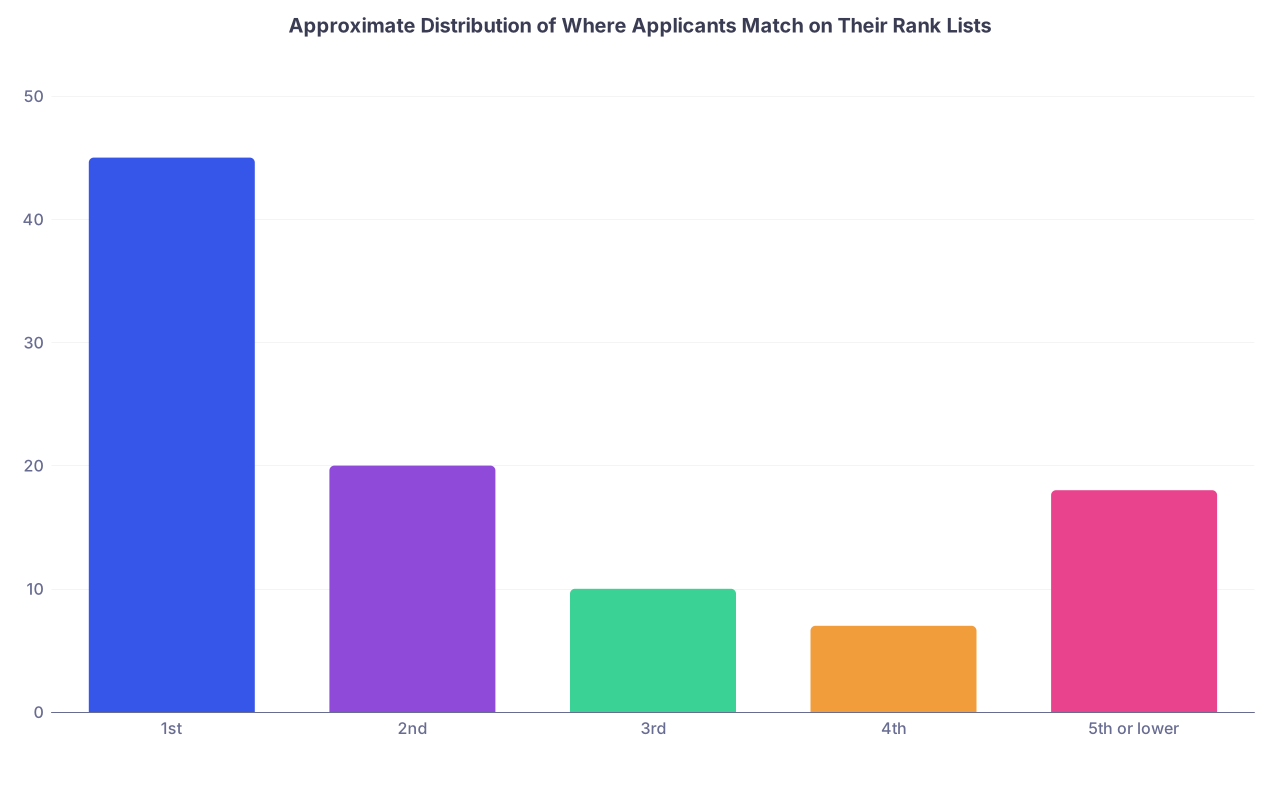
Every year, the NRMP shows a simple distribution: where applicants match relative to their rank list position.
The pattern is insanely consistent:
- Most applicants who match do so in their top 3 ranked programs.
- A huge chunk match at their #1.
| Category | Value |
|---|---|
| 1st | 45 |
| 2nd | 20 |
| 3rd | 10 |
| 4th | 7 |
| 5th or lower | 18 |
These are approximate but realistic ballpark numbers from recent cycles across specialties: the majority of people land where they most wanted to go.
If “honest” rank lists were dangerous, you’d see something very different—lots of people matching at #5–10 because they “overreached” and got burned. That is not what happens.
2. Longer rank lists help you match; “strategic” truncation hurts
NRMP repeatedly shows a simple, unsexy truth: longer rank lists are associated with higher match rates for both US MDs and DO/IMGs.
| Applicant Type | 1–3 Ranks | 4–7 Ranks | 8+ Ranks |
|---|---|---|---|
| US MD Seniors | ~80% | ~92% | ~96% |
| DO/IMG | ~50% | ~65% | ~75% |
You know what shortens lists? Fear-driven “strategy” like:
- “I won’t rank this dream program; I’m sure they wouldn’t take me.”
- “If I rank too many places above my safety, maybe I’ll miss the safety.”
That’s how you quietly drop your match probability for no reason.
The algorithm doesn’t say, “Oh, you ranked 15 places; you’re greedy. I’ll punish you.” It just walks down your list and gives you the highest program that also wants you. Full stop.
3. Program behavior doesn’t change based on how you rank them
Another fear:
“If I tell a program they’re not my #1, or if I rank them lower, they’ll tank me.”
This is fantasy. Programs do not see your rank list when making theirs. They never see it at all unless there’s a SOAP audit years later or some rare situation. The Match is blind at the ranking phase.
Program behavior is driven by:
- Your application strength.
- Your interview performance.
- How you fit their needs (geography, visa issues, couples, niche interests).
- Their own idiosyncrasies and internal politics.
Not by how you construct your list. They don’t know it.
Why “Strategic” Rank Lists Backfire
Let’s walk through the most common myths I hear residents repeat like gospel.
Myth 1: “Don’t waste your #1 on a reach program”
Common scenario:
- You loved Big Academic Center A. You think it’s a stretch.
- You also liked Solid Community Program B and think you’re very competitive there.
- You’re scared that if you put A #1, you’ll somehow lose B.
Here’s what the algorithm will actually do:
- It will try to match you at A first.
- If A doesn’t want you enough, you get rejected on paper and the algorithm moves to B.
- If B wants you, you match at B exactly the same as if you’d ranked B #1.
You do not lose B by trying for A first. You literally cannot. The only way you lose A is by not ranking it above B.
The people who get burned here are the ones who say, “A feels impossible, I’ll put B #1 so I’m safe.” Then they find out later someone with nearly identical stats matched at A.
That sting lasts.
Myth 2: “Programs can tell if they’re your backup and will rank you lower”
No, they can’t. They guess. Sometimes badly.
Programs infer “interest” from:
- Signal tokens (in specialties that use them).
- Geographic ties.
- Emails expressing strong interest.
- Away rotations.
- Whether you did a second look.
- How desperate they are to fill.
But they never see your numeric ranking. If anyone suggests programs “punish” applicants for ranking them lower, they’re confusing the Match with some high school prom committee.
I’ve sat in meetings where PDs say things like, “We’re pretty sure we’re her backup, but she’s excellent; rank her high anyway.” Or the opposite: “He’s probably ranking us #1 but we still don’t want him.”
Your strategy should not be anchored to a fantasy that programs can see your list. They can’t.
Myth 3: “Putting a ‘safety’ #1 locks in your chance”
Another version:
“I’m 99% sure I’ll match at X if I put them first. If I rank Y above them, I might lose X.”
Here’s what the data and math say: if X will take you, and they’re the highest program on your list that will take you, you will end up there—no matter how many “reaches” you rank above.
When I see people burned, it’s almost always because they under-ranked themselves:
- Strong applicant in IM who assumes they can’t match at university programs.
- DO or IMG convinced they have “no shot” at certain regions.
- Non-traditional applicant who thinks their story is a liability when it’s actually their differentiator.
They self-select out. The algorithm is ready to give them more; they handcuff it.
What an “Honest” Rank List Actually Means
“Be honest” doesn’t mean “be naive.” It means this:
Rank programs in the exact order you’d want to train there if all of them offered you a spot. No side calculations. No imaginary probabilities. Just preference.
That sounds too simple, so people complicate it. Let’s break the real decision-making into pieces that matter.
1. You’re not ranking “prestige,” you’re ranking your actual life
You should be ruthless about this. Imagine you matched at each program and it’s PGY-2 and you’re on call at 2am. How do you feel?
Factors that actually affect that feeling:
- Geography: partner employment, family, childcare, cost of living.
- Culture: malignant vs supportive, scut load, how seniors treat interns.
- Training: breadth of cases, fellowships, autonomy, patient population.
- Fit: did you feel like you could be yourself around the residents, or were you performing the whole time?
Putting the brand-name university at #1 because everyone on Reddit would drool over that match while ignoring the fact your partner can’t work in that city? That’s not strategy; that’s self-sabotage with better stationery.
2. “Backup” programs still belong on your real list
Here’s the subtle point: you should only rank a program you’d actually be willing to attend.
The algorithm can’t save you from yourself if you:
- Rank a place you’d be miserable at, then match there and regret it.
- Leave off places you’d tolerate and then go unmatched because you didn’t want to “settle.”
Honesty cuts both ways. You’re not obligated to rank every place you interviewed. But if you interviewed somewhere and would rather match there than SOAP or scramble, it belongs on your list.
3. Couples Match: the one real twist—but the core rule still holds
Couples matching does complicate things. Now you’re ranking combinations, and you may sacrifice your individual #1 to get a better joint outcome.
Even then, inside that grid of pairings, the same rule holds: rank combination pairs in the order you actually prefer them, not in the order you think is “most realistic.”
What couples get wrong is trying to outsmart the probabilities instead of clearly stating:
- Together in City A at “slightly lower” programs
vs - Apart in A/B at “better” programs
vs - Together in City C at their backups
The algorithm will give you the best combination you ask for that’s feasible. It doesn’t reward pessimism.
A Quick Reality Check Using Data Logic
Let’s be blunt. If “strategic lying” on rank lists worked, we’d see:
- Applicants with “safer” #1s matching at higher rates than those who put reach programs first.
- Strong candidates who listed many dream programs up top having worse match outcomes than similar candidates who were conservative.
NRMP’s years of data don’t show this. What they do show:
- Applicants who rank more programs match more.
- Applicants overwhelmingly match near the top of their lists.
- The applicant-proposing algorithm is designed so that telling the truth about your preferences cannot hurt you relative to any other ranking strategy.
There’s no separate prize for “conservative” ranking. The only prize is a residency spot you’re more or less happy with. Lying to yourself about what you want doesn’t increase your odds of getting one. It just increases the odds you’ll resent it later.
How to Build Your Rank List Without the Myths
Here’s a practical, no-drama way to do it that actually aligns with how the Match works:
List every program where you’d be willing to train for the full residency.
If you’d rather go unmatched than go there, delete it.Forget about where you think you’re “most likely” to match.
You already did that calculus when deciding where to apply and attend interviews. Now it’s about preference only.Sort them from “Would be thrilled” to “Would tolerate if it kept me out of SOAP.”
Yes, that bottom tier is real. Many people still put them on the list, and it often saves their year.Do not move a program up just because you think it’s safer.
If you’re going to live in that city, train in that system, and work with those people for 3–7 years, the bar is higher than “feels safe.”
The Bottom Line: Are Honest Rank Lists Dangerous?
No. Dishonest ones are.
You don’t get extra credit for pessimism. The NRMP algorithm is literally designed so that ranking programs in your true order of preference can’t hurt your chances of matching. All the gaming, second-guessing, and “I’ll play it safe by putting my backup first” maneuvers just lower your ceiling without improving your floor.
Three key points to walk away with:
- The Match is applicant-favoring: it always tries to give you the highest program on your list that also wants you.
- Ranking a “reach” program higher cannot make you lose a “safer” program that would otherwise have taken you.
- Your only real job is to rank programs in the exact order you’d want to attend them; anything else is superstition dressed up as strategy.


