

The idea that a “short, selective” rank list makes you look confident is one of the most dangerous myths in the Match ecosystem. It does not make you look confident. It just makes you more likely to go unmatched.
The core truth: programs never see how many you ranked
Let me start with the piece almost nobody seems to believe the first time they hear it:
Programs do not see how many programs you ranked.
They do not see where you ranked them.
They do not see if you ranked only 5 or a bloated 25.
They see one thing at the end: whether you matched with them or not. That’s it.
The rest is urban legend born from group chats and anxious Reddit threads. I’ve heard variations on this for years:
- “If I rank too many, it looks like I’ll go anywhere.”
- “If I only rank my top 5, they’ll know they’re special.”
- “Short list = confident. Long list = desperate.”
All wrong. Mathematically wrong. Procedurally wrong. And sometimes personally disastrous.
The NRMP algorithm is applicant-proposing. That means:
- It takes your list as gospel about what you prefer.
- It tries to match you to the highest program on your list that also ranked you high enough and has an open spot.
- It does not reward “confidence.” It rewards having options.
There is no “confidence parameter” in the code. Just ordered preferences.
What the data actually shows about list length and matching
Let’s look at numbers, not vibes. The NRMP publishes data on how rank list length correlates with match rates every cycle. The relationship is boringly consistent: longer lists are associated with higher match rates, all else equal.
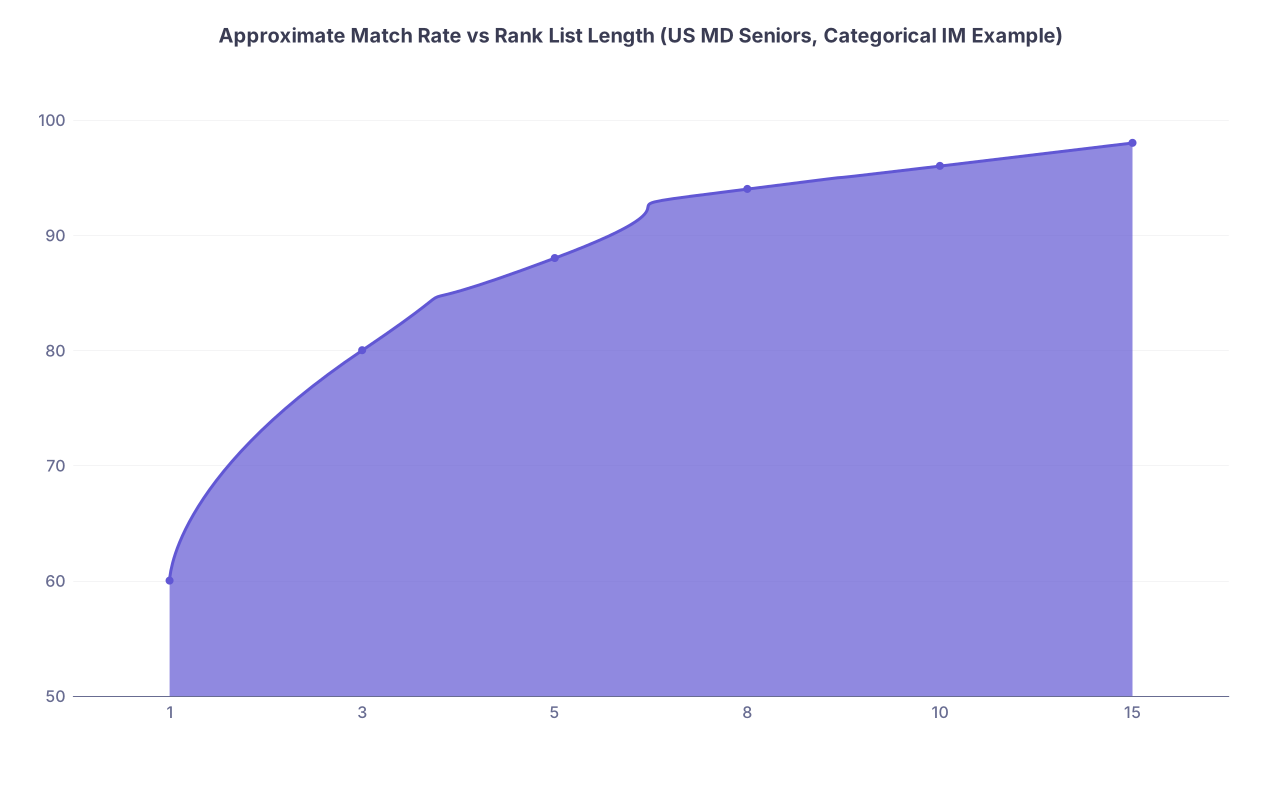
| Category | Value |
|---|---|
| 1 | 60 |
| 3 | 80 |
| 5 | 88 |
| 8 | 94 |
| 10 | 96 |
| 15 | 98 |
Those exact numbers vary by specialty and year, but the pattern is stable:
- Very short lists are risky
- Moderate lists are better
- Longer lists plateau at a high match rate but rarely hurt
Now the important part: none of this is because programs “like” long lists. They never see them. This is purely probability. You’re giving the algorithm more shots to find a home for you that’s still within your acceptable range.
I’ve watched this play out in real life:
- The “I’m only ranking my top 4 derm programs, I’ll SOAP if needed” student who ended up unmatched, then in tears trying to pivot into prelim medicine.
- The “I don’t want to move away from my partner, so I’ll just rank 3 local IM programs” applicant who missed by one slot and had to move anyway—except now to a random prelim year in another state.
Not rare exceptions. I see some version of this every single year.
How the algorithm actually treats your list (and why “confidence” is irrelevant)
The Match is not a vibes-based ritual. It’s a deferred acceptance algorithm.
Here’s the rough flow from the applicant side:

| Step | Description |
|---|---|
| Step 1 | Start with your #1 program |
| Step 2 | You are tentatively matched there |
| Step 3 | Try your #2, same check |
| Step 4 | You go unmatched |
| Step 5 | Did that program rank you high enough with open spot? |
| Step 6 | Any program left on your list? |
Notice what’s missing from that flow:
- “Check if list is short and reward confidence”
- “Penalize applicant for ranking backup community programs”
- “Boost applicant for only ranking elite academic centers”
Those rules don’t exist.
Here’s what the algorithm actually “cares” about on your side:
- The order of programs: that’s your preference signal
- The presence or absence of a program: if it’s not on the list, it literally does not exist for you
Programs do their thing independently: they submit their own ordered rank lists based on who they liked. They don’t know if they’re #1 or #15 on your list. That information is invisible to them.
So when you shorten your list “to show confidence,” what you’re really doing is deleting potential good outcomes from the algorithm’s search space. You’ve penalized yourself. No one else.
“But my advisor said a short list shows I know what I want”
I’ve heard this line quoted almost verbatim:
“If you rank 20 places, it looks like you don’t know what you want. A focused list of 6–8 programs shows clarity and confidence.”
This is aesthetically pleasing nonsense.
Here’s the actual issue buried inside that advice: being realistic vs being delusional. Those are not the same as “short” vs “long.”
There is a bad list-building mistake: creating a long list of places that were never going to rank you in the first place. For example:
- 12 insanely competitive coastal academic IM programs
- With a 205 Step 1 (before pass/fail), no research, and weak letters
- And nothing else on the list
That’s not confidence. That’s ignoring signal.
But the corrective is not “shrink the list so you look selective.” The corrective is:
- Add programs where you realistically have a shot
- Keep the competitive ones you genuinely prefer, higher on the list
- Don’t delete realistic backups because they “ruin the aesthetic” of your rank list
I’ve sat with students showing me pristine 7-program lists, all big-name university hospitals, explaining how “my mentor said this shows I’m serious about academics.” What it really showed was a bizarre willingness to gamble an entire career start on whether seven PDs all decide they like you enough in the same year.
The illusion of leverage: you don’t negotiate with your rank list
Another myth that flows from this “confidence” fantasy: that your rank list signals leverage to programs. As if they’ll somehow intuit:
- “This applicant ranked fewer programs, so they’ll be more loyal.”
- “They only ranked a small handful, they must be high on everyone’s lists.”
Reality check: by the time rank lists are submitted, interview season is over. Programs are not dynamically adjusting based on your hypothetical strategy. They have zero visibility into your list construction.
Your rank list does not change how much a program wants you. That decision is already made and locked.
The only leverage you actually have with your list is over your own outcome: where you land given how much programs already liked you. Saying “I’ll only rank 5, so they know I’m serious” is like betting your savings on black because you wore your lucky shirt. It feels intentional. It isn’t.
What actually matters more than list length
Now, I’m not arguing you should rank every place that ever sent you a “Thanks for applying” email. There is such a thing as ranking too far down into programs you genuinely would hate.
The real strategic question isn’t “short vs long.” It’s:
- “Are all the programs on this list ones I’d actually be willing to attend?”
- “Given my competitiveness, do I have enough realistic options ranked below my reaches?”
That’s where the data meets your personal line in the sand.
Here’s a more honest breakdown of how rank list length interacts with reality:
| Strategy Type | Typical List Length | Real Risk Level |
|---|---|---|
| Only dream/reach programs | 3–8 | Very high |
| Mix of reaches and realistic targets | 10–18 | Moderate–low |
| Mostly realistic + some “safeties” | 12–20+ | Low |
Notice something: list length is partly a result of how diversified your interviews were, not a performative choice at the end.
If you only interviewed at 5 places, that’s a different conversation. But choosing to rank only 5 out of 14 interviews because “shorter looks better” is self-sabotage dressed up as strategy.
The emotional trap: ego, fear, and the “I’d rather not match” lie
There’s a more honest, uglier driver behind this myth: ego.
I’ve had applicants look me straight in the eye and say:
- “I’d rather go unmatched than go to [community program X].”
- “If I match at that place, it means I failed. I’d rather reapply.”
Almost none of them actually mean it once the SOAP storm hits. In February, it’s about pride. In March, it’s about survival and visas and paying rent and not losing a year.
Ranking fewer programs often isn’t about confidence. It’s about protecting your ego from the idea that you might end up at a place you don’t brag about at alumni weekend.
If you genuinely, after calm thought, believe a program would be toxic for your training, mental health, or family, do not rank it. That’s just self-respect.
But if the real objection is “it’s not prestigious enough,” and you’re carrying a borderline application in a competitive specialty, you’re not being “confident” by cutting it from your list. You’re betting the next 12 months of your life on your self-image.
I’ve seen people burn a shot at a stable, decently supportive mid-tier program because they “could do better,” then spend the next year in limbo, trying to explain an application gap while scrambling for research or a second try.
Specialty matters, but the core rule doesn’t change
Different specialties obviously behave differently:
- Family med and psychiatry: more forgiving, match rates high even with moderate list length
- IM and pediatrics: solid odds with a mixed, reasonable list
- Derm, plastics, neurosurg, ortho: brutal, even with long lists
But the fundamental rule is identical everywhere:
Within your specialty, ranking more acceptable programs almost always increases your chance of matching somewhere acceptable. It does not lower your chance of matching at your top choices.
That last sentence people never internalize. Ranking backup programs below your favorites does not make the algorithm more likely to send you to the backup. It just gives you something to fall back on if your favorites don’t want you.
I’ve watched incredibly strong applicants in competitive specialties build deep lists: 5–8 dream programs, 10–15 reasonable ones, a few slightly less desirable but acceptable places. They almost always end up high on their list anyway. The backups were just insurance they were thrilled not to use.
The only good reasons to keep a list short
There are a few reasons to keep your rank list short that are actually rational. Notice how none of them involve “confidence” or “optics”:
- You genuinely cannot or will not live in certain regions because of serious family, medical, or immigration constraints
- You uncovered credible red flags about a program’s culture, training quality, or safety and would rather reapply than train there
- You’re using a deliberate two-cycle strategy in an ultra-competitive specialty and have a realistic backup career plan if you go unmatched
Those are values decisions, not ego plays. You’re trading match probability for something you consider non-negotiable. That’s fine if you understand the stakes.
What’s not fine is chopping a list from 15 to 7 because “I want programs to know I’m serious about them.” They will never know. The only thing that will know is the algorithm. And it doesn’t care about your narrative.
How to actually build a smart rank list
If you want a rule of thumb that is grounded in data and sanity, it’s this:
- Rank every program where you’d be willing to train, in your true order of preference.
- Do not rank any program where you’d genuinely rather go unmatched than attend.
- Within those constraints, more programs is safer than fewer.
You don’t get extra points for ascetic minimalism. There’s no award for “cleanest list” on Match Day.
If you’re worried about looking desperate, you’re optimizing the wrong variable. No one ever pulled me aside at a program and whispered, “You know, we almost didn’t rank her—she had too many places on her list.” That conversation doesn’t exist.
What I have heard, multiple times, is this:
- “I wish I had ranked that one extra community program. If I’d matched there, I’d be an R1 right now instead of doing this gap year mess.”
The regret is almost always about programs they didn’t rank. Not about ones they did.
Two key points to walk away with:
- Programs do not see how many programs you ranked or where you ranked them. The algorithm doesn’t reward “confidence”; it rewards giving yourself options you’d actually accept.
- Ranking fewer programs almost never helps you and often meaningfully increases your chance of going unmatched. Rank every program you’d genuinely be willing to attend, in honest order. Then stop trying to impress an algorithm that can’t see you.


