

Programs do not see your rank list. They cannot “punish” you for ranking them low. The belief that they can is one of the most persistent, harmful myths in the Match.
Let me be blunt: this myth survives for one reason—people do not actually read how the NRMP algorithm and rules work. They hear a chief or an attending say “rank them high so they know you’re interested” and they run with it.
You want reality, not hallway folklore. So let’s walk through what the data, the algorithm, and real-world behavior actually show.
What Programs Can See And When
The entire “they’ll know I ranked them low” idea collapses once you understand what information programs actually have access to.
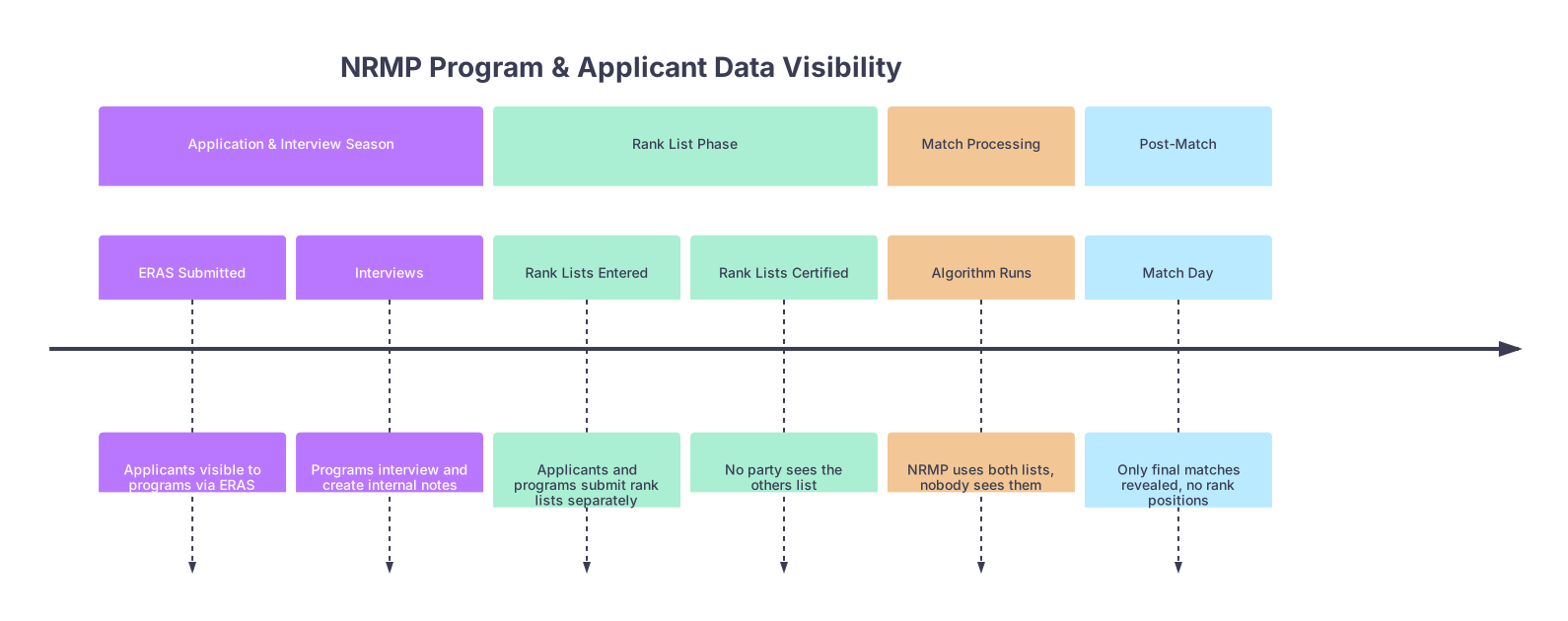
Here’s the critical sequence.
| Period | Event |
|---|---|
| Application & Interview Season - ERAS Submitted | Applicants visible to programs via ERAS |
| Application & Interview Season - Interviews | Programs interview and create internal notes |
| Rank List Phase - Rank Lists Entered | Applicants and programs submit rank lists separately |
| Rank List Phase - Rank Lists Certified | No party sees the others list |
| Match Processing - Algorithm Runs | NRMP uses both lists, nobody sees them |
| Post-Match - Match Day | Only final matches revealed, no rank positions |
Programs see your ERAS application, your interview performance, maybe a “signal” if you used them, maybe an email, maybe a post-interview letter. They do not see your rank list. Ever.
Programs submit their rank lists. You submit yours. NRMP runs the algorithm. On Match Day, all anyone sees is the final outcome: who matched where.
NRMP does not generate a report that says: “This applicant ranked you #12 but still matched here.” That information literally does not exist in any form that’s visible to them.
This is not me speculating. It’s baked into NRMP policy and enforcement. The Match survives on one non-negotiable rule: rank lists are confidential.
How the Algorithm Actually Treats Your List
The next part of the myth goes like this: “Even if they do not see my list, the algorithm somehow favors programs I rank higher, so if I put them lower I’ll fall down their list.”
Wrong. Completely backwards.
The NRMP algorithm is applicant-proposing. That phrase is in the official documentation and it matters. It means the system is literally rigged in your favor, not the programs’.
Here’s the spine of how it works, stripped of fluff:
- The algorithm looks at your first-choice program.
- If that program ranked you and has an open spot, you are tentatively placed there.
- Then it moves to your second-choice program, and so on.
- If a “more preferred” program (by you) later wants you and has room (or prefers you to someone they already tentatively placed), you get moved up.
So ranking a program lower never makes you less likely to match there compared to someone who ranked it higher. What matters is how they ranked you. Your rank list only sets your own preferences across programs, not your “loyalty points” with any single program.
If you’re still suspicious, fine. Let’s make it concrete.
A Simple Example That Exposes the Myth
Say there’s Program X with 2 spots. Their rank list:
- #1: Applicant A
- #2: Applicant B
- #3: You
- #4: Applicant D
Two scenarios for your list:
Scenario 1 – You rank Program X #1
You: X, Y, Z
Scenario 2 – You rank Program X #5
You: A, B, C, D, X, Y, Z
Now suppose:
- Applicants A and B match elsewhere higher on their own lists.
- Programs Y and Z either did not rank you, or filled with others they preferred to you.
What happens to you with respect to Program X in each scenario?
- In both cases, once the algorithm gets to Program X and you, Program X has 2 open spots (A and B left).
- You are their #3, and #1 and #2 are gone.
- You get one of those 2 spots.
Your chance of matching at X is identical in both scenarios, as long as you eventually “reach” X on your own list.
The only thing that changed when you ranked X #5 instead of #1 is this: the algorithm will try to place you at A, B, C, D first (if those programs ranked you highly enough). Which is exactly what you want. It’s in your favor.
You don’t get punished by Program X. You just get a chance to go somewhere you like better.
What The NRMP’s Own Data Shows About Strategy
The NRMP has published applicant behavior and outcome data for years. They track who matches, how many programs they rank, and patterns of rank-list strategy.
They also publish surveys asking programs what matters in creating their rank lists. Spoiler: your final rank position of them is not on there for the simple reason that they never see it.
Here’s a simplified comparison using actual themes from NRMP’s Program Director Survey and Match data:
| Factor | Affects Your Match? |
|---|---|
| Where you rank a program | No |
| Where a program ranks you | Yes |
| Number of programs you rank | Yes |
| Interview performance | Yes |
| Signals / demonstrated interest | Sometimes |
| Post-interview “love letters” | Mostly no (and risky) |
What the NRMP has consistently shown:
- Applicants who rank more programs have higher match rates, up to a rational limit.
- Applicants who rank programs truly in order of preference, without trying to “game” perceived interest, match to more preferred programs.
There is zero NRMP evidence that ranking a program lower on your list decreases your likelihood of matching there, conditional on you wanting to go there at all.
Why? Because the algorithm does not factor in any “loyalty” signal based on how high you put them. It just uses the order to know which program you’d rather be at if multiple programs are willing to take you.
The Real Source of the Fear: Pre-Match, SOAP, and People Misremembering
When someone swears to you, “I ranked them low and they punished me,” what they’re usually doing is rewriting history around one of three realities.
1. Programs change their mind after interviews
Programs adjust their rank lists based on:
- Faculty impressions
- Red flags from references or dean’s letters
- Late Step 2 scores
- Subtle “fit” concerns discussed in committees
I’ve heard PDs in real time say: “I liked her, but I’m nervous about that professionalism comment” and move someone 20 slots down. That applicant often later decides the program “must’ve known I wasn’t that interested.” No. They just had their own concerns.
2. Pre-Match era scars and non-NRMP systems
Older attendings trained when some specialties still used pre-match contracts or when the match rules were looser. In those systems, explicitly ranking someone lower could reflect back through all sorts of handshake deals and side channels.
You’re not in that era. Under current NRMP rules, trying to import that logic is like using a pager guide to configure your smartphone.
3. SOAP and unofficial backchannels
During SOAP, programs do sometimes infer “interest” from who answers, who calls, who emails frantically. That’s a completely different process from the main Match and has its own dysfunctions.
People then blur that experience into core Match strategy. Apples and oranges. In the main Match, the algorithm is blind to your advocacy emails and they still never see your rank positions.
Why Programs Like the Current System (And Don’t Try to Break It)
Here’s the part applicants miss: programs have no incentive to try to guess or punish your ranking. The present structure gives them what they care about most—filling with people they ranked as high as possible.
Programs want:
- High fill rates
- Strong residents they ranked high
- Minimal chaos and re-interviewing
The Match delivers that. They submit a list sorted from “we love them” down to “fine, if we must,” and the algorithm hands them the best they can get based on who actually wants to come.
Whether they’re your #1 or your #8 doesn’t affect their outcome at all, as long as you eventually land on them when all the dust settles.
Could a rogue PD fantasize about punishing applicants who “disrespected” their program? I am sure someone out there thinks like that.
But they have no mechanism to do it. They never see your list. They only decide once: when they build their rank list, based on information available before anyone has a certified list.
Where “Showing Interest” Does Matter (And Where It Doesn’t)
Now, there is a grain of truth that gets twisted into the full-blown myth.
Interest can matter at exactly one point in the process: when programs are building their rank lists. Not when the algorithm runs. Not after you certify your list.
Examples that can nudge you up a program’s list:
- You send a thoughtful, specific email after an interview showing you actually understand their program.
- You use a limited “signal” on them (in specialties that use signaling).
- You rotate there, do good work, and residents advocate for you.
All of that happens before rank lists lock. So programs may interpret your behavior as “likely to come” and slide you up a few slots, especially if they’re worried about over-ranking people who will all match at “more prestigious” places.
But that is completely separate from what position you eventually put them on your certified ROL.
That “I’m really interested in you” communication influences how they rank you. It does nothing to how your lower ranking of them later supposedly “punishes” you.
The Real Ranking Strategy That Works
You want an actual strategy to maximize your outcome? It’s brutally simple, and yes, a little boring:
- Build your list in true order of preference. Where you genuinely want to be, not where you think they want you to want to be.
- Rank every place you would rather go to than SOAP or not matching, even if you think they’re a reach.
- Do not drop programs you’d be okay attending just because someone told you “you’ll hurt your chances at others” or “they’ll know you ranked them low.”
This aligns perfectly with how the algorithm is designed and with the NRMP’s own published guidance. They’ve spent decades yelling this into the void.
To drive it home, here’s what gaming the system vs. following it looks like in practice:
| Approach | Outcome Pattern |
|---|---|
| True preference order | More likely to land at most desired viable program |
| Over-ranking “safe” programs | Higher chance of matching lower than necessary |
| Dropping programs you like out of fear | Higher risk of not matching at all |
When people say “I ranked them higher to show interest,” what they’re actually doing is lying to the algorithm about their own preferences. The algorithm then faithfully delivers exactly what they told it they wanted. And years later, they claim they were “forced” into their #2.
They weren’t. They just played themselves.
How To Respond When Programs Fish For Your Rank
Here’s the uncomfortable twist. Even though they cannot see your list, some programs still fish.
They’ll say:
- “If we ranked you highly, would you rank us highly?”
- “Where do you think we’d be on your list?”
- “We really hope you’ll rank us #1.”
These kinds of questions are dancing on the edge of NRMP rules. Programs are not supposed to coerce or demand commitments. They’re allowed to express interest; they’re not supposed to extract ranking promises.
You do not need to answer with a specific number. A sane, rule-abiding response is:
- “I really enjoyed your program and it will be on my rank list.”
- “You’re one of the places I’m seriously considering.”
- “I’m still finalizing my list, but this has been one of my favorite interview days.”
That’s enough to convey interest without lying or painting yourself into a corner. And it keeps you from bending your rank list later just to justify a moment of verbal pressure.
The Bottom Line: Who Actually Has The Power
Strip away the noise and posturing and the power dynamic in the Match is simpler than it feels in February at 2 a.m.
Programs have power at one moment: when they build their rank lists. They decide how much they want you, based on what they know.
You have power at a different moment: when you build yours. You decide how much you want them, based on what you know.
After that, the algorithm marries those two sets of preferences in a way that systematically favors your side. Applicant-proposing. On purpose.
So no, programs do not punish you for ranking them low. They cannot see it. They do not get that information. The only real “punishment” is when you betray your own preferences out of fear and end up somewhere you did not actually want most.
Years from now, you won’t remember the anxiety of whether a program felt “disrespected” by your rank list. You’ll remember whether you had the guts to be honest about where you wanted to train—and let the system work the way it was designed.


