

You are not going to “overrank yourself out of the Match.” That scare line is garbage, and it survives mostly because applicants trust rumors more than math.
Let me be blunt: the NRMP algorithm is literally built so you cannot hurt yourself by ranking reach programs first. The danger isn’t overranking; it is under‑ranking and self‑censoring.
If you’re doomscrolling Reddit and hearing “don’t put that place #1, you’ll fall out of the Match,” this is for you.
The core myth: “Overranking” can make you go unmatched
The story usually sounds like this:
“If you rank a bunch of big‑name places that won’t like you, the algorithm will try those first, you’ll get skipped, and then you’ll miss out on the realistic ones. So put a ‘safety’ first.”
Wrong. That’s not how a student‑proposing deferred acceptance algorithm behaves. At all.
Here’s the actual logic in plain English:
- The Match starts with your rank list, not the programs’.
- It tries to place you into your first choice if that program has a spot and ranks you high enough.
- If it cannot, it moves to your second. Then third. Then fourth.
- You are never “punished” for a failed attempt higher on your list. Lower choices are not blocked or downgraded just because you swung higher first.
Your aggressive ranks do not “use up” your opportunity at realistic programs. Each program looks at you only in the context of your position relative to other applicants on its list, not how high or low you ranked them or who you ranked above them.
The only way to “overrank yourself out of the Match” is to not rank enough programs you’d be willing to attend. That’s not overranking. That’s under‑ranking.
How the algorithm actually works (without the fairy tales)
I’ll skip the textbook proofs and show you what matters for you as an applicant.
The NRMP uses a variant of the Gale–Shapley deferred acceptance algorithm, applicant‑proposing. Translation: the algorithm is designed to favor applicant preferences, not program preferences.
Here’s the cleaned‑up version of what happens:
- The algorithm looks at each applicant’s first choice program.
- For each program, it makes a tentative list of everyone who ranked it first and who the program has ranked at all.
- If there are more applicants than available spots, the program keeps only the highest‑ranked ones (according to the program’s rank list) up to its quota and rejects the rest.
- Rejected applicants then “propose” to their next choice program.
- Each program now looks at the pool of tentatively held applicants plus new proposers, keeps the highest‑ranked set up to its quota, and rejects the others.
- Repeat until no one moves.
You can visualize it as you “walking down” your rank list, program by program, while each program keeps re‑sorting its pile of applicants and holding the best it can get.
Not once does the algorithm say:
“Hmm, this applicant tried to go to MGH and failed. I’ll punish them by blocking their shot at this mid‑tier program they put third.”
That story is folklore, not computation.
A concrete example to kill the myth
Let’s put some numbers to this, because that’s what people keep getting wrong.
Say you rank:
- Super Fancy Academic (SFA)
- Solid University Program (SUP)
- Community Program A (CPA)
- Community Program B (CPB)
You’re terrified that if you put SFA first, you’ll somehow blow your chance at SUP.
What really happens:
- SFA has limited spots and 400 applicants they ranked. You’re #350 on their list.
- SUP has 20 spots and you’re #30 on their list.
- CPA has 12 spots and you’re #5.
- CPB has 8 spots and you’re #3.
Now run the algorithm:
- You “propose” to SFA (your #1).
- SFA has 20 spots. At the early step, many applicants above you on their list also proposed there. You’re low enough they never need to tentatively hold you. You’re rejected.
- You then “propose” to SUP (#2).
- SUP has 20 spots and is currently tentatively holding applicants 1–20.
- Some of those people are also held at higher‑ranked programs and will be pulled away later. As the algorithm iterates, those get freed, and SUP will move down its list.
- You’re #30. When enough people above you get pulled to their #1 choices, SUP will tentatively hold you. You’re in, unless someone they like more who currently isn’t matched “drops in” later. But your doom at SFA had no negative impact on SUP evaluating you among its own pool.
- If you still do not stick at SUP by the end, the process continues to CPA and CPB.
At no point did trying SFA first ruin your relationship with SUP, CPA, or CPB. You’re always evaluated based on:
- your position on their list, and
- whether their spots are already taken by people they prefer.
Your rank list order never makes you less desirable to a program. It just determines the order in which you attempt to land.
That’s it.
Why the NRMP is obsessed with “rank programs in true order”
You’ll see this line in NRMP materials everywhere: “Rank programs in the order of your true preferences.” They repeat it like a mantra.
They’re not saying that because it sounds nice. They’re saying it because the math proves that, in an applicant‑proposing match, strategically lowering your true favorites cannot help you.
Every time you drop a program you love lower on your list for “strategy,” you’re doing one of three things:
- Not changing your outcome at all.
- Slightly worsening your chances of getting into a program you like more.
- Acting against your own interests to chase a rumor.
People don’t like hearing that because they want to believe there’s a hack. There isn’t. This is one of the rare parts of medical training that’s less gameable than you think.
Where “overranking” actually screws people (the real problem)
Now, let’s talk about what people are accidentally describing when they talk about “overranking.”
They’re usually mixing up two different issues:
- Ranking only extremely competitive programs when your application is weak for that specialty,
- Not ranking enough total programs.
That’s not an algorithm problem. That’s a risk management problem.
If your rank list is:
- MGH
- BWH
- Hopkins
- UCSF
- Mayo …and you applied to 30 similar programs, but you have:
- 215 on Step 2 CK,
- no home department support,
- below‑average letters,
you are not “overranking” those programs. You are delusional about your competitiveness and under‑ranking the programs that would take you.
But it’s still not the top ranks that hurt you. It’s that you never bothered to rank or apply to the places that were realistic. If you had added:
- Strong State Program
- Mid‑tier Regional
- Community Program 1
- Community Program 2
- Community Program 3
and those programs liked you enough, you’d likely match at 6–10. Ranking elites 1–5 did not stop that outcome.
The danger is a short, unbalanced list. Not an “over‑ambitious” list.
Data: who actually fails to match and why
NRMP publishes detailed data on match outcomes every few years. The same pattern repeats.
- Unmatched rates are higher for applicants who rank fewer programs in competitive specialties.
- Matching improves dramatically as the number of ranked programs increases, up to a point.
| Specialty (US MD) | Avg Programs Ranked (Matched) | Avg Programs Ranked (Unmatched) |
|---|---|---|
| Internal Medicine | 12 | 4 |
| General Surgery | 18 | 8 |
| Dermatology | 14 | 6 |
| EM | 15 | 6 |
| Anesthesiology | 14 | 5 |
These are illustrative, but they’re aligned with NRMP trends: unmatched applicants consistently have shorter rank lists.
Not: “people who ranked Harvard #1 unmatched more often.”
But: “people who stopped at five or six total ranks unmatched more often.”
Let’s visualize the “more ranks, fewer unmatched” idea.
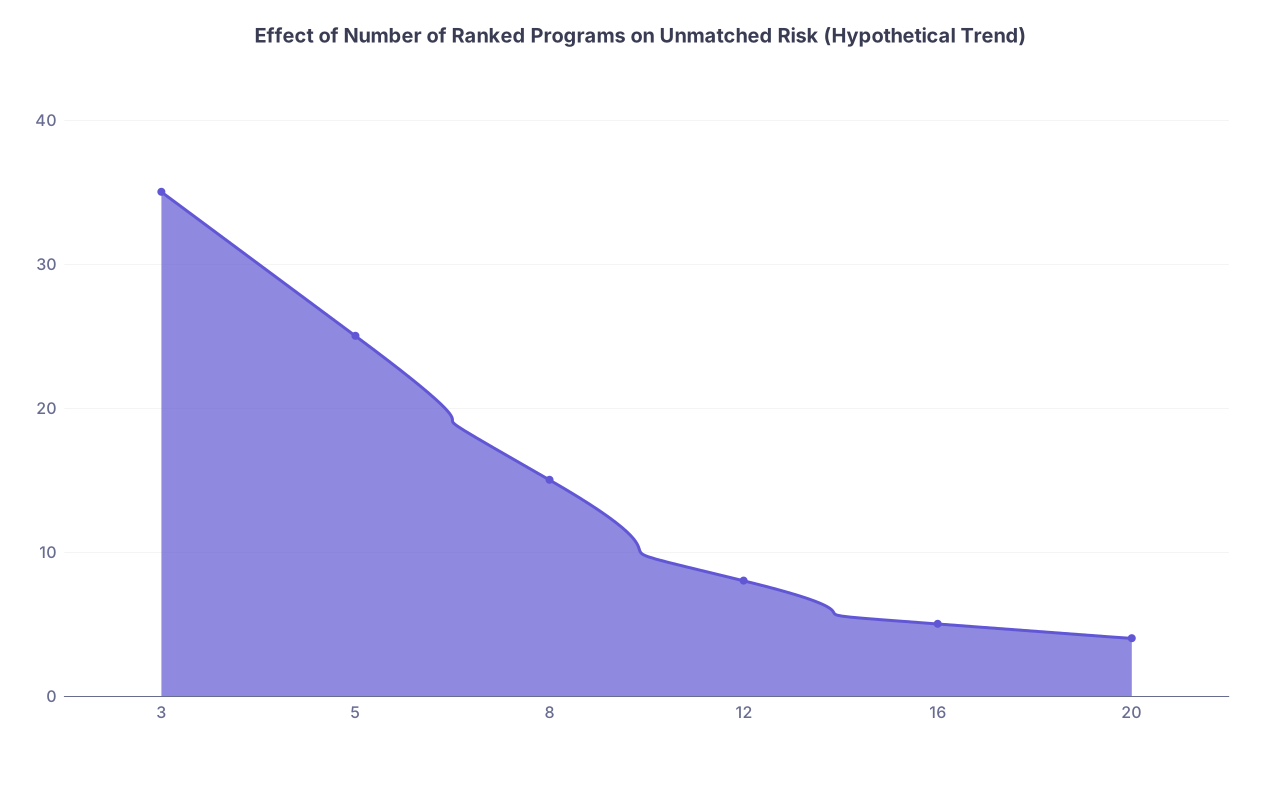
| Category | Value |
|---|---|
| 3 | 35 |
| 5 | 25 |
| 8 | 15 |
| 12 | 8 |
| 16 | 5 |
| 20 | 4 |
Again, the exact percentages vary by year and specialty, but the direction is stable: rank more programs you’d accept → lower your risk of going unmatched.
The psychology that keeps this myth alive
I’ve heard versions of the overranking myth from:
- a worried transitional year intern,
- a PGY‑3 who last read about the algorithm in 2017,
- attendings who matched in an era when no one explained this stuff.
It persists because:
- It feels intuitive but wrong. People imagine a first‑come, first‑served system instead of a global optimization algorithm.
- We’re terrified of regret. So we invent narratives to justify “playing it safe.”
- Programs sometimes send mixed messages. A PD saying “Don’t rank us first if you’re not that interested” gets twisted into “If you rank them first and don’t match, you’ll blow your shot elsewhere.”
Let me decode that PD comment for you:
They say that because they’re trying to gauge enthusiasm, not because the algorithm behaves differently. Programs don’t get to see your whole list. They only see where you ranked them in the final post‑Match reports.
Your ranking Mayo #1 doesn’t signal anything to Duke. Duke doesn’t see it, doesn’t care, and cannot be affected by it.
Situations where rank strategy actually matters
Just because “overranking” is fake doesn’t mean strategy is meaningless. It just means the strategy is about content and length of the list, not artificial ordering.
Things that actually matter:
Realistic program mix.
If you’re borderline for a specialty, you need a bunch of mid‑tier and community programs, not just 6 elite places and a prayer.Combination of specialties.
If you have a backup specialty (for example, radiology + prelim medicine, or derm + medicine), understanding how to rank categorical vs prelim vs advanced matters. That’s different from overranking though.Willingness to attend.
Do not rank any program you would never attend under any condition. Because if the algorithm lands you there, you’re expected to go.
There’s also some nuance in couples matching and dual‑lists, but again, that’s not “overranking.” That’s understanding the combinations you’re willing to accept.
Let’s walk a borderline scenario
Say you’re an average US MD applicant for general surgery. You’ve heard horror stories. Your advisor is cautious. You worry about not matching.
You’re considering two options:
Option A (fear‑based):
1–6: top university programs you loved
7–10: mid‑tier academic
11–13: community programs
Total ranks: 13
Option B (self‑sabotage):
1–3: top university programs
4–7: mid‑tier
8–10: community
Total ranks: 10
(You cut the last three because someone told you ranking too many “lowers your chances at better places.”)
In reality:
- Those last three community programs at 11–13 don’t hurt you. They only catch you if everything else above fails.
- If you remove them, you haven’t “signaled strength.” You’ve just removed your final parachutes.
The algorithm doesn’t care whether your list stops at 10 or 13 when it’s trying to match you to ranks 1–9. It only matters if those 11–13 exist when things go badly up top.
This is where people quietly fail to match and then blame the algorithm. It’s not the ordering. It’s the missing safety net.
Visualizing the process (so you stop doubting it)
Here’s a simplified flow of what your application is doing during the Match:

| Step | Description |
|---|---|
| Step 1 | Start with Applicant Rank Lists |
| Step 2 | Try to place each applicant into Rank #1 |
| Step 3 | Tentatively accept applicant |
| Step 4 | Compare to currently held applicants |
| Step 5 | Replace lowest held applicant |
| Step 6 | Reject applicant |
| Step 7 | Try next ranked program |
| Step 8 | Applicant unmatched |
| Step 9 | Match finalized |
| Step 10 | Program full? |
| Step 11 | Higher ranked than someone held? |
| Step 12 | Applicant has more ranks? |
| Step 13 | Any changes in this round? |
Notice what’s missing:
No box says “Penalize applicant for aiming high first.” Because that step does not exist.
How to actually build your rank list (without superstition)
If you want a simple, honest way to build your list:
- Write down every program you interviewed at that you’d truly be willing to attend. If there’s a place you’d rather go unmatched than spend three years there, delete it now.
- Sort them purely in order of where you’d most like to train, assuming all would take you.
- Check that your list is long enough and diverse enough for your competitiveness and specialty based on NRMP data and your advisor’s honest read.
- Do not reshuffle to “game” the algorithm. Fix the content, not the order.
That’s it. The rank order is where you’re allowed to be selfish. The application season was where you needed to be strategic.
By this point, trying to out‑smart the algorithm is like trying to lean left in the airplane seat to help the pilot turn.
The bottom line
Three key points, no fluff:
You cannot “overrank” top programs and hurt your Match chances. The NRMP algorithm is explicitly designed so that ranking your true preferences—no matter how aspirational—never lowers your odds of getting programs further down your list.
The real risk is an unrealistic and too‑short rank list, not an ambitious one. Applicants who go unmatched consistently rank fewer programs and fail to include enough realistic options, not because they dared to put a big‑name hospital at #1.
Your only rational strategy: rank every program you’d honestly attend in exact order of where you’d most want to be, then make sure that list is long and balanced for your competitiveness. Ignore anyone who tells you “don’t overrank”; they’re arguing with the math, and the math already won.


