

The fear that “ranking preliminary and categorical programs together is risky” is exaggerated—and often backwards. The actual risk is misunderstanding how the Match algorithm works and building a rank list around myths instead of math.
Let me be blunt: the algorithm does not punish you for ranking prelims and categoricals on the same list. It does not get confused. It does not “favor” one over the other because you mixed them. People do that to themselves with bad strategy.
You’re in the danger zone only if:
- You misunderstand how primary vs supplemental rank lists work, or
- You rank programs in an order that doesn’t match your real preferences because you’re trying to “outsmart” the system.
So let’s dismantle the common nonsense and walk through how to do this correctly.
First: What “Preliminary vs Categorical” Actually Means in Match Terms
Forget the brochure version. Think like the algorithm.
- Categorical position: A PGY-1 job that includes your advanced training (e.g., IM categorical 3-year, general surgery categorical 5-year). No separate intern year needed.
- Preliminary position: Typically a one-year PGY-1 (IM, surgery, transitional year) that you might pair with an advanced position (radiology, anesthesia, derm, PM&R, etc.), or use if you just need an intern year.
The NRMP classifies them as:
- Categorical: Position code starts with C
- Prelim: Position code starts with P
- Advanced: Position code starts with A
The algorithm doesn’t emotionally care what they are. It only cares about:
- Your rank order
- Program rank lists
- Contractual rules for couples / linked positions
Every year I hear some version of:
“I was told not to mix prelim and categorical on the same list because it can hurt my chances of matching categorical.”
That’s wrong. The Match algorithm is applicant-proposing. It tries to give you your most preferred option that’s also willing to take you. If you put a prelim spot above a categorical, you are literally telling the system: “I prefer this prelim outcome over that categorical outcome.” The “risk” there is not algorithmic. It’s that your list doesn’t match your actual goals.
How the Algorithm Actually Treats Different Position Types
Here’s the core rule you need in your bones:
The algorithm always tries to match you to the single highest-ranked position on your list that can accept you.
It doesn’t know you “really meant” categorical unless your list says so.
If you’re applying to:
- Only categorical positions: simple, one list, nothing extra.
- Advanced + prelim positions: you now have both a primary rank list (advanced programs, categorical programs, any position) and a supplemental rank list (prelim/TY years attached to an advanced program).
This is where people get lost.
The structure matters more than the labels
The system uses:
- Primary list: All positions you’re directly ranking (categorical, prelim-only, advanced).
- Supplemental lists: Prelim/TY years that are “linked” under an advanced program entry.
For example, radiology applicant:
Primary list:
- Harvard Radiology (Advanced)
- UCSF Radiology (Advanced)
- Internal Medicine Categorical – State U
- Transitional Year – Community Hospital
Under “Harvard Radiology (Advanced)” you can build a supplemental list:
- Brigham TY
- BIDMC Prelim Medicine
- Newton-Wellesley TY
Now, what happens?
- The algorithm first tries to match you into your #1: Harvard Rads.
- If Harvard Rads can tentatively accept you, then the algorithm looks to your linked supplemental list and tries to place you into the highest prelim/TY that will take you.
- If you get bumped from Harvard Rads later in the process, that linked prelim year evaporates as well—because it only exists if you actually match Harvard Rads.
Ranking categorical and prelim positions together on the primary list doesn’t confuse anything. It just expresses your preferences.
The Biggest Myth: “Ranking Prelim Above Categorical Hurts Your Categorical Chances”
No. If you rank a prelim above a categorical, what you’ve said is:
“Matching this standalone prelim (even without an advanced spot) is better to me than matching this categorical.”
You did that. The algorithm just follows instructions.
If you actually want the categorical more, rank the categorical higher. That’s the end of the story.
Here’s a typical bad strategy I’ve seen:
You want internal medicine long-term. You also applied to a few prelim medicine years as a “backup” while you reapply next year if needed. Someone tells you:
“Put a few prelims near the top to ‘secure’ a match, then your IM categoricals after. That way you won’t go unmatched.”
So you create this:
- Prelim Medicine – Small Community
- Prelim Medicine – Regional Hospital
- IM Categorical – State U
- IM Categorical – University A
- IM Categorical – Community B
If any of those prelims want you, the algorithm will place you there instead of the categorical positions below—because you told it they are higher priority. You didn’t “increase your chance of matching categorical.” You just lowered it by ranking less-desirable outcomes above your real goal.
The safe strategy: rank in your true order of preference. If matching categorical at Community B is better than doing a random prelim and reapplying, Community B should sit above every prelim on your list. Simple.
When Is It Actually Smart to Rank Prelim and Categorical Together?
There are several common, rational scenarios where mixing them on the same primary list is fine—or necessary.
1. You’re advanced + prelim, but also have a “plan B” categorical
Radiology, derm, anesthesia, ophtho, PM&R folks, listen up.
You might have:
- A few advanced positions you really want
- A few categorical IM or TY programs you’d happily do if you don’t match advanced
Your primary list might look like:
- Mass General Radiology (Advanced)
- UCSF Radiology (Advanced)
- Mayo Radiology (Advanced)
- IM Categorical – State U
- TY – Nice Community Hospital
Under each advanced program, you add a supplemental prelim list.
Is it “risky” to put those categoricals on the same list? No. It’s clarity. You’re telling the algorithm:
- Try to get me Rads + a prelim year (through supplements) first.
- If none of my advanced + linked prelim combinations work out, then give me an IM categorical.
- If that also fails, I’ll take a standalone TY next.
That’s exactly what the system is built for.
2. You’re not 100% sure which path you want
Say you’re torn between:
- General Surgery categorical
- Anesthesia advanced + prelim
Your true preference might be:
- Anesthesia – Big Academic (Advanced)
- Surgery Categorical – Good University
- Anesthesia – Mid-tier (Advanced)
- Surgery Categorical – Community
- IM Categorical – Safe State Program
Again: mixing these isn’t “risky.” It’s honest.
The risk is when you rank something higher that you don’t actually want more, because you think the algorithm needs to be massaged. It doesn’t.
Where People Actually Get Burned
The horror stories you hear are almost never “I mixed prelim and categorical and the algorithm punished me.” They’re usually one of these:
Misunderstanding supplemental lists
Someone applies to advanced programs but fails to build out adequate supplemental prelim/TY lists. They match an advanced position but to no prelim year, ending up in the SOAP chasing an intern spot. That isn’t from ranking prelims and categoricals together. That’s from not ranking enough prelims under each advanced position.Inverting their true preferences
They rank prelim-only outcomes above categorical options they would have preferred long-term. Then they “regret” the match. The algorithm did exactly what they asked.Terrible backup structure
They list advanced programs only, with a few prelims, and no categorical backups. When the advanced programs don’t want them, they’re left with only prelims and no long-term pathway. Again, not a problem with mixing—just poor planning.
Here’s a concise comparison of where actual risk lives:
| Concern | Real Risk? | Why |
|---|---|---|
| Mixing prelim and categorical on one list | No | Algorithm follows your preferences |
| Ranking prelim above categorical you prefer | Yes | You misordered your priorities |
| Not building enough supplemental prelims | Yes | Can match advanced without a PGY-1 |
| Having no categorical backup | Yes | You might end up with only a prelim |
| Algorithm “confusion” | No | It’s deterministic and structured |
What the Data Actually Shows (NRMP, Not Rumor)
Let’s ground this in real numbers, not anecdotes.
From recent NRMP Program Director and Results/Data reports:
- Applicant-proposing algorithm: The system is built to maximize applicant outcomes based on their rank order. This has been stable since the early 2000s.
- Unmatched advanced applicants often fail because they:
- Did not rank enough programs
- Had weak supplemental prelim lists
- Were too top-heavy on advanced choices with no backup categorical options
None of the NRMP technical documentation or post-hoc reviews show some hidden penalty for mixing prelim and categorical programs together. The main issues they highlight are:
- Too few ranks
- Misalignment between preferences and rank order
- Inadequate pairing of advanced positions with prelim years
If anyone is telling you, “Don’t mix them, you’ll confuse the algorithm,” they’re either misunderstanding the rules or repeating third-hand lore.
Concrete Ranking Scenarios: Good vs Bad
Let’s walk through some realistic examples.
Scenario 1: Anesthesia + Categorical IM Backup
Your true preference:
- Any anesthesia advanced at strong academic center + a decent prelim
- Good categorical internal medicine
- A standalone prelim if all else fails
Good primary list:
- Anesthesia – Big Academic A (Advanced)
- Anesthesia – Big Academic B (Advanced)
- IM Categorical – University C
- IM Categorical – State U
- TY – Strong Community Hospital
- Prelim IM – Regional Hospital
With robust supplemental lists under each advanced program.
Bad primary list:
- TY – Strong Community Hospital
- Prelim IM – Regional Hospital
- Anesthesia – Big Academic A (Advanced)
- Anesthesia – Big Academic B (Advanced)
- IM Categorical – University C
- IM Categorical – State U
Here, you’ve told the algorithm: “Give me a standalone TY year before trying to get me anesthesia or categorical IM.” If that’s not your real preference, you’ve sabotaged yourself.
Scenario 2: You’re IM-focused but used prelims as “safety”
You want IM categorical. Prelims are only acceptable if all categorical fails.
Good list:
- IM Categorical – Top Choice
- IM Categorical – Mid-tier Academic
- IM Categorical – Community A
- IM Categorical – Community B
- TY – Community C
- Prelim IM – County D
Bad list:
- TY – Community C
- Prelim IM – County D
- IM Categorical – Top Choice
- IM Categorical – Mid-tier Academic
- IM Categorical – Community A
- IM Categorical – Community B
Again, no algorithm trickery. Just misordered values.
Practical Rules That Actually Work
You do not need a PhD in game theory to rank correctly. You just need to stop trying to out-clever a system that has no emotions.
Here are the rules that hold up in the real world:
Rank every program in exact order of where you’d want to train, from best to worst.
Don’t “strategize” around where you think you’ll get in. The algorithm already accounts for that.For advanced specialties, build generous supplemental prelim/TY lists.
If you want Rads at Big Academic, you want some intern year rather than none. Rank many prelims under each advanced program.Use categorical programs as explicit, ranked backup plans if you’d truly rather do them than end up with only a prelim.
That means putting categorical backups above standalone prelims if that matches your real preference.Mixing prelim and categorical on the same primary list is fine—your ordering is what matters.
There is no inherent penalty to mixing. There is a penalty to lying about your preferences to the algorithm.If someone’s advice contradicts the NRMP algorithm description, default to the algorithm.
The technical document beats “my senior told me” every time.
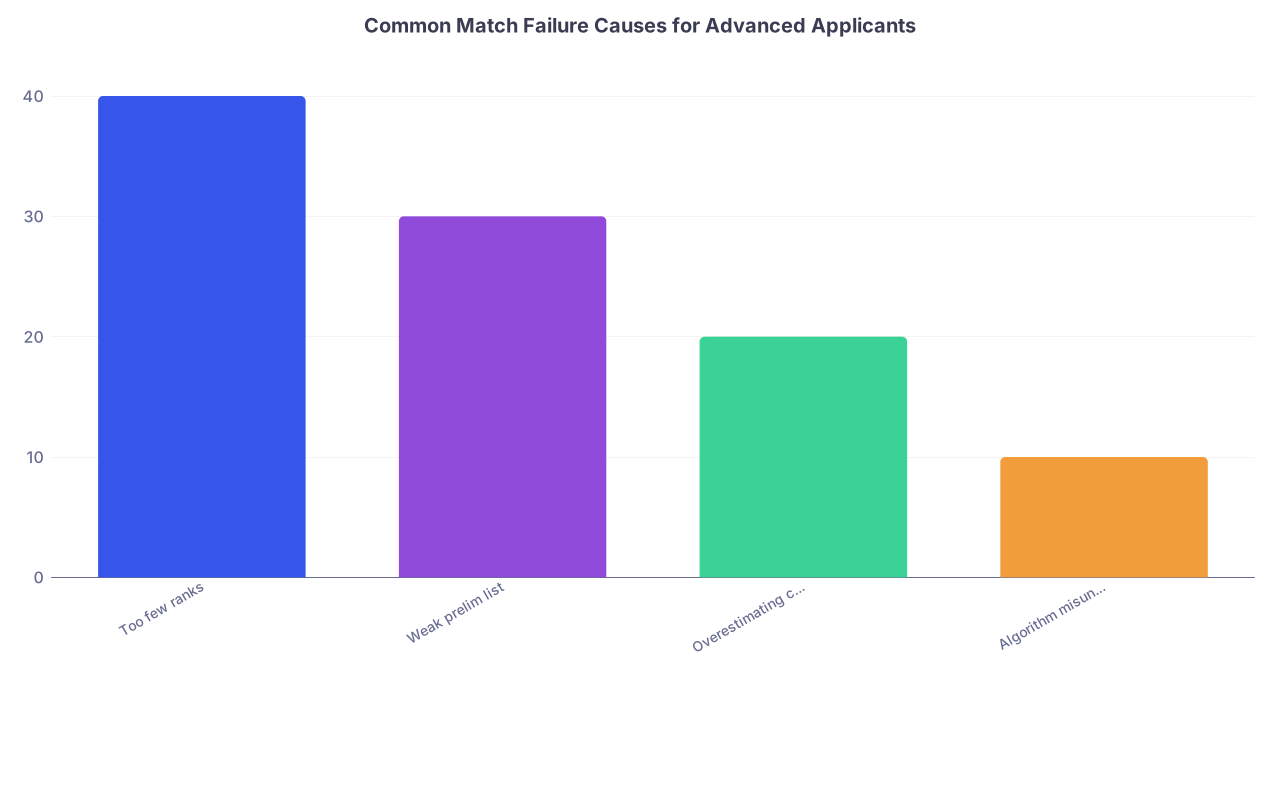
| Category | Value |
|---|---|
| Too few ranks | 40 |
| Weak prelim list | 30 |
| Overestimating competitiveness | 20 |
| Algorithm misunderstanding | 10 |
A Quick Mental Check Before You Certify Your List
Before you hit certify, do this literally out loud:
For each rank from #1 downward, say:
“If I matched here and never looked further down, would I be okay with that being my outcome?”
- If you say “No, I’d rather be at #5 than #3,” your list is wrong.
- If there’s a prelim above a categorical and you’d rather be categorical long-term, your list is wrong.
- If your backup categorical is below a prelim you consider a desperation move, your list is wrong.
You’re not gaming anyone; you’re just sorting outcomes from best to worst—for you.

| Step | Description |
|---|---|
| Step 1 | Start Rank List |
| Step 2 | Keep its position |
| Step 3 | Move it down |
| Step 4 | Reorder to match true preference |
| Step 5 | Add more prelims/TY in supplements |
| Step 6 | Certify Rank List |
| Step 7 | Does this program beat all below it? |
| Step 8 | Any prelim above preferred categorical? |
| Step 9 | Enough prelims under each advanced? |
Ranking preliminary and categorical programs together isn’t the bomb under your Match chances people claim it is. The real explosion happens when your rank list reflects fear, bad rumors, or “strategy” rather than what you actually want.
Years from now, you won’t be thinking about whether you separated prelims and categoricals. You’ll remember whether you were honest with yourself about where you truly wanted to train—and whether you had the courage to rank your list that way.


