

What actually happens if you rank a “safety” program you dislike… and that’s the one you match to? Is that really better than going unmatched?
Let’s cut through the folklore you hear on the interview trail and in GroupMe chats. There are two loud camps:
- “Never rank a place you don’t love. It’s safer to go unmatched than to be miserable for 3–7 years.”
- “Just rank every program you interviewed at. Matching anywhere is better than scrambling/SOAP.”
Both sound confident. Both are incomplete. And both ignore what the actual NRMP data say about how risk, regret, and “safety” really play out.
I’m going to walk through this like we’re sitting in a call room and you just opened your rank list spreadsheet. I’ll be blunt: some of what you’ve been told is wrong. Some is half-true. And some advice that sounds “caring” is actually dangerous.
The Core Myth: “It’s Safer To Rank Only Places You’d Be Happy At”
The myth sounds reasonable:
“If I only rank programs I’d be happy at, I either match somewhere good for me, or I don’t match and try again. That’s safer than ending up trapped in a toxic program.”
Here’s the problem: that statement mashes three completely different questions into one emotional blob:
- How does the algorithm actually work?
- What are your odds of matching at all?
- What’s the real cost—professionally and personally—of going unmatched vs. matching low on your list?
You cannot answer “Is it safer?” honestly without separating those.
Let’s start with the part everyone gets wrong: the algorithm.
What The Matching Algorithm Actually Protects You From (And What It Doesn’t)
The NRMP algorithm is applicant-proposing. That means:
- It tries to match you to your highest ranked program that has you on their list.
- You can’t hurt your chances at your top choices by listing “safety” programs lower.
- Your list is about preferences, not about “tricking” the algorithm.
So the common worry — “If I put that mid-tier community program last, I’ll get stuck there instead of maybe getting my dream academic spot” — is just false.
If Program #1 and Program #8 both rank you high enough, the algorithm gives you Program #1. Full stop. Program #8 having you on their list doesn’t block that.
So ranking “extra” places you’re lukewarm about does not reduce your chance of matching to a place you love. It just reduces your chance of going unmatched.
Here’s the real decision:
- Not ranking a program = “I would rather risk not matching at all than match there.”
- Ranking a program last = “Only if every place I like more doesn’t want me, I’ll accept this as a fallback.”
That’s the adult, accurate framing. Not the sentimental “only rank places you’d be happy” slogan.
What The Data Say About Rank List Length and Match Risk
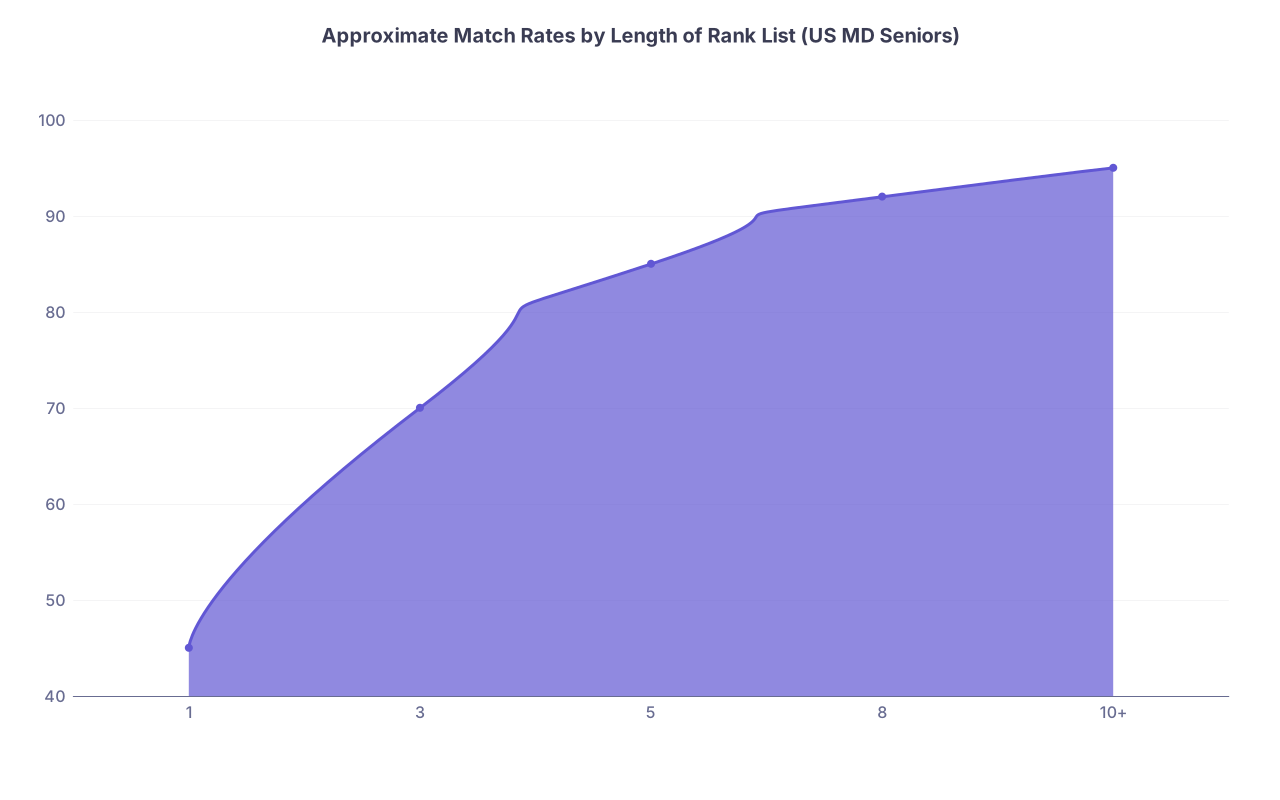
You don’t have to guess. The NRMP publishes a very detailed “Charting Outcomes in the Match” and “Results and Data” every year. Buried in there is a very clear message: short lists are risky.
Here’s an oversimplified, but directionally correct, picture for U.S. MD seniors in a moderately competitive specialty:
| Category | Value |
|---|---|
| 1 | 45 |
| 3 | 70 |
| 5 | 85 |
| 8 | 92 |
| 10+ | 95 |
The real numbers differ by specialty, but the pattern is always the same:
- Ranking only 1 program? That’s a coin flip or worse.
- Rank 3–4? Still dangerous.
- Beyond ~8–10 programs, your odds start to plateau, but they’re much higher.
Now overlay the myth:
“Only rank places you’d be happy at” often = “I’ll rank 3–4 programs because those are the ones I ‘really liked’, and leave off the 4–6 that felt just okay.”
You’ve just voluntarily moved yourself from ~92–95% territory down to 70–80% territory purely because of vibes. Not actual abuse. Not clear dealbreakers. Just, “I didn’t feel butterflies.”
That’s not “safer.” That’s gambling with several years of your career because someone on Reddit said “don’t settle.”
But What About Being Miserable For 3–7 Years?
Here’s where the myth has a kernel of truth. There are programs that are legitimately not worth ranking:
- Documented malignant culture (not just rumors, but repeated consistent reports)
- Clear violation of ACGME requirements, chronic under-staffing, safety concerns
- Places where your gut is screaming “these people are not safe” (harassment, bigotry, blatant disrespect)
That’s not “I didn’t love the city” or “the residents didn’t seem like my people.” That’s “this may harm my mental health or career development in a serious way.”
For those, yes: do not rank them. It is absolutely rational to prefer the risk of going unmatched to signing up for sustained harm.
The problem is when people drag ordinary, imperfect programs into the same bucket as malignant ones. Example I’ve actually heard:
- “I didn’t like that their ICU is off-site.”
- “They only have one research month.”
- “The call rooms were ugly.”
Those might matter. But they’re not in the same universe as a program where they brag about “weeding out the weak” or where residents tell you off the record, “half our PGY-2s are on SSRIs for a reason.”
You need a different filter:
- Programs I genuinely should not train at (safety/culture/values issues) → Don’t rank.
- Programs I don’t love, but can tolerate and still become a competent physician → Rank, but low.
- Programs I’m excited about → Rank higher, in true order of preference.
“Only rank places you’d be happy at” usually lives in category confusion. It treats “not my dream” as equivalent to “unsafe/toxic.” That’s how people self-sabotage.
The Real Cost of Going Unmatched (That People Glaze Over)
People romanticize “I’ll just reapply” like it’s an automatic do-over. It is not.
What actually happens if you go unmatched:
You’re now a reapplicant.
Many programs will quietly (or explicitly) filter you harder. The NRMP data are blunt: reapplicants generally have lower match rates than first-timers with similar stats.You need a bridge year plan.
That may mean a prelim year, research position, gap year job, or SOAP scramble into something you didn’t intend. None of those are guaranteed to “fix” your application.Your specialty options may narrow.
Unmatched in Derm? ENT? Ortho? Reapplying purely to the same hyper-competitive field without major upgrades is a fantasy for most. Many end up pivoting to IM, FM, Psych, etc. a year later. Which they could have matched into straight away.Financial and emotional cost are huge.
Another year of rent, loans accruing interest, no attending salary. Plus the hit to your confidence, your relationships, and your mental health. People do not talk about the depression that hits in April when your friends are picking apartments near their new hospitals and you’re trying to piece together a research job.
Is it survivable? Yes. Many do it and land well. But calling that path “safer” than matching to a solid, if unsexy, program? That’s spin.
There is a tiny group for whom going unmatched is genuinely the lesser evil: people facing real threat at particular institutions (identity-based discrimination, severe mental health risk, family constraints so rigid that only certain regions are viable). For them, the cost of a bad match is uniquely high.
Everyone else needs to stop pretending that going unmatched is a nice neat “try again” button.
How To Decide: Should You Rank That “Meh” Program Or Not?
Let’s make this concrete.
You interviewed at 10 programs in Internal Medicine. Your feelings:
- 2 programs: Loved them. Top choices.
- 4 programs: Fine. Decent training, not dream locations.
- 3 programs: Just okay. You didn’t click, but nothing overtly bad.
- 1 program: Residents hinted at serious bullying, constant 28+ hour shifts without post-call protection, PD bragged about “we don’t tolerate weakness.”
Here’s how the myth-based ranking goes:
“I’ll only rank the 2 I loved and the 4 I liked. I’d be ‘miserable’ at the ok ones. So 6 programs total.”
Evidence-based, adult ranking:
- 1 malignant-feeling program → do not rank.
- Other 9 → rank all, in true order of preference. Dream 2 at the top, then the 4 you liked, then the 3 “meh” ones.
Why? Because your list is not a list of “places you endorse as amazing.” It is a forced-order preference among your realistic options for next year.
Ranking a “meh” program last only comes into play if:
- all 6 programs you like better do not rank you high enough to fill their spots, and
- your choice is: match at the “meh” place vs. not match at all.
Go back to the framing:
- If the thought “I would genuinely rather spend the next year unmatched, possibly change specialties, and accept the hit to my trajectory than train here” is true, then leave it off.
- If that thought is just “ugh, but I’d be a little disappointed,” you rank it.
Put differently: your rank list is where you encode your indifference curve between “disappointment now” and “career derailment later.”
Comparing Outcomes: Match Low vs. Unmatched + Reapply
Let’s line up the two futures people pretend are equivalent.
| Factor | Match at Low-Ranked Program | Go Unmatched & Reapply |
|---|---|---|
| Training start | This July | 1+ year delay |
| Board eligibility timeline | On time | Delayed |
| Financial trajectory | Resident salary sooner | Extra year of debt/no resident pay |
| Psychological hit | Disappointed, but progressing | Major blow, visible to peers |
| Specialty flexibility later | Can often still switch via fellowship/transfer | May be forced to switch earlier than planned |
| Future competitiveness | Normal | Weaker as reapplicant unless big upgrades |
There are scenarios where “Go Unmatched & Reapply” wins. But those are edge cases, not the default.
For most people, matching at #7 on your list in a stable, decent program is far “safer” than throwing yourself into the unmatched pool because Twitter told you to “never settle.”
Where People Radically Misjudge Program Quality
Another quiet issue: applicants are terrible at predicting which places they’ll actually thrive.
You interact with a program for maybe 6–12 hours total:
- A quick tour
- A half-day of interviews
- A dinner with residents who may be on their best behavior
- Some website stalking and Doximity gossip
And from that, you’re trying to forecast 3–7 years of working life.
I’ve seen this play out dozens of times:
- Student loves shiny brand-name academic program, matches there, then hates the malignant, competitive culture.
- Same student would have probably been happier at a “boring” community program where attendings actually teach and residents support each other.
You are overweighting:
- City glamor
- Research hype
- “Fit” from a single dinner
You are underweighting:
- Stability of leadership
- Resident autonomy vs. exploitation
- Actual fellowship placement patterns
- Concrete learning opportunities
So be very careful about declaring “I’d be unhappy there” based on a day of vibes. Overconfidence here leads to dumbly short lists.
A Saner Framework: How To Rank Safely And Honestly
Skip slogans. Use a simple, ruthless framework:
Identify true red-flag programs
Did you see or hear credible signs of:- Systematic mistreatment
- Dangerous violations of duty hours/safety
- Explicit values mismatch you cannot live with (e.g., for you: abortion care, LGBTQ+ hostility, overt racism/sexism)?
If yes → do not rank. You are not obligated to “take one for the team.”
For all other programs, force a ranking.
Among the rest, don’t play games. Put them in true preference order. Even if the gaps are tiny. Even if it feels arbitrary between #5 and #6.Err on the side of longer lists.
NRMP data are crystal clear: more programs ranked = higher match rate, up to a point. The plateau happens when you’ve listed virtually all places you interviewed.Reality-check your risk tolerance.
Ask yourself plainly:- “If I end up at Program X, will I still become a competent physician with a shot at the career I want—even if I complain a bit along the way?”
- “If I go unmatched, do I actually have the emotional, financial, and academic resources to take that hit and rebuild strategically?”
Answer honestly, not aspirationally.
Ignore peer bravado.
The loudest voices saying “only rank places you’d love” usually… matched at their top 3 anyway. Survivorship bias at its finest. They never had to live the consequences of the advice they’re giving you.
The Evidence-Based Answer
So, is it “safer” to rank only places you’d be happy at?
No—not by default.
Here’s the evidence-based version:
- Ranking fewer programs than you reasonably could increases your odds of going unmatched.
- Adding lower-preference but acceptable programs does not reduce your chance of matching at a top choice.
- The only rational reason to leave a program off is if you believe matching there would be worse for your life and career than going unmatched and trying again.
That means:
- Don’t rank places that are clearly unsafe or fundamentally wrong for you.
- Do rank places that are “just okay” but will still train you decently. Even if your pride doesn’t love that idea.
- Stop pretending that going unmatched is a clean reset. It’s a salvage operation, and a tough one.
Years from now, you probably won’t remember whether you matched at #2 or #5 on your list. You’ll remember whether you gave yourself a real chance to start training, or whether you trusted a catchy myth more than your own long-term future.


