

Ranking “reach” programs does not hurt your Match odds. The fear that it does is one of the most persistent, and most damaging, myths in the entire residency process.
Let me be blunt: the NRMP algorithm literally cannot punish you for aiming high on your rank list. It has no such mechanism. The only thing that punishes you is ranking too few realistic programs—or, worse, ranking programs in an order you do not actually prefer, because someone told you to be “strategic.”
You are not gaming the algorithm. You are either working with it, or fighting it. Right now, a lot of people are fighting it because they have been given bad advice.
Let’s dismantle this properly.
The Core Myth: “Ranking Reaches First Will Make You Go Unmatched”
You’ve probably heard some version of this:
- “Do not put dream programs at the top; you’ll waste your top spots.”
- “If you rank too many reaches, the algorithm will skip over safer programs and you’ll end up unmatched.”
- “Be realistic. Rank mid-tier programs higher so you lock something in.”
This is all wrong. Not “kind of misguided.” Just wrong.
Here’s the reality: the NRMP algorithm is applicant-proposing. That phrase matters. It means the algorithm is built to favor your preferences, not the programs’. It tries to place you into the highest-ranked program on your list that will accept you, and it does this in a way where rank order can only help you, never hurt you.
You don’t lose anything by asking for the best possible outcome first.
The fantasy version students imagine goes like this: you “use up” a slot on your list with a reach program, get “rejected,” and then somehow the algorithm punishes you by not considering you fairly for more realistic places.
That’s not how it works. The algorithm doesn’t get tired of you. It doesn’t say “well, they swung too high, tough luck.” It just moves down your list until it finds a program that has space and wants you.
No penalty. No wasted slots. No downside.
What the NRMP Data Actually Shows
Let me anchor this in something more than rhetoric. NRMP has been publishing the Match Algorithm description and data reports for years. Their own documentation states, repeatedly, that:
- Applicants should rank programs in true order of preference, without trying to “game” perceived competitiveness.
- Ranking more programs generally increases your chance of matching.
- There is no disadvantage to ranking a highly competitive program first, even if it’s a long shot.
They are not hiding some trick. The algorithm is known, published, and analyzed by mathematicians. This is not a black box.
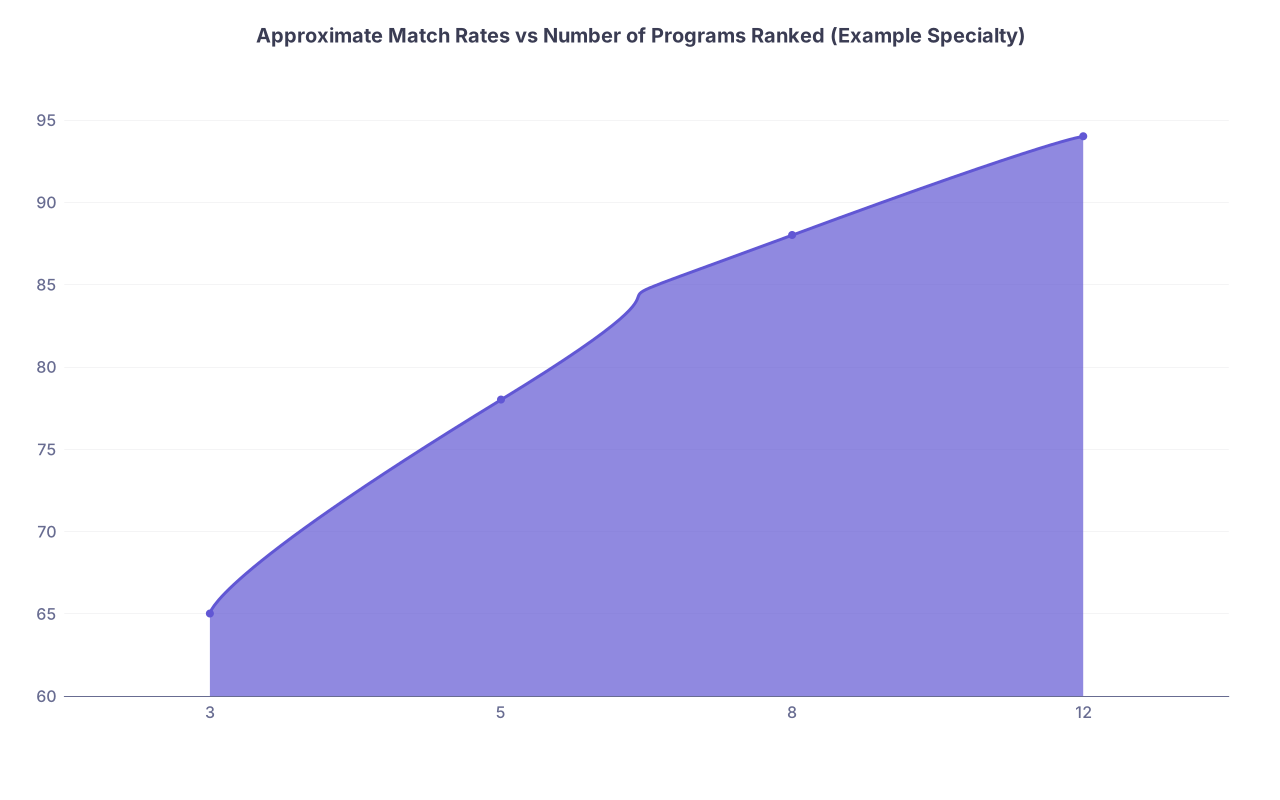
Look at how match rates change with number of ranks. From NRMP data (recent cycles show similar patterns), for U.S. MD seniors in more competitive specialties:
| Category | Value |
|---|---|
| 3 | 65 |
| 5 | 78 |
| 8 | 88 |
| 12 | 94 |
That trend—more programs ranked, higher match rate—has been consistent. And here’s the key: those lists always include a mix of safer and reach programs. There is no “match cliff” because you dared to rank Mass General or UCSF first.
The danger isn’t reaches. The danger is a short list or a dishonest list.
- Short list: you simply do not give the algorithm enough realistic options.
- Dishonest list: you bump “safer” but less desirable programs up because someone scared you with the reach myth.
I’ve watched applicants walk into this trap, especially in competitive fields like dermatology, ortho, ENT, plastics. They get 12 interviews, rank 8 because “the others were reaches I guess I won’t rank high,” then panic when they match somewhere they were lukewarm about—or worse, go unmatched because they under-ranked the full slate.
The algorithm would have been happy to try their dream choices first and still land them in their safer options if needed. They just didn’t let it.
How the Algorithm Actually Treats Your Rank List
You need a mental model of what happens so you can see why the myth fails.
Very simplified version—ignoring most of the technical jargon—of the applicant-proposing algorithm:
- Start with you at the top of your rank list, at Rank #1 program.
- The algorithm “proposes” you to that program.
- If the program has an open spot and you’re reasonably high on their list, they tentatively accept you.
- Later, if a more-preferred applicant (on their list) comes along and they’re full, they might drop you for that person.
- If you get dropped, the algorithm goes to your next ranked program and repeats the process.
- This continues until either:
- You’re tentatively held somewhere and not displaced anymore, or
- You run out of programs (you go unmatched).
Now notice what’s missing:
There is no “you wasted a top slot on a reach, therefore the safer program won’t see you.” The safer program sees you when it’s your turn on your list. If you’d have gotten in there by ranking them higher, you’ll still get in there by ranking them lower, as long as there’s a position open and you’re high enough on their list.
That is what “applicant-proposing” guarantees.
To crystallize the difference, here’s the key contrast between how students think it works versus how it actually does:
| Belief About Reaches | Actual Algorithm Behavior |
|---|---|
| “Reaches use up top spots on my list” | The algorithm just moves down your list as needed |
| “Ranking reaches lowers my match odds” | Ranking order **cannot** lower your match odds |
| “Safer programs will skip me” | Programs don’t see your list order at all |
| “I should rank safe programs higher” | You should rank by **true preference**, period |
| “Mixing reaches is risky” | Reaches + safeties together usually helps you |
Programs never see your rank list. They only see their own list. They do not know where you ranked them, how many reaches you ranked, or in what order.
The only thing your ordering does is tell the algorithm: “If more than one program wants me, send me here first.”
Concrete Example: What Actually Happens If You Rank Reaches First
Let’s go through a real-world-style example. Suppose:
- You have 10 interviews in Internal Medicine.
- 3 are “reaches” (big-name academic places).
- 4 are solid mid-tier university programs.
- 3 are community programs you’d tolerate but don’t love.
Your honest preferences: Reach A > Reach B > Mid 1 > Mid 2 > Reach C > Mid 3 > Mid 4 > Comm 1 > Comm 2 > Comm 3.
You’ve heard the myth and you’re tempted to do something like:
- “Be realistic”: put mid-tier and community programs first to “secure a spot.”
- Or cut some reaches lower because “they’re not going to take me anyway.”
So you end up with a distorted list: Mid 1 > Mid 2 > Mid 3 > Comm 1 > Comm 2 > Comm 3 > Reach A > Reach B > Reach C > Mid 4.
What did you gain?
Nothing. If Mid 1 could have taken you as your #3 choice, it will still take you if it sits at #1 or #8. Your odds of matching at Mid 1 do not improve by ranking it above a place you actually like better. The program does not move you up their list because you ranked them higher.
What did you lose?
You possibly lost the chance to end up at a program you truly preferred. Because if Reach A and Mid 1 both want you, and you created that “strategic” list, the algorithm is now forced to send you to Mid 1—even though you liked Reach A more. You literally told the system: “I want Mid 1 more than Reach A.” It believed you.
The actual winning strategy is boring and brutally simple: rank Reach A > Reach B > Mid 1 > Mid 2 > Reach C > Mid 3 > Mid 4 > Comm 1 > Comm 2 > Comm 3.
The algorithm will:
- Try Reach A first. If they can’t take you, no harm; it moves on.
- Then Reach B. If they can’t, moves on.
- Then Mid 1. If they can take you, they tentatively hold you.
- If later Reach C freed a spot and preferred you, they’d pick you up off Mid 1 and you’d move up in desirability on your terms.
Reaches never block you from landing safely. They just give you extra shots at a better outcome before the system settles on your floor.
The Real Risks You Should Worry About
The myth about ranking reaches distracts you from problems that actually destroy match chances. The people who go unmatched with multiple interviews almost never lose because they ranked a dream program too high.
They lose because of things like this:
Too few total programs ranked
Folks with 8–10 interviews in a competitive specialty ranking only 6–7 programs “because I didn’t like the others enough.” That’s playing strong opinions in a weak position.
Omitting places entirely out of pride or overconfidence
I’ve seen this exact line: “I wouldn’t actually go there, so I’m not ranking them.” Then March arrives and they decide, in fact, that they would have gone there.
If you truly would not go somewhere under any circumstances, sure, do not rank them. But be ruthlessly honest about what “under any circumstances” means. Job market. Visa status. Couples match. Future fellowship. Debt.
Couples Match miscalculation
Couples under-rank combinations, especially not including enough “safety” pairings where one partner goes slightly down-tier to preserve both matching. They get seduced by a top-heavy grid and forget the combinatorial math.
False sense of security from “strong” applications
Step 260, AOA, big-name research, 18 interviews—and they still under-rank because everyone tells them they’re “a lock.” Then they end up at the exact floor of their list or scrambled in SOAP, stunned.
The more “elite” your stats, the more you should respect the chaos factor.
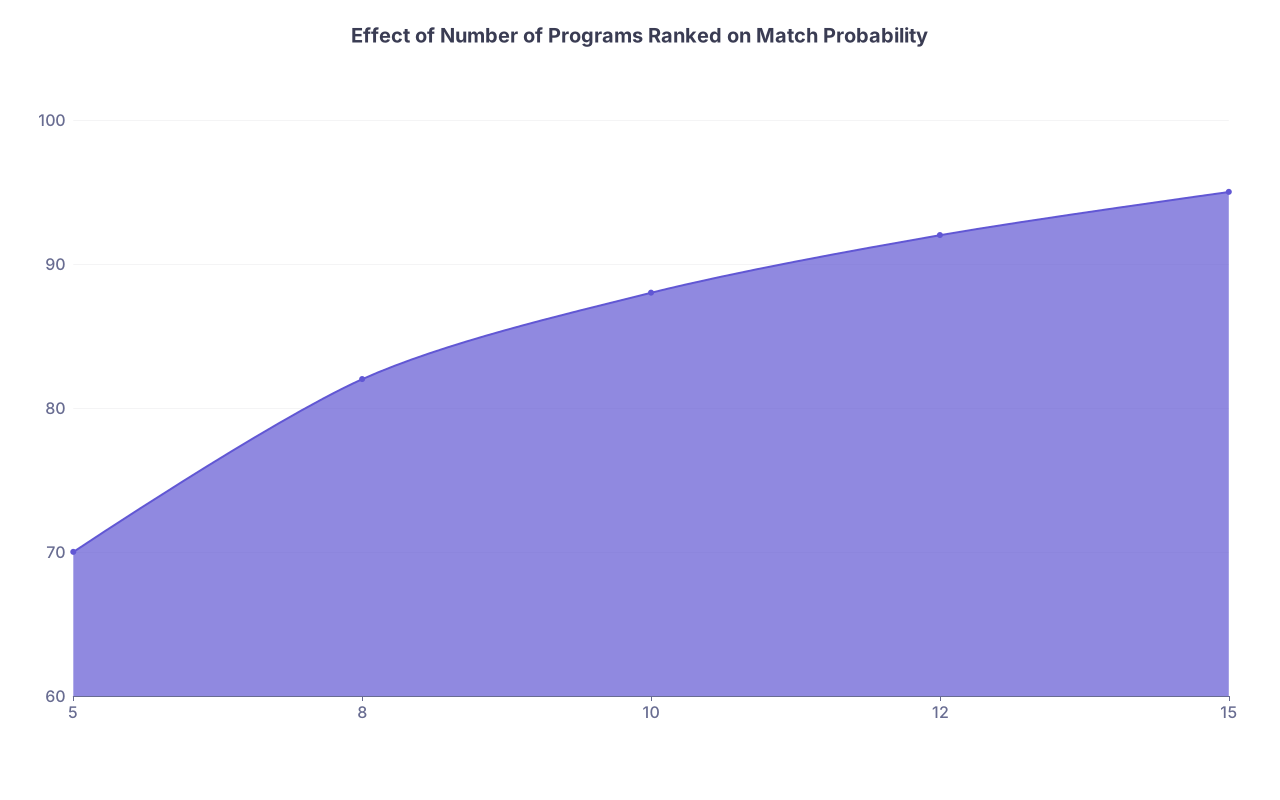
Here’s the pattern NRMP data consistently supports across specialties:
| Category | Value |
|---|---|
| 5 | 70 |
| 8 | 82 |
| 10 | 88 |
| 12 | 92 |
| 15 | 95 |
You’ll notice two things:
- The curve climbs as you add programs.
- There is no dip when more of those programs are reaches.
The composition of the list (within reason) is less important than the size of the list and your honest ordering of preferences.
Common “Strategic” Mistakes People Defend With Bad Logic
Let’s call out a few specific behaviors that stem from the reach myth.
“I’m ranking this safety higher because they seemed to like me more”
Programs’ perceived enthusiasm does not change the algorithm. If they ranked you high, they’ll reach you where you are on your list. Ranking them higher does not unlock some hidden bonus.
If your gut preference is Program X > Program Y, but you’re ranking Y higher because “I think they’ll actually take me,” you’re letting fear overrule math. The algorithm already accounts for their likelihood of taking you. You don’t have to layer your anxiety on top of it.
“I have 20 interviews but I’ll just rank my top 10 that I actually loved”
This is how very strong applicants end up regretting life choices.
You’re not asked to move in forever with these programs on Match Day. You’re asked to preserve options. Rank all of them in honest order. Worst case, the algorithm reaches your #18 and saves you from SOAP. Best case, you never see #18 because your higher preferences catch you.

“If I rank too many community programs, I’ll get pulled down”
No, you won’t “get pulled down.” You’ll get matched at the highest-ranked place that also wants you. If none of the academic places want you but a community program does, that’s not the algorithm dragging you down; that’s reality catching up with you.
Skipping those programs from your list doesn’t change how academic programs feel about you. It just removes your parachute.
So What Should You Do With Reaches?
The answer is much simpler than the tortured “strategies” people invent.
Use this rule:
If you would genuinely prefer to train there over any program below it on your list, then rank it above them. Regardless of how competitive it is. Regardless of what anyone tells you about “realistic chances.”
You want a hierarchy driven by your actual life:
- Where can you grow?
- Where will you be supported?
- Who are the residents you vibed with at dinner?
- Where did you feel like a human instead of a CV?
That’s the data the algorithm doesn’t have. That’s your job to encode.
And yes, that means your rank list might start with:
- A ridiculously elite academic program where only 1–2 of your classmates got in over the last decade.
- Another stretch program in a high-cost city.
- Your “home” institution.
- A strong mid-tier place.
- A solid community program.
That’s not naive. That’s exactly how the system is designed to be used.

| Step | Description |
|---|---|
| Step 1 | Start Rank List |
| Step 2 | Place Program X higher |
| Step 3 | Place Program X lower |
| Step 4 | Submit list in true preference order |
| Step 5 | Do I prefer Program X over all below? |
| Step 6 | Any more programs to compare? |
Notice what’s missing from that flow? “Is Program X realistic?” That’s the program’s problem, not yours.
A Quick Word on Outliers: When “Strategy” Actually Matters
There are a few narrow scenarios where nuance matters more:
- Couples Match: You’re ranking pairs of programs. You do need to think about combinations and include a decent number of “one person goes lower than ideal” options if your priority is both matching.
- Dual applying (e.g., EM + IM, or Rad Onc + IM prelims): You need to structure your lists so your backup specialty still has enough ranks and isn’t gutted by you artificially inflating unrealistic primary specialty options without safety nets.
- Visa / extreme geographic constraint: If there are very few programs that can legally or practically take you, the size of your feasible pool matters a lot.
Even in these edge cases, though, the core truth stays the same: within each feasible bucket, you still rank in true preference order. You don’t “sacrifice” your preference order because a program is a reach. You just make sure your overall number of ranked options in each realistic scenario is robust.
| Category | Value |
|---|---|
| Too Few Ranks | 90 |
| Dishonest Order | 70 |
| Ranking Reaches | 5 |
| Omitting Safeties | 80 |
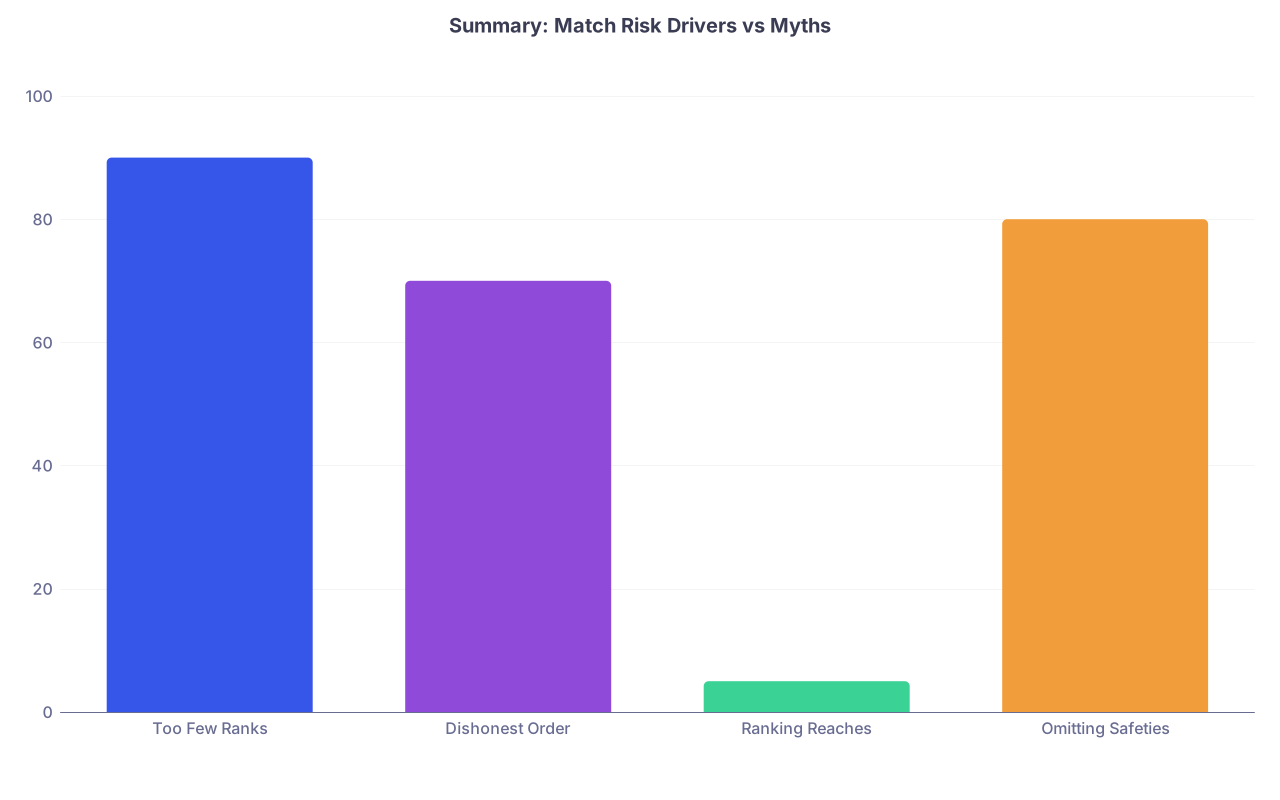
The real killers: too few ranks and omitting safety programs you’d actually attend. Not daring to rank a dream program first.
Years from now, you won’t remember the exact slot where you ranked each “reach.” You’ll remember whether you were honest with yourself about what you wanted, or whether you let other people’s fear drive your choices.
So stop worrying that ranking reach programs will hurt your Match odds. It won’t. What will hurt you is building a rank list that reflects your anxiety instead of your actual priorities.


