

Signaling does not change how you should rank programs. At all. And anyone telling you otherwise is either guessing or repeating hallway folklore.
Let me be blunt: specialty signals, preference signals, gold stars, love letters—whatever flavor your specialty is using this year—matter on the application side. They are almost irrelevant on the rank list side for you as an applicant.
Yet every January, I hear the same anxious nonsense:
- “I signaled them, so I kinda have to rank them higher, right?”
- “They said we were a ‘great fit’ and referenced my signal—I’ll get penalized if I rank them too low.”
- “If I rank a non-signaled program above a signaled one, the algorithm might screw me.”
No. No. And no.
Let’s separate the myths from what the data and the NRMP algorithm actually support.
The Core Truth: Signals Affect Interviews, Not the Match Algorithm
Preference signaling is a pre-Match filter. Programs use it to decide:
- Who to invite for interviews
- Sometimes, who to take more seriously during review
Once rank lists are submitted, the Match algorithm does not care one bit about who you signaled.
Not a little bit. Not “only in tie-breakers.” Zero.
The NRMP algorithm is a variant of the Gale–Shapley “deferred acceptance” algorithm. It uses:
- Your rank list
- Programs’ rank lists
- Quota (number of positions)
It does not use:
- Signals
- Where you interviewed first
- Number of emails sent
- How “interested” you looked on Zoom
If a program somehow bakes your signal into its rank list, that’s on their side. By the time you’re ranking programs, the signaling step is done. You’re not changing any program’s rank list by moving them up or down on yours.
So the central rule, which very few people say clearly enough:
You should rank programs strictly in order of where you would actually want to match, regardless of who you signaled.
Anything else is self-sabotage.
Myth #1: “If I Signaled a Program, I’m Obligated to Rank It Higher”
I’ve heard faculty say this explicitly: “If you signal us, you’re telling us we’re one of your top choices, so you should rank us that way.” Sounds reasonable. Also meaningless in the actual Match mechanics.
Reality check:
- A signal is a tool to get an interview and maybe some extra attention.
- It is not a binding commitment. There is no rule—ethical or algorithmic—that forces your rank list to mirror your signals list.
Two things can both be true:
- In September, you signaled Program A because it looked amazing on paper.
- In January, after interviews, you realize Program C is a much better fit.
You don’t owe Program A your future just because you burned a signal there when you barely understood what they were really like.
I’ve seen people do this wrong. MS4, mid-tier US MD, applied to EM. They gave a signal to a big-name brand program they thought they “should” love. Interviewed there, hated the culture—malignant vibe, residents looked miserable. But they said to me, “I signaled them, I’ll look dishonest if I don’t rank them top 3.”
They ranked it #2 instead of #5–6 where they actually wanted to be. They matched there. They regretted it by February of intern year.
The signal didn’t force that outcome. Their mis-ranking did.
Myth #2: “Signals Change How the Algorithm Treats My List”
No, they don’t. The NRMP has been quite explicit on this: the algorithm uses rank lists only.
Let me give you a stripped-down example.
You have this true preference order:
- Program X (no signal)
- Program Y (signaled)
- Program Z (signaled)
But you’re scared of “looking bad” or “wasting the signal,” so you artificially rank:
- Program Y
- Program X
- Program Z
Here’s what can happen:
- Program X would have ranked you high enough that you would have matched there if you had put it #1.
- Program Y ranks you lower, but still high enough to catch you when the algorithm hits your #1 choice (fake #1).
The algorithm tries to place you at Y first. Y has a spot, you fit, you match there. It never even tries to place you at X.
You just lost your true top choice because you wanted to “honor” a signal.
The algorithm did exactly what it’s supposed to do: tried to give you your highest ranked possible choice. But you fed it a rank list that didn’t match your actual preferences. That’s not strategy; that’s self-inflicted error.
What Signals Actually Do (On the Program Side)
Programs are the ones who “use” signals. You use them exactly once: when you choose where to send them. After that, they’re just part of your file. Programs may:
- Prioritize reviewing signaled applicants sooner
- Use signals to break ties when deciding interview invites
- Sometimes weigh them in ranking decisions if they believe signals = real interest
But this is all upstream from your rank list.
To make it concrete, think of it like this:
| Stage | Do Signals Matter? | How They’re Used |
|---|---|---|
| Deciding interview invites | Yes | To prioritize which apps to review |
| Deciding interview order/day | Maybe, rarely | Occasionally to sort interest |
| Creating program rank list | Sometimes | As one factor in ranking applicants |
| NRMP Match algorithm process | No | Algorithm ignores signals completely |
| Your rank list strategy | No | Should reflect only your true preferences |
The only place signals directly affect your life is earlier: did you get the interview or not. Once you’re at ranking time, your job is simple: tell the truth about where you want to be.
Myth #3: “Programs Will Be Mad If I Rank a Non-Signaled Program Above Them”
I’ve heard PDs complain in private about signals. They’ll say things like:
- “We were a ‘signal’ but clearly not truly their top choice.”
- “Signals are noisy, students use them oddly.”
But here’s the key: they don’t know your rank list when they create their rank list. By the time they see where you matched, it’s over. They can be mildly annoyed. They cannot retroactively change anything.
There’s no Match police auditing “signal honesty.” There’s no data feed to programs that says, “This applicant ranked you lower than three non-signaled programs, shame on you for trusting their signal.”
Also: almost everyone uses signals imperfectly. Some signal places they think they “should” want. Some gamble on long-shots. Some change their mind after visiting, after second looks, after a terrible interview day. PDs know this. Any PD who treats signals like blood oaths is misunderstanding their own tool.
You are allowed to learn. You are allowed to change your mind.
You are not in a relationship with programs; you are in a one-shot allocation game.
How You Should Use Signals (Earlier in the Season)
This is the only strategic piece that actually uses signals, and it’s well before ranking:
- Use signals to increase your odds of getting interviews at places you would be genuinely excited to attend, especially ones that might not otherwise notice you.
The data from early signaling specialties (OTO, Derm, Ortho, etc.) showed:
- Applicants who signaled a program were more likely to get an interview there.
- Programs used signals to prioritize limited interview spots, especially among borderline or mid-pack applicants.
Where people screw this up:
- Signaling “prestige” programs they have almost no chance at, while ignoring excellent but realistic places
- Spreading signals without a strategy, then feeling obligated to rank according to that early guesswork
Once you’ve sent signals, throw them in the mental trash when you’re making your rank list. They’ve done their job.
The Only Correct Rank List Strategy (With or Without Signals)
This is not complicated, but people insist on overthinking it.
Your rank list should:
- List every program where you would be willing to train.
- Put them in exact order of where you’d most like to match, from “dream” to “I’d still be okay here.”
- Ignore:
- Perceived “chances” based on post-interview vibes
- How programs responded to your signal
- What your advisor “thinks” you’ll get
- Guilt, obligation, flattery, or fear
The Match algorithm is applicant-optimal. That means:
- You will never be punished for ranking a long-shot program #1.
- You will never “lose” a safer program by ranking it lower unless you get something you wanted more.
- You cannot “game” your way into a better outcome by lying about your true preferences.
The only way to lose is to misrepresent what you actually want.
Common Bad Advice About Signals and Ranking (And Why It’s Wrong)
Let’s call out a few specifically.
“Rank your signaled programs higher to show you’re serious.”
Programs do not see your rank list before forming theirs. They can’t reward you for being “serious.” Your seriousness is invisible until after the Match.
Signal = September tool.
Rank list = February truth.
Different phases, different rules.
“If a signaled program told you you’re ‘high on their list,’ bump them up.”
Programs overcommunicate enthusiasm constantly:
- “We were very impressed with you.”
- “You’d be a great fit here.”
- “We hope to see you here in July.”
Some mean it. Some are just being nice. Some are borderline violating NRMP communication guidelines.
What you actually know: nothing objective.
Rank them where they belong on your list. If you like them enough to be above other programs, sure. But not because of that one-email dopamine hit.
“If you don’t rank a signaled program highly, future applicants from your school might be hurt.”
This is speculative fear-mongering. Programs aren’t running longitudinal Bayesian models based on three years of signal-to-rank alignment from your med school.
Most PDs barely have time to run their own service, let alone track who “honored” their signals across cohorts.
Could a PD get grumpy and vent to faculty that “students from School X don’t follow through”? Maybe. Does that translate into a measurable disadvantage to next year’s MS4s? I have never seen real evidence.
Sacrificing your own career fit to protect a hypothetical, unmeasured marginal effect on a future class is not smart.
What the Limited Data and Logic Actually Support
We do not have perfect RCT-level data on signals and rank behavior. But we do have:
- NRMP’s clear explanation of the algorithm: rank lists only, no signals.
- Specialty-specific signaling outcome reports showing effects on interviews, not Match placement mechanics.
- 20+ years of Match data showing the algorithm is robustly applicant-favoring when applicants rank by true preference.
We also have consistent patterns:
- Seniors who try to be “strategic” with rank lists (e.g., pushing up places that “liked them” or that they signaled) are more likely to express regret later.
- Seniors who ruthlessly ordered their list based on where they wanted to wake up on July 1 are far more at peace, even if they missed a dream long-shot.
The logic is straightforward:
- The only rational move is to feed the algorithm your real utility function: where you actually want to go, in order.
- Signals are noise at this stage. Emotional noise, mostly.
A Simple Mental Model For Your Rank List
Here’s a visual way to think about it.

| Step | Description |
|---|---|
| Step 1 | All Programs You Interviewed At |
| Step 2 | Do NOT Rank |
| Step 3 | Place on List |
| Step 4 | Sort by where youd be HAPPIEST |
| Step 5 | Ignore signals, vibes about chances |
| Step 6 | Submit |
| Step 7 | Would I be okay matching here at all? |
Signals never appear in this flow. Because they belong upstream: in “who even gives you an interview” territory.
One Concrete Example: When Signals and Rank Lists Collide
Say you’re applying to Internal Medicine with 4 signals. You used them on:
- Big Academic A (your perceived dream in September)
- Regional Academic B (home-ish)
- Solid Community C
- Long-shot Very Famous D
Interviews roll around. You end up loving:
- Regional Academic B — fantastic residents, support, great leadership.
- Unsignaled Program E — small but high-quality academic center, hidden gem.
- Solid Community C — good backup, fine but not exciting.
- Big Academic A — impressive but cold, residents seem burned out.
- Very Famous D — faculty were great, but location terrible for your partner.
Your true preference order in February is:
- B
- E (unsignaled)
- C
- A
- D
Your rank list should look exactly like that. Your September signal distribution is old data. Outdated beliefs. No longer relevant.
If you change it to:
- A
- B
- D
- C
- E
just to “align with signals” and prestige, you’re telling the algorithm: “Put me in one of the programs I liked less, please.”
Sometimes it will listen.
Bottom Line: What To Actually Do
When you sit down to finalize your rank list, here’s the honest checklist:
- Ignore where you sent signals.
- Ignore who flattered you most.
- Ignore “I think they’ll rank me higher, so I should…” thoughts.
- Ask one question for each program:
“If I wake up on Match Day and see this name on the screen, will I feel relieved, okay, or crushed?”
Then sort them accordingly.
Signals were for September. Rank lists are for the next 3–7 years of your life.
Years from now, you will not care where you sent your tokens in ERAS. You will care whether you wake up for work in a place that fits you, challenges you, and doesn’t hollow you out. Rank for that—and let the signals fade into what they always were: just another noisy tool in a chaotic process.
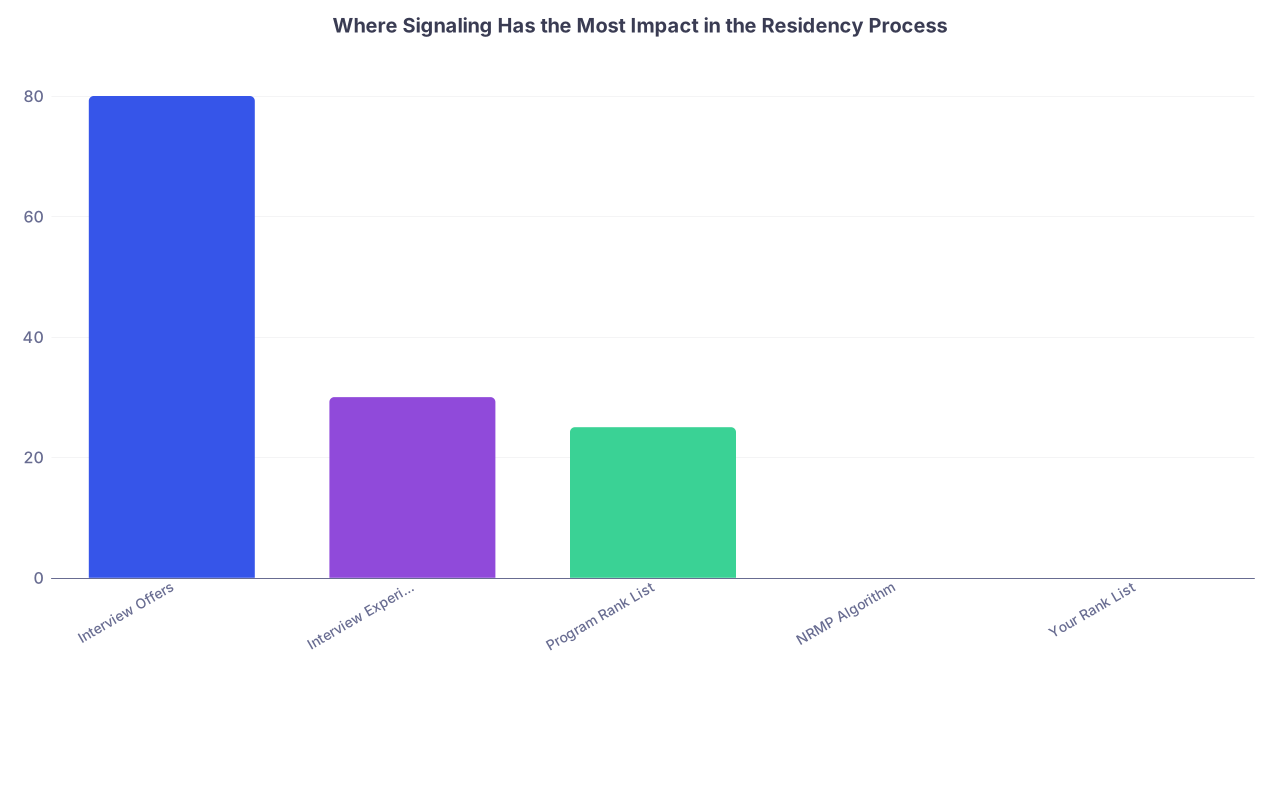
| Category | Value |
|---|---|
| Interview Offers | 80 |
| Interview Experience | 30 |
| Program Rank List | 25 |
| NRMP Algorithm | 0 |
| Your Rank List | 0 |


