

27% of applicants admit they ranked a program higher because it was one of their first two interviews.
And a lot of them ended up regretting it.
Let me cut straight through the superstition: interview order is one of the most overinterpreted, emotionally-loaded, and data-free “signals” in the entire residency process. People treat it like tarot cards. Early invite = “they love me.” Late January interview = “backup only.” First interview of the season = “must be top choice because they took a chance on me.”
None of that maps cleanly to how programs actually think. Or how the Match algorithm works. Or what your future happiness will look like.
You’re asking the right question: Does interview order predict where you should rank a residency?
The blunt answer: No. Not reliably. And when applicants act like it does, they make bad ranking decisions.
Let’s break down the myths and what the data and real-world behavior actually show.
What Applicants Think Interview Order Means (And Why It’s Mostly Wrong)
I’ve heard all of these in real hallways:
- “They interviewed me in October, I must be high on their list.”
- “They squeezed me in late January, I’m clearly a bottom-tier backup.”
- “It was my first interview and they treated me so well—this must be my #1.”
- “If they pre-interview socialed me hard, they’ll rank me to match.”
Most of this is projection. You’re trying to turn a chaotic, semi-random scheduling process into a narrative that soothes your anxiety.
Here’s the reality I’ve seen from program side conversations and coordinator emails:
- Interview dates are driven by faculty schedules, OR block time, clinic days, and holidays—not your “priority status.”
- Early interview ≠ high rank. Late interview ≠ low rank.
- Programs often haven’t even decided final rank philosophy until after the whole interview season.
- Many places scramble to add “extra” dates because leadership suddenly realizes they need more candidates.
The key: the sequence in which you interview is almost never a clean signal of how a program views you. It’s even worse as a signal of where you should rank them.
What Interview Order Actually Does Predict: Your Emotions
Where interview order does matter is inside your head.
Early interviews feel special. You remember the first program that:
- Didn’t screen you out.
- Treated you like a near-colleague for the first time.
- Took place when you were still fresh, not burnt out on Zoom or airports.
You’re more emotionally open. Less cynical. More easily impressed. That shiny-new experience biases you.
Late interviews have the opposite problem:
- You’re exhausted.
- You’ve already seen 6–12 versions of “we’re like a family” plus “we have great training and collegial culture.”
- Small flaws suddenly feel like dealbreakers because you’ve got a mental comparison list now.
So you end up with this psychological trap:
Early interviews feel deceptively amazing. Late ones feel deceptively “meh.” That alone can warp your rank list if you don’t correct for it.
The Match Algorithm Does Not Care About Interview Order
Let’s drag the algorithm into the daylight because a lot of interview-order superstition comes from not understanding how it works.
The NRMP algorithm is applicant-proposing. Translation: it’s built to honor your preferences as much as mathematically possible, not the program’s.
Here’s the only thing that really matters for you:
You submit a rank list in order of where you would most like to end up, assuming all options were guaranteed.
It doesn’t use:
- Your interview date
- Whether you got the invite early or late in the season
- Whether the PD smiled more than average
- Whether they “hinted” they liked you
It literally just uses the order you rank programs.
To make this concrete:
| You Rank | Program Rank of You | Match Outcome |
|---|---|---|
| #1 | #15 | You match there if spots unfilled by higher-ranked applicants |
| #3 | #2 | You still match #1 or #2 if they can take you, even if #3 ranked you higher |
| #5 | #1 | You match #1–4 if possible; program's love doesn't override your higher choices |
Your job is not to decode how much a program “likes” you from interview date. Your job is to decide how much you like them, uninfluenced by these phantom signals.
Do Earlier Invites or Dates Mean a Program “Likes” You More?
Sometimes. But not in a way that should control your rank list.
Programs vary wildly in how they handle invites and scheduling. Some patterns:
- Some send all invites in one blast based on a screening score. Your place on that email list is irrelevant.
- Some roll them out in waves as faculty review applications in batches.
- Some hold back “late” invites for strong applicants who applied late or were flagged by a faculty member.
- Some have “protected” early dates for home students or couples match pairs.
So yes, if you get a very early invite, they probably saw something they liked. But the step from that to “I must rank them higher” is where people go off the rails.
Also, where you fall in their pile does not change how well you will:
- Fit the resident culture
- Handle their call schedule
- Get the cases, mentorship, and support you want
- Feel living in that city for 3–7 years
You know what predicts those far more than invite or interview date?
Actual content: conversations with residents, how faculty talk about trainees, call and rotation structure, resident turnover, and how your gut feels after 12 interviews, not just 2.
Data: Early Interviews vs Match Outcomes
There’s no major NRMP study showing “people who interview in October match better than people in January” within a given program. Why? Because interview time is such a noisy, confounded variable it’s almost meaningless analytically.
What we do know from NRMP and specialty reports:
Match success correlates with:
- Number of contiguous ranks in a specialty
- Overall application strength (Step scores when relevant, clerkship grades, LORs, research in some fields)
- Breadth of programs applied to (to a point)
It does not meaningfully correlate with:
- Whether your interview was in November or January
- Whether your invite came early in the season or late
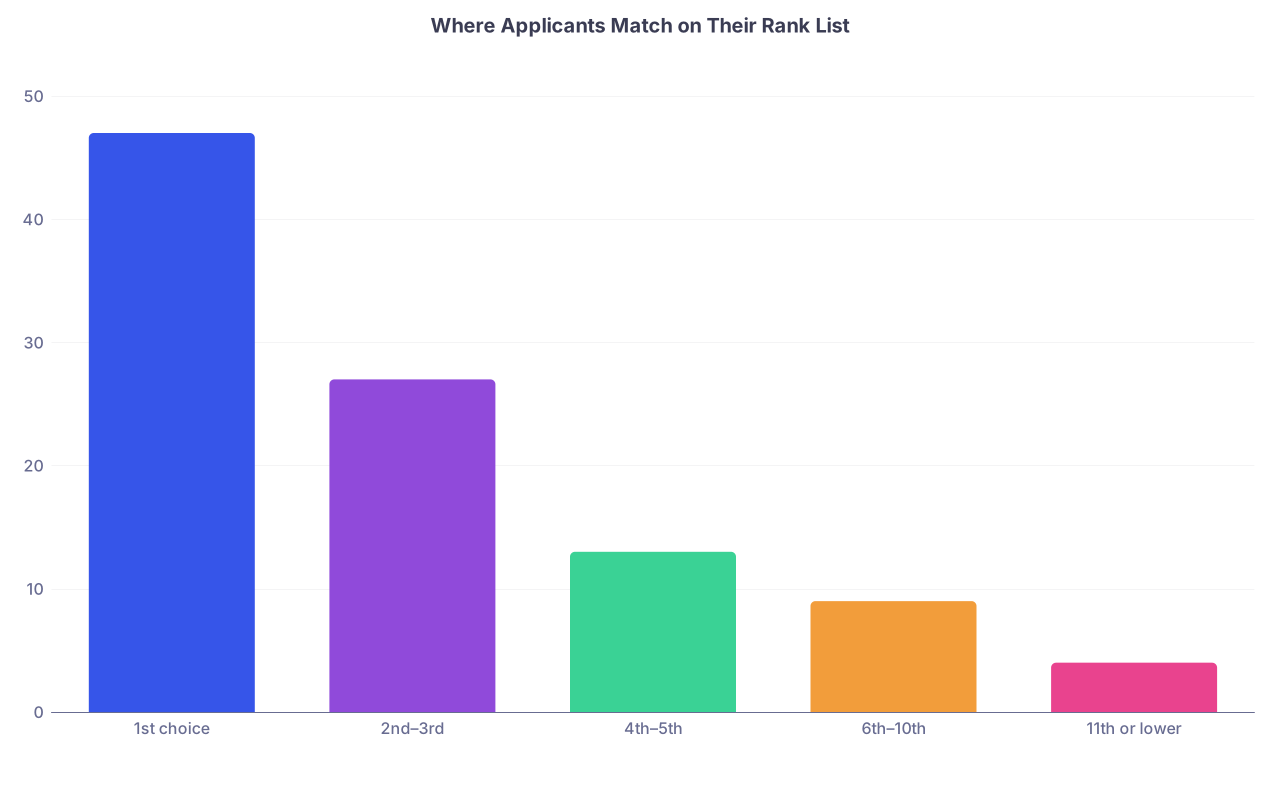
To visualize where people actually match relative to their rank lists:
| Category | Value |
|---|---|
| 1st choice | 47 |
| 2nd–3rd | 27 |
| 4th–5th | 13 |
| 6th–10th | 9 |
| 11th or lower | 4 |
Nearly half match at their first choice. Many of those first-choice programs were not first or early interviews. They became first choice later, when the applicant had more data and perspective.
The Most Dangerous Interview-Order Trap: “First Love Bias”
Here’s the trap I’ve seen over and over:
Your first 1–3 interviews feel dramatically better than they deserve.
Why?
- You’re finally “wanted” after months of anxiety.
- You haven’t yet seen how different programs can be.
- You’re still impressed by basic courtesies (“They fed us lunch!” “They gave us swag!”) that you later realize are standard.
So you walk out thinking, “I could totally see myself here. This might be #1.”
Then you interview 8 more places. You see programs with better training, better culture, better cities, or simply a better fit for your personality. But your brain keeps anchoring back to that first early-interview program because it’s emotionally charged.
This is classic cognitive bias:
- Anchoring – first serious data point gets overweighted.
- Availability – early program is especially vivid in your memory.
- Endowment effect – you feel weirdly “attached” because they were early to show interest.
The result: people over-rank their early programs and underweight better options they saw later.
How to correct for “first love bias”
You do not fix this with willpower. You fix it with structure.
Do this after your last interview, not after each one:
- Write down your top 5 criteria (examples: teaching quality, operative volume, resident happiness, location, fellowship placement, support for parents, etc.).
- Rate each program blind to interview order on each criterion on a simple 1–5 scale.
- Only after that step, look at your emotional pull and gut feel.
You’ll be surprised how many early-interview programs fall in the middle of the pack once you compare systematically.
Late Interview ≠ Backup Program
Another myth that wrecks rank lists: “If I interviewed there in late January, they must be my backup. I’ll never be high on their list.”
Interpretation: “If they really liked me, they’d have invited me early and given me an early date.”
Reality on the ground:
- Some programs only interview in January because of holidays and block schedules.
- Some add late dates because leadership panics: “We only have 60 ranked for 8 spots, that feels thin, let’s add another day.”
- Some pull you in late after a letter writer calls or a faculty advocate emails the PD.
Programs absolutely have people they love on “late” days. I’ve heard PDs say things like:
“Our best resident right now interviewed the last day because that’s when he could fly in.”
They do not intentionally restrict high-priority candidates to early days. They just need enough strong candidates across all dates to fill their list.
The Only Interview Timing That Sometimes Matters
So is there any timing-related thing you should pay attention to? Yes, but it isn’t what you think.
The one semi-real signal: being “waitlisted” for an interview and then pulled in very late.
That can mean:
- You were initially below the cutoff and moved into the pool after cancellations.
- They want a bigger buffer of candidates to make their rank list feel safe.
- A faculty member advocated for you late.
Even then, that information is marginal. Because:
- Programs often over-invite, under-invite, then recalibrate mid-season.
- Your position on their list is going to be based on your file + interview performance, not the micrometer difference between being invited November 2nd vs November 28th.
You know what’s still a stronger predictor of your match and fit?
How you rank them.
How to Build a Rank List Without Letting Interview Order Screw You
Here’s a simple, ruthless approach that ignores the noise and respects what actually predicts your happiness.
Step 1: Forget when you interviewed. Literally.
Make a list of programs alphabetically or by region. Hide the interview date column if you’ve been tracking it. Do not sort by “first interview to last.”
If you can’t help but remember, fine. But do not use it as a ranking dimension.
Step 2: Define what actually matters to you
Different people care about very different things. I’ve seen people thrive at low-name-recognition programs because they cared about:
- Close family support
- Low malignant culture
- Strong work-life sanity
Meanwhile others were laser-focused on:
- Case volume and autonomy
- Specific fellowship pipelines
- Research infrastructure
There’s no universal right answer. But there is a wrong one: “they interviewed me early” or “the residents were really nice on Zoom for 45 minutes” as the main criterion.
Step 3: Use a simple comparative system
For each program, give yourself a quick score from 1–5 on your 4–6 top criteria. Do it fast, from memory. Don’t overthink.
Then do pairwise comparisons:
“If both offered me a guaranteed spot, would I pick Program A or Program B?” Repeat, tournament style, until you have a rough rank order.
You’ll notice something: the interview order becomes irrelevant very quickly once you’re forced to choose on substance.
Why This Matters: The Regret Problem
NRMP satisfaction surveys and random hallway conversations share a theme: people regret choices driven by emotion and noise more than choices driven by clear priorities.
Common regret lines:
- “I picked them because they felt so enthusiastic about me on interview day, but the culture is way more toxic than some places I ranked lower.”
- “It was my first interview and they love-bombed us. I should have trusted what I learned later about the workload.”
- “I wrote them higher because I thought I wouldn’t match at the place I actually liked more.”
Not once have I heard someone say:
“My only regret is that I didn’t weight my interview date more heavily.”
Because it just isn’t a reliable predictor of anything that will matter to you as an intern at 2 a.m.
The Bottom Line: What Interview Order Really Means for Your Rank List
Strip away the folklore, and you’re left with this:
- Interview order is mainly a logistical artifact, not a value judgment about you, and absolutely not a guide for where you should rank a residency.
- The Match algorithm rewards your true preference order, not the programs that happened to see you earliest or invite you first.
- Early interviews feel better than they deserve; late ones feel worse. If you do not correct for that bias, you will build a distorted rank list.
Rank programs in the order you would genuinely want to live and train there, assuming every one of them would take you. That’s it. Everything else—especially interview order—is noise masquerading as signal.


