

Your home program is not a magical safety net.
Plenty of students put their home institution at the top of their list assuming, “They know me. They’ll take care of me.” Every year, some of those students open their emails on Match Day and learn the hard way: that assumption is wrong.
Let me be even clearer: home programs are not automatically safer, and for some applicants, they’re objectively riskier to rank highly. The mythology around “home field advantage” in residency is massively overstated, and the historical data plus program behavior back that up.
You want a rank list that actually maximizes your chance of matching and your long‑term happiness, not one built on sentimental loyalty or false security. So let’s gut-check what people say about home programs versus what actually happens.
The Myth of the “Home Field Advantage”
You’ve probably heard variations of:
- “Programs love their own students.”
- “If you’re not a problem, your home program will rank you high.”
- “It’s your safest option.”
There’s some truth buried in there, but it’s not what people think.
Many program directors do like their own students. They’ve invested time in them, know their reliability, have seen them on the worst services, at 2 a.m., when it actually matters. That can translate into a loyalty bump.
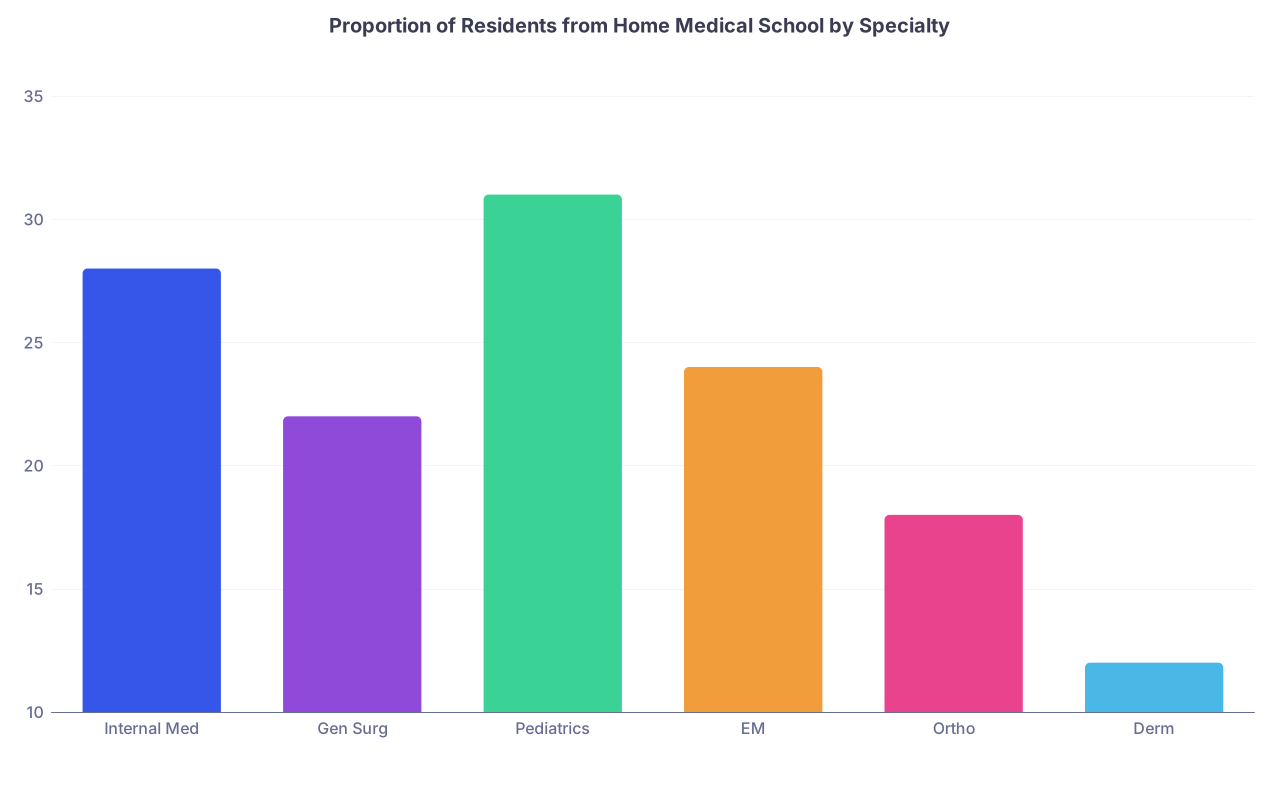
But here’s what the history and survey data show:
| Category | Value |
|---|---|
| Internal Med | 28 |
| Gen Surg | 22 |
| Pediatrics | 31 |
| EM | 24 |
| Ortho | 18 |
| Derm | 12 |
Those numbers (rough approximations based on historical NRMP and program surveys):
- Internal Medicine: ~25–30% home students
- Pediatrics: often similar or a bit higher
- Competitive surgical / lifestyle specialties: frequently lower home share
- Ultra-competitive (derm, plastics, ENT): many programs have a home student some years, none in others
Translated: most spots are not going to home students. Plenty of programs routinely match zero from their own school in certain years. I’ve watched a big-name academic IM program go from 6/10 home students one year to 1/10 the next, with no “big scandal” in between. Just a different applicant pool and priorities.
So the “home field advantage” is conditional, not guaranteed. And definitely not a safety net.
What Actually Drives Home Program Decisions
Program directors are not asking, “Is this our student?” first. The internal conversation looks more like:
- “Is this person in our top tier of applicants overall?”
- “Do they fit what we need this year?”
- “Are there political issues if we don’t rank them highly?”
- “Will our faculty revolt if we don’t keep them?”
- “Are we overloading with our own students at the expense of diversity?”
When committees sit down, they don’t create a “home student list” and then fill in the rest. They build a board of names—away rotators, external applicants, home students all jumbled together—and then argue about tiers.
What helps a home student:
- Strong clinical performance that faculty can vouch for.
- Solid Step/COMLEX scores relative to the program’s usual match.
- Acting-internship performance with specific champions (“I’d be happy on call with them every night.”).
- A reputation as low drama, high reliability.
- Clear communication of interest (and not playing weird games with “you’re my #1 unless…”).
What hurts a home student:
- Being “fine” but not special relative to the pool.
- Any whiff of professionalism issues. One bad story gets magnified because they’ve known you for years.
- The faculty being split: a few really like you; a few strongly do not. That division itself can sink you.
- A strong sense that you’re using them as a backup and leveraging them for other interviews.
I’ve watched this play out: a home student with decent but not standout performance, one or two quiet red flags, then a stellar away rotator from another school. Faculty will say the quiet part out loud: “If we only have one spot left in this tier, I’d rather have the away student.”
Home doesn’t override overall competition.
When a Home Program Is Safer – And When It Isn’t
The question you actually care about: Should my home program be ranked higher because it’s “safer”?
Sometimes yes. Sometimes absolutely not.
Let’s separate scenarios.

Scenario 1: You’re a clear top-tier candidate at your home program
You:
- Consistently honored core clerkships in that department
- Did an AI there and were explicitly told “we’d love to keep you”
- Have scores/letters that match or exceed their typical resident profile
In this case, historically, home programs often rank such students near the top. You’re low risk for them. So yes, ranking them highly can be “safer” in the sense that they’re relatively likely to rank you highly.
But here’s the problem: applicants inflate this category. Everyone thinks they’re in it. They’re not.
Scenario 2: You’re solid but middle-of-the-pack at your home program
You:
- Did fine on rotations, some high passes, maybe an honors or two
- Have mixed evals (“hard worker” but also “needs more initiative”)
- Have Step/COMLEX scores around or slightly below their usual residents
- Did not get strong, explicit encouragement from key decision makers
Historically, this is the danger zone. You are not especially safer at home than at similar-tier external programs who only see the polished version of you.
At home, they’ve seen:
- Your stronger and weaker attendings’ opinions
- Your behavior with nurses and staff
- How you were when tired, behind, or frustrated
That depth cuts both ways. An away program sees a 4-week highlight reel. Your home program knows the whole season.
For many students in this middle band, home is emotionally safer, not statistically safer.
Scenario 3: Your relationship with the home program is complicated or weak
Red flags like:
- You had to remediate a rotation in that department
- There was a professionalism note or informal “concern” meeting
- A key faculty member clearly does not like working with you
- You never really clicked with the residents or culture
I’m blunt here: home may be more dangerous to rank highly.
Programs are often more comfortable ranking an unknown external applicant with glowing letters than their own student with mixed internal buzz. I’ve sat in rank meetings where the message was clear: “I don’t want to deal with three more years of this dynamic.”
In that context, putting your home program #1 because you think they “know you” is wishful thinking.
What Past Match Data and Behavior Actually Suggest
The NRMP doesn’t publish a neat table saying “home programs are X% safer to rank.” But we can infer patterns from several consistent observations and surveys.
Programs usually do not go out of their way to rescue their own students on the rank list.
They might give a mild bump, not a parachute. If you’re not competitive relative to their pool, they often do not try to engineer a “save.”High-prestige programs decrease the home-student share over time.
Many big academic centers intentionally avoid overfilling with their own students. Diversity of background, fresh perspectives, political fairness. That weakens the “home safety” idea at those places.Competitive specialties treat home students like everyone else—with slightly better intel.
In derm, ortho, plastics, EM, ENT, etc., home status is a plus, not a shield. A mediocre home applicant does not magically beat an outstanding away rotator.
Here’s a simplified comparison that matches what I’ve seen repeatedly across programs:
| Applicant Type | Relative Rank Safety at Home | Relative Rank Safety Externally |
|---|---|---|
| Top-tier home student | High | High |
| Mid-tier home student | Moderate | Moderate–High (at right tier) |
| Home with mixed reputation | Low | Moderate (at less-informed sites) |
| Outstanding away rotator | Moderate–High | High (especially where rotated) |
The key insight: “Home” doesn’t move you a category. It tweaks within a category.
If you’re mid-tier, you stay mid-tier, just with more scrutiny.
Why So Many People Still Believe “Home is Safer”
Because of three biases:
Survivorship bias
You see the people who matched at their home program and say, “See, it worked.” You do not see the ones who ranked home #1 and matched far down their list, or worse, did not match and quietly redid the process next year.Narrative bias
Stories like “I ranked my home #1 and they took me!” spread easily. They’re simple, comforting. The more common story—“I ranked according to true preference and it worked out fine”—does not circulate the same way.Emotional bias
Students are scared. Home “feels” safe: familiar hospital, faculty you know, geography you understand. Fear dresses itself up as strategy.
Fear is not a strategy. It’s a distortion.
How to Actually Think About Ranking Your Home Program
Here’s the reality: the NRMP algorithm is applicant-optimal. The number one rule that has held up over years of data analysis is simple:
Rank programs in your true order of preference, ignoring guesses about where you’re “safer.”
But people still twist themselves up about home because they don’t trust their own read of the situation. So use a more honest framework.

Ask yourself:
If this weren’t my home program—if it were just another name—where would I rank it based on training quality, culture, and fit?
Strip away familiarity bias. How does it stack up against similar programs in other cities?Am I objectively a top-tier, mid-tier, or marginal candidate for this specific program?
Not overall. For them. Look at:- Their usual Step/COMLEX range
- Their usual level of research/leadership
- What faculty have actually said to you, not what you wish they meant
What have key decision-makers explicitly communicated?
Vague “we’d love to have you here” is cheap. Strong signals matter:- “We’re ranking you to match.”
- Direct advocacy conversations from PD or APD after interview.
- Very strong relationships with multiple influential faculty.
Does ranking them higher meaningfully change my outcome if they’re likely to rank me the same regardless?
Most applicants overestimate their ability to game the system. You ranking them #1 does not make them rank you higher. If they like you enough to match with you, they’ll likely have you high anyway.
When It’s Rational to Push Home Down Your List
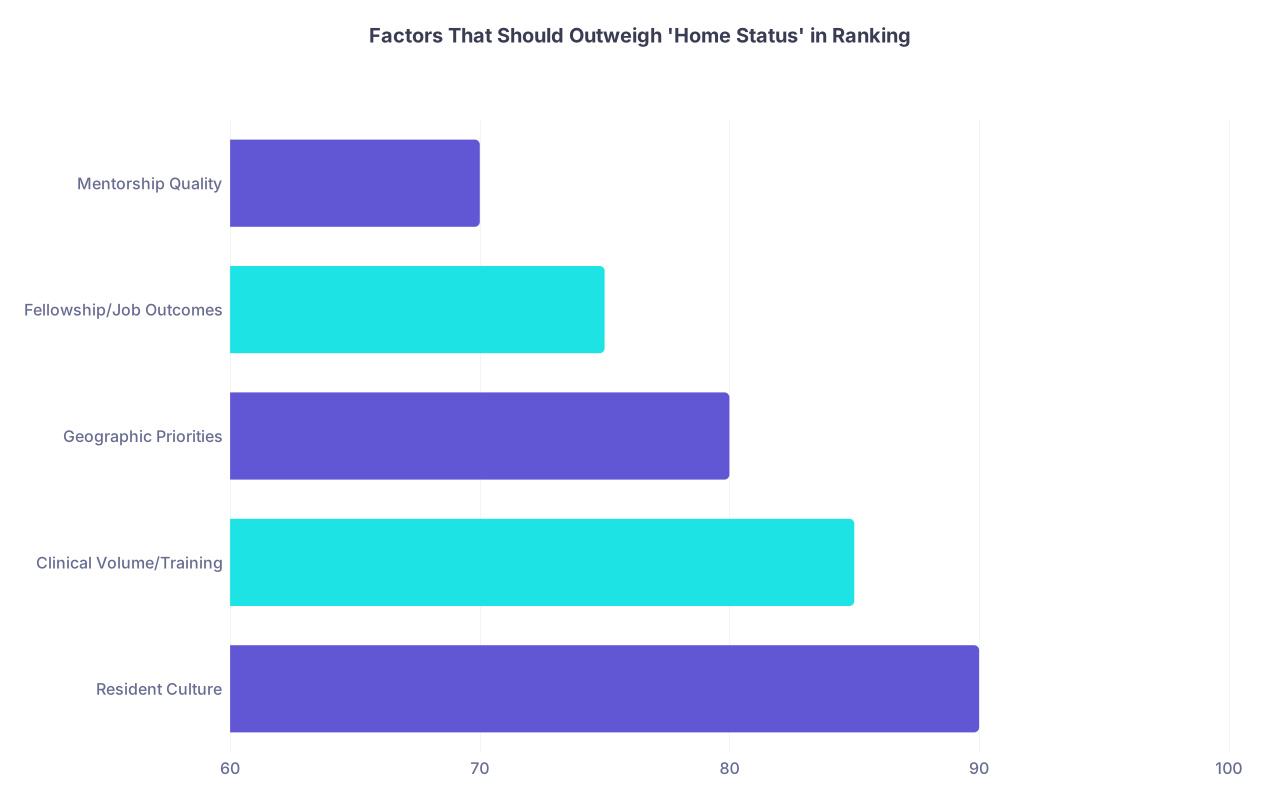
Let’s be concrete. Here are situations where putting your home program below others—sometimes far below—is not only reasonable, it’s smart.
You felt consistently unhappy on your own wards: toxic culture, burned-out attendings, miserable residents.
“But it’s safe” is a bad reason to choose three more years of that.You saw blatant favoritism or politics in how current residents were treated.
That usually doesn’t get better when you’re on the inside.The training is narrow, weak, or misaligned with your goals (e.g., weak procedural volume in EM; no critical fellowships in IM).
A decent external program with better training is safer for your career.You and the program clearly want different things—research vs clinic-heavy, community vs tertiary, etc.
Misalignment here can make a “safer” match worse in every way that actually matters.
| Category | Value |
|---|---|
| Resident Culture | 90 |
| Clinical Volume/Training | 85 |
| Geographic Priorities | 80 |
| Fellowship/Job Outcomes | 75 |
| Mentorship Quality | 70 |
Those factors matter more than whether you already know where the bathrooms are.
Tactical Moves If You’re Unsure About Home
If you’re still stuck, do this instead of guessing.
Quietly reality-check with trusted faculty.
Not “Will I match here?” but “Realistically, where do you see me falling among your applicants?” Some will give you a brutally honest answer. Those are the ones to listen to.Check your school’s historical match trends.
Does your home program typically take several home students, or is it usually 0–1? That changes how much “safety” you should assign it.Compare “tier-matched” programs honestly.
If your home is a strong academic program and your external interviews are mostly at similar or slightly lower-tier places, the “safety” might actually be outside, where you are slightly overqualified rather than borderline.Do not rank strategically based on imagined PD psychology.
“If they see I put them #1, they’ll…” — no. They won’t see your list until after the match is done. Your rank order does not influence theirs. Stop trying to outsmart an algorithm that doesn’t care about your feelings.
The Real Safety Is in Your Preferences, Not Your Zip Code
The persistent belief that “home programs are automatically safer” survives because it feels comforting in an uncertain process. It gives people the illusion of control: “If I just rank home higher, I’m covering myself.”
History tells a different story. Many home students match there. Many don’t. Some are rescued; many are not. And a disturbing number rank their home program high for the wrong reasons, then spend years regretting it.
You do not owe your home program loyalty on your rank list. You owe yourself honesty.
Rank in true order of preference. Treat “home” as one data point, not a security blanket. Years from now, you will not care that you knew the EMR on day one. You’ll care whether you built a career and a life you can stand to wake up to.


