

Your first draft rank list is wrong. Everyone’s is. The advantage goes to the person who has a system for fixing it.
Most applicants treat rank list building like “vibes plus anecdotes.” They mash together impressions from interview days, hearsay from residents, a partner’s preferences, and what their advisor said in the hallway. Then they obsessively reorder things fifteen times in ERAS the night before the deadline.
You can do better than that.
You need a clear, three‑pass editing process that takes you from messy, emotional draft to a disciplined, defensible, final rank order list that actually matches your life and priorities.
I am going to give you that process.
The Core Principle: Edit Your List Like a Document, Not a Feeling
Before we get into passes, you need one rule burned into your brain:
You rank programs in the exact order you would want to match them, assuming you could get into all of them.
Not based on:
- Where you think you are “more competitive”
- Where your friends are ranking
- Where a PD smiled at you more
The algorithm favors your preferences. Not your attempts to game it.
Your job is not to guess where you will match. Your job is to decide where you want to match and then list programs that way. The three‑pass editing process is how you get clear enough to do that.
Overview: The 3‑Pass Editing System
We are going to treat your rank list like a serious writing project.
Pass 1 – Coarse Sort:
Get everything into the right tier and brutally remove anything that should not be ranked.Pass 2 – Structured Comparison:
Use a fixed set of criteria to compare programs within tiers and between close contenders.Pass 3 – Stress Test and Lock:
Pressure‑test your list against real‑world scenarios, gut checks, and future‑you, then freeze it.
By the end, you should have:
- A final rank list you can explain in two minutes without sounding like you are improvising
- A short list of non‑negotiables you actually honored
- Less anxiety because you went through a defined process, not emotional turbulence
Let’s go pass by pass.
Pass 1: Coarse Sort – From Chaos to Tiers
Objective of Pass 1:
Get your programs into three to five clear tiers, and delete the ones that have no business on your list.
This pass is fast, dirty, and blunt on purpose.
Step 1: Dump Everything into a Working Sheet
Do not try to edit inside ERAS/NRMP first. Too clunky. Too emotional.
Use:
- Google Sheets
- Excel
- Notion
- Even a ruled legal pad if you are analog
Create columns for:
- Program name
- City / region
- Notes from interview
- Deal‑breakers (yes/no)
- Initial gut tier (1–5)
You will refine later. This is just your sandbox.
Step 2: Define Your Non‑Negotiables (Real Ones)
If you do not define limits now, you will violate them later when panic kicks in.
Non‑negotiables are binary. Either a program passes or it is off the list. They are not “strong preferences.” They are “I will be legitimately angry at myself if I match there because of this.”
Examples that actually count:
- Absolute geographic constraints (partner’s job, legal custody, visa limitations)
- Financial constraints (cannot safely live on resident salary in that city)
- Training concerns (malignant culture, unsafe supervision, major red flags)
- Program structure mismatch (you want categorical IM and this is only prelim; you want strong critical care and they basically have none)
Weak “non‑negotiables” (which are really just preferences):
- “I prefer big cities” (unless tied to very specific constraints)
- “I liked the free lunch”
- “I want a brand‑name hospital for ego reasons”
Be ruthless: 3–5 real non‑negotiables is normal. Fifteen is fantasy.
Create a column: “Fails a non‑negotiable?” (Yes/No).
Any “Yes” gets removed from your working rank list. You can keep them in a separate “Do Not Rank” tab just for record keeping.
Step 3: Quick Gut Tiering
Now, without overthinking, assign each program a tier 1–5 based on your current gut feel:
- Tier 1 – Dream / top choices. You would be genuinely excited to match here.
- Tier 2 – Excellent fits. You would be happy here, only slightly behind Tier 1.
- Tier 3 – Solid but with trade‑offs. Fine programs, maybe geographic or lifestyle compromises.
- Tier 4 – Acceptable safety net. You would work hard to make it work, but you would not celebrate.
- Tier 5 – “I will be disappointed if I match here but it is technically okay.”
Key rule:
If it feels like a coin flip between 2 tiers, put it in the lower tier for now. You can promote later, but demoting is emotionally harder.
Do this quickly. 15–20 seconds per program. You are capturing your gut, not defending it.
Step 4: Remove Tier 5 If You Have Depth
Now you need to be honest.
If you have:
- A reasonably long list (10+ programs in relatively non‑competitive specialties; more if competitive), and
- Multiple programs you feel good about above Tier 5
Then ask:
“Will I be upset for three years if I match at this Tier 5 place?”
If the answer is yes → move it to “Do Not Rank.”
If the answer is no → leave it as Tier 4 (bump up) or treat as a true backstop.
This is where people get stuck in scarcity panic. I have watched students keep programs on the list that would have meant a long‑distance partner, isolation from family, and a known toxic culture—only because they were scared of not matching.
Real talk:
- If you are an average applicant in a moderately competitive specialty and you applied widely and got ~10+ interviews, your unmatched risk is not dramatically changed by one extra horrible program tacked at the bottom.
- But your life is dramatically changed if that is where you spend 3–7 years.
Step 5: Clean Tier Boundaries
Once you have 3–4 meaningful tiers and have removed the nonsense, do a quick scan:
- Any program that obviously does not belong with its neighbors? Move it up or down one tier.
- Any tier with too many programs to meaningfully compare later (e.g., Tier 2 has 12 programs)? Split into 2A and 2B if needed.
By the end of Pass 1, you should have:
- 3–5 tiers
- No programs that violate true non‑negotiables
- A rough picture: “These are my top handful. These are acceptable. These are backup.”
Stop here. Walk away for a day if you can. Pass 2 requires a cooler head.
Pass 2: Structured Comparison – Rank Within and Between Tiers
Pass 2 is where we destroy the vague “vibes‑based” list and replace it with something systematic.
Objective of Pass 2:
Use fixed criteria to:
- Order programs within each tier.
- Resolve close calls between adjacent tiers.
- Create a preliminary full rank order.
Step 1: Choose 5–7 Comparison Criteria
If you have 20 criteria, you have none. Choose 5–7 that matter most. Not what your class group chat rates highly. What you actually care about when you imagine daily life there.
Examples:
- Training quality (breadth, acuity, fellowship match, procedural volume)
- Resident culture (supportiveness, camaraderie, burnout vibe)
- Geography / support system (family, partner, outdoor activities, etc.)
- Cost of living (rent, commute realities)
- Program structure (4+1 vs traditional, outpatient vs inpatient heavy, electives)
- Reputation / future doors (if you care about academics, fellowships, location flexibility)
- Lifestyle (call schedule, weekends, night float, expected hours)
- Niche priorities (research support, global health, specific fellowship presence)
Now, rank these criteria themselves from most important (1) to least (7). This is crucial. You will use this order when breaking ties.
Step 2: Rate Each Program on Each Criterion
Use a simple 1–5 or 1–3 scale. Do not over‑engineer this.
I like 1–5:
- 5 – Outstanding / ideal for you
- 4 – Strong
- 3 – Acceptable / average
- 2 – Weak
- 1 – Problematic
You will not have perfect data for every program. That is fine. Use:
- Interview notes
- PD / resident conversations
- Faculty advisors
- Alumni from your school who matched there
- Public facts (fellowship match lists, call schedules, COL calculators)
If you truly have no information on a criterion, leave it blank rather than guessing. Just do not leave too many blanks.
Step 3: Weighted Scoring (Without Turning This Into a Math Project)
You are not building an algorithm, but a light weighting keeps you honest.
Assign each criterion a rough weight:
- Top priority: x3
- Next 2 priorities: x2
- Remaining 2–4: x1
Example:
| Criterion | Priority Rank | Weight |
|---|---|---|
| Training quality | 1 | 3 |
| Resident culture | 2 | 2 |
| Geography/support | 3 | 2 |
| Cost of living | 4 | 1 |
| Lifestyle/schedule | 5 | 1 |
Now for each program:
- Multiply the 1–5 rating by the criterion weight.
- Sum across all criteria.
Do this at least for your Tier 1–3 programs. You can be looser with the bottom tier.
You will get a total “fit score” for each program. The exact number is not gospel, but patterns matter.
Step 4: Order Within Tiers Using Scores + Judgment
Now, within each tier:
- Sort programs by total fit score (descending).
- Check if the score order matches your instinctive preference.
Where score and gut disagree:
- Look at the top 2–3 highest‑weighted criteria.
Example: Maybe Program A wins overall, but Program B is clearly superior on your #1 and #2 criteria. That tells you something. - Re‑read your notes from interviews: who felt like “your people”?
- It is fine to override the numeric order, but make yourself write one sentence why:
- “I am putting Program B above A because being near family (criteria #3) is more important to me than the slight training edge at A.”
This exercise forces you to make an explicit trade‑off, not an impulsive one.
Step 5: Compare Across Adjacent Tiers
Once you have an ordered list within each tier, you will see that some “lower tier” programs actually score similarly to upper tier ones.
Now do:
- Compare the bottom 1–2 of Tier 1 with the top 1–2 of Tier 2.
- Compare the bottom 1–2 of Tier 2 with the top 1–2 of Tier 3, and so on.
For each close pair, ask:
“If I woke up matched at Program X instead of Y, would I be disappointed or relieved?”
Your emotional answer matters. It tells you whether your tiers are still accurate.
If your fit scores and gut both suggest that a Tier 2 program is actually better than the bottom of Tier 1 → promote it. Adjust tiers if needed.
Repeat this chain reaction until anything above is clearly preferable to anything below.
Now you have a single preliminary rank order.
Step 6: Sanity Check for Outliers
Scan the whole list top to bottom.
Red flags that your structure is off:
- A program far from family and support with only marginal training improvement sitting way above strong local options—unless you truly value that trade‑off.
- An extremely malignant program that you “ranked up for prestige” despite your stomach flipping every time you think about it.
- Your partner’s or family’s essential needs basically obliterated in the top 3–5.
If you see these, you are not done. Adjust now. Better to have an uncomfortable conversation with yourself today than three years into a bad fit.
At the end of Pass 2, you should have:
- A full provisional rank list ordered from 1 to N
- A set of criteria and notes justifying the order
Now we stress test.
Pass 3: Stress Test, Gut Check, and Lock
Pass 3 is where you stop tweaking pixels and test whether the picture holds up under pressure.
Objective of Pass 3:
- Confirm that your list withstands practical, emotional, and future‑self scrutiny.
- Identify and adjust only the top inflection points (usually in your top 5–8).
- Then stop touching it.
Step 1: Scenario Testing – “If I Matched Here…”
For your top 8–10 programs, do a quick mental drill:
Imagine you just opened your email on Match Day and saw:
“Congratulations, you matched at [Program X].”
For each one, quickly write:
- First 3 words that come to mind
(e.g., “Relieved, excited, safe” vs. “Oh. Okay. Huh.”) - One sentence: “Day‑to‑day life here would look like…”
If you feel:
- Relief + excitement → good.
- Heavy dread or a sinking feeling for a top 3 choice → that program is too high.
People lie to themselves here because they are attached to the idea of “elite” programs. Do not. You are the one doing the call nights.
Reorder any pair where your reaction clearly contradicts the current ranking.
Step 2: Future‑You Exercise (5 Minutes, No Drama)
Pick your top 5 and your bottom 3 that you still plan to rank.
For each of the top 5, complete this sentence in a notebook:
“Five years from now, I would be proud I trained at [Program X] because…”
If you struggle to fill that blank for a top 3 program with anything beyond prestige or vague reputation, that is a warning sign.
For the bottom 3, write:
“If I matched at [Program Y], the main way I would make it work would be…”
If all three require heroic mental gymnastics or fantasy (“I would just travel home every weekend across three time zones”), ask: why are they on your list at all?
This is where some people finally remove the last 1–2 programs that never made sense.
Step 3: External Reality Check (One or Two People, Max)
Bring in at most 1–2 trusted humans who:
- Actually know you
- Will not project their insecurities onto your list
- Understand the basic structure of your specialty
Show them:
- Your top 10 programs in order
- Your main criteria and their ranking
- Any big trade‑offs you’re still stuck on (e.g., Home vs. Big Name, Partner vs. Prestige)
Ask them specific questions:
- “Given how much I care about X, does it make sense that Program A is above B?”
- “Does this list look like a person who values family support, or am I pretending?”
Listen for patterned feedback, not one‑off opinions.
What you do not do:
- Crowdsource your list in a group chat.
- Let your most prestige‑oriented classmate decide your top 3.
Make changes only if their critique lines up with doubts you already had.
Step 4: Freeze the Top, Loosen the Bottom
By now, your top 5–8 should be rock solid. You should be able to defend the order clearly and calmly.
Once you hit that point:
Declare the top 5–8 “frozen.”
Write them down physically on paper in order. That becomes your “no‑touch” zone, unless some huge new information appears (which it almost never does at this phase).The rest of the list (positions 9 onward) you may adjust a bit for comfort, but stop obsessive micromanaging.
The truth:
The Match is massively influenced by your top half. The precise order of #17 vs #18 in most lists is statistical noise compared to your overall strategy and the number of programs ranked.
Step 5: Final Sanity Checks Before Submission
Run through this quick checklist:
Algorithm sanity:
- Are programs ordered strictly by your preference, not by where you “think you are competitive”?
- Any program you would rather not match than match there? If yes, remove it.
Logistics check:
- Visa issues correctly considered (if relevant)?
- Any geographic constraints you lied to yourself about?
Emotional check:
- Read the list aloud from top to bottom.
- Does the order “feel” like it is trending downward in desirability? If somewhere in the middle your heart jumps up for a lower program, you missed something.
Deadline discipline:
- Submit at least 24–48 hours before the deadline. Not because NRMP is unreliable, but because people do dumb things under last‑minute anxiety.
Once submitted:
Screenshot or print your final list for your own records. Then stop logging in “just to check.”
Common Rank List Traps This 3‑Pass System Fixes
Let me call out a few mistakes I see constantly—and how this process prevents them.
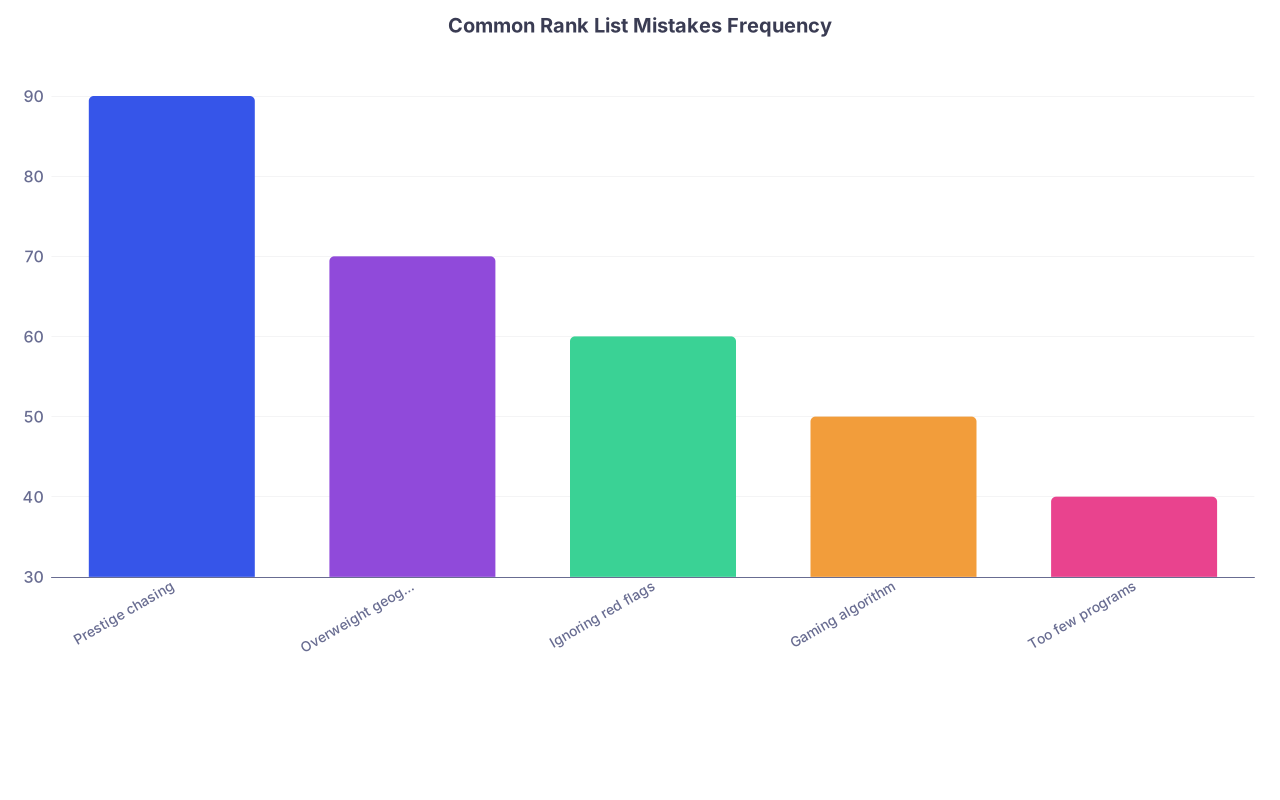
| Category | Value |
|---|---|
| Prestige chasing | 90 |
| Overweight geography | 70 |
| Ignoring red flags | 60 |
| Gaming algorithm | 50 |
| Too few programs | 40 |
Trap 1: Prestige Over Fit
You put the brand‑name academic powerhouse #1 even though:
- You hated interview day
- Residents looked miserable
- It is across the country from your support system
Pass 2’s weighted criteria + Pass 3’s scenario test force you to confront that your daily life and mental health matter more than the name on your badge.
Trap 2: Geography Blinders
You over‑prioritize one city because friends are there or because you are scared to leave your comfort zone.
Pass 1 lets you separate real constraints (partner’s job, kids’ custody arrangements) from “I am just scared to move.” The scoring in Pass 2 then puts geography in its place alongside training, culture, and career goals.
Trap 3: Keeping Truly Toxic Programs “Just In Case”
I have seen people match at their bottom program and then privately admit, “I knew I should have just not ranked it.”
Pass 1’s non‑negotiables and Pass 3’s future‑you exercise make that kind of self‑betrayal harder. If you still keep a toxic program after those, that is no longer fear. That is self‑sabotage.
Trap 4: Trying to Outthink the Algorithm
The classic mistake:
- “I will put my home program a little lower because they like me and I’ll probably match anyway, so I’ll shoot my shot with Big Name U on top.”
That is not how the algorithm works. And the 3‑pass process is built around the correct assumption: you can and should order everything by true preference.
Example: Walking Through the Passes with a Realistic Set
Let’s make this less abstract. Quick example for an internal medicine applicant with 11 interviews.
Programs (shortened):
- Home U
- Big Name East Coast
- Solid Regional Academic
- Community Program A (close to partner)
- University‑Affiliated B
- Newer Program, great vibe
- Community Program C (bad vibe, great location)
- Safety D
- Safety E
- Far‑away malignant Big Name
- Prelim Only Program
Pass 1 – Coarse Sort
Non‑negotiables:
- Needs a categorical position (remove #11)
- No known malignant culture (move #10 and maybe #7 to “Do Not Rank” if truly malignant)
- Must not require living apart from partner >2 years (maybe move some very far programs down tiers)
Gut tiers:
- Tier 1: Home U, Big Name, Solid Regional
- Tier 2: Community A (partner city), Univ‑Affiliated B
- Tier 3: Newer Program, Safety D, Safety E
- Tier 4: Community C (iffy), others
- Remove clearly bad malignant places.
Already looks saner.
Pass 2 – Structured Comparison
Top criteria for this person:
- Training quality (3x)
- Resident culture (2x)
- Partner/location (2x)
- Reputation/fellowship (1x)
- Lifestyle (1x)
Rate each program 1–5 on these. Score them. Result might look like:
| Program | Fit Score |
|---|---|
| Home U | 49 |
| Solid Regional | 46 |
| Big Name East | 45 |
| Community A | 44 |
| Univ‑Affiliated B | 41 |
| Newer Program | 39 |
Now the order is no longer just prestige. Big Name might drop from #1 to #3 because it crushes lifestyle and partner proximity, while Solid Regional and Home U look like better overall fits.
Pass 3 – Stress Test
Scenario test: imagining Match Day.
- “You matched at Big Name East Coast.” → First feeling: stress about cost, distance from partner, but proud.
- “You matched at Solid Regional.” → First feeling: relief, solid training, easier life.
- “You matched at Community A.” → First feeling: thrilled to be near partner, okay with training.
You might end up with a final top 5 like:
- Home U
- Solid Regional
- Community A
- Big Name East Coast
- Univ‑Affiliated B
Totally different than the “gut + prestige” initial instinct. And much more aligned with how future‑you will feel two years in.
Visual: 3‑Pass Timeline in Match Season
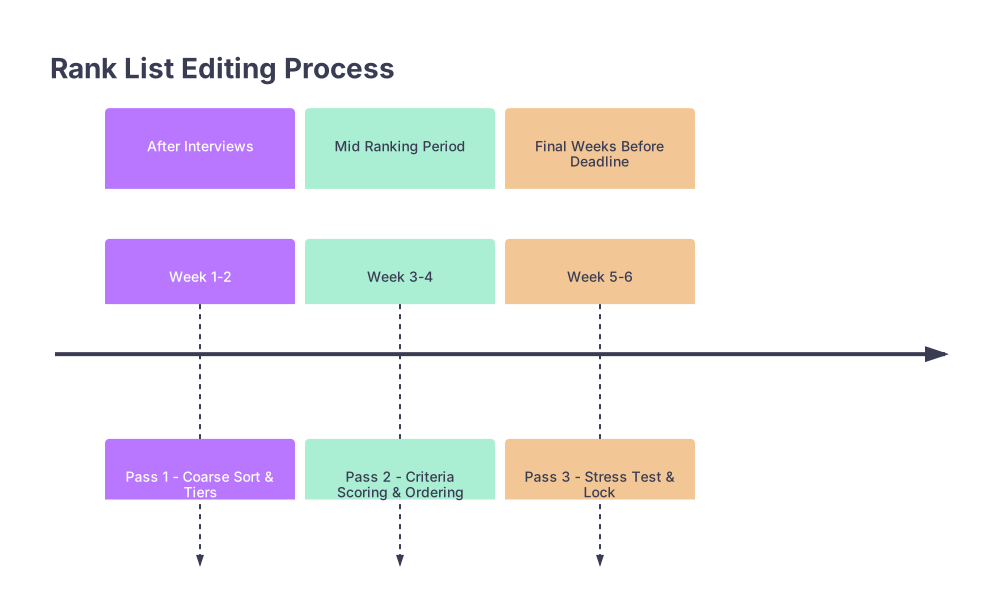
| Period | Event |
|---|---|
| After Interviews - Week 1-2 | Pass 1 - Coarse Sort & Tiers |
| Mid Ranking Period - Week 3-4 | Pass 2 - Criteria Scoring & Ordering |
| Final Weeks Before Deadline - Week 5-6 | Pass 3 - Stress Test & Lock |
If interviews just ended, you start with Pass 1. Mid‑February is Pass 2. Final 1–2 weeks before the deadline: Pass 3 and submit.
Quick Comparison: “Vibes Only” vs 3‑Pass Process
| Aspect | Vibes‑Only Approach | 3‑Pass Editing Process |
|---|---|---|
| Basis for order | Emotions, prestige, hearsay | Defined, weighted personal criteria |
| Handling red flags | Often ignored or minimized | Explicit non‑negotiables in Pass 1 |
| Top 5 clarity | Shifts daily | Frozen after Pass 3 |
| Bottom programs | Kept “just in case” | Removed if truly unacceptable |
| Anxiety level | High, constant tweaking | Lower, structured decisions |
You choose which column you want to live in for the next month.
What You Should Do Today
Do not try to “remember this for later.” Use momentum.
Today, do just Pass 1.
- Open a spreadsheet.
- List your programs.
- Define 3–5 true non‑negotiables.
- Delete or “Do Not Rank” anything that fails those.
- Gut‑tier everything 1–5.
Stop there. That single step will already put you ahead of most of your classmates who are just swirling.


