

The way most couples “wing” their couple’s match rank list is a good way to end up in different cities. Or both in programs you hate.
If you and your significant other are in different specialties, you cannot afford a vague plan or last‑minute spreadsheet chaos. You need a protocol. A sequence. And you need to stick to it.
Below is a step‑by‑step system I have walked multiple couples through: IM + EM, FM + Psych, Ortho + Pediatrics, even Derm + Gen Surg. Different fields. Different competitiveness. Same core process.
Step 1: Get Completely Clear on Both of Your Non‑Negotiables
You cannot build a rational couples rank list until you know your hard boundaries. Most couples skip this and go straight to “let’s list programs,” then wonder why they cannot agree.
Sit down—no phones, no scrolling—and do this separately first, then compare.
1.1 Define your individual non‑negotiables
Each of you writes down:
- Absolute geographic limits
- Examples: “Must be within 90 minutes of my chronically ill parent,” “Not willing to live in a city with a cost of living higher than NYC,” “No rural programs.”
- Deal‑breaker schedule or culture issues
- “No 24‑hour call more than X times per month”
- “I will not train at a hospital known for malignant culture”
- “I need strong LGBTQ+ friendly environment”
- Program structure needs
- “I must be at a county or safety‑net hospital”
- “I want guaranteed ICU exposure every year”
- “I need a program with strong fellowship placement in cardiology / peds heme‑onc / etc.”
- Personal life constraints
- Visa issues, childcare, major health conditions, ongoing therapy or fertility treatment locations
Then, force‑rank your top 5 non‑negotiables. Everything else is “nice to have,” not a hill to die on.
1.2 Agree on joint non‑negotiables
Now combine:
- What are joint requirements?
- “We must end up in the same city” (yes, obvious, but say it)
- “We must be within 20 minutes’ commute of each other’s programs or shared housing”
- “We will not both match at programs where one of us is clearly miserable just for the name brand.”
- What are joint preferences, not rules?
- “We prefer large cities but will consider medium cities.”
- “We like being near mountains, but that is not required.”
Write the joint non‑negotiables down in 3–5 bullets. This becomes the filter for every choice you make later.
Step 2: Understand the Couples Match Mechanics (Without Myths)
Ranking as a couple is powerful—but unforgiving if you misunderstand how it works.
Here is the core reality:
- You two submit one combined list of paired rankings
- Each “line” on your couple’s list is:
- Partner A Program X – Partner B Program Y
- The algorithm treats each line as a unit:
- It will place you in the highest line on your list where
- A could match X and
- B could match Y
- It will place you in the highest line on your list where
- If one cannot match their side of the pair at that rank, the algorithm moves to the next line on the list.
No partial matches on a given line. Both or neither.

| Step | Description |
|---|---|
| Step 1 | Start at top rank pair |
| Step 2 | Both match to this pair |
| Step 3 | Move to next rank pair |
| Step 4 | Unmatched or scrambled |
| Step 5 | Can A and B both match here? |
| Step 6 | Any pairs left? |
Common myths I have heard on rounds or in resident lounges:
- “If one of you is strong, they can pull the other in.”
False. The algorithm does not do favors. It just follows your list and available slots. - “You should rank every possible pair.”
No. Ranking places you are not willing to go is how couples end up divorced or re‑matching. - “You should prioritize the more competitive specialty always.”
Not blindly. You weight the risk, but you do not sacrifice the other person’s entire career trajectory without a conscious decision.
Understand the rules. Then use them.
Step 3: Map Your Fields and Competitiveness Honestly
Different fields means different competitiveness and different program distribution. You do not rank the same way for Psych + FM as you do for Ortho + Derm.
You both need a realistic sense of where you stand.
3.1 Categorize your strength relative to your field
For each partner, using your specialty’s data (Charting Outcomes, program fill rates, Step scores, publication expectations):
- Are you top‑tier, solid mid‑range, or borderline for your specialty?
Be brutally honest. Your friends will lie to make you feel better. NRMP data will not.
Key factors:
- Board scores / COMLEX
- Clinical grades and AOA / GHHS
- Letters of recommendation (who wrote them and how strong)
- Research in that specialty
- Number and “tier” of interviews
3.2 Decide who is the “limiting” partner (for probability, not importance)
This is not about who is smarter or more valuable. It is about who is currently more constrained in the Match market.
Examples:
- Derm + IM couple, where Derm partner has 8 Derm interviews from mostly mid‑tier programs, and IM partner has 18 interviews across all tiers. Derm is the limiting partner.
- Ortho + Psych couple, where Ortho partner has 5 interviews (borderline) and Psych partner has 14. Ortho is the limiting partner.
Why this matters:
- The limiting partner’s specialty and interview set will define the ceiling of what locations you can realistically rank high.
- The non‑limiting partner will often need to accept:
- Slightly weaker program prestige,
- Less perfect fit,
- Or more geographic sacrifice,
to stay bundled as a couple.
| Pairing | Stronger Side | Limiting Side | Strategy Focus |
|---|---|---|---|
| Derm + IM | IM | Derm | Maximize Derm options |
| Ortho + Psych | Psych | Ortho | Prioritize Ortho cities |
| EM + FM | EM | FM | Flexible on FM program |
| Gen Surg + Peds | Peds | Gen Surg | Protect Surg interviews |
If you pretend you are both equally flexible when you are not, your rank list will be fantasy fiction.
Step 4: Build the Master Program Grid (This Is Non‑Optional)
The couples who do this well all end up here: a nasty, color‑coded spreadsheet or table that looks overwhelming and saves their careers.
You are going to build one joint grid. Here is the minimum structure you need.
Columns:
- City / Metro area
- Partner A program name
- Partner B program name
- Distance between hospitals
- Commute feasibility (Green/Yellow/Red)
- A’s subjective rating (1–10)
- B’s subjective rating (1–10)
- A’s program tier (e.g., Reach / Target / Safety)
- B’s program tier
- Joint viability (Excellent / Good / Risky / No‑go)
- Notes (call schedule, culture rumors, fellowship options)
Rows: every possible combination where:
- A has an interview at a program in City X, and
- B has an interview at a program in the same city or realistically commutable city.
You do not list combinations in city pairs that no sane person would commute (like living in Boston while one works in New Haven daily).
4.1 Practical tips to build the grid fast
- Use filters heavily. Filter by city to see all options there.
- Use conditional formatting:
- Red fill for “No‑go (joint non‑negotiable violated).”
- Yellow for “Risky, but maybe.”
- Green for “Both of us would be content or happy.”
- If you are lazy and thinking “we will remember all this,” you are lying to yourself. Interview season brain is mush.
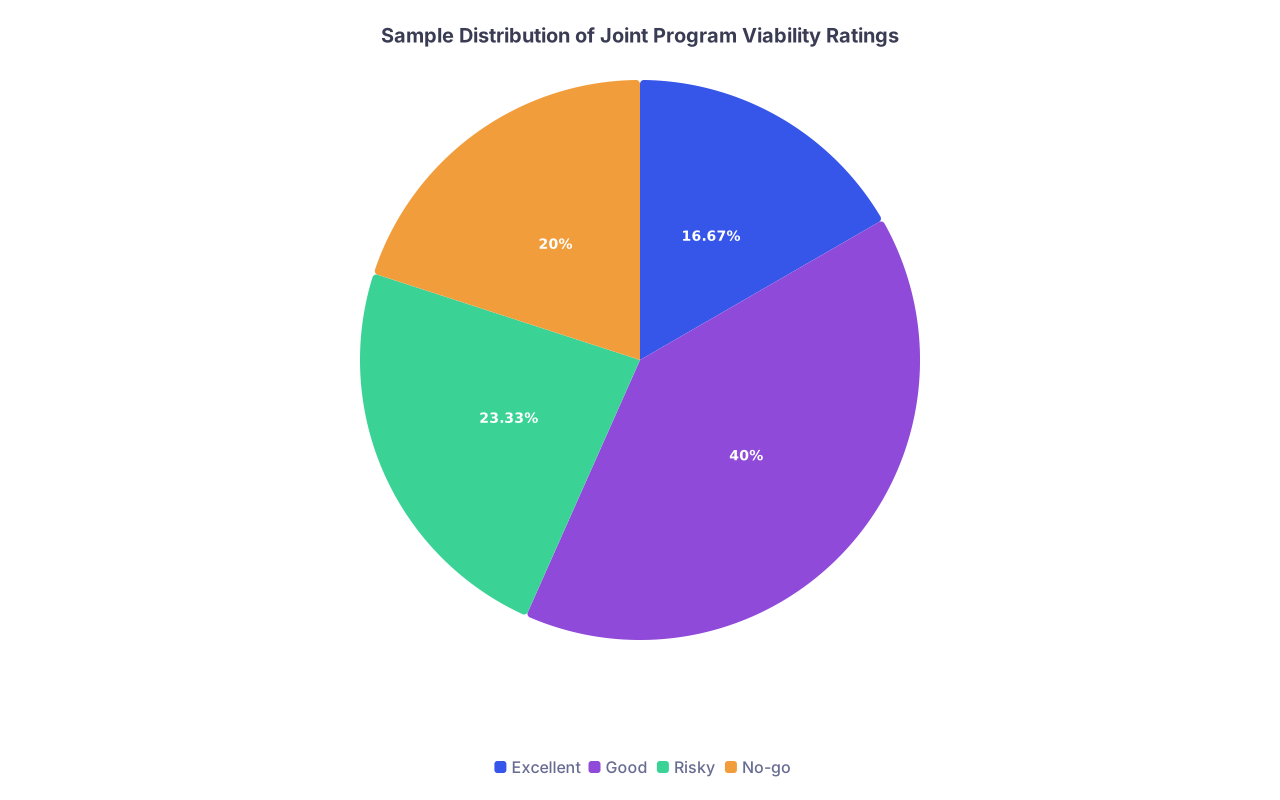
| Category | Value |
|---|---|
| Excellent | 5 |
| Good | 12 |
| Risky | 7 |
| No-go | 6 |
The grid is your battlefield map. Everything else is tactics.
Step 5: Decide City‑First vs Program‑First Strategy
With different specialties, you cannot always have city and program both ideal. You need to decide where you are willing to bend.
Use that grid and ask:
- Are there multiple cities where both of you have at least “Good” or “Excellent” programs?
- Or are there only 1–2 cities where the limiting partner even has a shot?
This dictates two broad strategies.
5.1 City‑first strategy
Use when:
- The limiting partner has scattered interviews, but there are a few cities where both of you can realistically match.
- You have strong geographic constraints (family, visas, etc.).
In city‑first, your priorities are:
- Rank all high‑viability pairs in your top few cities first, even if the program quality is a bit lopsided.
- You accept:
- One partner may land in a “solid but not elite” program
- As long as the other is not in a disaster of a program.
Example:
- Partner A (Gen Surg) has:
- City 1: mid‑tier Surg program
- City 2: strong Surg program
- Partner B (Peds) has:
- City 1: elite Peds program
- City 2: weaker Peds program
If you both deeply want City 1 and it fits life constraints, you might rank:
- City 1 combo (mid Surg + elite Peds)
- City 2 combo (strong Surg + weak Peds)
or reverse, depending on competitiveness and risk tolerance.
5.2 Program‑first strategy
Use when:
- One partner is in a hyper‑competitive specialty with only a few realistic programs.
- You are more flexible on location.
Here:
- Anchor around the competitive partner’s realistic programs.
- In each of those cities, find the best possible option for the other partner—even if not perfect.
- Only once you run out of those do you start ranking less ideal combinations.
Example:
- Derm partner has 4 realistic programs in 3 cities.
- IM partner has 15 interviews nationwide.
Your top ranks almost always cluster around those 3 cities, even if IM has “dream” programs elsewhere, because Derm’s options drive your ceiling.
Step 6: Construct the Actual Couples Rank List (Line by Line)
Now you have to translate this logic into actual NRMP lines. This is where most couples panic and just start guessing. Do not.
Here is a systematic approach.
6.1 Rank within each city first
For each city where both have interviews:
- List out all pairings in that city:
- Example, City A:
- A1 (IM Program X), A2 (IM Program Y)
- B1 (EM Program M), B2 (EM Program N)
- Example, City A:
- For each person, rank their programs in that city individually:
- IM partner: A1 > A2
- EM partner: B2 > B1
- Create a city‑specific couples ranking:
- A1 – B2
- A1 – B1
- A2 – B2
- A2 – B1
…but you do not have to keep every combination if some are unacceptable.
- A2 – B1
Cross out any pairs that violate:
- Individual non‑negotiables
- Joint non‑negotiables
- Or where one of you rated the program 2/10 and said “I would be miserable here.”
You now have an internal ranking of pairs within each city.
6.2 Merge cities according to your strategy
Now you must interleave these city‑specific lists into one global list.
Use your earlier strategy (city‑first vs program‑first) plus competitiveness logic:
- If one specialty is extremely competitive:
- Push combinations with strong options for that partner higher to reduce unmatched risk.
- If both are mid‑tier with a lot of interviews:
- You can be more aggressive with city preferences.
Example: You might end with something like:
- City A: A1 – B2 (Both strong fits, competitive partner strong here)
- City A: A1 – B1
- City B: A3 – B4 (Better city, slightly worse program for one partner)
- City C: A2 – B5
- City D: …
This merging step is where you two will argue. That is normal. Use the written non‑negotiables and numeric ratings to prevent it from turning into feelings‑only warfare.
Step 7: Decide on Safety Pairs and “Break‑the‑Couple” Options
This is the uncomfortable part. You must decide in advance how much you are willing to risk to stay together vs avoid going unmatched.
There are three layers of risk management.
7.1 Conservative safety pairs
These are combinations where:
- Both partners might not be thrilled,
- But both are at programs where they will solidly train and not hate life,
- In a city you can both live with.
You sprinkle these lower in your list—but above any nuclear “break the couple” options.
7.2 True last‑ditch couple pairs
These are high‑risk emotionally:
- One or both of you actively dislike the city.
- Or one partner is at a clearly inferior program (weak training, nasty culture, poor outcomes).
- But they are safer match probabilities than going separate.
You must decide:
Would we rather
- be together in a place we do not like at all,
- or risk one of us going unmatched?
There is no morally correct answer. There is only what you two, as adults, decide.
Be explicit:
- “We will not rank programs we would truly rather reapply than attend.”
- Or: “We will rank them, but they will be dead last.”
7.3 Break‑the‑couple rankings (optional but critical for some pairs)
For some couples, especially:
- Very competitive field + weaker application
- Or limited visas
- Or strong career‑sensitive plans (e.g., needing specific fellowship paths)
You should consider listing:
- Lines where:
- Partner A ranks a program,
- Partner B ranks “No Rank” (or vice versa)
This means:
- If the algorithm gets that far and can match one of you there, it will do so even if it cannot place the other partner.
You only do this if:
- You have talked explicitly about the possibility of long‑distance or re‑matching.
- You agree it is better than both going unmatched.
| Category | Value |
|---|---|
| Stay together at all costs | 20 |
| Stay together unless program is terrible | 50 |
| Allow break-the-couple lines for safety | 30 |
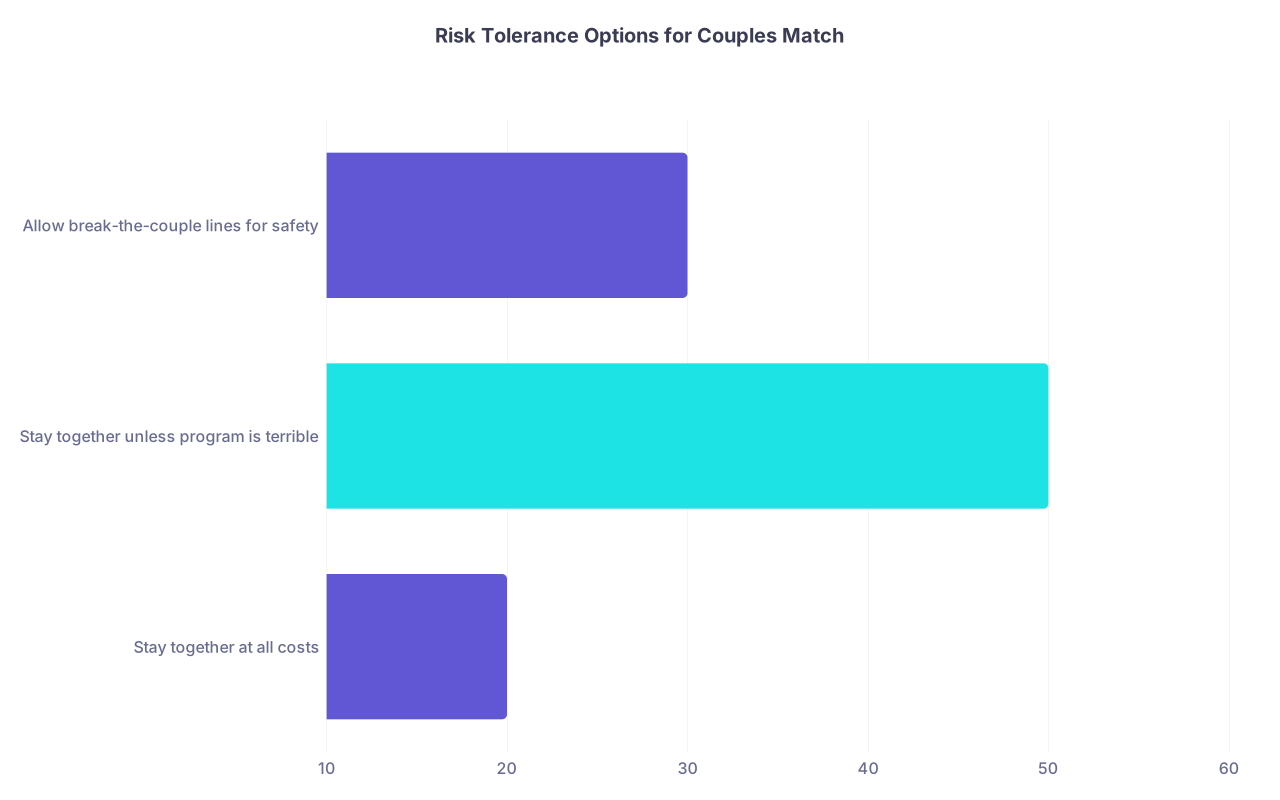
Numbers here are illustrative, but I have seen all three attitudes from real couples. There is no universal right answer. There is only “decided ahead of time” vs “panicked at the last minute.”
Step 8: Handle Asymmetry in Interest and Prestige
With different specialties, you will almost certainly face this scenario:
- One partner has a shot at a truly elite program in a city where the other has a mediocre or no interview.
- Or one partner has a “dream program” that the other absolutely hates.
You cannot dodge this. You decide how to handle it.
8.1 The “anchor program” problem
Example:
- Ortho partner has an interview at a top‑5 Ortho program in City X.
- FM partner’s only option in City X is a small, unopposed community program they felt lukewarm about.
You have three rational options:
- Rank City X pairs near the top anyway, accepting the FM partner’s less‑than‑ideal program, because Ortho opportunities are uniquely rare.
- Compromise: rank City X a bit lower, favoring slightly less prestige for Ortho in a city with better FM options.
- Do not rank City X at all as a couple, and accept that Ortho might list it solo in break‑the‑couple lines.
How do you choose? Use three questions:
- Will the “sacrificing” partner still receive decent training and be employable long‑term from that program?
- Is the benefit to the “advantaged” partner large (career‑changing) or marginal (name brand only)?
- Are you both truly on board with the trade, or is one of you just capitulating?
If the sacrificing partner will be miserable, burned out, and resentful, the prestige is not worth it. I have seen that movie. It ends badly.
8.2 Different vibes, same city
Sometimes you both have good programs in the same city, but the cultures are opposite. One happy, one malignant. Or one academic, one very community‑based.
Do not assume “same city” automatically equals “good joint option.” In your grid, treat each city‑pair independently, not just “City X is great.”
Step 9: Sanity‑Check Your Final List
Before you lock your rank list in NRMP, do a structured review. This is where you catch the dumb mistakes.
Run these checks:
- Top 5 lines test
- Are your top 5 pairs all combinations you would be honestly content with?
- Or did a “safety” accidentally float into the top due to spreadsheet chaos?
- Non‑negotiables check
- Are there any lines that violate your written individual or joint non‑negotiables?
- If yes, delete or move them to the absolute bottom (if they are truly last‑ditch only).
- Competitiveness realism
- Are you overloading the top 10 with “reach + reach” combinations for a borderline partner?
- You can rank reaches high, but you need a realistic gradient.
- Geographic reality
- Are there any pairs where one of you has a 90‑minute commute each way? Delete those. No one likes their life on I‑95.
- Emotional gut check
- Each of you, separately: read the list top‑to‑bottom and mark any line where your heart sinks. Then discuss those lines. Some should be deleted.
I tell couples: if you would be furious at the algorithm for matching you to a given pair, that is your fault. You ranked it. Remove it.
Step 10: Communication Rules So You Do Not Destroy the Relationship
The technical strategy is useless if you two cannot get through conversations without blowing up.
Set explicit rules:
- No rank list discussions after 10 pm. Tired brains escalate.
- No “you always” / “you never” in these conversations. Stay on the topic: specific pairs, specific cities.
- Use the data: “You rated this 4/10 after the interview. What changed?” not “You’re being irrational.”
- If one of you cries or shuts down, you pause for at least 24 hours.
Also, agree on one fact:
You are not fighting each other. You are fighting the structure of the system. Your job is to solve for “us vs NRMP,” not “me vs you.”
Quick Example: Applying the Steps to a Realistic Couple
Let me run through a condensed version.
- Partner A: Internal Medicine, strong app, 18 interviews.
- Partner B: Emergency Medicine, moderate app, 10 interviews.
- Overlap cities: Boston, Philly, Chicago, Mid‑size City X.
You:
- Decide EM partner is the limiting side.
- Build a grid of all IM–EM pairs in those cities.
- See that:
- Boston: A has 3 IM programs (one top‑tier), B has 1 marginal EM program.
- Philly: both have solid mid‑tier options.
- Chicago: A has one mid‑tier IM, B has 2 good EM programs.
- City X: both have strong community programs, but city is meh for you.
You agree:
- Joint goal: Same city > program prestige, as long as neither is in a clearly malignant or career‑limiting program.
You build:
- Within‑city rankings (e.g., Boston pairs ordered, Philly pairs ordered).
- Then merge globally:
- Philly best IM – best EM
- Chicago mid IM – best EM
- Philly next IM – best EM
- City X best IM – best EM
- Boston top IM – only EM (acknowledging B is less happy here)
- City X lower pairs
- Break‑the‑couple lines if either strongly wants a solo option.
You sanity‑check for non‑negotiables, commute, and resentment. Then lock it.
This is the kind of structured, unemotional ranking that actually works.
Core Takeaways
- Do not start ranking until you have written, shared non‑negotiables and a joint grid of city‑program pairs. If it is not in the grid, it should not be on the list.
- Identify the limiting partner and choose a clear strategy: city‑first or program‑first. Then build and merge city‑specific pair rankings into one global list.
- Decide upfront how far you are willing to go with safety pairs and break‑the‑couple options, and delete any pair you would truly rather reapply than attend.


