

It is late January. Your rank list “final version” is in a spreadsheet, you have talked it to death with your partner / friends / that one attending who actually gives decent advice. You are mentally done.
And then your email pings at 4:12 p.m.
“Interview Invitation – [Program You Thought Was a Reach] Residency Program”
Now your list is not final. Your brain starts doing backflips:
- “What if this is actually my #1?”
- “Do I cancel something else?”
- “Am I about to blow up a carefully balanced list because of recency bias?”
This is where people make dumb mistakes. Overcorrecting for a shiny new option. Or undercorrecting because they are exhausted and just want to be done.
Let us fix this systematically.
Step 1: Freeze Your Current List – Then Stop Touching It
Before you think about the new program, you need a clean baseline.
Export your current rank list
- If you are using:
- ERAS Rank Order List tool → take screenshots and export to a spreadsheet.
- Notion / Excel / Google Sheets → Save a “Rank List v1.0 – Before New Interview”.
- Lock that version. Do not overwrite it. This is your comparison anchor.
- If you are using:
Write your current top 10 on paper
Yes, actually write it.- Putting it on paper forces clarity.
- You will use this later to spot recency bias and emotional swings.
Write one sentence per program: “Why it is here”
One line only. No essays.- “#1: Near partner, strong cardiology, great resident vibe.”
- “#5: Strong reputation, but location is rough for us, no family nearby.” This is your “pre-new-interview” thinking. Critical reference point.
Now, and only now, are you allowed to think about the new invitation.
Step 2: Decide If This Interview Is Actually Worth Doing
Not every late interview is a golden ticket. Some are noise. This is where people waste time and mental energy.
Use a quick decision filter. If you can answer “No” to two or more of these, strongly consider declining:
Would I honestly consider ranking this program in my top 5 if it goes well?
- Not “could it theoretically be top 5.”
- “Would I actually move other programs down for it.”
Does this program solve a real problem in my current list?
Examples:- You have great training options but all far from your partner → this one is in the same city as your partner.
- You have strong clinical programs but no real research powerhouse → this is an academic juggernaut.
- You are over-weighted in community programs → this is a balanced university program in a better location.
Is it at least neutral or better for overall life logistics?
- Cost of living
- Family/partner support
- Visa issues if IMG
- Geography you actually could tolerate
Is this program clearly stronger than your bottom third?
- If your #12–#18 are “safety but meh,” and this is a mid-tier academic program in a city you like, it probably clears this bar.
- If this is another version of the same “meh” in a worse city, skip it.
If it passes this filter, book the interview. If not, decline and keep your brain energy for everything else.
Step 3: Gather Targeted Intel Before and After the Interview
You do not have time for a full research project now. You need high-yield data only.
Before the interview: 30–45 minutes, max
Focus on four buckets:
- Training quality
- Outcomes
- Culture
- Fit with your actual life
Here is a tight structure:
Website and social media (10–15 minutes)
- Number of residents, call schedule, rotation sites.
- Fellowship placements (especially in your area of interest).
- Clinic vs inpatient balance.
- Any strong research niches that match your interests.
- Instagram / Twitter: social vibe, what they highlight.
Backchannel intel (10–15 minutes)
- Ask co-applicants: any red flags, malignant rumors, insane call, poor board pass, etc.
- Use group chats / Discord / FB groups but filter aggressively. One bitter comment is not data.
- If you know an alum of your med school there, send a 3-line email:
- Who you are.
- One sentence interest.
- Three specific bullets you want their honest take on (culture, autonomy, fellowship help).
Rank List Fit Hypothesis (5 minutes)
- Tentatively place it on your current list before the interview.
- Example: “Prelim guess: Between #3 and #5 if culture is good.”
- Do not move anything yet. This is just your hypothesis heading in.
After the interview: disciplined reflection
Do not “go with your gut” alone. Your gut is easily tricked by:
- Charismatic PD
- Free lunch
- One exceptionally friendly resident
Immediately after the interview (same day, not next week), capture:
- 3 things that strongly impressed you
- 3 things that concerned you or felt off
- 1–2 quotes or moments that stuck with you
(Example: “We are not here to be your friends; we are here to make you surgeons.” Good or bad depending on you.)
Now you have raw data. Time to formalize it.
Step 4: Use a Lightweight Scoring System That Actually Works
You do not need a 50-variable spreadsheet. That is cosplay decision-making. You need a system that:
- Is simple enough you will use it.
- Is structured enough to combat emotional bias.
Here is a 6-factor model that works well for most people:
- Training quality & reputation
- Fellowship / career outcomes
- Resident culture & support
- Location & personal life fit
- Schedule / workload & wellness
- “Would I be happy here?” gut check
Score each 1–5. But do it fast, and do it for your current top 10 plus the new program. Not for all 20–30.
Sample anchor for scoring:
- 5 – Outstanding / near-ideal
- 4 – Strong, with minor issues
- 3 – Solid but not special
- 2 – Concerning or weak
- 1 – Dealbreaker territory
| Program | Training (1–5) | Outcomes (1–5) | Culture (1–5) | Location (1–5) | Workload (1–5) | Gut (1–5) | Total |
|---|---|---|---|---|---|---|---|
| A (Current #1) | 5 | 5 | 4 | 3 | 3 | 5 | 25 |
| B (Current #3) | 4 | 4 | 5 | 4 | 4 | 4 | 25 |
| New Program X | 4 | 5 | 3 | 5 | 3 | 4 | 24 |
You are not going to obey the total blindly, but it will show you where the new program actually stands when you strip away the “shiny new thing” factor.
Step 5: Run a Head-to-Head Comparison Where It Actually Matters
You do not need to compare the new interview to every program. Only to the programs it might leapfrog.
Let us say your tentative hypothesis is:
“New Program X might belong between #2 and #6.”
Do pairwise comparisons between X and #2, #3, #4, #5, #6.
For each pairing, ask:
If I matched at Program A vs Program X, which would I be happier with?
Forced choice. No “depends.”In 5 years, which name on my CV and which training environment gives me more options for what I want?
For my actual life (partner, kids, finances, support), which is less likely to burn out or isolate me?
Write it out like this:
- X vs #2: I would choose ____.
- X vs #3: I would choose ____.
- …
The rank order that emerges from consistent answers is rarely wrong. Where people mess up is when they:
- Say they would clearly choose X over #3 and #4 in real life.
- But then keep #3 and #4 ahead of X “because I had them higher before.”
Trust your forced-choice answers more than inertia.
Step 6: Adjust for Recency Bias and “Emotional Noise”
Your brain will overvalue whatever happened last week. That is recency bias. You neutralize it by forcing symmetry.
Do this:
Re-review your notes from earlier interviews in your top 5–7.
- Read what you wrote the day of those interviews, not what you remember now.
- Pay attention to:
- Moments you loved.
- Red flags you downplayed at the time.
Ask: If I had just interviewed at Program #2 yesterday, would I be this excited about the new one?
If the answer is no, you are probably overhyping the new program.Run the “reverse recency test”
Mentally fast-forward two months.- Scenario A: You matched at the new program.
- Scenario B: You matched at the program it would bump down (say your current #3).
Which scenario gives you more relief / happiness?
Do not overthink. First answer is usually correct.
Step 7: Do a Reality Check on Match Strategy, Not Just Preference
You are not just optimizing “where I want to go.” You are optimizing:
- Probability of matching
- At a place you can live with (ideally love)
A new interview affects your risk profile.
Key principles (do not ignore these)
NRMP rule: Always rank by true preference.
Trying to “game” it (ranking a “safer” place higher because you think it is easier) almost always backfires. The algorithm already does the safety work for you.But you can adjust how many programs you rank.
A new interview at a solid program might:- Allow you to cut a program you actively dislike.
- Or push you to keep more programs on the list if it indicates you are stronger than you thought.
Do not drop a program above the new one solely because you fear you “won’t match there.”
Keep your actual preferences in order:- #1: “Dream reach”
- #2–#5: Realistic but strong fits
- #6+ : Safety but acceptable options
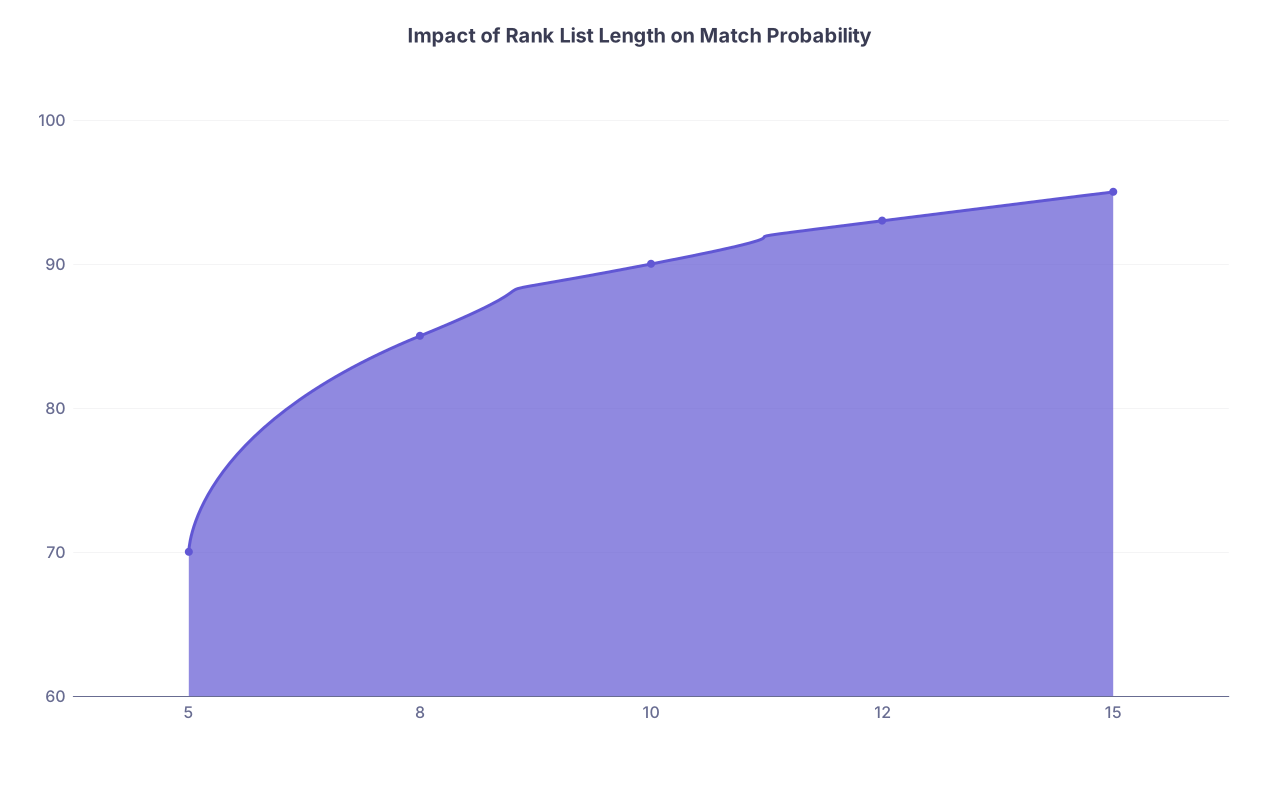
| Category | Value |
|---|---|
| 5 | 70 |
| 8 | 85 |
| 10 | 90 |
| 12 | 93 |
| 15 | 95 |
The approximate reality across many specialties: after ~10–12 programs, you get diminishing returns. But if your list is currently thin and this new program is solid, it meaningfully improves your safety net.
Step 8: For Couples Match – Rebuild the Grid, Do Not Patch It
If you are in the Couples Match, a new interview is not one new line. It is dozens of new pairings. You cannot just “slot it in.”
Here is the disciplined way:
Make or update your couples grid
- Rows: Your programs.
- Columns: Partner’s programs.
- Cell content: priority rank (1 = best, higher number = less preferred, X = do not rank).
Add the new program as a new row (or column)
Fill out:- What combinations with partner’s programs are superior to your current top 10 couples choices?
- Where are they lateral?
- Where are they clearly worse?
Create buckets instead of ranking every single combination manually
- Bucket A: “We would both be thrilled”
- Bucket B: “Good enough, both of us can live with it”
- Bucket C: “Only if we have to”
- Bucket D: “Do not rank”
Reconstruct the top 15–20 couples combinations from scratch
Do not just tape the new options on top. Rebuild the top of the grid. You will often find:- 2–4 combinations with the new program jump into Bucket A or B.
- Some old combinations drop because you now have better balanced options.
Yes, this is annoying. It is also what prevents the classic Couples Match regret: “We matched where only one of us is happy, and we had a better combo we never bothered to rank higher.”
Step 9: Sanity Check for Red Flags and Dealbreakers
Late interviews are sometimes:
- Programs filling gaps because stronger applicants canceled.
- Programs that historically have trouble filling because of culture issues or geography.
You need to be a bit colder here.
Hard filters you should respect
Ask yourself explicitly:
Did I see or hear anything that:
- Suggested malignant culture?
Examples I have heard verbatim:- “We do not really believe in days off.”
- “We do not care what ACGME says; we work like real doctors here.”
- Suggested poor support / professionalism?
- PD trashing other programs.
- Residents openly warning you about burnout.
- Indicated instability?
- Recent mass faculty departure.
- PD on their way out, major hospital merger turmoil.
- Suggested malignant culture?
Did residents look:
- Tired but proud (normal)?
- Or broken and bitter (problem)?
If a program crosses a serious red-line, it should not just slide “lower on the list.” It should move to “do not rank.” One malignant program on your list is one too many.
Step 10: Lock the New List, Then Stress-Test It
By now you should have:
- Scores for your top 10–12 plus the new program.
- Pairwise decisions.
- Any couples grid updates.
- A sense of your risk profile.
Now you construct Rank List v2.0.
Concrete process
Build the list based on true preference only
- Go top down:
- #1: If I could choose anywhere, I want to match here.
- #2: If #1 is gone, this is my next best.
- Keep doing that until you are done; do not look back while building.
- Go top down:
Run three thought experiments
a) “Regret test – top 3”
For each of your top 3:- If I match here and never get to see the others again, can I live with that? If you hesitate for #1 or #2, your order is off.
b) “Worst-case test – bottom 3 I still rank”
- Look at the last 3 programs on your list.
- Ask: Would I rather scramble / SOAP / reapply than train here for years? If yes → remove that program entirely.
c) “Unexpected win test”
Imagine matching at the new program instead of your original #1.- Do you feel secretly relieved?
- Or mildly disappointed?
Your body usually tells you the truth before your brain makes a speech about it.
Sleep on it once
- Do not keep editing the list daily. That is how you drive yourself insane.
- Set Rank List v2.0.
- Look at it once more the next day with a fresh brain.
- Make only changes you can justify in one clear sentence.
Then stop. Lock it. Walk away.
A Simple Flow to Follow
To make this concrete, here is the entire process as a compact flow:

| Step | Description |
|---|---|
| Step 1 | New Interview Invite |
| Step 2 | Freeze Current Rank List |
| Step 3 | Politely Decline Interview |
| Step 4 | Research Program Briefly |
| Step 5 | Pre-Interview Tentative Placement |
| Step 6 | Attend Interview |
| Step 7 | Post-Interview Notes & Scoring |
| Step 8 | Head-to-Head with Nearby Programs |
| Step 9 | Adjust for Recency Bias |
| Step 10 | Update Couples Grid & Combos |
| Step 11 | Rebuild List by True Preference |
| Step 12 | Run Regret & Worst-Case Tests |
| Step 13 | Lock Final Rank List |
| Step 14 | Is program potentially top 5 or solves a gap? |
| Step 15 | Couples Match? |
Common Pitfalls To Avoid
You are smarter than these, but residency season makes everyone a bit irrational.
Letting “prestige gravity” drag a program upward
“But it is [Big-Name Place]!” is not a reason by itself.- If location, support, or culture are bad fits, prestige will not fix your burnout.
Ignoring your partner / family situation because ‘it is only 3–7 years’
I have watched this blow up relationships repeatedly.
Distance and isolation magnify residency stress. Be honest about your support needs.Over-weighting a single charismatic faculty member
They might leave. They might not even interact with you much.
Culture is what the average resident experiences, not what one superstar attending promises you on interview day.Clinging to your old list order out of sunk-cost bias
“But I spent weeks building this list already.”
Irrelevant. You are making a multi-year decision. Let new, good data matter.
What You Should Do Today
You are probably either:
- Staring at a fresh unexpected invitation.
- Or worrying that one might pop up and blow up your plan.
Here is your next step, right now:
Open your current rank list and:
- Export and save a frozen “v1.0 – Before Any New Interviews”.
- Write one-line “why it is here” reasons for your current top 10.
- Build the 6-factor scoring template for those top 10 in a simple table or spreadsheet.
That way, when a new interview appears, you are not starting from chaos. You are plugging one new variable into a system that already exists.


