

You are sitting in front of your laptop. ERAS is open. NRMP rank list page is staring back at you. Two (or three) programs are basically tied in your mind. You have moved them up and down this list so many times the numbers are starting to blur.
Your friends are all saying the same thing in different words: “Just go with your gut.” Very helpful. Thanks.
Here is the problem:
If you are reading this, your “gut” has produced a deadlock. And you need a way to break it that is:
- Systematic
- Honest
- Hard to game in the moment
That is what this 5‑question checklist is for.
Use it when:
- You are torn between two programs at spots #1 and #2
- You have a cluster of 3–5 programs in the middle that feel interchangeable
- You keep changing your list order based on whoever you talked to last
By the end, you will have:
- A simple scoring system
- A clear tiebreak protocol
- A rank order you can defend to your future self
Step 0: Set the Ground Rules Before You Start
Before we get into the five questions, you need a structure. Otherwise you will just rationalize whatever you already feel.
Do this first:
Limit the decision set.
Do not apply this to all 20+ programs. You will burn out.
Use it only for:- Programs you might reasonably place in your top 8–10, or
- Tight clusters where you genuinely cannot tell which should go first
Decide your weighting scheme.
For each of the 5 questions, you will rate programs 1–5.
But some questions matter more than others.Use this default weighting (you can tweak, but do not make everything “equal” unless you really mean it):
- Question 1 (Training quality fit): weight 3
- Question 2 (Support and culture): weight 3
- Question 3 (Life outside the hospital): weight 2
- Question 4 (Trajectory and doors opened): weight 2
- Question 5 (Psychological signal check): weight 1
Translation:
- Training and culture: non‑negotiable core
- Life and trajectory: important but secondary
- Feelings and “vibes”: considered, but not in charge
Capture your answers on paper or a spreadsheet.
Not in your head. Your brain is biased and will rewrite history.Create a simple table like this:
| Program | Q1 Score | Q2 Score | Q3 Score | Q4 Score | Q5 Score | Weighted Total |
|---|---|---|---|---|---|---|
| A | ||||||
| B | ||||||
| C |
Lock in your scoring scale.
Use the same scale for all questions:- 1 = Concerning / poor fit
- 2 = Below average
- 3 = Acceptable / neutral
- 4 = Strong
- 5 = Excellent / near‑ideal
Once that is in place, now you run each tied program through the 5‑question checklist.
Question 1: “Where Will I Become the Doctor I Actually Want to Be?”
This is the training quality question. Do not water this down. You are not going to residency to be happy 24/7. You are going to:
- See enough volume
- See enough complexity
- Get enough reps
- Be trusted with enough responsibility
If you get this part wrong, everything else is just decoration.
Ask yourself bluntly for each program:
“If I matched here, how confident am I that I will finish residency clinically strong in the way I care about most?”
Break it down into subcomponents. You are not rating vibes; you are rating concrete training elements.
Look at:
Clinical volume and acuity
- Are you seeing bread‑and‑butter cases plus the edge of complexity you need?
- Example: For EM, a level I trauma center vs low‑acuity community shop. For IM, tertiary center with complex subspecialty services vs smaller hospital with lots of transfers out.
Autonomy vs scut ratio
- Do residents write real orders, run real codes, make real decisions?
- Or are they scribes for fellows and PAs?
- What did residents say on interview day when you asked, “Do you feel like the primary doctor for your patients?”
Procedural or skill exposure (depending on specialty)
- Surgery: how many cases by graduation, how many as primary surgeon
- IM: procedures if you care (lines, thoras, paras), ICU months
- Psych: variety of settings (inpatient, outpatient, consult, ED psych)
Didactic structure and accountability
- Real teaching vs “we technically have noon conference but everyone is in clinic”
- Board prep, in‑service performance, remediation support
Fellowship or job match track record in what you want
- Not generic “places”. Specific to your intended path.
Now, score each program 1–5 relative to your goals, not relative to prestige.
If you care about being an excellent community internist and hate research, a mega‑research powerhouse with weak community exposure might score a 3, while a strong community‑oriented university hybrid might score a 5.
Multiply this score by 3 for each program.
This question should already start separating programs. If two tie here, keep going.
Question 2: “Whose Residents Look Like People I Want as Colleagues at 2 a.m.?”
You are not marrying a brand. You are signing up to spend 3–7 years with a specific group of humans.
The question is:
“If my worst call of the year happened here, how confident am I that my co‑residents and faculty would make it survivable instead of brutal?”
This is not “Were they nice on interview day?” Interview days are theater. I am talking about real culture.
Look at:
How residents talk about each other
- Did they describe co‑residents as “family,” “solid,” “people who have your back”?
- Or did you hear subtle red flags: “You kind of have to advocate a lot for yourself,” “We are very independent” said with a tight smile.
Vibe on the pre‑interview social
- Were there awkward silences?
- Did one or two residents dominate while others sat quietly on camera?
- Did anyone interrupt each other kindly vs talk over everyone?
How they talk about leadership
- “Our PD is awesome, super approachable, always asking for feedback” = good sign.
- “We do not see our PD much but chiefs are great” = yellow flag.
- “We went through some rough changes with the last PD but things are improving” = big flashing sign to ask more.
How they talk about wellness and hours
- Do they say, “We are busy but people help each other out”?
- Or, “Hours are technically within duty limits” (translation: burnout is high)?
This question is about psychological safety and backup. Residency will punch you in the face some months. Who is standing next to you when that happens?
Score each program 1–5 on support and culture, then multiply by 3.
At this stage, many “tie” situations crack. Serious differences in culture show up when you are forced to score.
Question 3: “Where Can I Live a Life I Do Not Secretly Hate?”
Some applicants pretend location is superficial. It is not. It determines:
- Your commute time
- Your ability to see sunlight
- Your support system
- Your relationship health
- Your baseline mental health
The question here is not “Which city is more fun?” but:
“In this program’s setup, can I realistically maintain a sustainable version of my non‑work life?”
Look at a few specific pieces:
Geography and relationships
- Partner, spouse, kids, aging parents.
- Is this a one‑flight, half‑day drive, or “two flights and an airport nap” away?
- Is your partner able to work there or match there?
Housing and commute realities
- Are you commuting 15 minutes or 75 minutes in traffic?
- Is affordable housing within a reasonable radius of the hospital?
City fit for your personality
- Some people thrive in New York. Others quietly wither.
- Some want outdoors, others need culture and restaurants.
Cost of living vs PGY‑1 salary
- Do the numbers work without you being stressed about rent every month?
You are not optimizing for “ideal lifestyle.” You are optimizing for “I can do this grind here without losing myself entirely.”
Score 1–5 and multiply by 2.
Yes, it is weighted less than training and culture. Why? Because you can have a pretty good life in a second‑choice city with the right people and training. You cannot fix a toxic culture and weak training with a nice coffee shop nearby.
Question 4: “Which Program Opens More of the Specific Doors I Care About?”
This is not vague “prestige.” Prestige is the lazy version of this question.
The real question:
“Thinking about the 1–2 paths I am most likely to want after residency, which program gives me more leverage and support specifically for those?”
Examples:
- You are 80% sure you want GI.
- You are 70% sure you want community EM in a certain region.
- You are 60% sure you want academic psych with research time.
You do not need certainty. You do need directional honesty.
Evaluate:
Fellowship or job placement in your likely area
- Not just “Do they match GI?” but “Do they match GI from average residents, not just the superstar?”
- Job wise: “Do grads get hired in the region and type of practice I want?”
Mentorship depth in that niche
- Are there 1–2 overworked big names, or a real bench of people in that area?
- Did any interviewers say, “If you came here, you should talk to Dr. X, Dr. Y”?
Protected time and infrastructure
- Research track, QI projects, advocacy, admin, global health – whatever you care about.
- Is there structure or are you told, “You can do that on your own time”?
Program reputation where it actually matters
- Within your specialty, among fellowship directors and hiring groups.
- A mid‑tier university program with strong subspecialty ties can beat a big‑name hospital that is weak in your specific interest.
Score 1–5 and multiply by 2.
When two programs feel the same “now” but one clearly gives you more option value, that one deserves the higher rank unless something else is seriously off.
Question 5: “If I Got the Email Tomorrow, Where Would I Be Relieved vs Disappointed?”
You have done the rational work. Now you get one pass for emotion.
The question:
“Imagine it is Match Day morning. You open your email. It says: ‘Congratulations! You have matched at Program X.’ What is your first, unfiltered, physical reaction?”
You probably already know:
- One program would make your shoulders drop in relief
- One would give you a little “oh… okay” pause, even if your brain starts explaining why that is still fine
This is the revealed preference question.
Do this exercise honestly:
- Write the names of the tied programs on separate pieces of paper or notes.
- Shuffle them face down.
- Flip one over at random.
- Watch your immediate reaction in your body before the story in your head kicks in.
Now rate:
- 5 = “I would feel thrilled / deeply relieved.”
- 4 = “I would feel solidly happy and excited.”
- 3 = “I would feel okay, mildly pleased; this is fine.”
- 2 = “I would feel a bit disappointed, even if I know it is still good.”
- 1 = “I would feel heavy, anxious, or quietly crushed.”
Multiply by 1. Feelings matter. They just do not get to veto everything else.
Putting It Together: How to Break the Deadlock
Now you have:
- 5 scores per program
- Weighted totals
Walk through this in order.
1. Calculate Weighted Totals
For each program:
- Total = (Q1 × 3) + (Q2 × 3) + (Q3 × 2) + (Q4 × 2) + (Q5 × 1)
You can do this in 10 minutes in Excel, Google Sheets, or on paper.
For two or three programs in a deadlock, you may see a clear spread as soon as you total.
If one is clearly higher by 3+ points, that is your winner. Rank that one higher unless there is a true deal‑breaker you did not capture.
2. If Scores Are Tied or Within 1–2 Points
Now it gets more interesting. When two programs are very close, do not just shrug and flip a coin.
Use this tiebreak order:
First tiebreak: Question 1 (Training) and Question 2 (Culture)
- Compare only Q1 and Q2 scores.
- If one is higher in either category by ≥1 point, give that the edge.
- Example: Program A vs B:
- Q1: A=5, B=4
- Q2: A=3, B=5
- Here you decide what matters more to you: slightly stronger training vs clearly stronger culture. That choice itself clarifies your priority hierarchy.
Second tiebreak: Non‑negotiable constraints
- Partners, kids, visas, geography, medical needs.
- If one program clearly solves a constraint and the other makes life logistically ugly, that wins.
- This is where location can jump the line if it is truly non‑optional.
Third tiebreak: Question 5 (Emotional reaction)
- If two programs are dead even on objective metrics, you are allowed to let your gut decide.
- That is what Q5 was for: emotional honesty after rational work.
Final tiebreak: Aggressive honesty exercise
If they are still tied after all of that, do this:
- Write at the top of a page:
“I am forcing myself to rank Program A above Program B.” - Then write a short paragraph defending that choice to your future self.
- Then flip:
“I am forcing myself to rank Program B above Program A.” - Write that defense.
One of those paragraphs will feel more authentic and less like spin. That is your answer.
- Write at the top of a page:
Example: How This Looks in Real Life
Say you are ranking three IM programs: Riverview, Westside, and Metro U. You feel stuck between them for spots #2–4.
You run the checklist:
| Program | Q1 (×3) | Q2 (×3) | Q3 (×2) | Q4 (×2) | Q5 (×1) | Total |
|---|---|---|---|---|---|---|
| Riverview | 4→12 | 5→15 | 3→6 | 3→6 | 4 | 43 |
| Westside | 5→15 | 3→9 | 4→8 | 4→8 | 3 | 43 |
| Metro U | 3→9 | 4→12 | 5→10 | 5→10 | 2 | 43 |
They all tie at 43. Annoying, but helpful.
Now break the tie:
- Q1 (training): Westside clearly highest (5 vs 4 vs 3)
- Q2 (culture): Riverview highest (5 vs 3 vs 4)
- Q3 and Q4: Metro U wins for life and opportunities, but has the weakest training score and worst emotional reaction (Q5=2)
You ask: do I care more about top‑tier training (Westside) or strongest culture (Riverview)? Let us say you know you burn out easily and really value support. That pushes Riverview to #2, Westside to #3, Metro U to #4.
Without this structure, you would still be staring at three names and going in circles.
Visualizing What Actually Drives Your Decision
If you are a visual thinker, it sometimes helps to see how the factors stack up across programs.
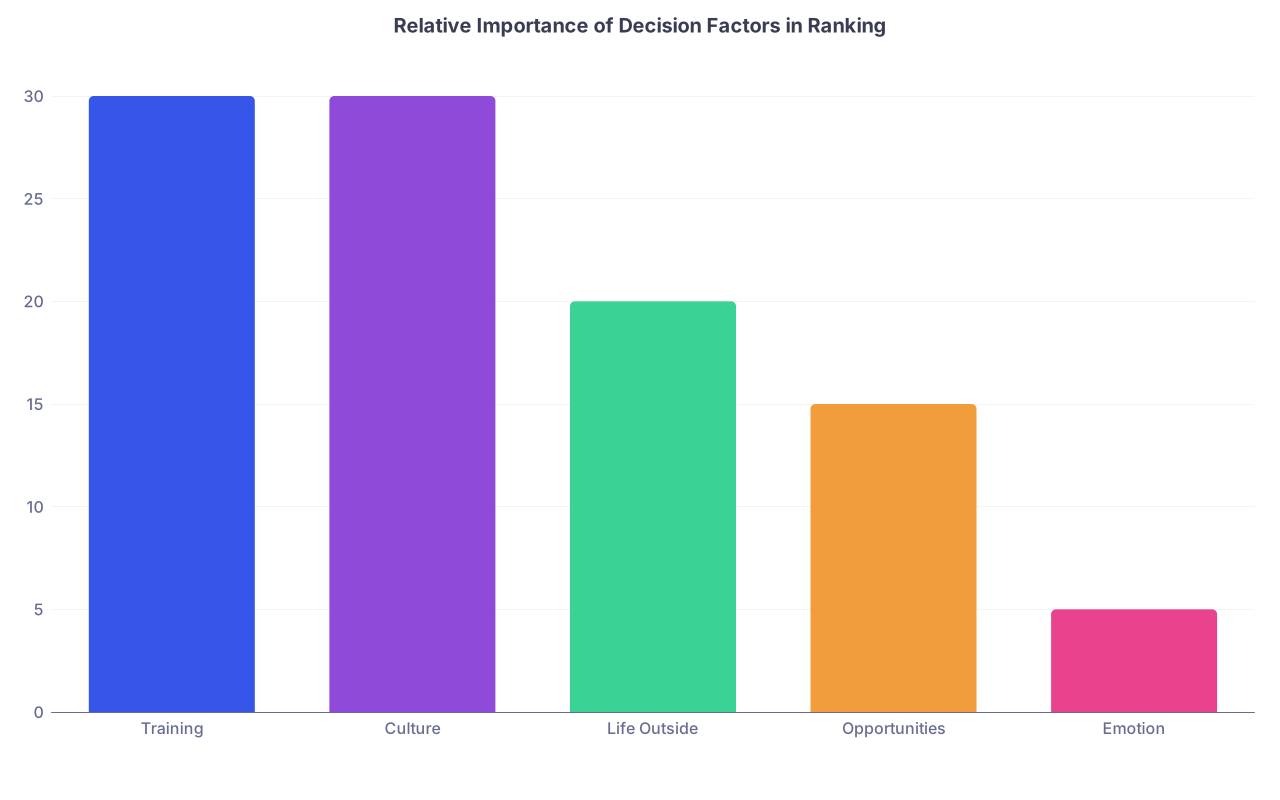
| Category | Value |
|---|---|
| Training | 30 |
| Culture | 30 |
| Life Outside | 20 |
| Opportunities | 15 |
| Emotion | 5 |
That is roughly what this framework is doing: giving most of the weight to training and culture, some to life and trajectory, and a little to feeling.
How to Use This for Your Entire List Without Losing Your Mind
You do not need this level of detail for all 15–20 programs. That would be a waste of energy and willpower.
Use this system in layers:

| Step | Description |
|---|---|
| Step 1 | All Interviewed Programs |
| Step 2 | Divide into Tiers |
| Step 3 | Top Tier: 1-5 |
| Step 4 | Middle Tier: 6-10 |
| Step 5 | Lower Tier: 11+ |
| Step 6 | Apply 5-Question Checklist Fully |
| Step 7 | Use Abbreviated Version: Q1-Q3 Only |
| Step 8 | Rank by Major Red Flags & Location |
- Top tier (1–5): Run full 5‑question checklist. No shortcuts.
- Middle tier (6–10): Use just Q1–Q3 with rough gut scoring for Q4 and Q5.
- Lower tier (11+): Roughly group by “would be fine,” “rather not,” and “only if I have to,” then sort by red flags/location.
The goal is not a perfect list. The goal is a defensible list that reflects your real priorities instead of last‑minute anxiety.
Common Mistakes This Checklist Helps You Avoid
Let me be blunt about a few patterns I have seen repeatedly.
Overweighting brand name
Matching at a big shiny name with weak culture and mediocre fit for your goals is the classic regret story. I have watched this happen.Underweighting culture
People say “Residents seemed great” about almost every place. That is lazy. When pushed to actually rank culture and support, gaps appear. Lean into those.Letting the last interview dominate
Recency bias is brutal. You leave a strong interview in February and suddenly you want to blow up the list you built in December. The checklist forces you to compare on stable criteria, not last‑day charm.Treating location as purely emotional
Either people ignore it completely (“I will survive anywhere”) or obsess about it (“I must be in this one city or my life is over”). Both are extremes. The checklist makes location one weighted factor among others.Using “I can survive anything” as a strategy
You probably can. But you do not get bonus points for surviving a bad fit. You just end up tired and behind.
How to Adjust This Framework for Different Situations
Couples Match
If you are couples matching, add one more “meta‑question”:
“How does this combination of programs work for us as a unit?”
You may need a second table comparing pairings, not single programs. At that point, training and culture still matter, but distance and support structures move up in weight.
Visa Needs or Major Constraints
If you are on a visa, or have a major non‑negotiable factor (health condition, dependent family issue), treat that like a hard filter, not just a weighted factor.
- Programs that cannot meet that need go to the bottom automatically, no matter how they score.
- Among programs that do meet it, you then use the checklist.
Very Undecided Career Path
If you genuinely have no idea whether you want fellowship vs community, research vs no research, then Q4 should focus less on specific fellowships and more on general optionality:
- Breadth of exposure
- Flexibility in elective time
- Support for “trying things out” without pressure
A Quick Reality Check: You Are Ranking Programs, Not Predicting Your Entire Life
One last thing. This process feels heavy because you are told “this determines your future.” It does not. It shapes your next 3–7 years and strongly influences your direction, yes. But people pivot all the time:
- Community program residents match competitive fellowships
- Big‑name residents leave academics and go full community
- People discover a love for something they never considered on interview day
Your job is not to foresee every possible future. Your job is to choose the training environment where:
- You will not be miserable
- You will grow
- You will have enough doors open to walk through later
The 5‑question checklist does that. It forces you to confront what you actually value and gives you a way to choose when programs look the same on the surface.

Your Next Step Today
Do not just nod and move on. Take 20 minutes and do this now:
- Pick the two programs you are most stuck between for your top spots.
- Draw a simple table with columns for Q1–Q5 and a total.
- Force yourself to give each program a 1–5 score for every question. No ties.
- Apply the weights, total them, and then walk through the tiebreak steps if needed.
When you are done, look at the program that comes out ahead and ask yourself one thing:
“Am I willing to bet my future self that this is the better choice, based on what I know now?”
If the answer is yes, lock it in on your NRMP rank list page today, not “later.” Your future self does not need another week of you second‑guessing the same decision with no new information.
Open your rank list right now and apply the 5 questions to that one deadlock you have been avoiding. That is how you start breaking the gridlock for real.


