

Your messy, bloated program shortlist is more dangerous than a mediocre Step score.
Because bad ranking logic will quietly sabotage an otherwise solid application season.
You do not need another vague lecture about “finding the right fit.” You need a system that takes your 40 half-random programs and turns them into a clear, defensible rank list where your #1 actually deserves to be #1.
This is that system. Stepwise. Mechanical. Honest.
Let’s fix the chaos.
Step 0: Admit Your Current List Is Biased and Messy
Before we build anything, you need to understand what you are fixing.
Here is what I see over and over:
- Lists driven by brand and gossip:
- “My aunt said that hospital is amazing.”
- “Everyone in my class is applying there.”
- Geography delusions:
- “All East Coast. I hate the cold but… prestige.”
- Ignoring personal non‑negotiables:
- Partner’s job.
- Family obligations.
- Children / schools.
- Chronic health issues.
- Magical thinking about competitiveness:
- Applying to all the top 20 categorical surgery programs with a 225 Step 2. No safeties.
- Emotional anchoring:
- You did one away rotation and now that program is #1 no matter what the data say.
You will keep some emotions. You are human. But you are going to cage them inside a structure.
Step 1: Define Your Three Buckets – Non‑Negotiables, Important, Bonus
You cannot rank programs intelligently until you know what you actually care about, in writing.
Grab a blank page (physical or digital). Split it into three sections:
Non‑Negotiables (Dealbreakers)
If a program fails one of these, you do not rank it. Period.
Common legitimate ones:- Must be within X miles of partner’s job / aging parents
- Must be categorical (not prelim only)
- Must have a minimum board pass rate (for example >90% over 5 years)
- Must have visa sponsorship (if applicable)
- Must not be malignant (based on strong, repeat reports, not one bitter Reddit post)
- Must offer your required track (for example integrated IR vs independent, child psych, physician‑scientist track)
Important Factors
These will carry substantial weight in your ranking, but you might accept tradeoffs. Examples:- Operative volume / procedural volume
- Fellowship match strength
- Resident happiness and culture
- Cost of living
- Proximity to family or support system
- Academic vs community environment
- Research time and mentorship quality
- Schedule structure / call system (night float vs 24‑hour call)
Bonus / Nice‑To‑Haves
These decide ties but should not drive your list.- Free food / parking
- Brand name if it does not materially change your career
- New hospital building
- Location “vibes” if you can still see yourself being OK there
- Moonlighting opportunities (for some specialties this might move up to “Important”)
If everything feels like “non‑negotiable,” that is your first problem. Be ruthless. If you insist on 20 non‑negotiables, you will trap yourself into a tiny and unrealistic list.
Step 2: Build a Simple Scorecard (Spreadsheet, Not Feelings)
Now you convert those priorities into something you can score.
Open a spreadsheet (Excel, Google Sheets, Notion table—does not matter).
Create columns like this:
- Column A: Program Name
- Column B: City / State
- Column C: Specialty Track (for example Categorical IM, Prelim, etc.)
Then add columns for each factor you identified under “Important” and “Bonus.”
Example for Internal Medicine:
- Autonomy
- Inpatient Volume
- Fellowship Match (Cardiology / GI / Heme‑Onc)
- Research Support
- Resident Culture
- Cost of Living
- Partner Job Market
- Proximity to Family
- Schedule / Call
- Moonlighting (Y/N)
- Gut Feeling (we will deal with this carefully)
You are going to score each factor for each program on a 1–5 scale:
- 1 = very poor or unacceptable
- 3 = average / neutral
- 5 = excellent
Do not overcomplicate the scale. Half‑points make people feel precise but usually just encode more noise.
Step 3: Set Weights Before You Plug In Scores
This is the part almost everyone skips. Then they pretend their list is “objective.”
You are going to assign weights to each factor before you score programs. That way you do not retro‑fit your values to justify a program you already like.
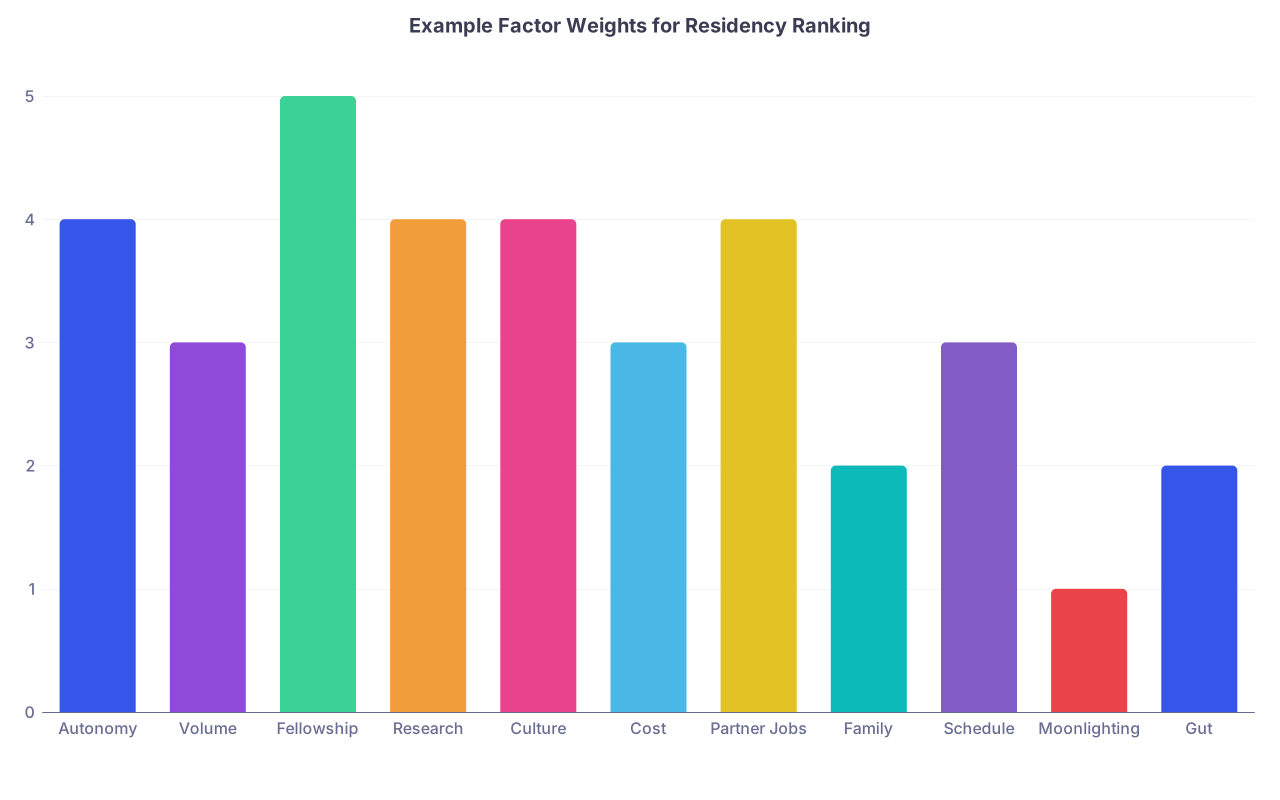
Example weights for an Internal Medicine applicant with strong academic interests and a partner:
- Autonomy – 4
- Inpatient Volume – 3
- Fellowship Match – 5
- Research Support – 4
- Resident Culture – 4
- Cost of Living – 3
- Partner Job Market – 4
- Proximity to Family – 2
- Schedule / Call – 3
- Moonlighting – 1
- Gut Feeling – 2
Notice:
- Non‑negotiables get a filter, not a weight. If a program fails them, it is out—no scoring.
- Highest weights go to career‑shaping features (fellowship match, autonomy, research).
- Social and lifestyle factors are still present but not dominating.
Let’s visualize this idea briefly:
| Category | Value |
|---|---|
| Autonomy | 4 |
| Volume | 3 |
| Fellowship | 5 |
| Research | 4 |
| Culture | 4 |
| Cost | 3 |
| Partner Jobs | 4 |
| Family | 2 |
| Schedule | 3 |
| Moonlighting | 1 |
| Gut | 2 |
You can tweak the weights. Just do it once up front, not every time you get new information.
Step 4: Filter with Non‑Negotiables Before Ranking
Now apply your non‑negotiables like a sieve.
Typical filters:
- Must sponsor J‑1 or H‑1B visa
- Must have categorical positions in your specialty
- Must have board pass rate above your threshold
- Must be within X hours of your family (if that is a real requirement, not a preference)
- Must not be widely reported as malignant by multiple independent sources
Go down your existing list and mark any program that fails as “OUT – Non‑negotiable”.
Do not delete them yet; you want to see how many you are excluding. But they will not be ranked later.
This step alone usually cuts 10–30% of a chaotic list.
Step 5: Gather Real Data, Not Vibes
You cannot score programs accurately if all your “data” are hearsay and Reddit threads.
Here is where to look, and what to extract:
Program Websites
- Call schedule snapshots
- Number of residents per year
- Rotations by year (how heavy is inpatient, ICU, electives)
- Dedicated research time
- Fellowship or job placement lists
FREIDA / AAMC / Specialty Societies
- Program size
- Board pass rates (if available)
- Fellowship match outcomes
Virtual and In‑Person Interviews
- Direct answers about:
- Culture (“What kind of resident does poorly here?” is a revealing question.)
- Autonomy
- Support for struggling residents
- Schedule and wellness
- Chat with residents without faculty present
- Direct answers about:
Current Residents / Recent Graduates (your best source) Ask targeted questions:
- “How many codes have you actually run alone by the end of PGY‑2?”
- “How easy is it to get letters for competitive fellowships?”
- “Who leaves this program unhappy? Why?”
Online Boards / Reddit / SDN
- Use them to flag patterns only.
- One angry rant means nothing. Five similar complaints from different years means something.
As you gather data, fill your spreadsheet scores roughly. You are not building a NASA model. A lot of your scoring will be “this sounds average” → 3, “this sounds fantastic” → 5, “red flags” → 1–2.
If you are unsure on a factor for a specific program, leave it blank for now. Do not guess wildly.
Step 6: Calculate a Weighted Score for Each Program
Now we combine scores and weights.
For each program:
- Multiply each factor score by its weight.
- Sum those products.
- Optionally, divide by the sum of all weights to keep the number on a simpler scale.
Example for one program:
- Fellowship Match: score 5, weight 5 → 25
- Resident Culture: score 4, weight 4 → 16
- Cost of Living: score 2, weight 3 → 6
- Partner Job Market: score 3, weight 4 → 12
- … and so on
Total weighted sum → 120 (for example)
Do this for all programs that passed the non‑negotiable filter.
You now have an initial objective ranking by total score. Do not fall in love with it yet. We still need to fix distortions and check your gut.
To keep this visible, build a simple comparison table of your top candidates:
| Program | Total Score | Fellowship Match Score | Culture Score | Cost of Living Score |
|---|---|---|---|---|
| Program A | 120 | 5 | 4 | 2 |
| Program B | 115 | 4 | 5 | 3 |
| Program C | 108 | 3 | 5 | 4 |
| Program D | 104 | 4 | 3 | 5 |
This is the skeleton. Now we add nuance.
Step 7: Sanity‑Check Against Your Future, Not Your Ego
Here is where people blow up their own match: they override all structure because of a single shiny object.
Your job now is to look at your top ~10–15 programs and ask two harsh questions:
If I train here, will I become the kind of physician I actually want to be?
For example:- If you want to be a proceduralist but your #1 program has low volume and sends everyone to outpatient primary care, something is off.
- If you want an academic career but your top pick has essentially no research mentorship, that is a mismatch.
Can I realistically live the life I need for 3–7 years in this city and culture?
This is not “do I love the nightlife.” This is:- Can you raise kids here?
- Can your partner work here without resenting you?
- Does the cost of living strangle you at PGY‑1 salary?
Where your future self violently disagrees with your current spreadsheet, you fix one of two things:
- You mis‑scored a factor for that program → adjust the score.
- Your weights were wrong → intentionally re‑weight, once, with justification.
This is not license to fiddle everything until your favorite program “wins.” It is a structured audit.
Step 8: Integrate Gut Feeling in a Controlled Way
Emotions are not the enemy. Unchecked emotions are.
If you felt a dramatic difference visiting Program X vs Program Y, you should encode that. But not let it hijack the process.
Two ways to do this safely:
Use “Gut Feeling” as a low‑weight factor
You already added it with a weight (for example 2 out of 5). Now actually score it:- 1: Uncomfortable, multiple red flags, could not see myself there
- 3: Neutral, would adapt fine
- 5: Strong positive pull, felt “my people”
Final 1:1 Tiebreaker
If two programs’ total scores are within a small band (for example 2–3 points), and your gut clearly prefers one, bump that one above the other on the final rank list.
What you must not do: take a program that is structurally poor for your goals (weak training, wrong geography, bad culture) and let a good free dinner and friendly PD talk you into top‑three.
Step 9: Adjust for Risk and Competitiveness (Reality Check)
Your rank list should reflect both:
- Where you would be happiest and best trained if matched
- And the likelihood that you would actually match there
The NRMP algorithm is applicant‑favorable, so you should rank in your true order of preference, not trying to “game” probabilities on the rank list itself. But where probability matters is:
- How many programs you put on the list overall
- How wide a range of competitiveness you include
For your internal planning, you can classify programs like this:
- Reach: Your stats and CV are at or below the program’s typical range.
- Match: You are squarely within their common profile.
- Safety: You are above their usual range or have a strong “in” (home program, strong connection).
Create a rough label in your spreadsheet. Then look at your top 10–15 ranked programs:
- If the top 8 are all “Reach,” you are being reckless.
- If almost all are “Safety,” you are underselling yourself.
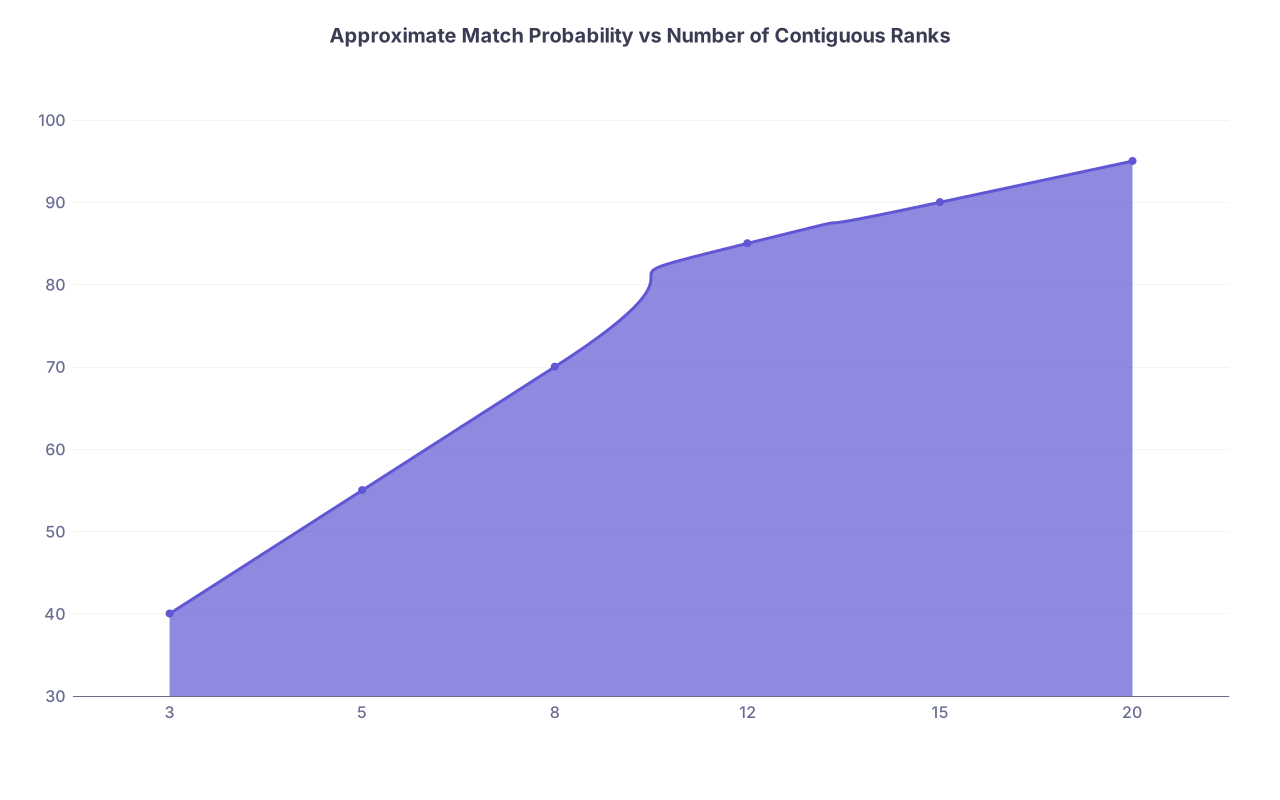
For US allopathic seniors, NRMP data clearly show match probability skyrockets by about 12–15 contiguous ranks for most core specialties. For IMGs, those numbers are often higher.
So:
- Core specialties (IM, Peds, FM): aim for at least 12–15 ranked programs.
- Moderately competitive (EM, Anesthesia, OB/GYN): 15–20+.
- Highly competitive (Derm, Ortho, ENT, Plastics, IR): as many as realistically possible where you would actually go if matched.
| Category | Value |
|---|---|
| 3 | 40 |
| 5 | 55 |
| 8 | 70 |
| 12 | 85 |
| 15 | 90 |
| 20 | 95 |
Do not rank a program you truly would not attend. Ranking a program you would rather not match than attend is how people end up miserable.
Step 10: Build the Final Rank Order List (With Controlled Overrides)
By now you should have:
- A filtered list of programs that meet non‑negotiables
- Weighted scores for each
- Adjusted scores for obvious mis‑ratings
- A risk label (Reach / Match / Safety) for each
Now:
- Sort the sheet by total weighted score (descending).
- Look down the resulting order and ask yourself:
“If I matched at #1 instead of #2, would I feel clearly happier / better trained?”
If the answer is “no,” those programs are probably mis‑ordered. - Perform small, justified swaps:
- Move Program B above A if:
- Their scores are similar, and
- Your future career reasoning and gut both favor B.
- Document the reason in a “Notes” column. One line. For example:
- “Better Cardiology pipeline, partner job in same city.”
- Move Program B above A if:
- Keep iterating down the list until you have a sequence that feels internally consistent:
- At each step, if you would clearly rather match to the lower program than the one above it, swap them and re‑evaluate.
What you should not do:
- Re‑score entire categories emotionally at this late stage.
- Blow up the whole ranking after a single late‑cycle interview high.
If a late interview truly changes your perspective, go back to your scorecard, add the new program, score it, and see where it lands.
Step 11: Run Two Stress Tests
Before you swear this is your final rank list, run these two mental simulations.
Stress Test 1: “Match Email” Check
Imagine it is Match Day. You open your email, and it says:
“Congratulations, you have matched at [Program X].”
Go down your list one by one. For each program, note your first gut reaction:
- Relief and excitement? Good.
- Neutral “Okay, that makes sense”? Acceptable.
- Dread or “Oh no, anywhere but there”? That program should not be on your list.
If there is any program you would genuinely consider not showing up to if you matched there, delete it. Right now.
Stress Test 2: Life Catastrophe Check
Picture a hard year: sick parent, financial hit, relationship stress. Would this program and city:
- Make that harder than necessary, or
- Give you at least a fighting chance to cope?
This is where cost of living, support system, and culture suddenly become very real. Adjust only if you see glaring mistakes. You are not designing a fantasy; you are minimizing worst‑case damage while maximizing opportunity.
Step 12: Lock It In and Stop Tinkering
Once you have:
- Applied non‑negotiables
- Scored and weighted programs
- Adjusted obvious errors
- Run the two stress tests
Lock the rank list. Put the final order into NRMP (or your matching system of choice). Save your spreadsheet as a record of why you made these choices.
Then stop.
The week‑to‑week micro‑shifts in your feelings will never settle. If you keep adjusting every time you reminisce about a free steak dinner, you are just injecting noise.
Example: A Mini Walkthrough
Let me walk you through a simplified, concrete mini‑example to make this less abstract.
You are applying to Internal Medicine. You narrowed your list to three serious contenders after interviews:
- Program A: Big urban academic center
- Great subspecialty fellowships.
- Brutal cost of living.
- Partner would struggle to find work.
- Program B: Mid‑sized university‑affiliated program
- Solid but not famous.
- Happy residents, strong community.
- Reasonable research, decent fellowships.
- Program C: Large community program
- Heavy patient volume.
- Limited research.
- Excellent cost of living.
Your weights (simplified):
- Fellowship – 5
- Culture – 4
- Cost of Living – 3
- Partner Job Market – 4
- Research – 3
- Gut – 2
You score:
Program A
- Fellowship: 5
- Culture: 3
- Cost: 1
- Partner Jobs: 2
- Research: 5
- Gut: 3
Program B
- Fellowship: 4
- Culture: 5
- Cost: 3
- Partner Jobs: 4
- Research: 3
- Gut: 5
Program C
- Fellowship: 3
- Culture: 4
- Cost: 5
- Partner Jobs: 4
- Research: 1
- Gut: 3
Weighted sums (roughly):
- Program A: (5×5) + (3×4) + (1×3) + (2×4) + (5×3) + (3×2) = 25 + 12 + 3 + 8 + 15 + 6 = 69
- Program B: (4×5) + (5×4) + (3×3) + (4×4) + (3×3) + (5×2) = 20 + 20 + 9 + 16 + 9 + 10 = 84
- Program C: (3×5) + (4×4) + (5×3) + (4×4) + (1×3) + (3×2) = 15 + 16 + 15 + 16 + 3 + 6 = 71
Objective order: B > C > A.
Now sanity‑check:
- Could you get the fellowships you want from B? Yes.
- Would your partner be reasonably happy there? Yes.
- Does A’s prestige justify the lifestyle hit and partner strain? Probably not.
- Does C give enough academic opportunity for your goals? Maybe, but weaker.
So your final rank order: B, C, A.
Most students without this framework would put A first “for the name.” I have watched that blow up careers and relationships.
Final Thoughts: What Actually Matters
Strip away all the noise and it comes down to this:
Use a structure, not your anxiety, to rank programs.
Non‑negotiables as a gate, weighted factors in a scorecard, controlled use of gut feeling.Rank for the physician you want to be, and the life you can actually live.
Autonomy, training quality, and realistic lifestyle beat shiny logos and fancy brochures.Once your process is solid, trust it and move on.
A disciplined, transparent method beats endless second‑guessing. Your future self will thank you for choosing clarity over chaos.


