

The worst rank lists are built on vibes instead of a system.
If you are torn between academic vs community programs and your list feels like chaos, the problem is not your confusion. The problem is your process.
I have watched smart applicants sabotage good seasons because they “felt more academic” one week and “maybe I want quality of life” the next. Programs did not change. Their framework did.
You need a protocol. Not more opinions.
Here is how to build a rational, defensible rank list when you are genuinely unsure about academic vs community training.
Step 1: Stop Arguing Labels and Define the Real Trade‑offs
“Academic vs community” is lazy shorthand. Programs exist on a spectrum, and the label on their website is often marketing, not reality.
You are not choosing between two words. You are choosing between specific training environments.
Start by breaking the problem into concrete dimensions. These are the levers that actually matter:
- Clinical volume and autonomy
- Fellowship and career outcomes
- Research expectations and support
- Teaching culture and resident role
- Lifestyle and workload
- Location / support system
- Program stability and leadership
Forget “academic” and “community” for a moment. Focus on what you actually want your day-to-day and your career to look like.
The Core Question You Must Answer
If I force you to pick one as higher priority, which wins:
- Being maximally prepared and competitive for fellowship / niche academic career,
or - Having broad clinical confidence, decent lifestyle, and flexibility for generalist or undecided paths?
Not forever. Just for residency.
Answer that honestly, and you already have a bias toward one end of the spectrum. That bias will anchor your later tiebreakers.
Step 2: Build a Simple, Ruthless Scoring Framework
You cannot mentally juggle impressions from 12–30 interviews. No one can. The people who say “I just knew” are rewriting history.
You need a scoring system that:
- Limits criteria
- Forces you to weight priorities
- Produces numbers that reduce noise, not create it
Use this as a starting point. Customize, but do not add more than 2–3 extra factors.
| Criterion | Suggested Weight (%) |
|---|---|
| Clinical Training & Autonomy | 25 |
| Fellowship/Career Outcomes | 20 |
| Teaching & Culture | 20 |
| Lifestyle & Wellness | 15 |
| Location & Support | 10 |
| Program Stability/Reputation | 10 |
Now define what 1 vs 5 actually means for each criterion. Example:
Clinical Training & Autonomy (25%)
- 5 – High volume, graduated autonomy, seniors clearly confident; residents manage complex cases, not just scut
- 3 – Decent volume, some autonomy but many decisions attending-driven
- 1 – Low volume, heavy service work with little decision-making
Fellowship/Career Outcomes (20%)
- 5 – Consistently matches into competitive fellowships or desired jobs; program director discusses outcomes with data
- 3 – Sporadic fellowships; mostly local jobs; vague about outcomes
- 1 – No clear record, PD hand-waves, residents unsure
Do this for every criterion. If you cannot define it, you should not score it.
Step 3: Classify Programs Along the Spectrum (With Data, Not Branding)
Now you translate “academic vs community” into something you can use.
I use a simple 4-type model:
- Academic-Heavy
- Academic-leaning Hybrid
- Community-leaning Hybrid
- Pure Community
You are not trying to be perfect. You are trying to avoid lying to yourself.
Here is a simple diagnostic:
| Feature | Academic-Heavy | Academic-Hybrid | Community-Hybrid | Pure Community |
|---|---|---|---|---|
| University affiliation | Core campus | Strong | Loose | None/minimal |
| Fellows present | Many services | Some services | Few | None |
| Research expectation | Required | Optional but easy | Available if push | Rare |
| Typical graduates | Fellowships | Mixed | Mostly general | Mostly general |
| Services covered | Tertiary/quaternary | Mixed | Mostly bread & butter | Bread & butter |
Do this:
- For each program, based on your interview, website, and residents you spoke with, assign one of these four types.
- Write it directly next to the program name:
- “Program A – Academic-Heavy”
- “Program B – Community-Hybrid”
This label is not your ranking. It is just context.
Now you can see your actual pool:
- Maybe you interviewed at 3 Academic-Heavy, 4 Hybrids, 5 Community.
- That already tells you something. You subconsciously applied to both ends for a reason. You are not purely academic nor purely community.
Step 4: Collect Hard Data From Each Interview (Retroactively If Needed)
If your interviews are done and your notes are garbage, you can still salvage this.
You want answers to these concrete questions. No fluff:
Training & Autonomy
- What is the average daily census for interns?
- Who writes the orders? Intern vs senior vs APP?
- Do seniors run codes?
- Any services where residents feel more like scribes than doctors?
Fellowship / Career
- Where did the last 3 years of grads go? (Ask for a list. If they hesitate, that is data.)
- For your specialty: what fellowships have people matched into and how often?
- Is there a track record for your likely path? (Academic, community, niche interest)
Research Environment
- Is there protected research time?
- Is IRB support centralized or each person fending for themselves?
- Are there ongoing projects residents can plug into, or do you start from zero?
Culture / Wellness
- What is the vibe at 2 a.m. on nights? Jokes and teamwork or silent resentment?
- How do they handle weak residents? Support vs shame vs eject?
- Any recent program director turnover?
Lifestyle / Location
- Typical work hour reality vs advertised?
- Commute times residents actually have?
- Cost of living in areas residents live in?
You are looking for concrete phrases in your notes and memory:
- “We do not track duty hours; we trust residents” → Translation: you will be working a lot.
- “Residents rarely scrub on X because of fellows” → Translation: academically prestigious, procedurally weaker for residents.
- “You can do research if you want, but no one really does” → Translation: this is not an academic pipeline.
If you do not have these answers for a program, email a resident now and ask 3–4 precise questions. You do not need a second interview. You need 10 minutes of honest data.
Step 5: Score Every Program, Then Overlay the “Type”
Now you actually rank.
Make a spreadsheet with:
- Rows: Programs
- Columns: Your criteria
- Column: Program Type (Academic-heavy, etc.)
- Column: Total Weighted Score
Score each criterion 1–5 per program, multiply by weight, sum.
Sort by total score, highest to lowest.
You will see patterns:
- Maybe your top 3 by score are all academic-leaning hybrids.
- Maybe a “prestige” academic program falls to the middle because the culture is toxic.
- Maybe a “sleepy” community program jumps higher than expected because the residents are truly happy and clinically solid.
Now you are no longer saying, “I vibed with that place.”
You are saying, “This program scored 4.3/5 on training, 4.5/5 on outcomes, 4.7/5 on culture, which is more aligned with what I value than the shiny name that gave me bad vibes.”
Step 6: Decide How Much You Really Care About Academic Exposure
This is where the academic vs community debate actually becomes a decision.
Use these thresholds:
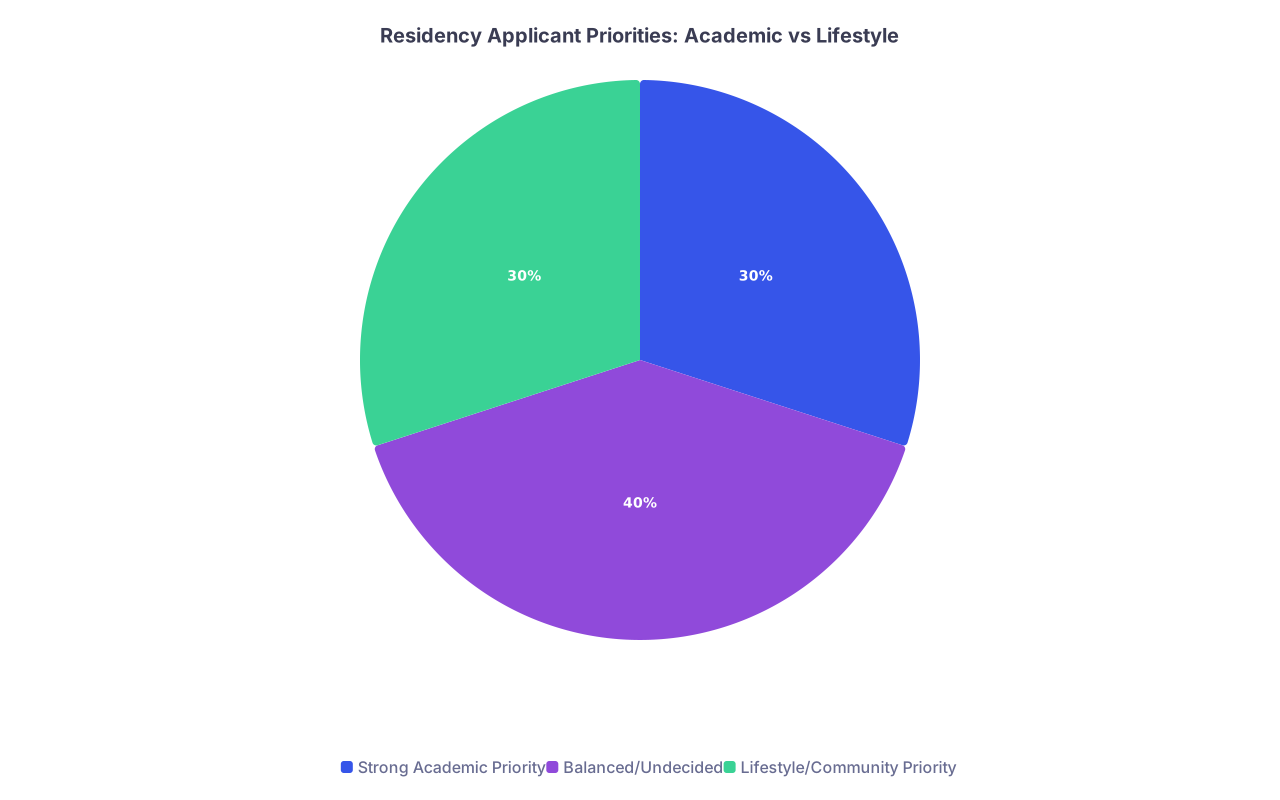
| Category | Value |
|---|---|
| Strong Academic Priority | 30 |
| Balanced/Undecided | 40 |
| Lifestyle/Community Priority | 30 |
If you are Strong Academic Priority (you want a competitive fellowship, research, or eventual academic post):
Your tiebreaking rules should look like this:
Between two similarly scoring programs:
- Prefer: Academic-heavy or Academic-hybrid
- But only if:
- Residents actually match where you want to go
- You still score culture ≥ 3/5 (do not ignore toxicity)
Accept some lifestyle hit:
- Slightly worse call schedule
- Slightly higher cost of living
- More fellows around when there is a clear trade for:
- Name recognition
- Real research infrastructure
- Proven fellowship placement
If you are Lifestyle/Community Priority (you see yourself as a generalist, long-term community doc, or you simply value life outside work more):
Your tiebreakers flip:
Between two similarly scoring programs:
- Prefer: Community-hybrid or Strong community with excellent training scores
- Culture, autonomy, and happiness > big-name academic reputation
Accept some academic limitations:
- Less research
- Fewer fancy conferences
- More bread-and-butter, less zebras
If you are ** genuinely undecided / balanced**:
Then your best friend is the hybrid program.
Why hybrids are often the safest play
Academic-leaning and community-leaning hybrids give you:
- Enough name/structure to pursue fellowship or academic work if you push for it
- Enough autonomy and volume to feel like a competent generalist
- Often better culture than the most hardcore academic powerhouses or the most bare-bones community shops
If your top 3–5 total scores are mostly hybrids, that is your answer. Your behavior (what you scored high) is telling you what you value more than your internal debate.
Step 7: Use a Flowchart to Break Final Ties
When you are stuck between 2–3 programs after scoring, do not re-open the whole debate. Use a simple decision flow.

| Step | Description |
|---|---|
| Step 1 | Compare Top 3 Programs |
| Step 2 | Drop Below Safe Line |
| Step 3 | Rank Higher |
| Step 4 | Rank Higher |
| Step 5 | Trust Gut, Rank Higher |
| Step 6 | Use Location/Support as Tiebreaker |
| Step 7 | Major Red Flags? |
| Step 8 | Clear Fellowship/Career Advantage? |
| Step 9 | Clear Culture/Lifestyle Advantage? |
| Step 10 | Gut Says Strong Preference? |
Concrete rules:
Red flags always override “academic vs community”
Examples:- Multiple residents privately warn you: “Do not come here”
- Massive recent leadership turnover and nobody can explain the plan
- Duty hours clearly violated with no plan to fix
Those programs go down the list. No exceptions.
Fellowship/career advantage only matters if it is documented
- Actual match lists
- Recent grads in fellowships you care about
- Faculty who will pick up the phone for you
Not: “We’re well respected” with zero proof.
Culture/lifestyle advantage is valid You are not weak for choosing a healthier environment.
Burnout will destroy both clinical and academic ambition.Gut is allowed only after data Once two options are genuinely equivalent on paper, then:
- Revisit your interview day memories
- Who did you picture yourself becoming like?
- Which resident group felt like your people?
That is when you let instinct break the tie. Not before.
Step 8: Protect Yourself from Two Classic Cognitive Traps
You are vulnerable to two big errors right now.
Trap 1: Prestige Poisoning
Symptoms:
- You keep bumping a big-name academic program higher despite residents looking miserable.
- You tell yourself, “It is only three years,” while ignoring that those three years shape your skills, mental health, and early career.
Reality:
- A mid-tier academic-hybrid with strong teaching and sane culture often produces better clinicians and fellowship candidates than a brand-name program that treats residents as cheap labor.
- Fellowship PDs actually know which programs train well, regardless of U.S. News nonsense.
Protocol:
- Any time you move a program up only for name, force yourself to write down:
- What concrete benefit does this name give me for my specific goal?
- What am I giving up (culture, autonomy, wellness) and is that worth it?
If you cannot articulate the trade, you are chasing status, not strategy.
Trap 2: Short-Term Comfort Myopia
Opposite problem:
- You want to stay near your partner, your dog, your favorite coffee shop.
- You are tempted to put a weak program at the top because “I will be happier there.”
Sometimes this is valid. Often it is not.
Reality:
- A program that under-trains you will feel comfortable… until PGY-3 when you realize you are underprepared and anxious about your first real job or fellowship.
- You can usually tolerate a slightly worse city for three years if the training clearly sets you up for decades.
Protocol:
- For any program you are pushing up for location alone, ask:
- If this program were in a random city, where would it fall on my list?
- Can I live with that ranking exploiting only location?
If the answer is “bottom half,” be very careful putting it at the top solely for proximity.
Step 9: Build Two Lists, Then Reconcile
Here is a trick that works absurdly well when you are torn.
Create:
List A: Academic-weighted ranking
- Temporarily increase weights for:
- Fellowship/Career Outcomes
- Research/Academic exposure (you can split this out briefly)
- Decrease Lifestyle/Location weights slightly.
- Temporarily increase weights for:
List B: Lifestyle-weighted ranking
- Increase:
- Culture / Wellness
- Lifestyle / Location
- Decrease:
- Research / Pure academic exposure (not training quality).
- Increase:
Now compare:
- Which 3–5 programs consistently stay near the top on both lists?
- Those are golden. These are programs that support both career and life. Push these up on final rank.
- Which programs move wildly between lists?
- These are pure trade-off programs. You must decide consciously:
- Am I willing to sacrifice quality of life for that academic bump?
- Or sacrifice academic potential for comfort?
- These are pure trade-off programs. You must decide consciously:
This dual-list method forces clarity. It also shows you whether you are secretly more academic-leaning or community-leaning by how uncomfortable you feel dropping certain programs when you shift weights.
Step 10: Reality-Check Against Match Strategy (Not Fear)
You do not build a rank list based on “where I think I will match.” You rank in your true preference order. But you should sanity-check for catastrophic risk.
Use your interview count and competitiveness to build three tiers:
- Tier 1 – Reach/Highly Desired: Dream academic or community programs
- Tier 2 – Solid, realistic, still good fits
- Tier 3 – Safety but acceptable
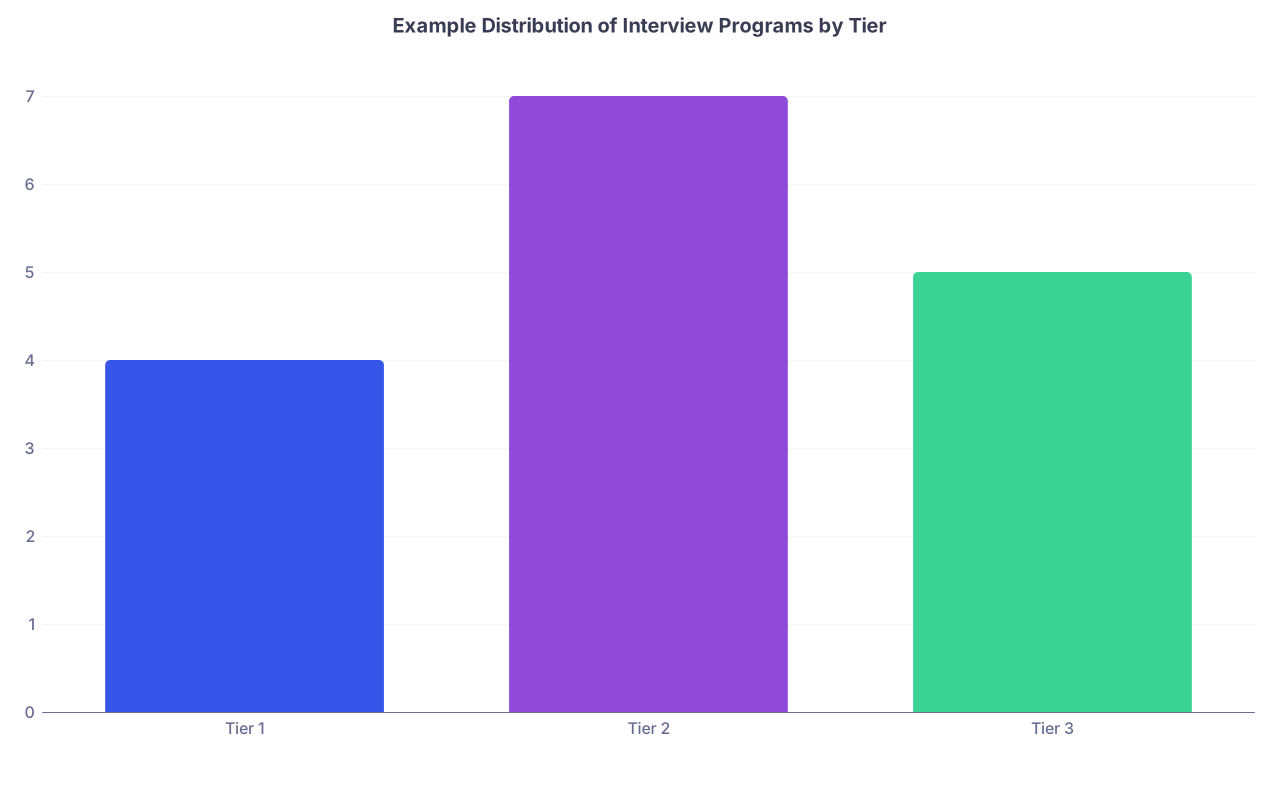
| Category | Value |
|---|---|
| Tier 1 | 4 |
| Tier 2 | 7 |
| Tier 3 | 5 |
Rules:
- You may rank all Tier 1 programs at the top in honest order, even if they are more academic or more community than you “think” you want. That is the point of a preference-based match.
- But make sure:
- You are not stacking 6 ultra-reach academic powerhouses at the top if your application profile is marginal and you only have 2–3 true safety/community programs.
- You are not burying all your decent hybrid/academic options because you got spooked about work hours.
A healthy final list usually looks like:
- Top: 1–4 programs you honestly love (regardless of type), in true preference order
- Middle: Majority of realistic hybrid / solid programs sorted by your scoring
- Bottom: Backup programs you would accept if needed, ordered by your criteria, not despair
Do not play “strategy games” like dropping a higher preference academic program below a community one because you “think they will not rank you.” You are almost always wrong about that. Rank based on your actual preference.
Step 11: Translate Analysis into a Clean, Final Rank Order
At some point, you must stop tweaking.
Here is the hard cutoff protocol:
- Lock the scoring sheet. No more rescoring unless you discover new factual information.
- For each adjacent pair on your provisional list, ask:
- “If both called me today with an offer, which would I accept?”
- If the answer consistently opposes your current order, swap them and move on.
- Stop after one full pass where you make no changes.
Then:
- Move on emotionally. You did the work.
- Do not let last-minute gossip from forums or classmates push you into chaos.
- If you feel the urge to change your list based on rumor, write down the reason. If it is not a new, concrete fact, do not touch the list.
Step 12: If You Are Still Tortured, Run the 5-Year Test
Last filter. Very effective when you are paralyzed between “more academic” and “more community.”
For each of your top 5 programs, answer:
- In five years, if I end up:
- As a generalist in a decent job, not academic, not fancy, but competent and not burned out,
- Would I feel okay that I went to this program?
- In five years, if I end up:
- In a fellowship or niche I like, but the path was rough and cost me a ton of personal life,
- Would I still say it was worth training where I did?
If for a given program:
- You would regret choosing it if your career landed on either outcome (generalist or academic), that program does not belong high on your list.
- Your top 3–5 should be places where at least one of those 5-year scenarios feels genuinely acceptable, not like a failure condition.
What You Should Do Today
Do not think about your entire list right now. That is how you end up doom-scrolling spreadsheets at 2 a.m.
Do this instead:
- Write down your top 6 criteria and assign weights that reflect your actual priorities.
- Pick three programs you are most unsure about (e.g., one academic, one hybrid, one community).
- Score those three programs honestly using your framework.
You will learn more about your true preferences from those three scores than from another week of “I do not know, maybe I am academic?” spiraling.
Open your notes, pick those three programs, and start scoring them. If your system works on the tough cases, it will work on the whole list.


