

Most applicants get the location vs training question exactly backwards—and they pay for it for years.
They treat location as a “nice to have” and training quality as some vague prestige glow. Then they end up miserable in a city they hate, at a program that looked shiny on paper but does not actually train them well for what they want.
Let me fix that.
This is a practical, step‑by‑step framework to rank residency programs when you care about both:
- Where you live
- How good your training actually is
Not vibes. Not reputation gossip. A system you can defend to yourself ten years from now.
Step 1: Decide Your Non‑Negotiables Up Front
If you skip this and jump straight to shuffling programs around, you will build a weak list that collapses under stress (like after a bad interview or a pushy mentor comment).
You need hard lines. Before you touch your spreadsheet.
1. Define your “Red Line” Location Rules
Write these down. Not in your head.
Examples of hard location rules:
- “I must be within 1 hour of my partner’s job.”
- “I will not live in a city with winter temperatures consistently below X.”
- “I must be within a 3‑hour drive of my kids’ grandparents.”
- “I will not live in a state with X legal or political environment.”
- “I will not live in a city where median rent for a 1‑bedroom exceeds Y.”
If a program breaks a red line, it goes off the rank list. Not “lower.” Gone.
You are not being picky. You are being honest.
2. Define Your “Red Line” Training Rules
Same idea, but for your future as a physician.
Common hard training rules:
- “I must match into a program with an established fellowship in my target field (cards, GI, heme/onc, etc.).”
- “I will not go to a program with consistently poor board pass rates.”
- “I need a program with at least X number of residents per class (I do not want an ultra‑small program).”
- “I refuse 24+ hour call every 3rd night for all 3 years.”
- “I will not attend a program on probation or with major recent ACGME citations.”
Again: if a program violates a red line, remove it. You will not magically become okay with it on Match Day.
Step 2: Translate “Location” and “Training Quality” Into Measurable Pieces
You cannot rank accurately if your categories are fuzzy. “Good location” and “strong training” are useless phrases. Break them down.
1. Break Down Location into Real Factors
Location is not just “city vs rural.” It is:
Proximity to support system
- Drive or flight time to family / partner / key people
- Number of direct flights if relevant
Cost of living
- Rent vs salary
- Parking costs, commuting costs
- Childcare availability and price
Lifestyle fit
- City size and density you actually tolerate
- Outdoor vs indoor hobbies (mountains, ocean, nightlife, restaurants)
- Crime and safety profile near housing and hospital
Partner / family constraints
- Job market in their field
- School systems if you have (or will have) kids
Pick 3–5 location sub‑factors that truly matter to you. Ignore the rest.
2. Break Down Training Quality into Real Factors
Forget “Top 10” list nonsense. You care about how you will train for the career you actually want.
Strong training usually boils down to:
Case volume and acuity
- Do you see enough bread‑and‑butter? Enough sick patients?
- Does the ED divert constantly or actually keep high‑acuity cases?
Autonomy and graduated responsibility
- Do seniors run codes and ICU decisions?
- Are attendings micromanaging everything or letting residents truly lead?
Board pass rates and in‑training exam performance
- Multi‑year track record, not one fluke year
Fellowship and job placement
- For competitive fellowships: do graduates match where you would like to be?
- For primary care / hospitalist: are graduates landing jobs they like quickly?
Teaching culture
- Regular didactics protected?
- Attendings known for teaching vs “service only” mentality
Program stability and leadership
- Frequent PD turnover is a red flag
- Recently lost major hospital / merged in a chaotic way?
Again: pick 4–6 that matter most for your specialty and goals.
Step 3: Assign Weights—And Be Honest About Your Priorities
Here is where most people cheat. They say, “Training is more important than location,” then stare at Zillow for 3 hours and bump all the coastal programs up.
Stop pretending. Your preferences already exist. You are just deciding to quantify them.
1. Decide Global Weights: Location vs Training
You need a top‑level split. Example:
- 50% Location, 50% Training
- 40% Location, 60% Training
- 30% Location, 70% Training
If you are single, mobile, and hyper‑career‑driven, 30/70 might be right.
If you have a spouse, two kids, and a mortgage, 60/40 may be more honest.
Pick numbers that reflect where you actually will be happiest and functional. Not where you think you “should” be.
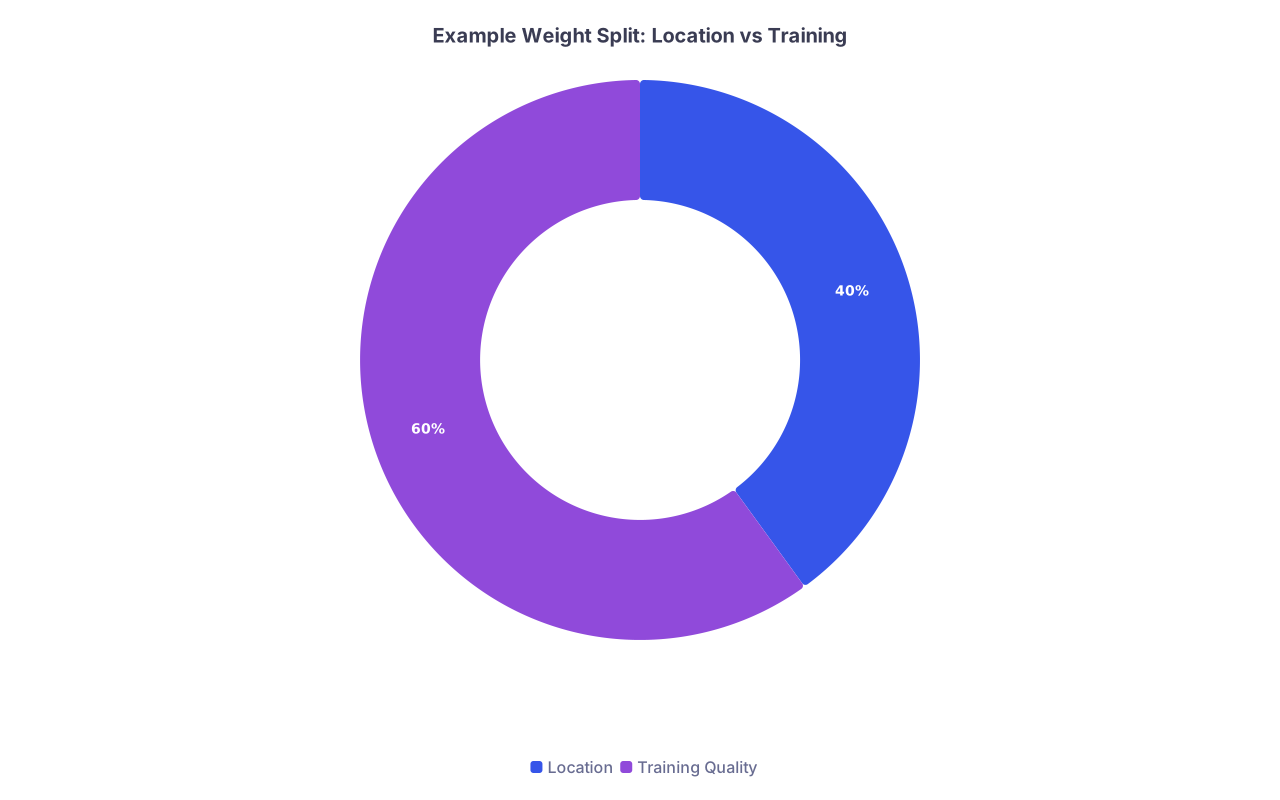
| Category | Value |
|---|---|
| Location | 40 |
| Training Quality | 60 |
2. Weight the Sub‑Factors Inside Each Category
Now split each side. Example for someone moderately family‑centered, applying to Internal Medicine:
Location (40% of total):
- Proximity to partner/family – 15%
- Cost of living – 10%
- Lifestyle fit (city size, outdoors, culture) – 10%
- Partner job market – 5%
Training (60% of total):
- Fellowship placement in cards / GI / heme‑onc – 20%
- Case volume and acuity – 15%
- Autonomy and responsibility – 10%
- Board pass rates – 5%
- Teaching culture – 10%
Do this once, thoughtfully. Then leave it alone. Do not move weights later to rationalize a favorite program.
Step 4: Build a Simple Scoring System (That You Will Actually Use)
You are going to score each program on each sub‑factor. Keep it simple or you will never finish.
1. Use a 1–5 Scale, Not 1–10
Five points is enough resolution. Ten is fake precision.
Quick rubric:
- 1 = Actively bad / concerning
- 2 = Below average
- 3 = Fine / acceptable
- 4 = Strong
- 5 = Exceptional or near ideal for you
Where do the numbers come from?
- Program websites (yes, with skepticism)
- FREIDA and ACGME data
- Current residents (email, Zoom, post‑interview socials)
- Alumni from your school who are there now
- Your own interview experience
Do not overthink 0.2 differences. This is about broad tiers.
2. Use a Simple Spreadsheet
You do not need a fancy app. Use sheets (Google, Excel, whatever).
Columns:
- Program name
- City / State
- For each sub‑factor: score from 1–5
- Calculated weighted scores
- Total composite score
Conceptually:
Total score =
(sum of [Location sub‑score × its weight]) +
(sum of [Training sub‑score × its weight])
Where weights are decimals that add up to 1 (e.g., 0.40 for location overall).
| Factor | Weight | Program A Score | Program B Score |
|---|---|---|---|
| Proximity to family | 0.15 | 5 | 2 |
| Cost of living | 0.10 | 4 | 2 |
| Lifestyle fit | 0.10 | 3 | 5 |
| Partner job market | 0.05 | 4 | 3 |
| Fellowship placement | 0.20 | 3 | 5 |
| Case volume / acuity | 0.15 | 4 | 4 |
| Autonomy | 0.10 | 3 | 4 |
| Board pass rate | 0.05 | 4 | 4 |
| Teaching culture | 0.10 | 3 | 5 |
You can then multiply and sum to get a total for A and B.
Step 5: Do a First Pass—Then Reality‑Check Your Emotions
Once you have scores, sort by total. That gives you a “cold” rank list.
You will look at it and think, “That cannot be right.” Good. That means your emotions are surfacing. Time to deliberately deal with them instead of pretending they do not exist.
1. Identify Programs Where Your Gut Strongly Disagrees
Mark three categories:
- “Feels too high”
- “Feels too low”
- “Feels right”
Then ask: is this because of:
- Prestige / name bias?
- One intense interview experience (good or bad)?
- Pressure from someone (mentor, partner, PD)?
- A factor you forgot to include in the framework?
If you repeatedly feel that “academic culture” or “resident happiness” is missing, then explicitly add those as sub‑factors and rescore.
You are not a robot. You are refining your model.
2. Decide What Emotional Overrides You Will Allow
I am going to say something most PDs will not: it is acceptable to override the numbers. Within reason.
Example:
- Your spreadsheet has University X #1 and Community Y #2, but your partner can only work near Community Y, and your interviews there felt like home.
- The numbers have them very close. You put Community Y #1 anyway. Fine.
Where I get concerned:
- You drop a high‑scoring program 8 spots because you had one awkward pre‑interview dinner.
- You bump a program way up just because it is in a coastal city you romanticize but have never actually visited in winter.
Override sparingly. And document to yourself why.
Step 6: Use Scenario Testing—“If I Match Here, Then What?”
This is the part people skip, and it is why they are shocked on Match Day. They never actually walked through life at each program.
Use some mental simulation. Systematically.
1. Run Three Life Scenarios for Your Top 10–15
For each program in your top 10–15, do this:
Scenario A: Typical Day in PGY‑2
- Wake‑up time?
- Commute? Cost and difficulty of parking / transit?
- What does your inpatient day look like—types of patients, autonomy, call?
- When do you get home? What do you realistically do after work?
Scenario B: Worst Month of the Year
- ICU with nights. Or wards with q4 call.
- What does that look like in this city?
- Winter snow and 40‑minute white‑knuckle commute?
- Walking home at midnight in a marginally safe neighborhood?
- Partner alone with newborn all month with no family around?
Scenario C: End of Training
- What is your CV after this program?
- Are you competitive for your desired fellowship or job market?
- Where do their graduates end up geographically? Could you move back “home” if you want?
If you do this honestly, certain programs will suddenly jump out as obviously wrong for you even if the score was decent.
Step 7: Adjust for Specialty‑Specific Realities
Location vs training is not the same fight in every specialty. The trade‑offs shift.
1. Competitive Subspecialty Path (Derm, Ortho, ENT, Plastics, etc.)
If you are in a hyper‑competitive specialty:
- Training quality and program reputation carry more weight.
- Location still matters for burnout and survival, but you cannot pretend a tiny unknown program gives you the same odds.
For these:
- Heavier weight on:
- Case volume in core procedures
- Operative autonomy for seniors
- Fellowship / job placement in your desired niche
- National reputation among fellowship PDs
Location still counts, but maybe 30–40% of your total, not 60%.
2. Primary Care / Hospitalist Track
If you want to be a strong clinician and then work in your preferred region:
- Training quality must still be solid (you do not want to feel underprepared).
- But location and long‑term geographic ties start to matter more. Many community jobs hire heavily from local residency programs.
For these:
- Heavier weight on:
- Where graduates practice (same state or region?)
- Community reputation of the program
- Your own long‑term desire to stay in that city or region
Location may reasonably be 50–60% of your weighting.
Step 8: Do a Reality Check Against Your Long‑Term Geographic Goals
The residency location vs training question is not just about 3–7 years. It is about where you are likely to end up after.
Programs are pipes. They spill graduates into specific markets.
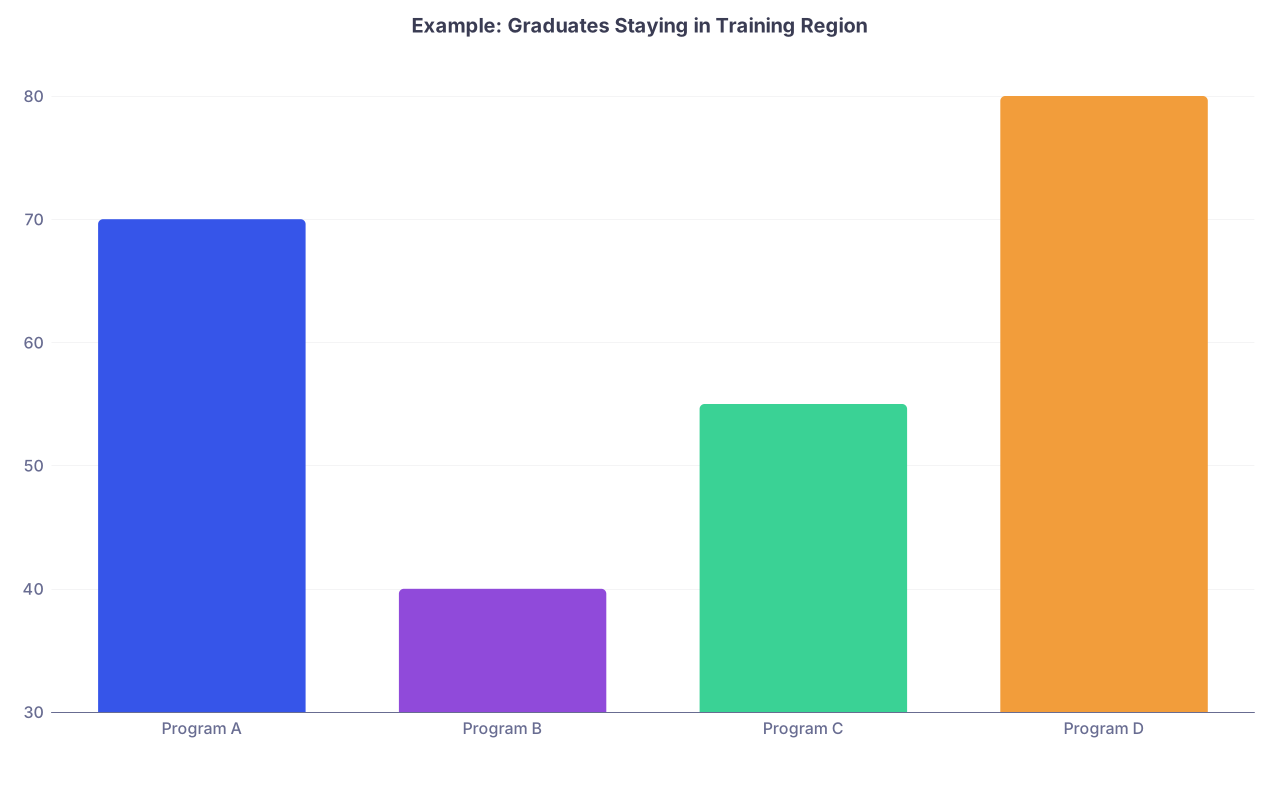
| Category | Value |
|---|---|
| Program A | 70 |
| Program B | 40 |
| Program C | 55 |
| Program D | 80 |
If 70–80% of graduates from a program stay in that region:
- Good if that is where you want to build a life.
- Bad if you are dead set on leaving that region and have no ties elsewhere.
Ask current residents:
- “Where do most people end up after residency?”
- “Do people struggle to leave this region if they want to?”
A “less desirable” city for residency may be a great career move if your goal is to settle near that city long‑term and the program is well connected locally.
The reverse is also true:
- That shiny coastal city program might launch most grads into jobs that require you to stay in that expensive metropolis forever.
Step 9: Protect Yourself from Common Ranking Traps
I have watched applicants blow up good lists for dumb reasons. Avoid these:
1. Prestige Over Function
Signs you are falling for name brand over reality:
- You are ranking a “big name” academic center high even though residents looked miserable and graduates quietly told you they would not choose it again.
- You dismiss a mid‑tier program with incredible fellowship placement and happy residents because “nobody at my school talks about it.”
Ask yourself:
“Would I still want this program if it were in a generic city with a generic name?”
If the answer is no, you are chasing prestige, not training.
2. Pure Vibes
I like gut feelings. But not when they are based on:
- One particularly funny resident on interview day
- Free Patagonia swag
- An impressive new hospital building with bad teaching inside
Force yourself to point to specific training or location factors if you want to move a program significantly.
3. Family / Friends Overreach
Yes, proximity to loved ones matters. But:
- If you choose a program with weak training just to be closest to home, you may regret it when you struggle with boards or feel underprepared.
- Conversely, if you ignore all family needs and plant yourself in a location that isolates you and your partner, burnout will catch you.
The framework is there to balance this. Do not let one loud relative blow up your weighting.
Step 10: When Location and Training Are Tied—How to Break the Tie
Sometimes you will have two programs with nearly identical scores. One is better location, one is better training. You need a tie‑breaker protocol.
Use this sequence:
Look at your worst‑month scenario.
Where would you rather be in your hardest month?Look at exit options.
Which program clearly opens more doors for what you want 5–10 years out?Ask: “If I matched here, would I be secretly disappointed?”
If you would quietly be bummed for days, that program goes lower.Consider risk tolerance.
- If you are more risk‑averse: favor the program with surer career outcomes.
- If you are more quality‑of‑life oriented: favor the better location with “good enough” training.
Flip it mentally.
Imagine you must put Program X above Program Y. Does that feel like a relief or like a loss? Your reaction tells you a lot.
Putting It All Together: A Simple Workflow
Here is how I would actually do this in practice.

| Step | Description |
|---|---|
| Step 1 | Set red-line rules |
| Step 2 | Define sub-factors |
| Step 3 | Assign weights |
| Step 4 | Score programs 1-5 |
| Step 5 | Calculate totals & sort |
| Step 6 | Gut check & adjust factors |
| Step 7 | Scenario test top 10-15 |
| Step 8 | Minor emotional overrides |
| Step 9 | Finalize NRMP rank list |
Concrete weekly plan (assuming you are post‑interview):
Day 1–2
- Write your red lines.
- Choose sub‑factors and weights. Build the spreadsheet template.
Day 3–5
- Fill in data and scores for all programs.
- Sort and get your first numeric order.
Day 6–7
- Gut‑check. Add any missing sub‑factors like “resident morale.”
- Scenario test your top 10–15. Adjust scores if needed.
Week 2
- Identify 2–3 programs you are truly conflicted about.
- Talk to an honest mentor or resident there.
- Apply your tie‑breaking sequence.
Final 3–5 days before certification
- Leave the list alone for 48 hours.
- Re‑read it once with your long‑term life in mind.
- Certify and walk away.
The Bottom Line
Balancing location vs training quality is not mystical. It is a structured value judgment.
If you remember nothing else, keep this:
- Decide your non‑negotiables early and delete programs that violate them. Do not bargain with red lines.
- Turn “location” and “training” into specific, weighted factors, score everything, then let your numbers and your honest gut refine each other.
- Use worst‑month and end‑of‑training scenarios to choose between close calls. You are ranking how your life will actually look, not just where the hospital is on a map.


