
It's 3:07 a.m. You've been paged three times in four minutes. One nurse wants PRN pain meds clarified. Another patient's potassium came back at 2.9. Someone in 8 West is suddenly hypotensive, and the senior is tied up in a rapid response. Your census has changed twice since sign-out. You're trying to remember whether you already called the cross-cover consult, whether that repeat troponin was due at 2 or 4, and whether the patient with cirrhosis needed lactulose now or after the abdominal film.
This is the moment applicants imagine, and honestly, they're not wrong to imagine it. Because this is where intern fear lives: not in big dramatic incompetence, but in one tiny missed task that snowballs. One forgotten lab. One order placed late. One handoff detail that falls through the crack because your brain, very reasonably, stops being a perfect machine at 3 a.m.
So the question gets painfully practical. If your memory fails, and it will, because you are human, what actually keeps patients safer: a paper pocket card or a task app?
My answer is not cute. Pocket cards and task apps protect against different kinds of mistakes. Paper helps when you need instant recall and zero friction. Apps help when the problem isn't knowledge, it's follow-through. If you're asking which one saves you when the night starts to unravel, the real answer is the one that catches your most likely failure mode before the patient pays for it.
What Paper Pocket Cards Do Well, and Where They Can Fail You
I get why paper feels comforting. I really do. There's something deeply stabilizing about reaching into your pocket and feeling an actual card there. No battery. No lock screen. No hospital Wi-Fi tantrum. No app update nonsense. Just the thing you need, right now, in your hand.
That matters more than people admit. In chaotic moments, friction is dangerous. If you need to remember ACLS medication timing, how your program likes you to structure a septic shock callback, what to say when you page a consultant at 2 a.m., or the threshold that should make you escalate a sodium trend instead of "just watching it," a good pocket card is fast. Brutally fast. Faster than opening three apps and pretending you're being efficient.
Paper is also good for memory anchors. Not full textbooks. Anchors. The tiny things that stop panic from erasing what you already know. A card that says "hypoxia: check probe, oxygen delivery, waveform, exam, CXR/ABG if needed, call early if worsening" can be enough to keep you from spinning in place. Same with insulin correction reminders, pressor basics, anticoag reversal prompts, transfusion thresholds your service actually uses, or the exact wording of your admission handoff script.
And paper keeps working when systems fail. During EMR slowness. During phone battery death. During the bizarre moments when you're in a stairwell, on hold with radiology, balancing a pager against your shoulder, and all you need is the one dose range you swear you knew yesterday.
But paper has ugly failure modes, and pretending otherwise is dumb. Pocket cards get gross, lost, outdated, and overstuffed. I've seen interns carry six cards clipped together like some kind of sacred talisman, none of which they can actually read under pressure. Tiny handwriting. Coffee stains. Old antibiotic guidance from July still being trusted in February. A white coat swap and suddenly the card with all your numbers is in yesterday's laundry pile. Great. Very reassuring.
The other problem is density. Nervous people, my people, love to overprepare. We tell ourselves we'll make one perfect master card with every electrolyte replacement rule, every code dose, every vent alarm response, every phone number, every overnight contingency. That card becomes unreadable by design. If it contains everything, it helps with nothing.
So use paper for what paper is good at: short emergency algorithms, favorite medication dose reminders you commonly blank on, call scripts, escalation triggers, and must-not-forget routines. Keep it lean enough that your eye can find what it needs in two seconds. If it takes longer than that, you built a pocket panic attack, not a safety tool.
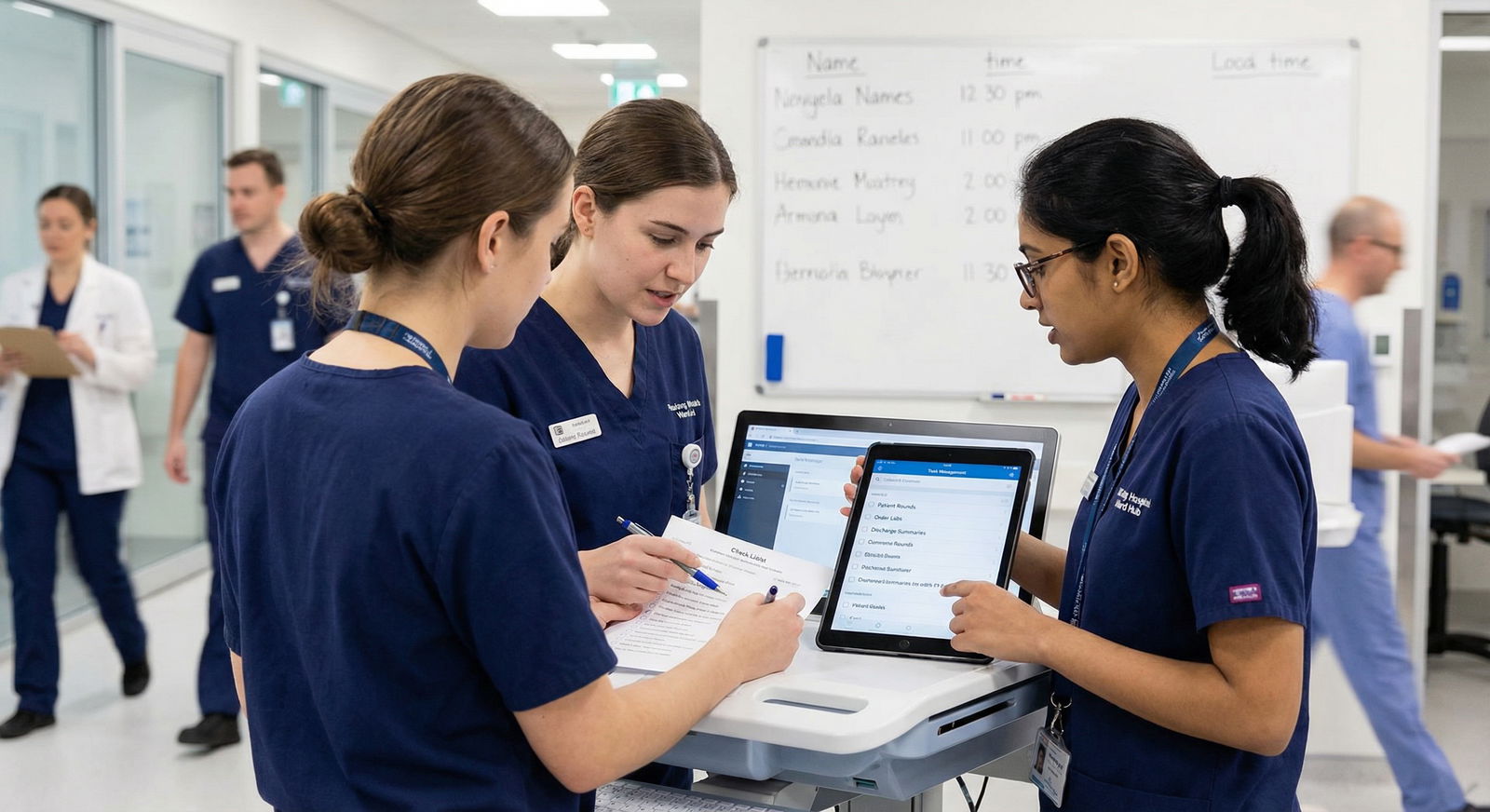
What Task Apps Do Well, and Where They Can Fail You
Task apps solve a different problem. They're not mainly about recall. They're about not dropping the ball after being interrupted twelve times.
That is a huge deal in residency. Most intern errors aren't "I had zero idea what to do." They're "I knew exactly what to do, then I got paged away, then two more things happened, and the original task died somewhere in the fog." That's where apps are better than paper. They let you capture a task immediately, time-stamp it, assign urgency, set a due time, reorder priorities, and mark actual completion. That's not just feeling organized. That's reducing mental load in a system designed to shatter your attention span.
A good task app gives your brain somewhere safe to put unfinished business. Repeat CBC at 0500. Recheck blood sugar after dextrose. Follow up CT read. Call back nephrology if urine output stays low. Confirm whether the family meeting was moved. These are exactly the kinds of things people forget when the shift turns ugly. Not because they're lazy. Because human working memory is tiny, and internship punishes overconfidence.
Apps also help after interruptions, which is where interns really get hurt. You're halfway through placing orders, then a nurse stops you, then your senior asks for an update, then another page comes in, and suddenly you can't remember whether "magnesium repletion" was done, half-done, or only thought about. A task app creates breadcrumbs. That matters. A lot.
And for teams, apps can be excellent, if your institution allows them and if they're being used correctly. Shared visibility helps handoffs. A cross-cover list that clearly shows what's pending is safer than vague verbal memory. A visible task queue can reduce duplicate work and stop the classic disaster of everyone assuming someone else called the consult.
But here's the anxious truth: apps have their own lies. The checkbox can become a false god. Just because you tapped something doesn't mean it happened, happened correctly, or happened soon enough. "Done" is not the same as "verified." I've seen this go bad. Lab was "followed up" but never acted on. Consult was "called" but no one answered and nobody looped back. Medication was "ordered" but not actually released or administered. Digital systems are very good at giving the illusion of closure.
Then there's the practical mess. Battery drain. Notification overload. App switching. Bad interfaces. Phone restrictions. Hospital policy. And the big one: patient privacy. If your hospital doesn't allow protected health information in personal apps or devices, then don't do it. Full stop. No clever workaround. No "but I'll delete it later." That's not rebellion. That's stupidity with consequences.
Even without privacy issues, too many alerts can make you numb. Once every task is "urgent," nothing is. Once your phone becomes a buzzing guilt machine, you stop trusting it. Then the app becomes one more thing you avoid checking because you're scared of what you forgot. I wish that sounded dramatic. It doesn't. It sounds like residency.
So yes, task apps can make interns safer. But only if you use one system consistently, enter tasks immediately, check it at deliberate points, and verify closure in the chart or with the team. Otherwise it's just polished chaos.
Which Keeps Interns Safer in Real Life? It Depends on the Failure Mode
Here's my blunt answer: if your main problem is "I can't remember the right dose, threshold, or emergency sequence under pressure," paper is safer. If your main problem is "I know what to do but I lose track of unfinished tasks," the app is safer.
That's why this debate gets weirdly unhelpful. People talk as if one tool should do both jobs. It shouldn't. And when you force it, you create new risks.
Pocket cards are best for knowledge recall. Think dosing ranges you commonly need, overnight escalation criteria, hyperkalemia steps, handoff prompts, quick code pearls, and the phone numbers or pager formats you never remember when you're stressed. They are excellent for reducing the kind of panic that makes your brain go blank. They are not excellent at dynamic tracking across a ten-hour shift with shifting priorities.
Task apps are best for execution and follow-through. They shine when you need to remember that the blood culture was ordered but not yet drawn, the repeat lactate is pending, the Foley was supposed to come out at 6, the family update still hasn't happened, and the patient with chest pain needs a second troponin review before sign-out. That's not reference material. That's operational control.
Look at common intern failure modes and the answer gets clearer.
Missed med dosing? Pocket card helps more. The danger there is recall failure or hesitation.
Forgotten labs? App helps more. The danger is interruption and follow-up failure.
Delayed consults? Usually app. Because the issue is often task capture and closure, not knowing that the consult should happen.
Incomplete sign-outs? Both matter. Pocket cards can give you a handoff structure; apps can show what's still active and unresolved.
Overload from too many simultaneous responsibilities? App wins for tracking, paper wins for calming recall pressure. That's exactly why the hybrid strategy is the most honest answer.
I strongly favor hybrid systems for interns. Not because I love complexity. I hate complexity. I favor hybrid because a lean paper card plus a lean task app covers two different error types without asking one tool to do something it's bad at.
The key word is lean.
Your paper card should be static or slowly changing reference. Things you need often. Things you might blank on. Things that matter immediately. Your app should be active tasks only. Things that need action, follow-up, documentation, or handoff. If you start putting full references in the app and every task on the card, you've built duplication, and duplication breeds doubt. "Wait, did I mark it there? Did I write it here? Which one is current?" That's how anxious systems mutate into unsafe systems.
Rotation matters too. ICU nights may justify more immediate-reference support and tighter task tracking because interruption density is brutal. Ward months with stable workflows may let you keep things simpler. Surgical services, night float, cross-cover heavy rotations, and services with constant page churn all increase the value of a robust task-capture tool. Meanwhile, rotations where device use is awkward, restricted, or culturally frowned upon may push you toward paper plus an approved sign-out workflow.
Service culture matters more than applicants realize. Some teams live in shared digital task lists. Others run on printed lists, whiteboards, and direct verbal updates. Fighting the workflow just to prove you have a personal system is usually a bad idea. You want your safety system to fit the environment, not duel with it.
And device access rules are non-negotiable. If your hospital has strict rules about phones or patient information, follow them exactly. There is no "but this app makes me feel safer" exception to privacy policy. Use approved tools. If that means your app only contains non-identifying reminders like "follow K at 0400" without patient details, then that's what you do.
The safest real-life setup for most interns is simple: a tiny paper reference for immediate recall, one approved task system for active work, and a specific moment-based habit for review. After every page. Before leaving a patient room. Before sign-out. Before sitting down, if you've been interrupted three times. Not glamorous. Very safe.
How to Use Both Without Creating More Anxiety
This is the part people mess up. They build a "system" so elaborate it becomes a second job. Don't do that. Your organizational method should not require organizational management.
Use one capture step, one assignment step, and one verification step.
If a task comes in, capture it immediately in your active task system. Once. If your app is the task system, put it there. Don't also scatter it across sticky notes, the patient list margin, your hand, and your soul. Then decide urgency once. Sick now, needs follow-up later, or can wait until daylight. Then verify completion once, by checking the chart, confirming with the nurse, seeing the result, or handing it off clearly.
Your pocket card should stay boring. That's a compliment. Keep only the things you use repeatedly and reliably: emergency algorithms you actually reference, a few threshold values, maybe key phone numbers, maybe a call script. Not twenty-seven rare scenarios you read about on Reddit and now fear irrationally. Residency already gives you enough to fear rationally.
Your app should also stay boring. One task list. Clear due times. If color-coding helps, fine, red now, yellow soon, blue before sign-out. But if you need five categories, custom tags, nested projects, and a philosophical taxonomy of pending actions, you've lost the plot. You are not running a startup. You are trying not to miss a repeat sodium.
Build in a daily reset. At sign-out, clear completed items, hand off unresolved ones explicitly, and start fresh enough that yesterday's debris doesn't poison tomorrow's attention. This is where many interns suffer silently: the list becomes a graveyard of half-relevant reminders, and then every glance at it triggers guilt instead of action.
And don't worship either tool. Pocket cards do not replace judgment. If the patient looks bad, look at the patient, call for help, and escalate. Don't hide behind a checklist. Apps do not replace communication. If the consultant needs to know now, you call now. If the order is urgent, you confirm it happened. If the nurse told you something concerning, you don't just create a cute reminder about it.
The whole point is to lower cognitive load so you can think more clearly. Not to create a private bureaucracy that keeps you busy while risk accumulates at the bedside.

Closing Reminder: Safety Comes From the System You Actually Use
The safest tool isn't the trendiest one. It's the one that matches the job, survives your worst shift, and still gets checked when you're tired and rattled.
Paper pocket cards reduce recall pressure. Task apps reduce follow-through failures. Together, they do something even more valuable: they reduce that awful background fear that you're one interruption away from forgetting something important.
You are not supposed to carry an entire hospital in your head. No good intern does. Good interns build routines that catch them when memory slips, fatigue hits, and the night gets messy. That's not weakness. That's professionalism.
So no, the goal isn't flawless memory. It never was. The goal is a reliable system that helps you remember what matters, do what's next, and catch mistakes before the patient pays for them.