
Your co-residents already think you’re disorganized way less than you think they do.
That’s the part nobody tells you when you’re spiraling because your sign-out was messy, you forgot to pend a discharge, and the senior had to remind you—again—to check overnight labs. In your head, it’s: “They all know I’m the weak link.” In their head, it’s usually: “Yeah, they’re a bit scattered, but they care and they’re learning.”
Those are very different realities.
Let me be blunt: residency is built to make organized people feel disorganized. Constant interruptions, pager going off mid-note, two attendings wanting two different things, the EMR freezing right when you’re trying to reconcile meds. Of course you drop balls. That’s not a character flaw. That’s the job.
But. There are quiet, un-flashy ways to tighten things up so you stop lying awake replaying every little mistake and wondering who’s talking about you.
Let’s go there.
First: Your Worst-Case Scenario Brain Is Lying To You
You know that voice: “They think I’m lazy. They don’t trust me. They’re rolling their eyes the second I leave the room.”
I’ve watched interns with color-coded lists, post-its, and alarm reminders still whisper to me that they’re “the disorganized one.” Meanwhile, everyone else describes them as “on top of it” and “really conscientious.” The internal narrative is almost always harsher than the external reality.
Here’s the ugly secret: most residents only really judge disorganization when it crosses into one of three zones:
- Unreliable follow-through – saying you’ll do something, then repeatedly not doing it
- Messy sign-out that creates more work – dumping chaos on nights or the next shift
- No insight – acting like the mess is fine or blaming everyone else
If you care, if you’re trying, and if you’re even asking “Do they think I’m disorganized?” you’re likely already not in that third category.
But anxiety doesn’t care about logic. So instead of arguing with your brain, let’s give it evidence: small, visible habits that signal, “This person is organized and improving,” even when you still feel like you’re paddling underwater.
The One Rule That Changes Everything: Write It Down Immediately
You cannot “just remember” things in residency. That’s cute for undergrad. In the hospital, it’s clinical self-sabotage.
Anything that comes out of someone’s mouth that implies you need to do something goes somewhere written within seconds. Not later. Not after this note. Right now.
“Can you reorder the CT with contrast?”
“Please call the daughter back.”
“Follow this lactate in two hours.”
“Check troponin trend before discharge.”
If it’s not written, it’s already half-forgotten.
And yes, I know the usual resistance:
- “It feels awkward to pause and write in front of people.”
- “I’ll remember this one, it’s simple.”
- “The attending is talking fast, I’ll catch it all and write it later.”
No. That’s the trap. I’ve seen so many “I’ll remember this one” tasks come back as 3 a.m. panic: “Oh my god, I never called that family.”
Pick a system. Any system. Then stick to it for a week before you judge it.
Here are a few that actually work in real life, not just in productivity blogs:
| System | Where It Lives | Best For |
|---|---|---|
| Pocket list | Small notebook | Rounds & quick tasks |
| EMR task note | Protected note | Follow-up labs, imaging |
| Phone app | To-do app / notes | Call-backs, reminders |
| Index cards | One per patient | Cross-cover & nights |
| Whiteboard | Workroom board | Team-shared priorities |
The “quiet fix” here is not perfection. It’s being seen writing things down and then closing the loop.
You know what seniors and attendings interpret that as? “They’re taking this seriously. They’re learning.”
You know what they interpret as disorganized? “Yeah, I’ll do it” and then no movement, no note, no update.
Your Sign-Out Is Probably The Loudest Signal You’re Sending
If there’s one thing that broadcasts “disorganized” louder than anything else, it’s a chaotic sign-out.
Not a single late note. Not a missed lab. The moment when you hand your patients to another human and they either think, “Okay, I’ve got this,” or “What the hell is going on with any of these people?”
And the painful part? You can be clinically strong and still sound like a disaster at sign-out.
Quiet fix: treat sign-out as its own skill, not an afterthought.
Think about what you crave when you’re receiving patients on night float:
- What absolutely cannot be missed?
- What will blow up at 2 a.m. if no one is watching?
- What’s the actual plan vs what’s just random background?
You don’t need a perfect template, but have a skeleton. Something like:
- One-liner: who is this human and why are they here?
- Today’s big events: what actually changed?
- Active issues: top 2–3 things that need watching
- If-then: what to do if X happens (pain, BP, fever, etc.)
And then the magic: before sign-out, you quickly scan your list and mark the actual “watch this” items. Literally with a symbol or capital letters or whatever.
So instead of droning, “Patient is a 68-year-old male with CHF, COPD, CKD 3, hypertension, hyperlipidemia, history of MI…,” and losing the night resident by word 7, you say:
“Mr. Jones – 68, CHF exacerbation. Diuresed well today, net -1.5L. Creatinine bumped from 1.2 to 1.5, we backed off evening Lasix. MAIN THING: watch urine output and BMP in the morning. If creatinine >1.8 or he stops peeing, please hold Lasix and page cards.”
That sounds organized even if your desk is a war zone and your notes are late.
It tells people: “They know what matters. They’ve thought ahead.”
That’s what changes reputations.
The “Five-Minute Reset” That Makes You Look Way More Together
You know that sticky, shame-y feeling at 4 p.m. when your list is scribbled on, you have six partially finished notes, and someone asks, “Where are we with Ms. X?” and your brain blanks?
That’s where chaos leaks out. You look scattered, even if you’ve actually done a lot.
Quiet fix: schedule brutal, tiny resets.
Literally set a timer or anchor it to something that always happens (post-rounds, pre-sign-out, post-lunch if that ever exists). Five minutes. No patient care tasks. Just:
- Clean your list
- Rewrite messy patient lines if needed
- Star or underline the true must-finish items
- Cross out the stuff that’s done
- Add any new “I’ll do it later” things that you’ve been trusting your brain with
This feels like you’re wasting time at first. You’re not. You’re clawing back cognitive bandwidth that was being eaten by pure disorganization.
The weird thing: your seniors will often have no idea what changed, but they’ll say things like, “You seem more on top of it this week.” Same you, slightly less chaos leaking into your body language and answers.
When You’ve Already Built The “Disorganized” Reputation
This is the nightmare scenario, right? You know you’ve dropped things. You’ve had the awkward “we need to work on your organization” chat. You’re sure everyone tagged you mentally as “the messy one.”
Here’s the part that might actually help: reputations in residency are built stupidly fast and changed stupidly fast. People are busy. They don’t have time to maintain a detailed mental file on you. They notice patterns that stick out.
So if the pattern shifts—consistently, quietly—they adjust.
You don’t need a big speech. You don’t need to sit everyone down and confess your sins. You need 2–3 visible behaviors that send a new signal, week after week:
The follow-up loop
When someone asks you to do something, don’t just say “okay.” Say, “Got it, I’ll [do X] and let you know when it’s done.” And then you do it and circle back: “Hey, heads up, I called the SNF, they can accept tomorrow.”That one line—“and I’ll let you know when it’s done”—forces you to close the loop, and it makes you look reliable even while you’re rebuilding trust.
The morning “what I’m watching” summary
At the start of rounds or pre-rounds, have 1–2 sentences ready for your sickest patients:
“For Ms. L, today I’m mainly watching her oxygen needs and checking if cultures are back. For Mr. K, I want to see his creatinine after yesterday’s contrast.”You sound focused. Intentional. That alone starts to erase “disorganized” from people’s brains.
Owning a small system—and saying it out loud once
You don’t need to declare you’re changing your life. But something like, “I started rewriting my list midday so I stop losing tasks; it’s helping me keep track,” dropped casually, signals: “I know this was an issue. I’m on it.”
Most seniors are not monsters. They don’t want you to fail. When they see real, consistent effort—especially around organization—they usually soften fast.
Technology: Use It, But Don’t Marry It
Let’s be honest: half of us secretly believe “If I just find the perfect app, I’ll stop being scattered.” Spoiler: you won’t. The app is not the problem.
But tools can help with one thing: remembering what your brain will 100% forget after three pages, a rapid response, and a random vaccine order.
Use simple tech. Not a whole productivity cult.
A few quietly powerful moves:
- Calendar reminders for time-based tasks: “Follow up lactate 16:00,” “Check path results tomorrow 10:00.”
- Alarm for sign-out prep: 30–45 minutes before your shift ends, something that nudges you: “Tidy list now.”
- EMR sticky notes or problem lists for longer-term follow-ups (e.g., “Call oncology when path back,” “Needs TTE before discharge”).
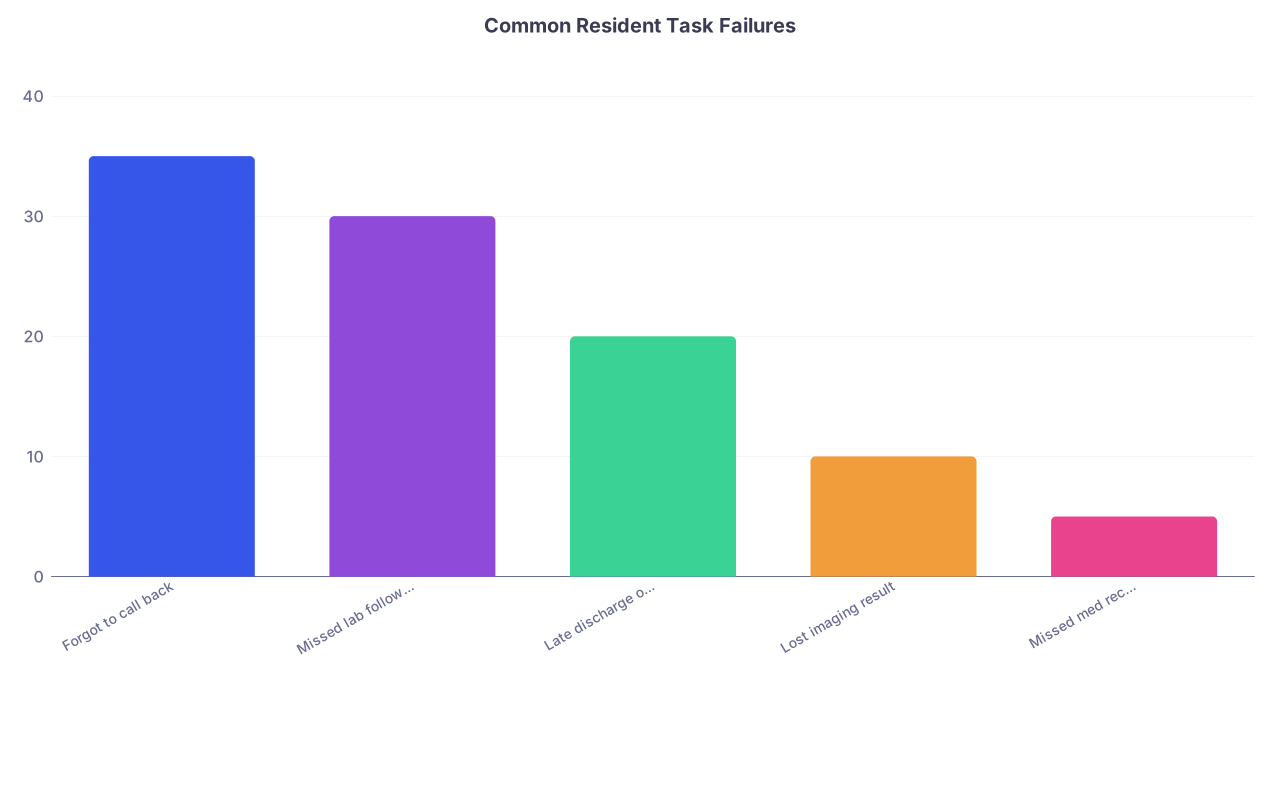
Here’s a tiny, visual reality check:
| Category | Value |
|---|---|
| Forgot to call back | 35 |
| Missed lab follow-up | 30 |
| Late discharge orders | 20 |
| Lost imaging result | 10 |
| Missed med reconciliation | 5 |
Those numbers aren’t “you are uniquely terrible.” They’re “this is what breaks for almost everyone.” You’re not special in your chaos. And that’s… oddly comforting.
Body Language: How You Look Organized Even When You Don’t Feel It
This one sounds shallow but it’s real. If you look like a tornado, people assume your brain is a tornado.
Tiny things shift that impression:
- Hold one thing at a time during rounds: your list and a pen. Not two phones, three papers, a coffee, and your badge lanyard in your mouth.
- When asked a question, pause, look at your list, and then answer. Rushed half-answers feel disorganized even if they’re technically correct.
- If you don’t know, say, “I’m not sure, I’ll check the chart and update you after rounds,” then actually do it. That’s more organized than bluffing.
And yeah, your workspace matters a bit. It doesn’t need to be minimalist Instagram-core. But once a day, shove the trash, random paper, and old lists into the bin. Visual clutter broadcasts internal clutter. You’re exhausted enough without that.
Nights, Cross-Cover, and The Fear Of Being Exposed
Night float or cross-cover is where my own inner “They’re about to discover I’m a mess” voice got loudest. You’re alone-ish, covering 30–60 people, and every page is, “What’s the plan?” and you think, “I have no idea, I just met this person through a screen.”
Quiet fix here: mechanical systems.
One trick that works stupidly well:
- When you’re cross-covering, keep a separate, clean sheet or digital list of “new issues overnight.”
- Every page gets a three-part mini entry: patient name/room, problem, what you did / what needs follow-up. Short, not narrative.
Example:
“Jones 705 – SBP 90s. 1L LR, held evening metoprolol. Needs BP, HR, exam in AM; update primary.”
Then in the morning, you don’t look like, “Uh, things happened, I think?” You look like, “Here are the three overnight issues, here’s what I did, here’s what you need to re-check.”
That alone reads as organized. Even if the rest of your night felt anything but.
When Anxiety About Being Disorganized Is Making You More Disorganized
Here’s the fun paradox: the more you obsess over looking disorganized, the more your brain clogs with shame and what-ifs and imaginary conversations, and the less actual bandwidth you have to track reality.
So then you forget more things. And then your brain says, “See? You are a disaster.”
If you recognize that loop, you don’t need another color-coding scheme. You need to shrink the problem.
Pick one domain to improve this week. Just one.
- This week is about: writing down every task as soon as it’s assigned.
- Next week is about: tightening my sign-out so nights aren’t guessing.
- Week after: doing a 5-minute midday list reset.
That’s it. You’re not redesigning your personality. You’re just tightening one screw at a time.
Residency already gives you 100 ways to feel inadequate. You don’t need to add 50 self-imposed ones.

| Step | Description |
|---|---|
| Step 1 | Start of Day |
| Step 2 | Pre-round list check |
| Step 3 | Write tasks as assigned |
| Step 4 | Midday 5 minute reset |
| Step 5 | Prep focused sign out |
| Step 6 | Review missed tasks |
FAQ (The Stuff You’re Probably Still Worried About)
1. What if I already missed something important and my senior is clearly annoyed? Is my reputation shot?
No, it’s not permanently shot. Be direct without over-apologizing: “I realized I missed following up on X today. I’m building a better system so that doesn’t happen again—right now I’m writing every task in one place and doing a mid-shift check.” Then actually do that. One miss doesn’t define you. Repeated misses with no visible change… that’s what sticks. You still have a lot of runway.
2. How do I organize when I’m literally drowning and don’t have time to breathe, let alone create systems?
The only systems worth anything in residency are the ones that give you time back. Writing tasks immediately, five-minute resets, and pre-sign-out checks feel like “extra,” but they pay you back by preventing the 30-minute scavenger hunts and 3 a.m. “oh no” moments. Think of it like washing your hands—it feels small, you still do it when it’s busy, because the alternative is worse.
3. What if I’m just not an ‘organized person’ by nature? Am I doomed to be the messy resident forever?
No. You don’t have to become Type A. You just need guardrails that protect you from your own tendencies. Plenty of disorganized-by-nature people become safe, effective, well-respected physicians by leaning on checklists, templates, and teammates. The bar isn’t “flawless spreadsheet robot.” It’s “patients are safe, tasks get done, team can rely on you most of the time.”
4. How can I tell if my co-residents actually think I’m disorganized or if it’s just in my head?
Look at behavior, not your anxiety monologue. Are people still asking you to follow up on tasks? Do they trust you with sicker patients sometimes? Do attendings let you run with plans? If yes, they don’t see you as a disaster. If a senior says something like, “We just need you to tighten up your follow-through,” that’s feedback, not a character judgment. You can even ask one trusted co-resident: “I’m working on organization—anything specific you’ve noticed that I could tweak?” Their answer will almost always be more generous than the one in your head.
If you remember nothing else, remember this:
You don’t need to feel organized to look and function organized.
Write things down immediately.
Clean your list once or twice a day.
Make your sign-out focused and intentional.
Those three alone are enough to move you out of the “disorganized” box in most people’s minds—and give your anxious brain a little proof that you’re not the chaos monster it keeps insisting you are.