
You’re 6 hours into night float. It’s 2:17 a.m. You just sat down after a rapid response, your pager is blessedly silent for the first time in three hours, and you’re scrolling through your sign-out list.
And then you see it.
A patient you barely remember from sign-out is now hypotensive. The note you have on them is a single line: “Watch BP, soft earlier.” No meds list. No diagnosis. No last set of vitals. No plan for what “soft” means or when to worry.
You feel that cold drop in your stomach. Because you know: this is how near-misses happen.
Bad handoffs don’t always cause disasters. Most of the time you get away with them. Until you don’t.
This is about not being the person whose sloppy sign-out sets up the next night float resident—or you—for a catastrophe.
The Silent Killer: “Stable, Nothing To Do” Sign-Outs
This is the most common and most dangerous handoff mistake: the lazy “stable, NAD” (no acute distress) sign-out.
You know the ones:
- “Stable. Nothing to do.”
- “Doing fine. Just follow labs.”
- “Chill patient, no issues.”
That’s not a handoff. That’s a liability.
Here’s what actually goes wrong when you do this.
1. You Hide Risk Behind Vague Reassurance
“Stable” at 4 p.m. does not mean “safe” at 3 a.m.
Examples I’ve seen:
- The “stable” 78-year-old on high-flow nasal cannula at 50 L, FiO2 80%. No desats… yet.
- The “doing fine” DKA patient whose gap is “almost closed” but hasn’t eaten in 24 hours and is still on an insulin drip.
- The “NAD” cirrhotic with a MELD of 30 and sodium of 121.
If your sign-out doesn’t tell the night float:
- Why this person is admitted
- What you’re worried might happen
- Where they are on the “about to crash vs actually fine” spectrum
…you’re just hoping the night intern can read your mind.
Do not write “stable” as a diagnosis.
2. You Skip the “If/Then” that Actually Prevents Near-Misses
Most night float disasters are not exotic. They’re basic “nobody told me what to do when X happens.”
Your sign-out should always include at least one actionable contingency for medium- or high-risk patients:
- “If SBP < 90 despite 1 L LR, page me or call ICU.”
- “If HR > 130 sustained and febrile, send lactate, blood cultures, start broad-spectrum per sepsis protocol.”
- “If new chest pain, EKG + troponin first, then call.”
When you don’t spell this out, the night resident:
- Hesitates and delays
- Does too little (overly reassured by “stable”)
- Or does too much and harms the patient
Not because they’re incompetent. Because you handed them a black box.
Mistake to avoid: Writing one-liner sign-outs like “Stable / NAD / no active issues” with zero context or contingency plans.
The “I Assumed You Knew” Problem: Missing Critical Background
Next trap: incomplete background. Not everything. Just the stuff that matters.
I’ve seen near-misses from what’s not in the handoff, including:
- No mention of code status
- No allergies, or buried in the chart
- No recent vital trends
- No key imaging that changes management
This is where people tell themselves: “It’s in the chart.” Technically true. Functionally useless at 3 a.m.
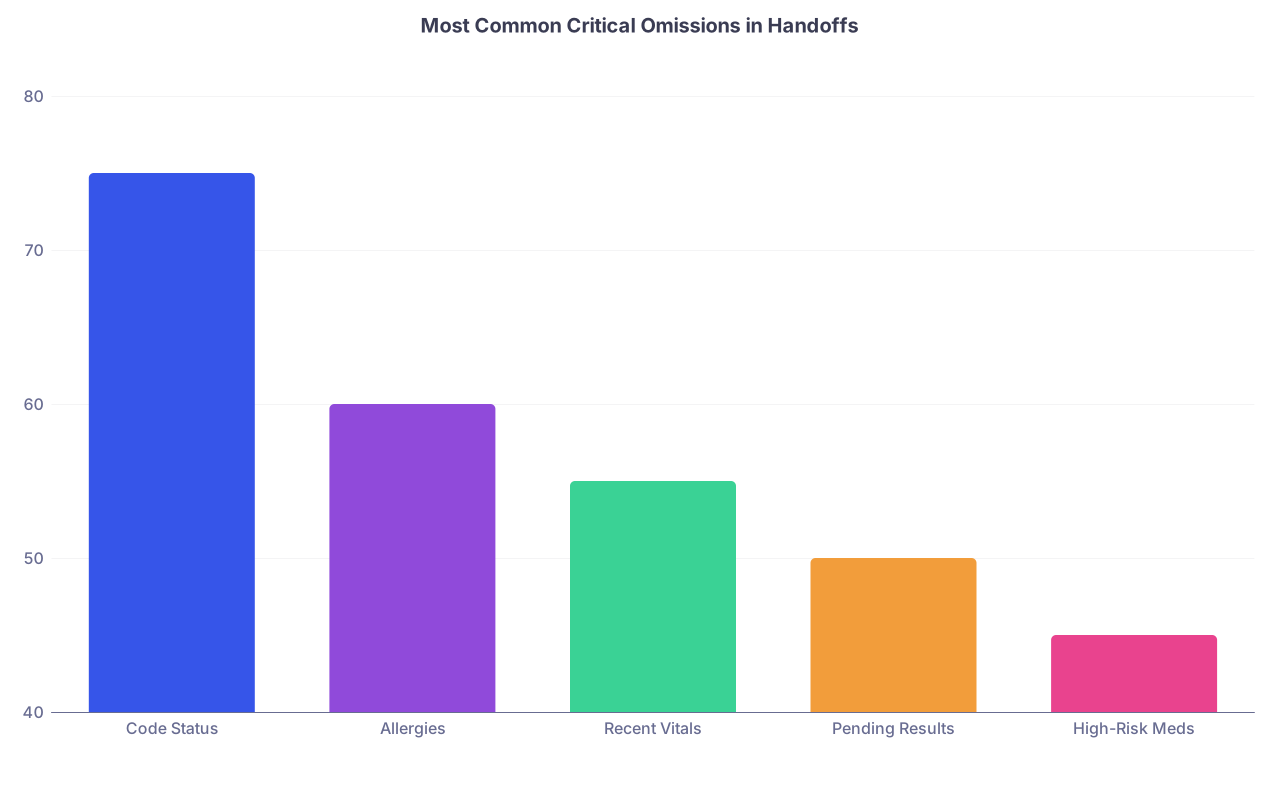
| Category | Value |
|---|---|
| Code Status | 75 |
| Allergies | 60 |
| Recent Vitals | 55 |
| Pending Results | 50 |
| High-Risk Meds | 45 |
Things that must not be left to the chart:
Code Status & Goals of Care
- “Full code” vs “DNR/DNI” must be in your sign-out. Period.
- If there was a recent family or goals-of-care conversation, summarize:
- “GOC discussed today—patient wants all interventions except CPR. Official DNR/DNI order entered.”
- “Family leaning toward comfort-only but no decision yet; they’ll be in tomorrow.”
Night float should never be guessing resuscitation status at 2 a.m.
Allergies That Actually Matter
- “Anaphylaxis to penicillin” and “history of torsades with QT-prolonging meds” do not belong buried in a tab.
- If your plan involves antibiotics, antiarrhythmics, or contrast, call out key allergies or prior adverse reactions.
Pertinent Recent Results Do not make them hunt:
- “CT head negative for bleed, read finalized at 19:30.”
- “CTA chest pending—ordered 17:45 for new hypoxia.”
- “K 3.1 at 16:00, gave 40 mEq PO; follow-up level ordered for 22:00.”
A classic near-miss: imaging ordered late, results come back scary at 1 a.m., but no one told night float to look for it.
Mistake to avoid: Assuming “they’ll just look it up” for core safety info: code status, key allergies, crucial pending results, last vitals, and any major change from baseline.
The Fragile Brain Dump: Overloading or Underloading Details
There are two equally bad styles of sign-out:
- Word salad
- Skeleton
Both cause near-misses, just in different ways.
1. The Word Salad Sign-Out
You’ve heard this sign-out:
- “So this is a 64-year-old with a past medical history of CAD, MI in 2006, stents in 2007, re-stent in 2010, diabetes, HTN, HLD, CKD 3, GERD, remote pneumonia, maybe asthma but unclear, ex-smoker…”
Meanwhile, night float is mentally checking out after “64-year-old.”
The risk:
- Important points get buried
- No clear sense of “what tonight could realistically go wrong”
2. The Skeleton Sign-Out
Other extreme:
- “64M, CHF. On diuresis. Call if more SOB.”
That’s how you miss:
- This is actually cardiogenic shock on milrinone
- They’re 4 L positive with rising creatinine
- They had 3 runs of NSVT at 5 p.m.
You must hit a sweet spot: structured, concise, and prioritized.
Here’s a format that actually works on night float: SBAR + If/Then.
S (Situation): Why they’re here today
“64M with acute decompensated HFrEF (EF 20%) admitted for volume overload and hypoxia.”B (Background): 2–3 relevant facts that change tonight’s risk
“Chronic AFib on apixaban, baseline Cr 1.6 (now 2.1). On 4 L NC (baseline RA).”A (Assessment): Where they stand going into the night
“Got 80 IV Lasix with 1.5 L out; still mild crackles, sats 93% on 4 L. BP soft-ish (low 90s) but asymptomatic, HR 90–110 AFib.”R (Recommendation/If-Then): Actual instructions
“If SBP < 85 or new confusion, hold diuretics and call me/CCU fellow. If O2 need > 5 L, page me and get ABG. Needs strict I/O and daily weight.”
That’s a usable sign-out. It doesn’t drown the night float or starve them.
Mistake to avoid: Either overloading with irrelevant history or stripping so much context that no one can tell how close the patient is to crashing.
The Pending Landmine: Ignoring “Results That Could Change Everything”
Another classic source of near-misses on night float: things you ordered, but they have to own when the result finally drops.
I’m talking about:
- Troponins
- CT scans for possible PE or bleed
- Critical lab rechecks (K, Na, Hgb, lactate)
- Cultures and blood gases
- Post-procedure imaging (post-thoracentesis CXR, post line CXR)
If it’s pending and it could change management in a big way, it needs to be:
- In the sign-out
- With a clear “what to do if…”
| Pending Item | What You Must Include in Handoff |
|---|---|
| CT PE protocol | What you suspect, what to do if positive/negative |
| Head CT after fall | Neuro status now, threshold for ICU/neurosurg |
| Troponin trend | Baseline ECG story, when to treat as NSTEMI |
| K/Na recheck | What you already gave, repletion limits |
| Post-procedure CXR | What to do if pneumothorax or malposition |
Example of bad sign-out:
- “CTPE pending.”
Example of safe sign-out:
- “CTPE ordered 18:00 for new O2 requirement to 4 L in patient with new AFib RVR and pleuritic CP. If positive, start heparin unless Hgb < 7. He’s full code. If negative and still tachycardic, adjust rate control; no need to wake team unless unstable.”
If you order it, you own it—including making sure whoever’s covering at night knows:
- It exists
- Why it was ordered
- What you expect
- What you want done with the result
Mistake to avoid: Dropping potentially critical orders at 16:55 and failing to mention them at sign-out.
The “Nobody Said Who’s Responsible” Disaster
Blurred responsibility is a quiet killer in night float systems.
Things that cause real trouble:
- Two services “sharing” a patient but neither owning overnight issues
- Unclear cross-cover (who handles rapid responses on “their” vs “our” patient)
- Consultant plans handed off with zero clarity on who’s executing what and when
1. Shared Patients / Co-managed Services
If a patient is:
- On medicine service with surgical comanagement
- On OB with medicine consult
- On heme/onc with ICU following
You need to explicitly say:
- “We (medicine) are primary overnight. Call us for all issues.”
- Or “Surgery is primary, we’re consult only. They should be first call for acute abdomen, bleeding, etc.”
I’ve seen delayed transfusions, missed hypotension, and unmanaged post-op pain because everyone thought “the other team” was on it.
2. Consultant Plans Without Ownership
Bad handoff:
- “Cards saw, recs in note.”
That seems fine at 4 p.m. At 2 a.m., it’s a trap.
Better:
- “Cards consulted for NSTEMI. They recommend: uptitrating beta blocker, starting high-dose statin (both done), and likely cath in AM. No plan for emergent cath tonight unless chest pain recurs or new ST changes.”
And crucially:
- “We are primary. If chest pain recurs, order ECG/trop, page cardio fellow and us.”
Mistake to avoid: Leaving “who responds and who decides” vague for multi-team patients. Ambiguity at 3 a.m. = delayed critical action.
Verbal Sign-Out Train Wrecks: How You Talk Matters Too
You can have perfect written sign-out and still screw things up verbally.
Patterns I see that cause near-misses:
1. Speed-Reading the Sickest Patients
People slow down for the socials and then sprint through the unstable ones because they’re uncomfortable and behind schedule.
If your voice sounds like this:
- “Room 612, 36F, new lupus, rash, etc etc—nothing to do; 613, 72M, on pressors in step-down, BP soft, got 3 liters, lactate up a bit but we’re watching, anyway 614…”
You’re doing it backwards.
Slow. Down. For. The. Sick.
If you’re short on time:
- Compress the true “no issues” in one-liners
- Spend 80% of your words on the top 3 risk patients
2. No Read-Backs on Critical Items
If you say something like:
- “If his SBP drops below 80, you have to call the ICU fellow right away”
You want the night resident to repeat back:
- “Okay, SBP < 80, call ICU fellow, correct?”
That “closed loop” is not some corporate buzzword. It’s how you catch:
- Misheard numbers (80 vs 90)
- Misunderstood triggers (“HR > 130 only if febrile” vs “any tachycardia”)
You don’t need this for everyone. But you absolutely need it for:
- Potentially unstable patients
- New admissions you barely stabilized
- Active bleed, sepsis, or respiratory borderline cases
3. Having No Written Backup
Verbal-only handoffs are how details evaporate.
If your sign-out:
- Lives only in your head and a quickly spoken monologue
- Or is a crumpled handwritten sheet no one can decipher
You’re one misfiled paper away from disaster.
At minimum, you want:
- A structured, shareable list (EMR handoff tool, OneNote, Excel—whatever your system uses)
- Clear flags/highlights for “watch closely” or “active issues”

| Step | Description |
|---|---|
| Step 1 | Day Team Prepares List |
| Step 2 | Identify High Risk Patients |
| Step 3 | Write SBAR Plus If Then |
| Step 4 | Highlight Pending Critical Results |
| Step 5 | Verbal Sign Out With Read Backs |
| Step 6 | Night Float Reviews And Clarifies |
Mistake to avoid: Relying on fast, casual verbal sign-out without structured written backup and without read-back on truly critical patients.
The “Hidden Time Bomb”: No Escalation or Fallback Plan
Sometimes the near-miss isn’t that you missed something. It’s that you were paralyzed when it happened.
As the handoff giver, you can prevent this by making escalation explicit.
At sign-out, your high-risk patients should have:
- Clear criteria for when to:
- Call senior resident
- Call fellow/attending
- Call ICU/rapid response
- Location of key documentation
- “POLST in chart and scanned under media.”
- “Most recent echo under cardiology tab, from yesterday.”
Even one line like:
- “Low threshold to call CT surgery if chest tube suddenly stops draining and he gets hypotensive”
- “If new neuro deficit, rapid CT and stroke code; don’t wait”
…can be the difference between a terrifying near-miss and a clean catch.
Mistake to avoid: Leaving night float with zero idea of when to push the big red button and who to involve.
A Simple, Non-Stupid Framework You Can Use Tomorrow
You don’t need a 12-page protocol. You need a short checklist burned into your brain.
For every patient being handed off to night float, ask yourself:
What’s the worst realistic thing that could happen tonight?
- Fall, bleed, arrest, decompensation, arrhythmia, delirium, withdrawal?
What signs would show it’s starting?
- SBP threshold? HR range? RR? New O2 or mental status change?
If that happens, what do I want the night resident to do first, second, and who should they call?
- Labs? Imaging? Meds to hold/start? Call senior/ICU?
What am I waiting on that might be abnormal?
- Pending labs or imaging that you ordered but someone else will see first.
Does the sign-out explain the “why,” not just the “what”?
- Why they’re here, why tonight might matter.
If your sign-out doesn’t answer those, it’s not done.
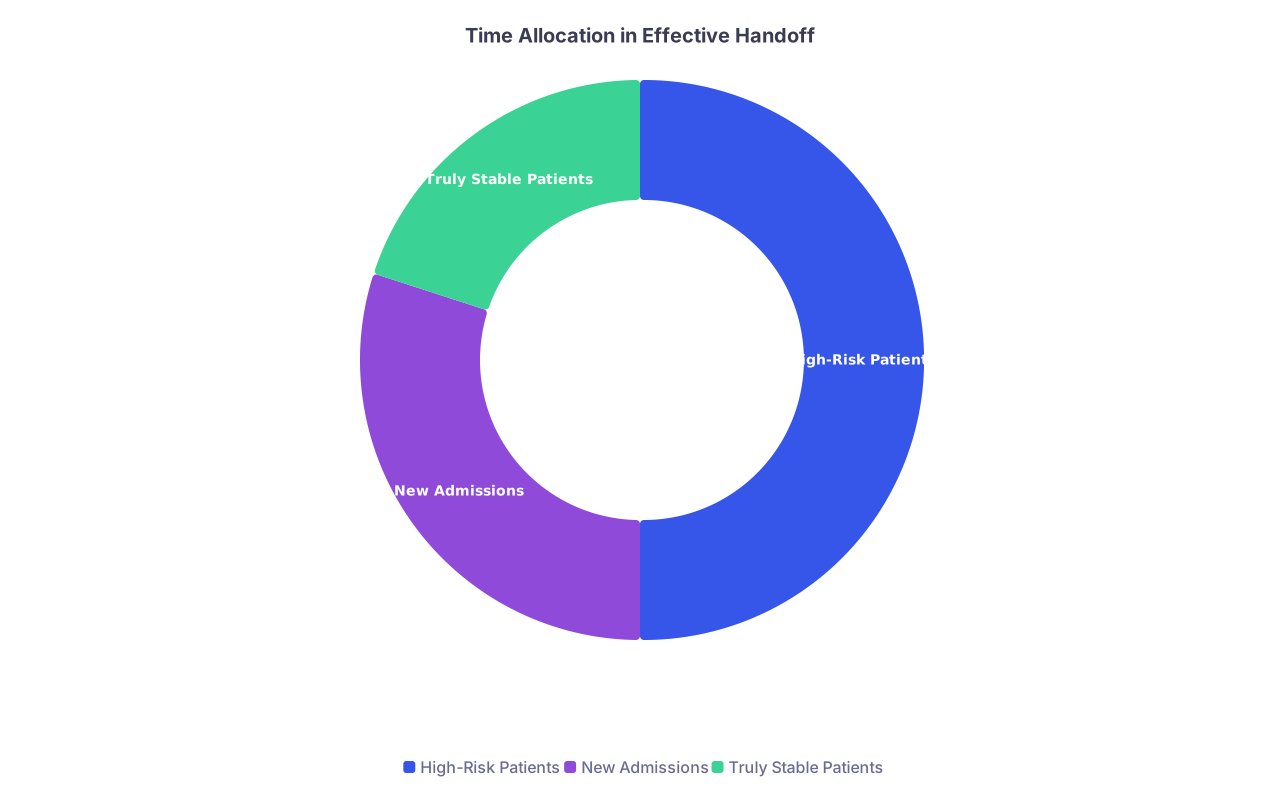
| Category | Value |
|---|---|
| High-Risk Patients | 50 |
| New Admissions | 30 |
| Truly Stable Patients | 20 |
Spend:
- ~50% of handoff time on 3–5 highest-risk patients
- ~30% on new admits with evolving problems
- ~20% on truly stable folks
If you’re doing the reverse, you’re setting up near-misses.
One Last Red Flag: Treating Handoff as an Annoying Chore
The most dangerous mindset I see in residents:
“Sign-out is paperwork. The real medicine already happened.”
Wrong. On night float, handoff is the medicine.
Most night-time near-misses I’ve seen didn’t come from:
- Exotic disease
- Rare side effects
- Wild procedural complications
They came from:
- “Didn’t know they were a GI bleed risk.”
- “Didn’t realize they were on a heparin drip.”
- “Didn’t see the CT result.”
- “Didn’t know DNR/DNI.”
That’s handoff failure. Not knowledge failure.




Your Next Move: Fix One Patient’s Handoff Today
Do not overhaul your entire sign-out system tonight. You won’t. You’re too busy and too tired.
Instead, do this one thing before your next night float starts or your next day-team sign-out ends:
Open your current sign-out list.
Pick the sickest patient or the one you’d least want to get called about at 3 a.m.
Rewrite their handoff using this template:
- One-line “why admitted today”
- 2–3 key background points that change risk
- Current status (vitals trend, O2, labs that matter)
- Any pending critical results + what to do if abnormal
- Clear If/Then for the top 1–2 likely overnight problems
- Code status and who to call for escalation
Then actually read it out loud at sign-out and ask the night resident:
“Is there anything here that would still make you nervous at 3 a.m.?”
Adjust it based on what they say.
Do that for one patient per day. In a week, your handoffs will be safer. In a month, you’ll have stopped multiple near-misses that you’ll never hear about.
Open your sign-out list right now. Find the one patient who scares you a little overnight. Rewrite that handoff before you log out.