
The fastest way for an intern to look unsafe on rounds is not a lack of knowledge. It’s disorganization.
I’ve watched brilliant interns get labeled as “dangerous” not because they didn’t know the antibiotic choice, but because they couldn’t find the latest creatinine, didn’t know what changed overnight, or lost track of a critical lab. Attendings do not forget those moments.
You’re a resident. Your job is to keep your patients safe and protect your intern from looking like they’re out of control. So let me walk you through the ten organization mistakes that quietly destroy trust on rounds—and how to stop them before they embarrass both of you.
1. Walking Into Rounds Without a Standard System
If your intern’s “system” is a random mix of sticky notes, half-updated lists, and stuff “stored in my head,” you’ve already got a problem.
This is how unsafe looks on rounds:
- They flip between three different places to find the potassium.
- They “think” MICU signed off but can’t show where it’s written.
- They say, “Wait, let me check,” for every single question.
That screams: I don’t know what’s going on with my patients.
The mistake: Letting each day be a fresh start with a new way of tracking patients. No consistency, no muscle memory.
What safe looks like:
- The same format every day.
- The same order of updates every day.
- The same place where key information lives.
You should insist your intern adopt one standardized structure for patient data. Could be:
- Printed list + pre-round note template
- Digital tool (if your hospital allows) + structured note
- Old-school index card system with a set layout per patient
Whatever it is, it must be:
- Reproducible
- Fast to scan
- The same across the whole team
If your intern can’t answer, “Where do you keep your active problems and plans?” without thinking—your team is disorganized.
2. Not Updating the List in Real Time
Nothing makes you look more unsafe than reading off an outdated list while making real-time decisions.
I’ve seen this on rounds too many times:
- Attending: “What’s her latest Hgb?”
- Intern: “It was 8.1 yesterday.”
- Attending: “The morning labs are back. What’s today’s?”
- Intern: scrolls… scrolls… “Uh… 6.7.”
- Cue attending’s silent “you almost missed a transfusion-level drop.”
The mistake: Treating the patient list as a static document instead of a living, constantly updated safety tool.
Red flags your intern is doing this:
- Labs on the list are from yesterday.
- Consultants listed as “pending” who actually saw the patient 18 hours ago.
- Imaging labeled “ordered” that has been done, read, and acted on.
You need to build the expectation: If something important changes, the list changes. Immediately.
Drill this into your intern:
- After labs drop: update vitals and critical labs on the list.
- After imaging: add result + impact on plan.
- After big consultant changes: update the plan section before the next round.
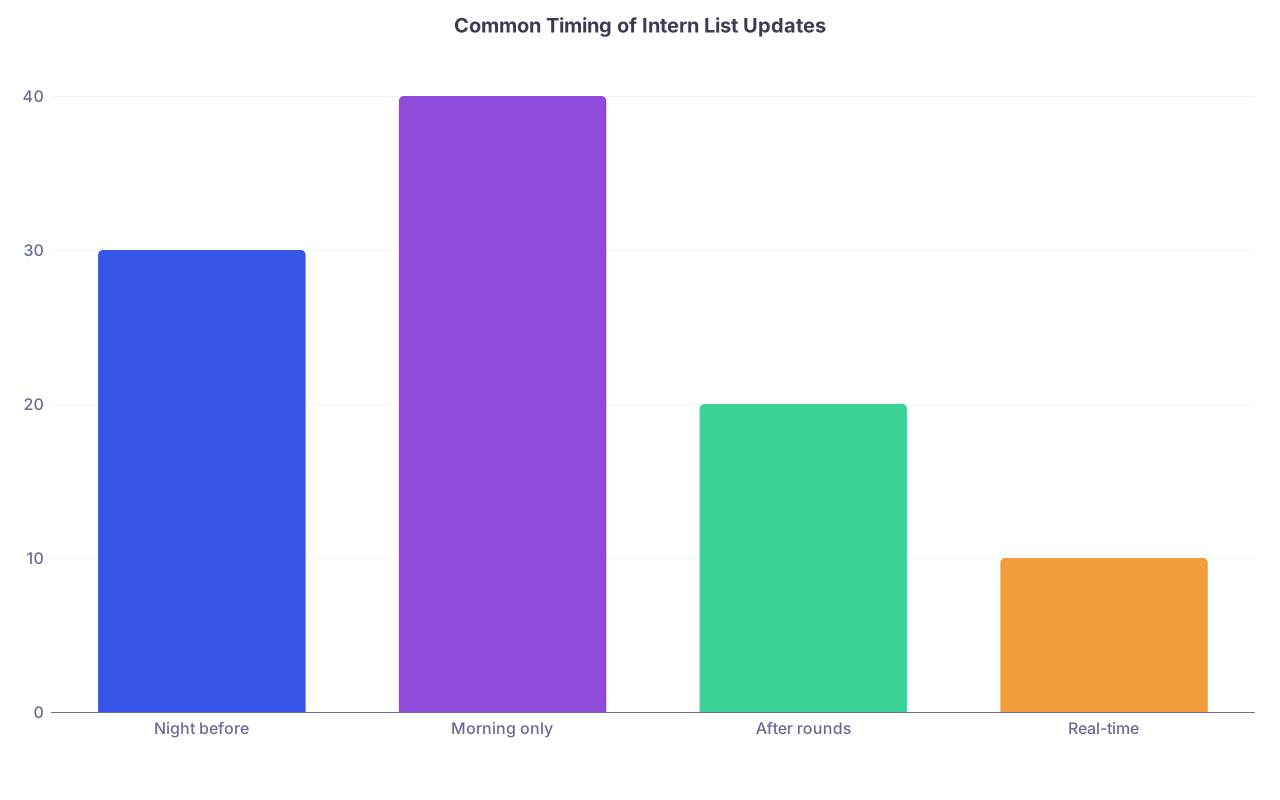
| Category | Value |
|---|---|
| Night before | 30 |
| Morning only | 40 |
| After rounds | 20 |
| Real-time | 10 |
Those “night before only” and “morning only” people? They’re the ones constantly caught by surprise on rounds.
Your move as resident:
Pick 2–3 non-negotiables they must always keep current on the list:
- Latest creatinine
- Latest hemoglobin
- Latest vitals or any new oxygen requirement
Make it explicit. “If those three are wrong on rounds, I’m going to stop you and we’ll figure out why your process is broken.”
3. Losing Track of Critical To-Dos
Nothing scares attendings more than the sentence: “Oh, I forgot to order that.”
That’s how people get hurt.
Typical pattern:
- Plan: “Follow-up CT head in 6 hours.”
- No written reminder, no time flag.
- Afternoon gets busy.
- 10 p.m. nurse calls: “Was CT ever ordered?” It wasn’t.
The mistake: Treating the plan as a vague set of intentions instead of time-bound, trackable tasks.
Safe interns:
- Convert each plan item into a concrete action with a who/what/when.
- Use a visible, organized task list.
Not:
- Mental notes
- Random sticky notes
- “I’ll remember that”
You need a system with:
- A daily task list per patient.
- Clear markers for:
- Time-sensitive items (e.g., “recheck K at 14:00”).
- Dependency tasks (e.g., “order echo after blood cultures”).
- Must-happen-before-discharge items.
This can be a dedicated tasks column on the printed list or a separate checklist for each patient.

| Step | Description |
|---|---|
| Step 1 | Plan on rounds |
| Step 2 | Convert to specific tasks |
| Step 3 | Add to written task list |
| Step 4 | Time or trigger assigned |
| Step 5 | Task completed |
| Step 6 | Update list and orders |
What you must not tolerate:
- Time-sensitive orders living nowhere except the progress note.
- “Plan” items with no assigned owner.
- “Oh right, I was going to do that” on anything critical.
If they tend to forget, the problem isn’t their memory. It’s the lack of an external, reliable system.
4. Presenting Without a Clean, Consistent Order
Unsafe doesn’t just sound messy. It feels messy.
Disorganized interns present like this:
- Start with a random lab.
- Jump to overnight events.
- Backtrack to medications.
- Then remember vitals.
- Forget the consultant’s plan.
- Remember discharge stuff at the very end.
Everyone listening gets the same impression: No one is driving this bus.
The mistake: Letting interns improvise the structure of their presentation every time.
You want one simple rule: Same structure. Every patient. Every day.
For example, force this pattern:
- Identification & hospital day
- Brief “yesterday vs today” summary
- Overnight events
- Vitals & oxygen needs
- I/Os if relevant
- Labs and imaging (only the ones that matter)
- System-based problems and plans
- Disposition/discharge items
Then hold them to it. Interrupt if they wander.
Why this matters for safety:
- You’ll hear when vitals don’t match the story.
- You’ll catch when an overnight event didn’t trigger any plan changes.
- You’ll notice when a new AKI is casually buried after “everything else is stable.”
Interns hate being interrupted. But it’s better to correct their structure now than let an attending label them as “scattered” for the rest of the year.
5. Not Separating Stable from Active Problems
Everything doesn’t deserve equal airtime. When interns treat a resolved electrolyte abnormality like it’s as important as new respiratory distress, they look clueless about risk.
Typical disorganized list:
- HTN
- DM2
- AKI
- Sepsis
- Old DVT
- Hypokalemia (K now 4.2)
All in one flat list. No signal about what’s driving admission today.
The mistake: Mixing chronic/stable issues with acute/active problems without hierarchy.
On rounds, this shows up as:
- Spending 90 seconds talking about home blood pressure regimen.
- Then 15 seconds mumbling about worsening oxygen needs.
- No visual cue about what’s actively dangerous.
Train your interns to structure their problem list like this:
- Category 1: Active Hospital Issues
- Things that could go wrong today.
- Things driving length of stay.
- Things that could send the patient to the ICU.
- Category 2: Chronic/Background Problems
- Mention briefly, only if something changed.
- Category 3: Resolved, no active management
- “Previously hypokalemic, now resolved.”
| Category | Example Problems |
|---|---|
| Active hospital issues | Sepsis, AKI, hypoxia, GI bleed |
| Chronic background | DM2, CAD, HTN |
| Resolved | Hyponatremia (corrected), DKA |
On your team, this should be standard. Any intern who presents an anemic problem list with no prioritization needs correction, not encouragement to “just keep going.”
6. Scattered Data: Labs, Imaging, and Consults All Over the Place
Unsafe impression on rounds: you ask a simple data question, and the intern:
- Scrolls.
- Clicks into three tabs.
- Says, “Hang on…”
- Reads off the wrong day.
That’s how attendings decide they don’t trust the numbers you’re using.
The mistake: Relying solely on the EMR during rounds without pre-aggregating key data.
For rounds, you need to assume:
- Wifi will lag.
- The EMR will log out.
- The attending won’t wait two minutes for you to click six times.
Your intern must have:
- Key labs written down (trend, not just the last value).
- Pertinent imaging results and dates.
- Major consultant recommendations with timestamps.
Not everything. Just the stuff that:
- Supports your assessment.
- Informs today’s decisions.
- Could get someone killed if missed.

What you should step in and fix:
- If they read labs off the EMR every single time, they will be slow, error-prone, and look unprepared.
- If they never write down consultant recs, they will misquote them or forget key parts.
Be blunt: “I don’t want to watch you scroll. I want to hear what matters.”
7. Ignoring Time and Sequence in the Story
A safe intern knows when things happened. An unsafe one vaguely says:
- “He had some chest pain yesterday.”
- “She got a bolus at some point overnight.”
- “The CT was, I think, in the afternoon.”
That’s a safety problem. Not a style issue.
The mistake: Not anchoring events to a clear timeline, so cause and effect disappear.
Attendings listen for:
- Did the hypotension come before or after the antibiotics?
- Did the troponin rise before or after the chest pain?
- Did the fever precede or follow the new central line?
If your intern’s presentation sounds like a blur, they’re not organizing mentally around time. That’s dangerous in sepsis, stroke, ACS, trauma—basically anything that can rapidly worsen.
Train them to handle overnight and recent events like this:
- Exact or approximate time.
- Trigger.
- Response.
- Outcome.
Example:
- Wrong: “He desatted overnight.”
- Right: “Around 02:00 he desaturated to 84% on 2L nasal cannula, got increased to 4L with chest x-ray ordered, which showed new right-sided infiltrate. Oxygen now stable at 94% on 4L.”
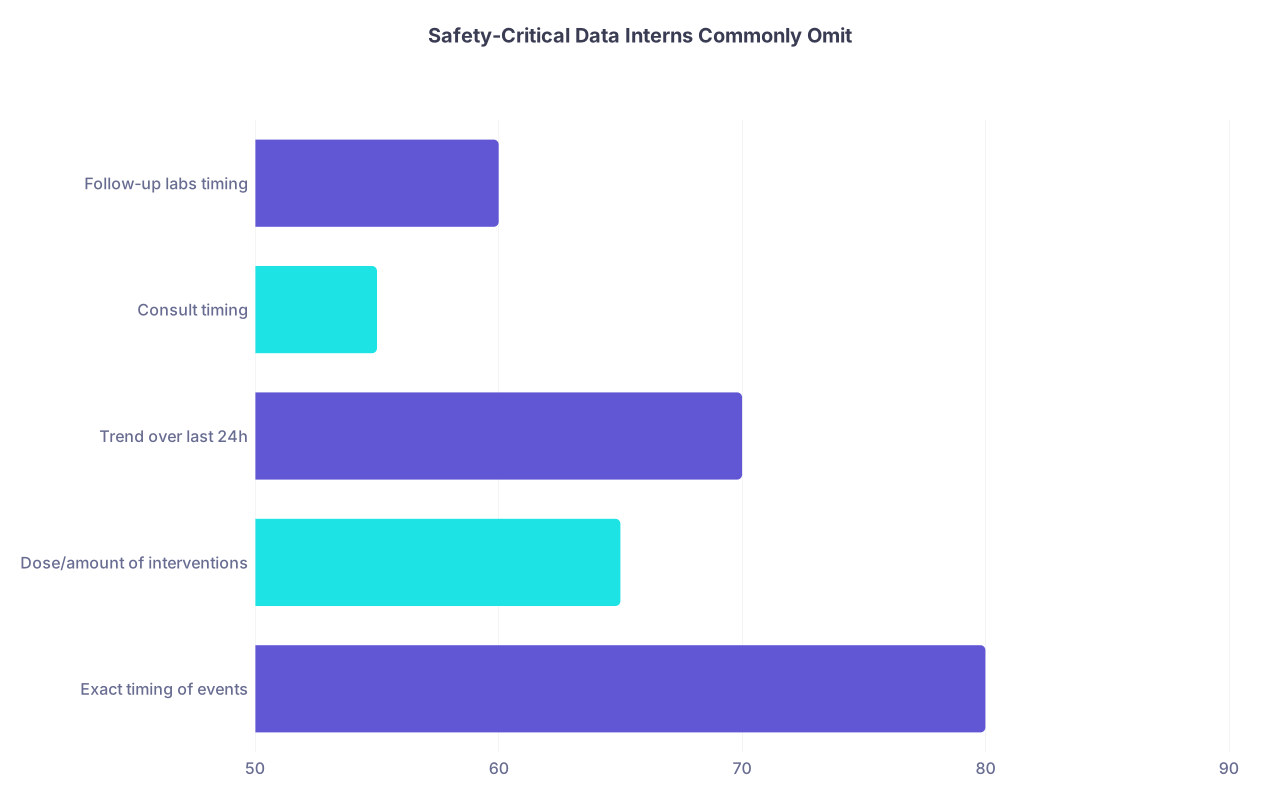
| Category | Value |
|---|---|
| Exact timing of events | 80 |
| Dose/amount of interventions | 65 |
| Trend over last 24h | 70 |
| Consult timing | 55 |
| Follow-up labs timing | 60 |
You should call it out every time:
- “What time did that happen?”
- “What was he on before and after?”
- “What changed after that intervention?”
This isn’t being picky. It’s training them to think like someone whose decisions actually matter.
8. No Pre-Rounds Triage: Treating All Patients the Same
On a busy service, an intern who approaches pre-rounds in alphabetical order with equal depth for every patient is asking to miss something dangerous.
Pattern:
- They spend 20 minutes on the stable cellulitis patient.
- They glance at yesterday’s septic shock patient.
- Rounds start late.
- New AKI or new hypotension gets discovered in front of the attending.
Now everyone wonders: What were you doing all morning?
The mistake: No triage system for who needs the most attention first.
You must teach them:
- Not all patients are equal.
- Not all charts need the same level of pre-round deep dive.
Coach them to build quick priors:
- Who was unstable yesterday?
- Who’s on pressors or high-flow or escalating oxygen?
- Who had a procedure?
- Who has pending critical imaging?
Then pre-round in this order:
- Sickest/most unstable first.
- Patients with major pending decisions.
- Everyone else.

| Step | Description |
|---|---|
| Step 1 | Start pre rounds |
| Step 2 | See first in person |
| Step 3 | Review labs and imaging early |
| Step 4 | Quick chart review |
| Step 5 | Move to next highest risk |
| Step 6 | Unstable or ICU risk |
| Step 7 | Big decision today |
If your intern always starts with the “easy” patient, correct that. It’s a coping mechanism, not a safe practice.
9. Not Closing the Loop on Yesterday’s Plans
Interns get into trouble when yesterday’s brilliant plan just… evaporates.
Things I’ve heard:
- “We planned to narrow antibiotics today, but I haven’t looked yet.”
- “We said we’d wean oxygen, I’m not sure if nursing tried.”
- “We were going to consult cardiology, I don’t see a note.”
Attendings notice this. They remember when plans die of neglect.
The mistake: Failing to build a habit of checking, “What did we say we’d do yesterday—and did it actually happen?”
This is a systems failure, not laziness.
Here’s what you want your intern doing every afternoon:
- Scan yesterday’s plans.
- Mark each as:
- Done and documented.
- Not done but no longer needed.
- Not done and still needed (urgent).
- Fix the open loops.

Teach them a simple habit:
- At the top of each problem, add a line: “Yesterday we planned: … / Today we did: …”
On rounds, unsafe is saying, “We were going to…”
Safe is saying, “Yesterday we planned X; today we did Y; result is Z; now we’re adjusting to…”
If they keep leaving loose ends, you don’t have a knowledge problem. You have an organizational one.
10. Keeping Too Much in Their Head and Not on Paper
The most dangerous interns are often smart ones who think they can remember everything.
They can’t. Neither can you. The difference is you’ve probably already been burned by that.
I’ve watched this exact scenario:
- Intern insists they “know the patients really well.”
- No detailed written plan, just a few cryptic bullets.
- On rounds they sound okay—until you start asking specifics.
- They remember major points but forget:
- The second blood culture.
- The exact insulin changes.
- The dose of anticoagulation.
- You only find out when you re-open the chart in the afternoon and realize the story they gave on rounds wasn’t quite right.
The mistake: Confusing mental familiarity with actual documented clarity.
Medicine is too complex to trust one person’s memory. Especially a sleep-deprived intern managing 10–20 patients at once.
You should be suspicious of:
- Barely any written notes on the list.
- “I’ll just remember” on anything critical.
- Strong resistance to writing down timelines or key numbers.
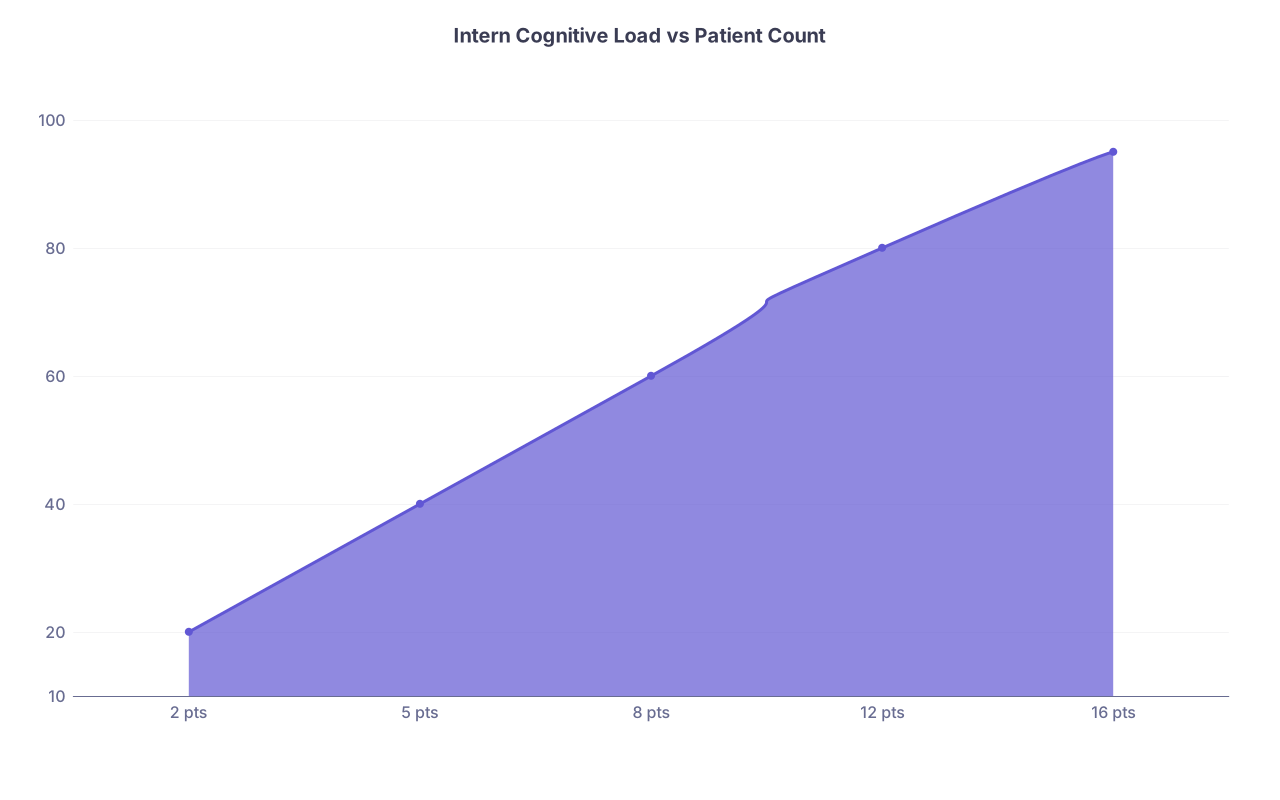
| Category | Value |
|---|---|
| 2 pts | 20 |
| 5 pts | 40 |
| 8 pts | 60 |
| 12 pts | 80 |
| 16 pts | 95 |
Once they’re above 8–10 active patients, their “I’ll remember it” confidence is fiction. At that point, safety is directly tied to how much is externalized onto a clear, organized system.
Push them to:
- Write down numbers that matter (labs, vitals, doses).
- Outline brief but clear plans.
- Stop trusting their tired brain to hold everything.
You’re not being mean. You’re preventing the preventable: errors born from ego and fatigue.
How to Fix This Without Becoming the Nagging Resident
You don’t need to micromanage every line of their list. You just need to attack the high-yield failure points.
Here’s a straightforward way to do it:
Pick one system and standardize it for your team.
Don’t let each intern reinvent the wheel. Show them your structure and tell them they’re using it for this rotation.Do one “chart organization” check early in the month.
Sit for 10 minutes. Look at:- Their patient list.
- How they record tasks.
- How they track labs/consults. Fix it then, before bad habits harden.
Interrupt disorganized presentations.
Don’t let them ramble. Gently but firmly say:- “Start with overnight events.”
- “Give me vitals next.”
- “Now walk me through active problems in order of severity.”
Enforce a daily close-the-loop check.
Before they go home:- “What did we say we’d do today, and what’s still not done?”
- Make them show you their list and how they marked it off.
Model it yourself.
If your own list is chaos, they’ll copy that. If your notes are clean, ordered, and consistent, they will rise to that standard faster than you think.

Being an intern is hard enough. Looking unsafe because of solvable organization problems is unnecessary—and frankly, unfair to them and the patients.
You can’t make them instantly smarter, but you can absolutely make them appear safer, more prepared, and more trustworthy in a week by fixing these ten mistakes.
Here’s your next step:
Tomorrow before rounds, pick one intern and ask to see their patient list. Spend 5 minutes tightening just two things: how they track active problems and how they record time-sensitive tasks. Then watch how much smoother—and safer—rounds feel.