
It’s 8:23 p.m. Your sign-out was at 6:30. You’re still at the workstation “just finishing a couple quick things” from your to-do list.
Your co-intern already left. The senior told you, “Go home, you’re good,” an hour ago.
But your list still has:
- “Follow up all labs”
- “Check on all consult recs”
- “Work on research abstract”
- “Inbox”
- “Epic clean-up”
And you’re telling yourself the same dangerous lie a lot of residents cling to:
“If I just organize my to-do list better, I’ll get on top of this.”
You will not.
Not if you keep making the same to-do list mistakes that trap almost every resident I’ve ever watched burn out in slow motion.
Let’s go straight at the problem: your to-do list is not neutral. It can either protect your time and sanity or quietly destroy both.
You’re probably doing several of the things below. Stop them. Now.
Time Trap #1: The Infinite “Follow Up” Blob
You know the one:
- “Follow up labs”
- “Follow up imaging”
- “Follow up consults”
- “Follow up cultures”
- “Follow up results”
This is the single fastest way to guarantee:
- Things get missed
- You stay late
- You feel permanently behind
Because “follow up labs” isn’t a task. It’s a category. And categories never end.
Here’s what goes wrong:
You keep rewriting the same vague items every day:
Yesterday: “Follow up labs”
Today: “Follow up repeat labs”
Tomorrow: “Recheck labs”You have no trigger point to know when you’re actually done.
You treat everything as equally urgent because it’s all lumped together.
The safer way is brutally specific.
Don’t write:
- “Follow up labs”
Write:
- “2 pm – check Na, K, Cr on 8E-12, 8E-14 after lasix”
- “Before sign-out – check CT abd result on 9W-06 (r/o perf)”
See the difference? It has:
- Patient/location
- What result
- Why you care
- When you’ll do it
That “when” matters more than you think.
If there’s no timeframe, your brain keeps it simmering all day. That’s why you feel mentally loaded even when you’re technically caught up.
Rule: every “follow up” item must have a time anchor and a specific target.
No exceptions.
Time Trap #2: Mixing Clinical Tasks with Life Admin and “Someday” Stuff
This one’s subtle, but deadly.
You’ve got a list that looks like:
- Check 2 pm troponin on 6B-09
- Call cardiology about anticoag plan
- Laundry
- Pay credit card bill
- Call dentist to reschedule
- Read about DKA protocol
- Work on fellowship personal statement
Looks productive. It’s not. It’s chaos.
Here’s the problem:
Your brain shifts between “on-shift clinical urgency” and “general life admin” modes constantly. That switching costs time and mental energy you don’t have.
You start feeling like a failure because at the end of a brutal day, 6 of your 8 remaining tasks are totally unrealistic after a 14-hour shift.
You create a permanent sense of “I’m always behind in every domain,” which is rocket fuel for burnout.
You need different lists for different realities:
- On-service work list (only things that must happen this shift or directly relate to patient care / documentation for this block)
- Life admin list (bills, errands, appointments)
- Career/long-term projects (fellowship, research, studying)
Stop cramming them into one master list. You are not a Silicon Valley productivity influencer. You are a resident trying to not forget to re-order the heparin drip.
Use hard boundaries:
- Work list: visible during shift, cleared or appropriately handed off
- Life/career list: hidden during shift, reviewed on off days or post-call when you’re not making medical decisions
If you glance at “update CV” at 4 pm while managing a GI bleed, that’s not ambition. That’s self-sabotage.
Time Trap #3: The Fake Priority List (“Everything is Important”)
You’ve done this:
- “Priority” section:
- “Finish all notes”
- “Pre-chart for tomorrow”
- “Check every lab”
- “Call all families”
- “Message PCPs”
- “Finish quality project email”
- “Read 2 UpToDate articles”
If your “priority” section has more than 3 items, it’s not a priority list. It’s wishful thinking.
Let me be blunt: on a heavy call day, you probably have the capacity for 3 true priorities outside of “don’t miss something clinically dangerous.”
You need to stop pretending you’re going to tackle 12 “important” things and then going home at 7:30 thinking you’re lazy because you only did 5.
Here’s what actually works:
| List Type | Number of Items | Result |
|---|---|---|
| Typical Resident | 8–15 | Chronic failure |
| Reasonable Day | 3–5 | Mostly achievable |
| Heavy Call Day | 1–3 | Actually realistic |
Your real mistake is moralizing. You make it about “discipline” or “motivation” instead of math. You had:
- 25 pages
- 7 new admits
- 3 families to call
- 2 critically ill patients
No amount of “better grind” covers that.
Fix it:
At the start of your day, pick 3 non-negotiables beyond the obvious “don’t let anyone crash unattended.”
Example on a normal day:
- Finish all progress notes by 3 pm
- Call family for 4E-08 update
- Send email to research mentor about data pull
On a brutal call day:
- Complete H&Ps on all new admits
- Enter essential orders and notes for sickest 3 patients
- One thing that makes tomorrow suck less (e.g., start one note, pre-write a discharge summary)
Everything else is “nice if it happens.”
You’re not lazy. You’re overloaded. Stop letting your to-do list gaslight you.
Time Trap #4: Using Your To-Do List as a Guilt Log
This one wrecks people quietly.
What it looks like:
- You keep copying undone tasks to the next day
- And the next
- And the next
“Read about sepsis bundle” has been on your list for three weeks.
“Work on poster” for two months.
Every time you see them, small punch of shame. “I should be doing more.” So you keep them on the list thinking that will force you to act.
It does the opposite.
You desensitize yourself. The list becomes background noise. And your self-respect takes a hit because the evidence is all in front of you: “I never finish what I say I’ll do.”
The smarter move is to separate:
- Today’s honest bandwidth
- Long-term intentions
Use a ruthless rule:
- If it’s been copied forward more than 3 times, it comes off the daily list and goes into a separate “Parked / Future” list.
That is not failure. That’s triage.
And you know how to triage. You do it in the ED all the time.
Your cognitive load is a limited resource. Don’t waste it staring at tasks you are not actually going to touch this week.
Time Trap #5: No Handoff Boundary – The “Just a Couple More Things” Lie
You tell yourself you’ll leave at 5:30–6:00 most days if things aren’t crazy.
Then 5:20 hits and your to-do list still has:
- 4 “quick notes”
- 2 “call family” items
- “Double-check labs”
- “Clean up in-basket”
So what do you do?
You quietly delete or mentally downgrade “handoff” as an option.
You start thinking, “I’ll just knock this out so the night float doesn’t have to deal with it.”
You stay 60–90 minutes late. Again.
Here’s the actual cost:
- You teach everyone that you’re willing to be the sponge for system failures.
- You train your brain that you are responsible for “finishing everything” instead of “doing what’s safe and appropriate for your shift.”
- You burn out. Not in a dramatic way. Just by attrition.
You need a hard stop policy for your to-do list.
Something like:
- 45 minutes before sign-out: stop adding new tasks that are not safety-critical.
- 30 minutes before sign-out: decide what will be:
- Done before sign-out
- Explicitly handed off
- Consciously dropped/postponed
If an attending adds something at 5:15 that clearly doesn’t need to be today?
You do not martyr yourself. You say, “I can hand this off to night float or tackle it first thing in the morning—any preference?”
That’s not laziness. That’s survival.
To support this, you need your list structured so that handoff isn’t embarrassing.
Time Trap #6: Handoff-Hostile Lists (Illegible to Anyone But You)
You’ve probably done sign-out like this:
“Night float, for Mr. Smith, um, I had written down ‘labs’ and ‘CT’ so just, like, keep an eye on that. Oh and maybe call the family if they show up.”
Your to-do list is full of internal shorthand that only makes sense to you:
- “CT?”
- “Abx?”
- “Ask cards”
- “Maybe DC tomorrow??”
This is a safety problem. And it crushes your time because you have to mentally reconstruct each note every time you look at it.
You want a list that:
- Is legible to you at 2 am
- Is legible to the night float at 7 pm
- Takes 5 seconds per item to understand
Use a simple format for any item that might make it to sign-out:
- What: “Check CT chest result”
- Why: “Looking for PE”
- So what: “If positive, start heparin; if negative, can stop empiric anticoag”
Looks like:
- “CT chest result – r/o PE – act: start hep if +, stop empiric if -”
That’s a safe handoff item. You’ve:
- Clarified the clinical question
- Stated what action is needed based on the outcome
- Reduced the risk they just “note the result” and move on
Stop writing cryptic garbage in your list. You’re not journaling. You’re managing patient care in a team sport.
Time Trap #7: Treating Every Ping as a New To-Do
EMR messages. Text pages. Secure chats. Emails.
If you let every incoming message spawn a new task on your list, you’ll drown. Fast.
You don’t need to turn every ping into a written task. That’s double work.
The trick: one-pass rule for simple items.
- If it can be safely done in under 2 minutes and doesn’t interrupt a critical task, do it now and never let it hit the list.
- If it will take longer or requires thinking/planning, then it earns a spot on the list—with a time anchor.
What you should stop doing:
- Writing “call RN back” when you have the phone in your pocket.
- Writing “sign orders” when the window is already open.
- Writing “acknowledge result” when you’re literally staring at it.
Your list should contain what your brain must not hold onto over time. Not “stuff I saw and will do in 30 seconds.”
Time Trap #8: No Visual Separation Between “Thinking” and “Clicking” Work
Not all tasks are equal. Some require judgment. Others are mindless clicks.
Your mistake is treating them the same on your list. So at 4:30 pm, when you’re fried, you stare at your to-do list and all you see is “work.” You can’t distinguish:
- “Write difficult family update note”
- “Reconcile meds”
- “Close chart review tab”
- “Sign 12 orders”
- “Write complex discharge summary”
You end up procrastinating the cognitively heavy stuff until you’re too tired to do it well. Then you stay late fixing it.
Better approach: visually mark brain-heavy vs. brain-light tasks.
For example, on your list:
- “B” = brain-heavy (requires decision-making / writing / clinical judgment)
- “L” = light (clicks, signatures, simple calls)
So you might see:
- [B] Write dispo plan for 7W-03 (placement issue)
- [B] Call family for goals of care on 8E-09
- [L] Sign all pended routine orders
- [L] Close completed charts in Epic
Then you:
- Do B-tasks earlier in the day when your judgment is still decent
- Save L-tasks for when you’re waiting for a callback or you’re mentally drained but still stuck in the hospital
This stops a very common time trap: spending your prime mental hours cleaning your in-basket and then trying to do nuanced thinking at 6:45 pm.
Here’s what a better time allocation looks like:
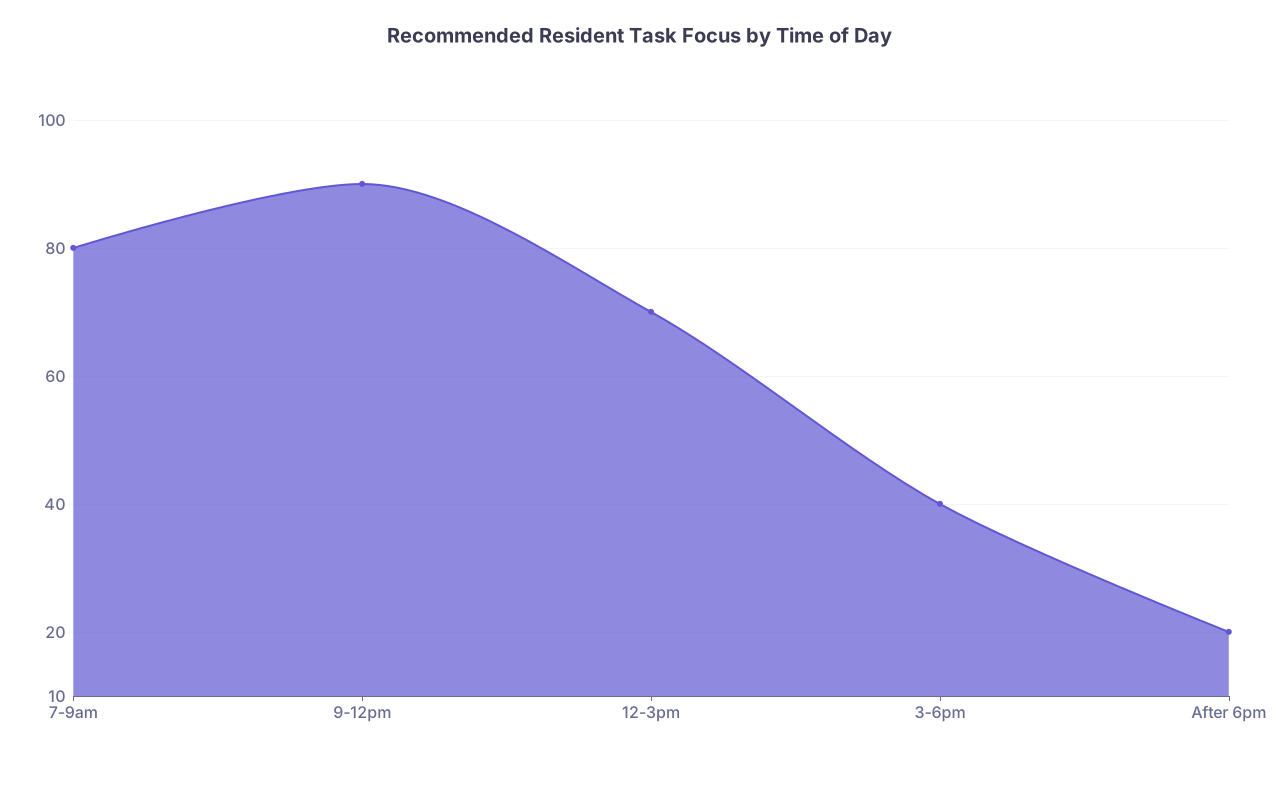
| Category | Value |
|---|---|
| 7-9am | 80 |
| 9-12pm | 90 |
| 12-3pm | 70 |
| 3-6pm | 40 |
| After 6pm | 20 |
Interpretation: your best thinking window is earlier. Don’t waste it on junk.
Time Trap #9: Ignoring Batchable Work
You’re making the day harder than it needs to be by scattering identical tasks everywhere on your list.
Example of scattered tasks:
- “Call radiology re: CT timing”
- “Call family for update”
- “Call cardiology for recs”
- “Call SNF re: bed availability”
So you call one person, then chart. Then check labs. Then call another. Then answer a nurse message. Then call third.
That constant switching is a tax on your attention.
Better:
- Cluster call tasks together on your list:
- “CALL BLOCK (before noon): cards, SNF, radiology, 4E-12 family”
- Cluster EMR clean-up:
- “INBOX BLOCK (4–4:30 pm): sign orders, file results, close charts”
Batching doesn’t just save time. It gives you visible progress. You knock out 4 calls in 20 minutes and you feel like you actually moved something forward.
And before you say, “But I can’t control when they call back,” fine. You’re right. But you can control when you initiate most of this work.
Time Trap #10: Building a Perfect System Instead of a Good Enough One
You know the type:
- New app every month
- Color-coded labels
- Subtasks on subtasks
- Cross-platform syncing
- Tags like “Urgent,” “Soon,” “Later,” “Someday,” “Low-energy,” “Admin,” “Deep work”
You spend more time reorganizing tasks than actually finishing them.
Residents do this because medicine gives you almost zero control. So you over-control your to-do list.
Stop.
In residency, you need a brutal, boring system that works when you’re post-call, hungry, and one consult away from losing it.
Something like:
- One place for your active work list (paper, phone, EMR sticky note—whatever you’ll actually look at)
- Simple structure:
- “Now / This Shift”
- “Later Today”
- “Handoff”
- 3 true priorities star-marked
- Quick review twice daily: late morning, pre-sign-out
That’s it.
I’ve watched people crash their PGY-2 year because they spent more energy “optimizing” their process than protecting their time. Don’t be that person.
A Simple, Safe Resident To-Do List Template
If you want something concrete, here’s a skeleton I’ve seen actually work on busy services.
Section 1 – Critical / Safety (top 3 max)
- “Check 2 pm troponin on 6B-09 – chest pain, call cards if rising”
- “Reassess 8E-14 BP after labetalol – if SBP >180, page neuro”
- “Confirm K repletion for 7W-02 (K 2.9) – recheck BMP at 4 pm”
Section 2 – Today, Before 3–4 pm (thinking work front-loaded)
- “[B] Write dispo plan for 7W-03 (SNF vs LTAC)”
- “[B] Call 8E-09 family for goals of care discussion”
- “[L] Place PT/OT consults for 4 discharges”
Section 3 – Late Afternoon / Low Brain (clicking work)
- “[L] Sign all pended orders (nurse messages)”
- “[L] Close completed charts in EMR”
Section 4 – Handoff Candidates
- “CT chest result – r/o PE – act: start hep if +, stop empiric if -”
- “Blood culture result – if positive, page ID / adjust abx”
Section 5 – Parked / Not Today
- “Email research mentor about data access (weekend)”
- “Read about DKA protocol (next golden weekend)”
Review:
- Early: promote a couple parked items only if the day is light
- Pre-sign-out: move appropriate items into “handoff” or “parked” instead of pretending you’ll crank them out at 7 pm
What You Should Do Today
Do not “think about this later.”
Right now, before your next shift:
- Grab your current to-do system (app, notebook, scraps of paper, EMR sidebar).
- Scan through it and:
- Kill every vague “follow up” item and rewrite 3 of them with:
- Specific patient
- Specific target (what you’re checking)
- Time anchor
- Identify anything that’s been carried forward more than 3 days and move it to a separate “Parked / Future” list.
- Circle or star your next shift’s 3 true priorities. Only three.
- Kill every vague “follow up” item and rewrite 3 of them with:
Then, at your next sign-out, set one boundary:
- 30 minutes before sign-out, stop adding non-urgent tasks and decide:
- What you’ll actually do
- What you’ll consciously hand off
Your to-do list should protect you, not punish you.
Open it up right now and start deleting the traps you’ve been carrying around.