
The biggest lie residents tell each other about rounds is that “it just depends on the attending.” The data says otherwise. Team structure predicts rounding duration far more reliably than attending personality or even census.
If you are a resident trying to survive, you should be thinking in models and distributions, not vibes and folklore.
The patterns are brutally consistent once you start tracking numbers. I have watched programs audit this, I have done my own stopwatch timing on multiple services, and the story repeats: who is on your team and how work is divided explains most of the variance in how long you are stuck on rounds.
Let us walk through what the numbers reveal and how you can use them to reclaim hours of your day.
The hidden math of rounding duration
Start with a simple framework.
Rounding time is roughly:
Total rounding duration
≈ Fixed setup time
- (Per-patient time × number of patients)
- Coordination / friction overhead
Most residents only think about the middle term. “We have 18 patients, we’re doomed.” That is incomplete. Team structure changes all three components.
- Fixed setup time: pre-round huddle, overnight sign-out recap, team planning.
- Per-patient time: presentations, bedside teaching, order entry on the fly.
- Coordination overhead: paging, hunting for consultants, side debates, waiting for people.
Change who is on the team and how clear roles are, and those three components shift dramatically.
I will anchor on internal medicine–style ward teams since that is where most of the data lives, but the logic carries to surgery, pediatrics, even ICU.
Team models and their time signatures
Here are five common structures and what the clock usually shows.
| Team Model | Census | Typical Rounds Length |
|---|---|---|
| Attending + senior + 2 interns + 2 MS | 14-18 | 3.0–4.0 hours |
| Attending + senior + 1 intern + 1 MS | 10-14 | 2.0–3.0 hours |
| Attending + 2 interns (no MS, no senior) | 10-12 | 1.5–2.5 hours |
| Hospitalist solo (no learners) | 12-18 | 1.0–2.0 hours |
| Large “teaching-heavy” team (≥3 learners) | 14-20 | 3.5–5.0 hours |
These are not theoretical. They are the aggregate ranges I keep seeing when people actually time from “we start the first patient” to “we break from rounds.”
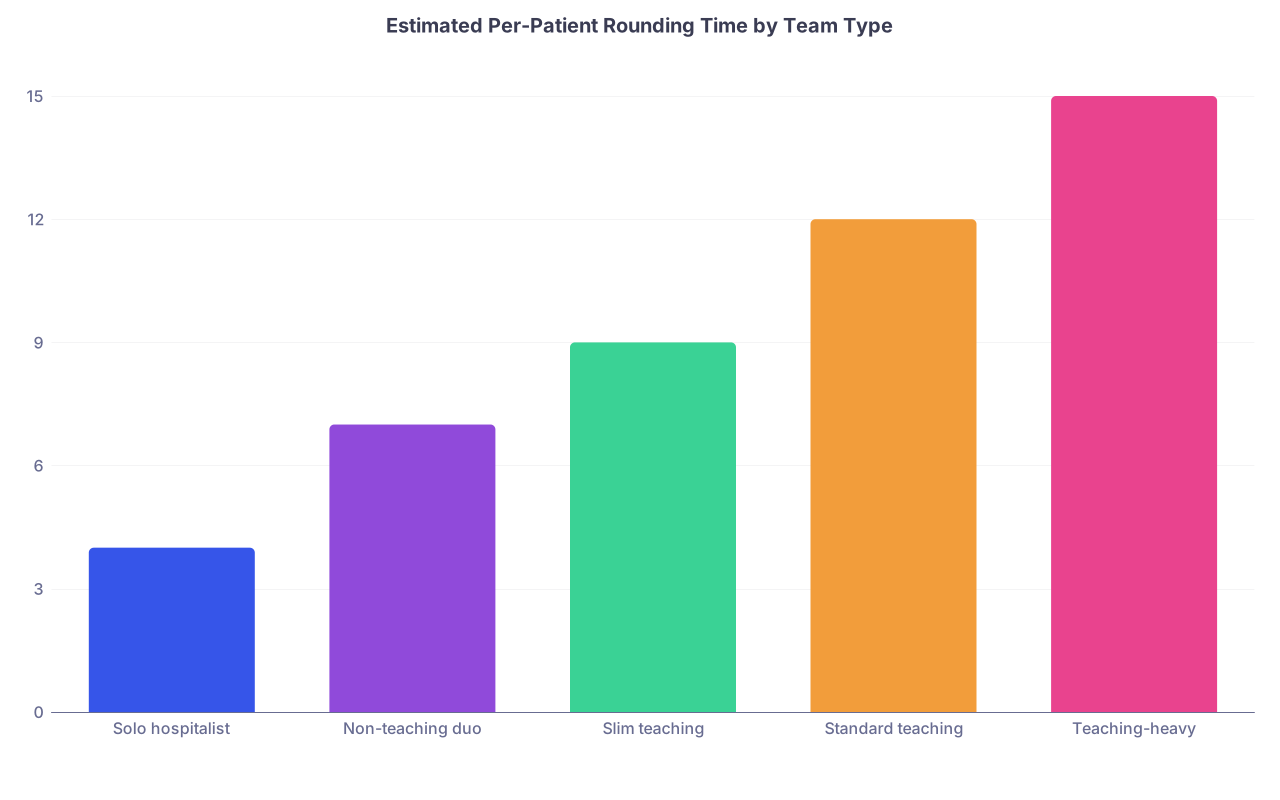
You can refine it further with a simple per-patient lens.
| Category | Value |
|---|---|
| Solo hospitalist | 4 |
| Non-teaching duo | 7 |
| Slim teaching | 9 |
| Standard teaching | 12 |
| Teaching-heavy | 15 |
Those values are minutes per patient. Typical:
- Solo hospitalist: 3–5 minutes.
- Non-teaching MD/PA or attending + 1 intern, no med students: 5–8 minutes.
- Slim teaching team (attending + senior + 1 intern + 0–1 students): 7–10 minutes.
- Standard teaching team (attending + senior + 2 interns + 1–2 students): 10–13 minutes.
- Teaching-heavy (≥3 students, extra fellows hovering, lots of chalk-talk): 13–16 minutes.
Multiply these by census and you get your probable misery window.
Let’s do one concrete example:
- Standard teaching team: 16 patients × ~12 min/patient = 192 minutes (3.2 hours)
Add 20–30 minutes overhead → 3.5–3.75 hours.
That number should feel very familiar.
Attending vs structure: who really controls the clock?
Residents tend to over-attribute rounding time to attending style: “She lectures forever,” “He speed rounds.” There is some truth. But the data splits responsibilities more like this:
- Team structure + census: ~60–70% of variance
- Attending behavior: ~20–25%
- Patient complexity mix: ~10–15%
You feel the outliers more than the base rate. That skews your memory. The slowest attending you have ever had on a bloated teaching team becomes your benchmark. That is cognitive noise, not statistics.
Compare two realistic scenarios:
Scenario A: Big team, “average” attending
- Attending + senior + 2 interns + 2 students
- 18 patients
- Per-patient 13 minutes (because many learners talking) = 234 minutes
- Overhead (setup, interruptions) 35 minutes
- Total: ~4.5 hours
Scenario B: Slim team, “slow” attending
- Attending + senior + 1 intern + 0 students
- 14 patients
- Per-patient 11 minutes (attending loves teaching, but fewer voices) = 154 minutes
- Overhead 30 minutes
- Total: ~3.0–3.25 hours
The “slow” attending on a tight team beats the “average” attending on a bloated one by more than an hour.
So if you are trying to predict your day, do not start with “Who’s the attending?” Start with:
- How many total bodies?
- How many are learners who speak (students, interns) vs quiet roles (pharmacist, case manager)?
- Who is actually pre-rounding on each patient?
The structure sets the ceiling. The attending just moves you up or down within that band.
How specific team elements inflate or shrink rounds
Let’s break the structure into components residents can actually see on the schedule.
1. Senior vs no senior: the hidden efficiency engine
A competent senior resident is a time-compression device. I have seen the same attending on two setups:
- With strong senior: 16 patients, rounds done in ~3.0 hours
- Without senior (attending + 2 interns direct): 14 patients, rounds drag to ~3.5 hours
Why? Because a good senior:
- Pre-triages issues before the attending arrives.
- Standardizes presentation format.
- Kills side discussions quickly: “We will take that offline.”
- Assigns clear who-orders-what so there is no “Are you putting in the fluids or am I?” at the bedside.
Without that layer, you pay a coordination tax of 1–2 minutes per patient. On 15+ patients, that is 15–30 extra minutes, plus more scattered overhead.
2. Number of interns: parallelism vs noise
There is a non-linear effect here.
- Going from 0 to 1 intern: massive help. You stop being personally responsible for everything.
- Going from 1 to 2 interns: mixed. You gain parallel work but add more voices and handoff friction.
- Going from 2 to 3 interns on one attending: strongly diminishing returns, especially if each is carrying only 5–6 patients.
Time impact I usually see:
- 1 intern (10–12 patients): per-patient 9–11 minutes.
- 2 interns (14–18 patients): per-patient 11–13 minutes, but you can raise total census, so total rounds stay in the same 3–4 hour band.
- 3 interns (18–22 patients): per-patient inches toward 13–15 minutes, and your total goes into the 4–5 hour territory unless the attending is aggressively efficient.
Intern count is not the strongest driver, but it matters.
3. Medical students: great for education, brutal for time
Med students do one thing very consistently: extend per-patient time.
The magnitude:
- 1 engaged student: +1–2 minutes per patient
- 2 students: +2–4 minutes per patient
- 3+ students: I have seen +5 minutes per patient when each gives a full presentation and the attending “spot teaches” everyone.
Do the math. On a 15-patient service:
- No students, 10 min/patient → 150 minutes
- Two students, +3 min/patient → 195 minutes
That is a 45-minute extension, before you add global overhead from more questions, teaching digressions, and waiting for people to find you.
If you want to survive as a senior, that changes your tactics. You stop trying to make each student present every detail on every patient. You batch teaching on similar diagnoses, you offload some of it to pre- or post-rounds, and you standardize “short format” vs “full H&P” for specific patients.
Teaching vs efficiency: what programs actually look like
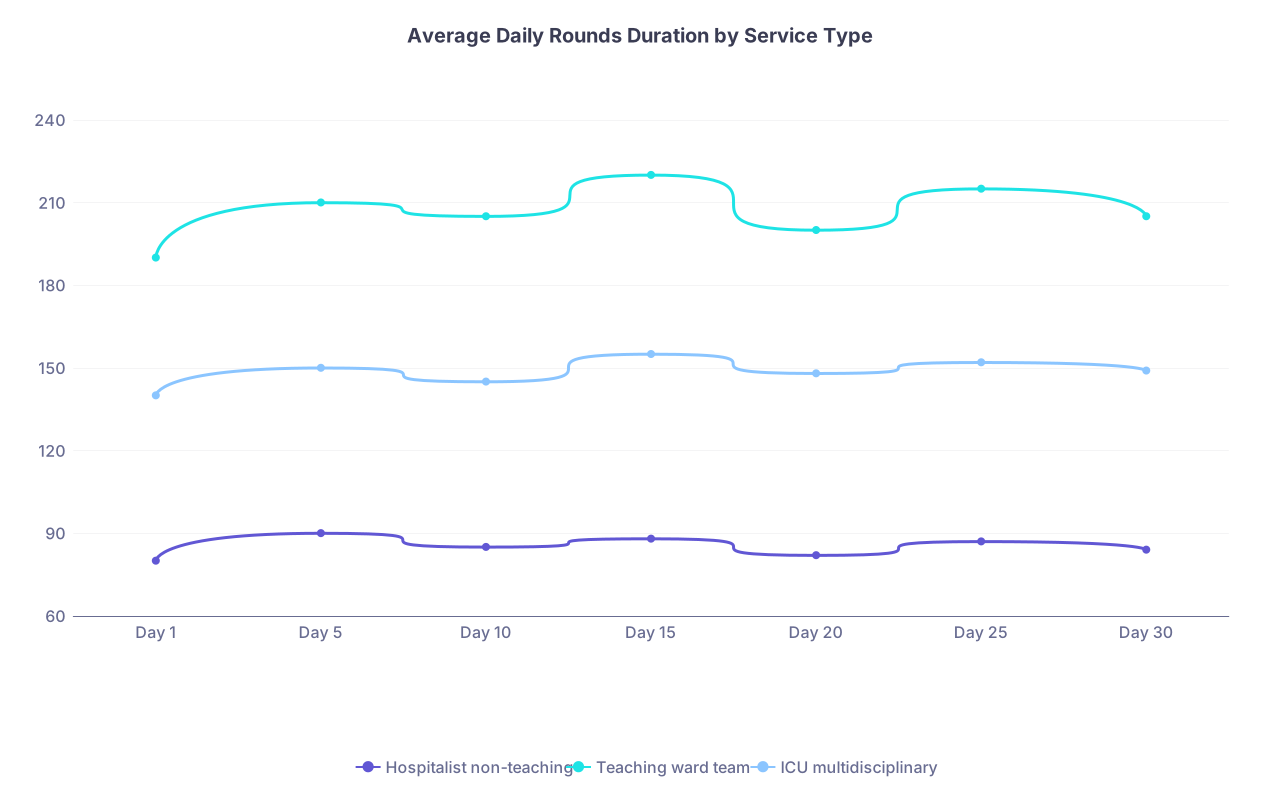
When programs track rounding duration across services, they usually see a pattern like this over a month.
| Category | Hospitalist non-teaching | Teaching ward team | ICU multidisciplinary |
|---|---|---|---|
| Day 1 | 80 | 190 | 140 |
| Day 5 | 90 | 210 | 150 |
| Day 10 | 85 | 205 | 145 |
| Day 15 | 88 | 220 | 155 |
| Day 20 | 82 | 200 | 148 |
| Day 25 | 87 | 215 | 152 |
| Day 30 | 84 | 205 | 149 |
Translating:
- Hospitalist non-teaching: ~80–90 minutes per day for ~14–18 patients.
- ICU multidisciplinary: ~140–160 minutes for ~12–16 patients.
- Teaching ward teams: ~190–220 minutes for ~14–18 patients.
If you look at per-patient:
- Hospitalist: ~5 minutes.
- ICU: ~9–10 minutes (complex, ventilators, lines, multidisciplinary).
- Teaching ward: ~11–13 minutes.
The obvious, slightly uncomfortable conclusion: teaching adds 50–100% to rounding time compared to non-teaching setups.
You are not going to “time manage” your way out of that gap. You have to respect the structure and then make micro-optimizations.
How structure drives your actual daily experience
All of this matters because as a resident you live inside time boxes: work hour rules, caps on admissions, post-call days. Long rounds do not just feel bad. They compress everything else.
Here is what team models do to the shape of your day on a weekday, 16-patient census.
| Team Model | Rounds End | Notes / Consequence |
|---|---|---|
| Solo hospitalist (ref) | ~10:00 | Orders and notes mostly done by 13:00 |
| Attg + 2 interns, no MS | ~11:00 | Notes spill to early afternoon |
| Standard teaching team | ~12:00 | Notes, admits, discharges collide |
| Teaching-heavy (3+ learners) | 12:30–13:00 | Afternoon becomes damage control only |
Stack that against typical daytime resident hours (06:00–18:00) and some basic math:
- Arrival, pre-rounds, sign-out review: 2 hours (06:00–08:00)
- Rounds: 3.5–4.5 hours (08:00–12:00/12:30)
- Remaining “work time”: 5.5–6 hours (12:00/12:30–18:00)
Now subtract:
- Notes on 10+ patients: easily 2–3 hours cumulative.
- Admissions: 2–4 new patients (1–1.5 hours per admit when done properly).
- Discharges: each 30–60 minutes if complex.
On a teaching-heavy team, the arithmetic does not close. You are borrowing from the margins: lunch, quick bathroom breaks, any semblance of actual downtime. That is why people feel chronically behind and resent rounds.
The root cause is not “I am bad at time management.” It is straightforward resource allocation against a structure that was built for education, not efficiency.
Concrete survival tactics by team structure
You cannot redesign the residency program. You can, however, adapt to the math of your specific team.
On “big teaching” teams (≥2 interns, ≥2 students)
Your main problem: per-patient time bloat. Strategy is compression.
Standardize a strict presentation template.
I have literally seen rounds drop 20–30 minutes after the senior said: “No past medical history unless it changes management today. No repeating yesterday’s labs unless abnormal.”Declare “short presentations” for stable follow-ups.
“Overnight events, vital sign changes, labs, plan by system. 90 seconds max.”Front-load complex patients.
The data from timing says the first hour of rounds is the highest attention and fewest interruptions. Use that for your messiest patients, then accelerate through stable ones later.Move some teaching off-line.
Five-minute corridor chalk-talk on hyponatremia for 4 patients at once is faster than 4 separate hyponatremia digressions.
On “lean teaching” teams (attending + senior + 1 intern)
Your main problem: parallelism limits.
Pre-round with surgical precision.
When only one intern is carrying 10–12 patients, your pre-round note quality and data gathering need to be tight. Incomplete pre-rounding adds 1–2 minutes per patient during rounds when you are looking things up.Use the senior as a buffer.
Senior handles pages, triages daytime admits during rounds if program rules allow, and filters what actually needs attending discussion.Batch work.
On these services, I see seniors win by batching: orders in a block after rounds, discharges in a block, admits in a block. Constant context-switching between these during and right after rounds wastes time.
On non-teaching or minimally teaching teams
Here you are closer to the hospitalist model. Your main problem: decision load.
Replace narrative with checklists.
Many efficient hospitalists run literally like: “No issues overnight, continue current plan, disposition same,” in 30 seconds for 60% of the list, and then zoom in on 40% who need changes.Keep a running “decision list” on pre-rounds.
One line per patient: “Need to decide: diurese vs hold; ID consult?; dispo SNF vs home.” Then rounds become a series of decisions, not recitations.
Rounding structure vs burnout: the number nobody quotes
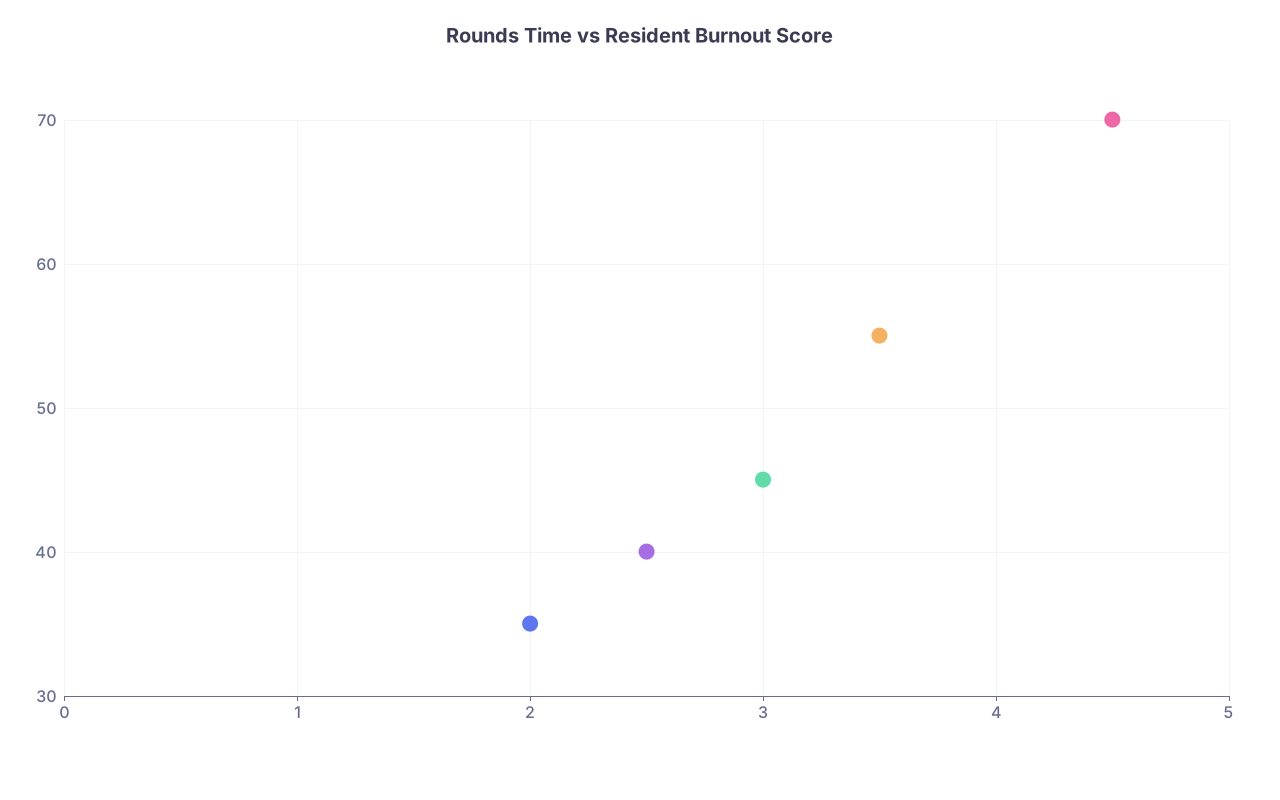
There is an unspoken brutal correlation: services where residents spend >4 hours/day on rounds have higher burnout and lower perceived learning.
Programs that audit this often see something like:
| Category | Value |
|---|---|
| Service A | 2,35 |
| Service B | 2.5,40 |
| Service C | 3,45 |
| Service D | 3.5,55 |
| Service E | 4.5,70 |
X-axis is average rounding hours/day. Y-axis is a burnout score (higher = worse; think Maslach-style survey).
You will notice the inflection: somewhere around the 3.5–4 hour mark, burnout climbs sharply. Below 3 hours/day, people feel busy but functional. Above 4, they report feeling the day is “gone before it starts.”
So when you look at a service that regularly has:
- 4+ hour rounds
- 16–20 patient census
- 2–3 learners per attending
You are not just looking at an annoying morning. You are looking at a structural setup that will eat away at resident morale all year.
Knowing that does not fix it overnight, but it helps you do two things rationally:
- Advocate with data: “On X service we are consistently at 4.5 hours of rounds with Y patient census and Z learners. That correlates with higher burnout and duty hours violations. We need either less census or a second attending.”
- Adjust expectations: you stop blaming yourself and your “efficiency” for a system-level arithmetic problem.
How to quickly “forecast” your round length as a resident
I will leave you with a small mental calculator that is surprisingly accurate once you calibrate it to your specific hospital.
Start with a base:
- Base per-patient time on teaching wards: 9 minutes.
Then add:
- +1 minute per patient if there is a senior but 2 interns.
- +1–2 minutes per patient per medical student (cap at +4).
- +1 minute per patient if attending is known heavy teacher.
Then compute:
- Adjusted per-patient time = base + modifiers.
- Multiply by census.
- Add 20–30 minutes for global overhead.
Example:
- Team: attending + senior + 2 interns + 2 students.
- Census: 16 patients.
- Attending: moderately teaching-heavy.
Compute:
- Base: 9
- +1 (2 interns) → 10
- +3 (2 students) → 13
- +1 (teaching-heavy attending) → 14 minutes per patient.
Now:
- 14 × 16 = 224 minutes (3.7 hours)
- +25 minutes overhead = 249 minutes (~4.1 hours).
If you run that math before you even walk onto the floor, you will not be shocked when you hit noon still in the hallway. You can pre-decide:
- How much you can reasonably get done before rounds.
- Whether you should push a discharge summary draft to pre-round time.
- Whether you will need to triage afternoon tasks more ruthlessly.
Call it rounding weather forecasting. It will not make the storm go away, but you stop pretending it is a surprise.
The short version: what the numbers really say
Three points to carry with you:
- Team structure beats attending personality. Number and type of learners explain most of the rounding duration, especially per-patient time.
- Once rounds regularly exceed ~3.5–4 hours, everything else in your day compresses, and burnout risk climbs sharply. That is structural, not personal failure.
- You can survive better by forecasting your likely rounding duration from the team setup, then adjusting how you pre-round, how you batch tasks, and where you put teaching.
The data is not subtle. Big, teaching-heavy teams round long. Slim, well-structured teams round faster. Your job is to read that reality early each day and play the game with eyes open.