
It’s 6:45 a.m. You’re speed-walking down the hallway, coffee half-spilled, badge twisted, already behind on prerounds. Your attending is at the far end of the ward, arms folded, talking with the charge nurse. You think you’re just “a little late” and “just having an off morning.”
You’re not. You’ve already been labeled in their head.
Let me tell you exactly what labels get applied, and how fast, because attendings and senior residents clock disorganization in the first 48 hours of working with you. Sometimes in the first 10 minutes of a call shift.
What you think they’re judging: your medical knowledge, your differentials, your plan.
What they’re actually judging first: your reliability, organization, and whether you’re going to be extra work or a safety risk.
You want survival tips? You need to understand the early red flags. The stuff nobody writes in your eval but everyone talks about in the workroom.
The First 5 Minutes: The Micro Red Flags
Here’s the part nobody tells you: attendings are constantly running a quiet risk assessment on you. Not maliciously. Just habit. They get burned enough times, they learn to scan quickly.
The first clues they use are tiny.
1. How You Show Up to Rounds
Not “are you physically there.” That’s minimum.
They watch:
- Do you have a list in your hand?
- Is it one list or three crumpled, half-printed ones?
- Are you holding a pen, actually ready to write?
- Do you open the chart before they ask you about the patient?
A resident who walks onto rounds with no printed list, no notes, and says, “Let me just pull it up” repeatedly? Immediately flagged.
Here’s the quiet translation in the attending’s head:
- No list → probably losing tasks
- No notes → probably not tracking updates
- Repeatedly “just pulling it up” → they didn’t preround properly
I’ve watched attendings say nothing and then tell the senior after rounds, “We need to keep a closer eye on them; they’re not organized.” They’re not talking about how smart you are. They’re talking about whether they trust you to follow through.

2. Your First Presentation
You might think the biggest issue is if your assessment and plan are weak. That’s not what gets noticed first.
What jumps out initially:
- Do you know the one-line without checking? (Name, age, relevant comorbidities, admit reason)
- Can you give overnight events in 2–3 crisp sentences?
- Do you clearly know today’s main problem for that patient?
The disorganized resident does this:
- Opens the chart only after being asked to present.
- Starts reading the note verbatim.
- Gets lost in the EHR: “Uh… wait… sorry… I’m just trying to find…”
- Bounces between problems with no structure.
Here’s the harsh reality: attendings see that and think, “I can’t leave this person alone with sick patients for long.” Once that doubt lands, it’s very hard to shake.
The fix is not “know everything.” The fix is structure. One-line. Overnight. Subjective. Objective. Assessment. Plan. Even if the content isn’t perfect, structured chaos looks safer than rambling confusion.
What Nurses Tell Attendings About You (This Hurts)
You know who will out you as disorganized in under 24 hours? Nursing.
They talk. A lot. And attendings listen because nurses see whether the resident’s chaos is adding risk to the floor.
Here’s what gets back to us almost immediately:
3. “I Can Never Find Them”
The number one nursing complaint about disorganized residents: “I don’t know where they are, and they don’t answer their pager.”
It sounds small. It isn’t.
A resident who can’t be located is a safety issue. So when a nurse says during rounds, “Yeah, I paged last night but never heard back” or “It took them forever to respond,” the attending’s internal meter flips from “maybe just busy” to “this person might not be safe.”
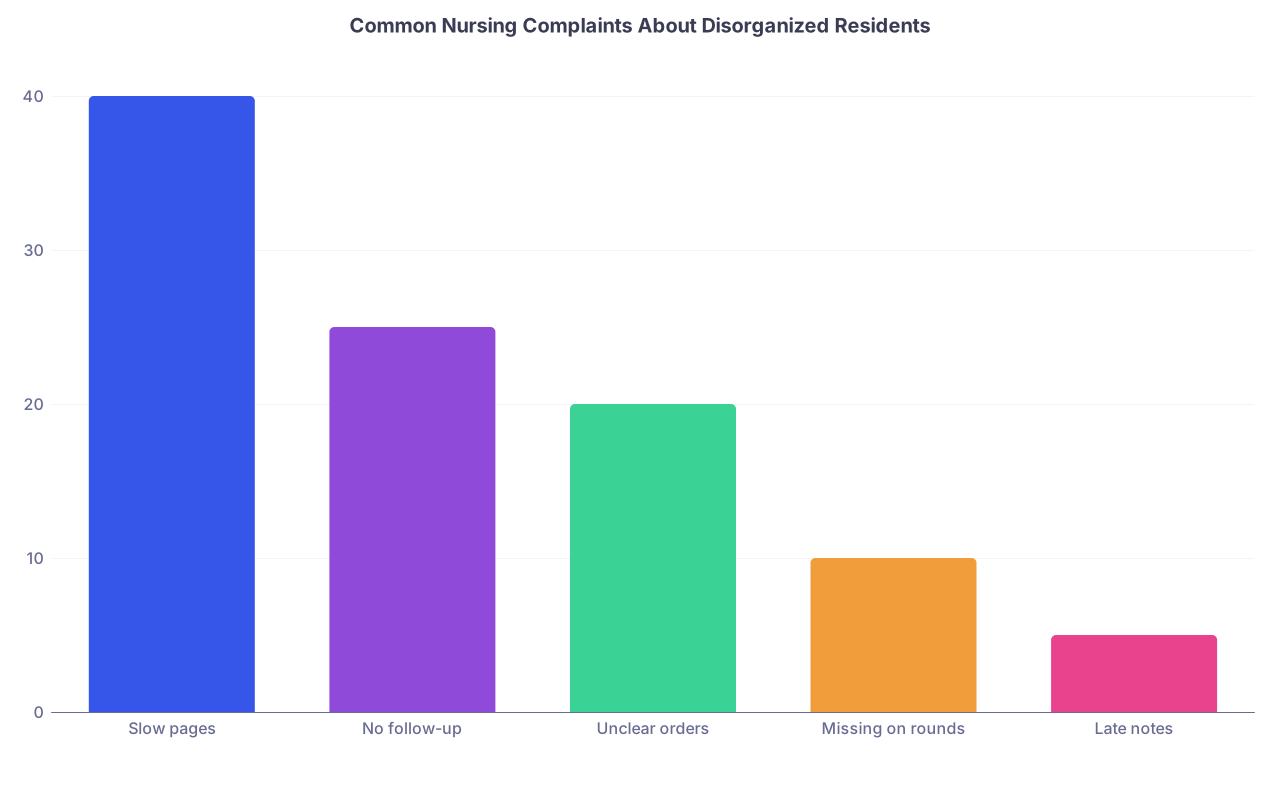
| Category | Value |
|---|---|
| Slow pages | 40 |
| No follow-up | 25 |
| Unclear orders | 20 |
| Missing on rounds | 10 |
| Late notes | 5 |
They notice if you:
- Ignore non-urgent pages for hours because you’re “in the zone” on notes.
- Walk off the unit without telling anyone.
- Never write your name/extension on the whiteboard in the pod.
- Don’t carry the phone/pager on you.
What it signals: you cannot manage competing priorities or communication. That’s the core of being an organized resident.
4. “They Say They’ll Do It But…”
This one kills evaluations quietly: “They say they’ll do it but it doesn’t get done.”
Nurses bring this up on rounds like this:
- “We were waiting on that pain med all night.”
- “Did you still want that CT? Radiology never got the order.”
- “Family was asking for an update, but no one came back.”
What an attending hears: this resident doesn’t close loops.
The disorganized resident often intends to do everything. They’re not lazy. They just:
- Don’t write tasks down.
- Tell nurses, “I’ll put that in now” then get distracted.
- Start five orders and complete one.
- Walk into a room meaning to update the family, then realize they don’t know the plan clearly, so they dodge it.
The problem isn’t bad intentions. It’s bad systems. And attendings are very unforgiving about loose ends because they’re the ones whose name is on the chart.
The EHR: Your Hidden Report Card
You think the EHR is just bureaucracy. Attendings use it as your x-ray. It shows your organization or lack of it in brutal detail.
5. Timestamp Patterns That Give You Away
Here’s what we look at when we start wondering if you’re disorganized:
- Time your notes are started and signed.
- Whether critical notes (admissions, transfer notes, consult notes) are consistently late.
- If you batch all your orders at 3 p.m. for things that should’ve been done at 9 a.m.
You want to know what screams disorganization? Repeatedly finishing H&Ps at 2 a.m. for patients admitted at 5 p.m. Not because the night was truly insane, but because you spent your evening randomly bouncing between tasks without prioritizing.
Or writing daily notes at 11:30 a.m. on patients you’re supposed to present at 9 a.m. That tells your attending you’re always behind your own day.
6. Chaos in Your Notes
We also look at how you document:
- Are your notes consistent in structure from patient to patient?
- Are problems listed in some logical order?
- Does your A/P wander all over the place?
Disorganized residents have A/Ps that look like free-writing exercises:
- HTN plan buried between depression and DVT prophylaxis.
- New serious issues (like a GI bleed) tacked on at the bottom without any structure.
- Plans that clearly don’t match the actual vitals / labs documented above.
Attendings scroll and think, “If their note looks like this, their brain probably does too.” That may not be fair. It’s still what happens.
On Rounds: The Tells You Don’t Realize You’re Giving Off
Rounds expose your organizational habits in public. That’s why they feel so brutal.
7. Losing the Thread When the Plan Changes
Real life: plans change mid-round all the time.
Good attendings will pivot: “Actually, let’s stop the fluids, call GI now, and move this patient to step-down.”
Disorganized residents do something very specific at that moment:
- They freeze, nod, and say “Okay” but don’t write anything down.
- They don’t enter the orders immediately or create a clear to-do.
- Twenty minutes later, they’re still unsure: “Wait, were we doing GI consult on 12 or 15? Were we stopping the heparin?”
I’ve watched attendings after rounds say to seniors: “They do not track changes in real time. They’re going to miss something important.”
Sometimes the senior quietly takes over the complex patients because they don’t trust the intern to handle the evolving plan. You feel “protected.” What’s actually happening: you’re being written off as disorganized.

8. The “Scatter” Presentation
Here’s a pattern that attendings hate: the scatter presentation.
Example:
You: “So Mr. Johnson is a 67-year-old with CHF, CKD, diabetes… um, overnight he… oh, actually, his sodium was low… and we also consulted cardio yesterday… and he had some shortness of breath… I ordered a chest x-ray, I think… the BNP is pending… oh and his blood sugar was 250…”
No structure. No prioritization. You’re just throwing data at the room and hoping someone else will organize it for you.
Attendings notice:
- You bring up minor issues before life-threatening ones.
- You don’t distinguish what changed from what stayed stable.
- You can’t summarize the “headline” for the day.
What this signals: you’re not mentally sorting information. And that’s the essence of being organized in medicine—taking a flood of data and arranging it into something actionable.
Time Management: The Part They Judge But Rarely Explain
You hear “time management” on evals and think it’s about working faster. Wrong. It’s about sequencing and prioritizing without dropping anything.
9. Your Morning Sequence
Attendings pay attention to how your day is structured. Especially mornings.
Disorganized residents:
- Start writing detailed notes before seeing patients.
- Go room to room without a clear order, getting constantly sidetracked.
- Check labs randomly instead of systematically.
- Keep saying, “I haven’t seen that patient yet” well into rounds.
A not-great but organized resident will at least:
- Scan all vitals/labs early.
- Lay eyes on everyone quickly, even if briefly.
- Identify who’s sick and who’s stable.
- Have a thin but coherent plan sketched out.
When you show up to rounds clearly unaware that one of your patients spiked a fever, dropped their pressure, or had a critical lab at 3 a.m., attendings file you under “unsafe.” That’s the word nobody tells you but gets written into their internal file.
10. The End-of-Day Meltdown Pattern
Disorganized residents look fine at 8 a.m., decent at noon, then fall apart after 3 p.m.
The late afternoon pattern:
- Pages pile up.
- Discharges aren’t done.
- Sign-out is rushed and full of gaps.
- They’re still on the unit an hour after everyone else, clicking frantically.
Attending perception: “If a resident is chronically the last to leave but not managing a heavier load, they’re inefficient and disorganized.”
They don’t see late nights as “dedicated.” They see them as a sign you can’t structure your work.
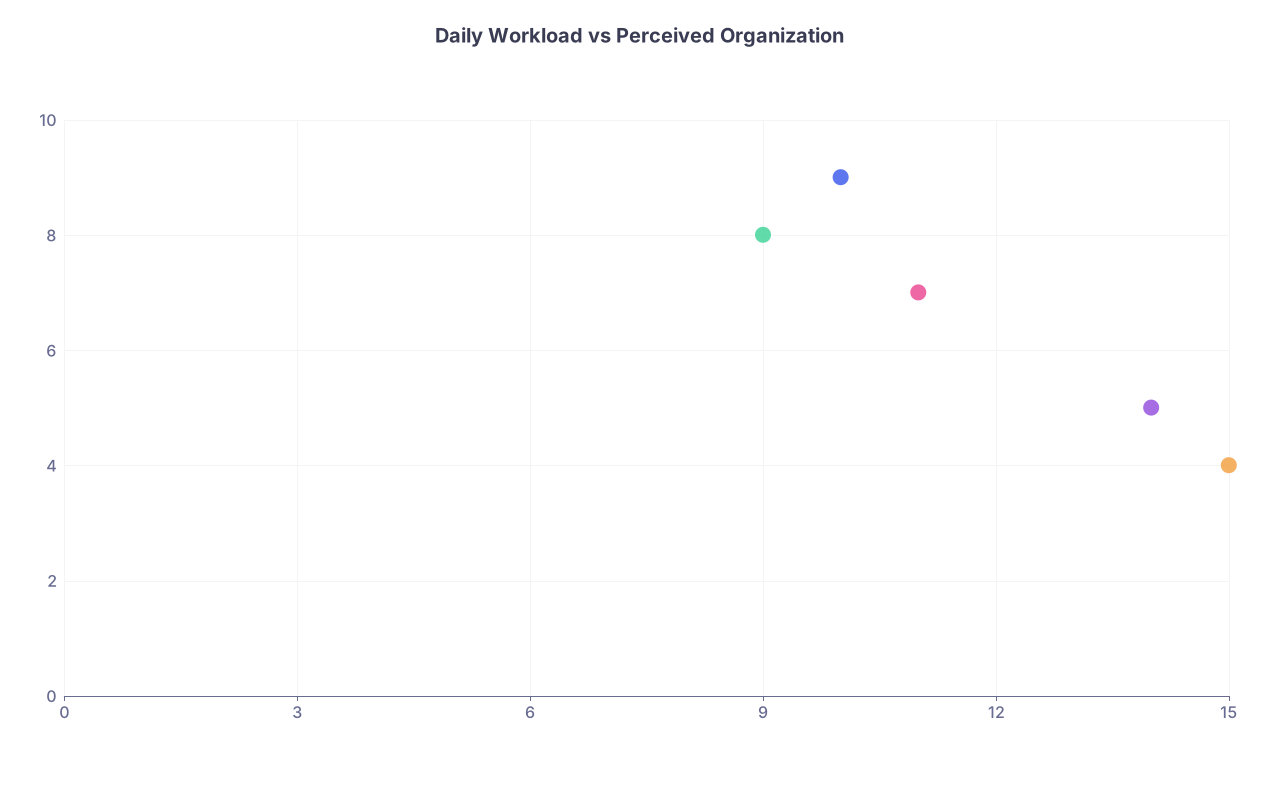
| Category | Value |
|---|---|
| Resident A | 10,9 |
| Resident B | 14,5 |
| Resident C | 9,8 |
| Resident D | 15,4 |
| Resident E | 11,7 |
(First number is approximate patient load, second is perceived organization score out of 10. The point: workload explains less than people think.)
How Disorganization Hurts You Long-Term (Beyond One Rotation)
This part nobody warns you about during orientation.
11. Your Reputation Travels Quietly
Program directors, chiefs, cores— they talk. Not formally, at first. Over coffee. After conferences. In hallways.
Phrases you never want to be associated with your name:
- “Nice, but scattered.”
- “Smart, but I don’t trust their follow-through.”
- “They need too much oversight.”
- “I wouldn’t want them solo on nights with a sick census.”
I’ve seen residents who were brilliant on paper get lukewarm fellowship letters because the attendings didn’t trust their organization. Not their knowledge. Their organization.
And when PDs write letters, they phrase it diplomatically:
- “Needs moderate supervision with complex patient loads.”
- “Benefited from close guidance on task management.”
- “Continues to develop efficiency and prioritization.”
You read that as neutral. Fellowship PDs read that as: disorganized under pressure.
12. Patient Safety Events Stick
If your disorganization ever leads to a real miss—delayed antibiotics, pending critical lab not followed up, a missed STAT imaging order—those events mark you.
Nobody will scream at you publicly if the culture is decent. But behind the scenes, you get an invisible asterisk.
Your seniors will hesitate to let you run the show on nights. Attendings will double-check your orders more. You’ll feel like people don’t “trust” you and you won’t completely understand why. This is why.
| Behavior | Attending Interpretation |
|---|---|
| No list on rounds | Poor task tracking, unsafe |
| Late notes every day | Inefficient, behind on patients |
| Unreturned non-urgent pages | Poor prioritization, unreliable |
| Scattered presentations | Weak organization, risky alone |
| Frequent missed follow-ups | Does not close loops, unsafe |
How to Look Organized (Even If You Do Not Feel Like It Yet)
You want survival tips, not just criticism. Fine. Here’s the inside playbook attendings never spell out.
13. Build a Visible System
Attendings don’t actually care what system you use. They care that you clearly have one.
What they notice:
- A single, clean, updated patient list— not five different half-marked sheets.
- Checkboxes or shorthand next to each patient: labs, imaging, consults, discharges.
- You physically checking off tasks on rounds.
- You pull out your list and recap the plan at the end of each patient.
This looks basic. It reads to attendings as: “This resident runs their service, not the other way around.”

14. Close Loops Aggressively
If you want to reverse a reputation for being disorganized, focus on one thing for the next month: closing loops.
That means:
- When you order a test, you write down “follow result” as a separate task.
- When a nurse asks for something, you either do it immediately or say, “Give me 10 minutes; I’ll come back” and then you actually do.
- When an attending says, “Let’s consider stopping X if Y is better this afternoon,” you write that as a timed check-in, not a vague memory.
And then—this part is important—you tell people you closed the loop:
- “CT abdomen done; prelim read is X.”
- “GI saw the patient; they recommend Y.”
- “I followed up the troponin—it’s downtrending.”
This makes you look ridiculously more organized than the resident who quietly did the same work but never reported back, leaving everyone wondering.
15. Clean, Boring Presentations Win
You don’t have to be brilliant. You do have to be clear.
Attending brains are overloaded. If you sound organized, you get an instant reputation bump.
Keep it simple:
- One-line.
- Overnight events.
- Subjective.
- Objective (only what matters).
- Assessment with 3–5 bullet problems max.
- Plan aligned to the problems.
If you’re prone to scatter, script the first 2–3 sentences of each presentation on your list before rounds. Not the whole thing. Just the opening. It forces your brain into structure.

| Step | Description |
|---|---|
| Step 1 | Recognize disorganization |
| Step 2 | Create single patient list |
| Step 3 | Add checkboxes for key tasks |
| Step 4 | Review list before rounds |
| Step 5 | Document clear plans |
| Step 6 | Close loops and update team |
| Step 7 | Build trust and reputation |
16. Honor the Pager
You’ll hear a lot of macho nonsense about “just ignore the pager” or “tell them you’re busy.” The truth is more nuanced.
Organized residents:
- Triage quickly. They answer pages fast but not necessarily do everything instantly.
- Use phrases like: “Got it. I’m tied up for 15 minutes, but I’ll come see them right after.”
- Batch non-urgent tasks but write them down so nothing disappears.
Attendings will ask nurses, “How is it working with them?” You want the answer to be, “They always get back to us, even if it’s busy.”
That single sentence buys you an enormous amount of goodwill, even if you’re still rough elsewhere.
FAQs
1. Can a few bad days make me look permanently disorganized?
Not if it’s truly a few days and you communicate. If you say, “I’m post-call and slower today; I wrote down all my tasks so nothing gets missed,” people understand. The problem is chronic patterns: late, scattered, unreachable. Those patterns, repeated over weeks, create your label.
2. What if I’m just slow, not disorganized?
Attendings distinguish “slow but structured” from “fast but chaotic.” If your notes are clean, plans are clear, loops are closed, and you’re reachable, most attendings will accept slower throughput, especially early in PGY-1. Speed improves. Chaos does not unless you attack it.
3. How do I repair a reputation for being disorganized mid-year?
You won’t fix it with words. You fix it with a very boring 2–4 week streak: on-time notes, tight sign-outs, clear lists, fast page responses, closed loops. Tell a trusted senior: “I’m working specifically on organization—if you see me dropping things, I want you to call it out.” Word spreads when seniors start saying, “They’ve really tightened up.”
4. Is it better to admit I’m overwhelmed or try to fake it?
Faking it while dropping balls is how you get labeled unsafe. Saying to your attending, “My bandwidth is maxed with these eight active patients; can we redistribute or help me prioritize?” reads as mature and self-aware. They may not like it, but they will trust you more than the resident who silently drowns.
5. What’s the one behavior that most strongly signals “organized” to attendings?
Consistently closing loops and reporting back. When you say you’ll do something, you do it, and you circle back with, “Here’s what I did and what I found.” That single habit—repeated—makes you look far more organized than elaborate apps, color-coded lists, or fancy note templates.
Two things to walk away with:
First, attendings judge your organization before they judge your brilliance. Fair or not, that’s reality, and it shapes your trust, autonomy, and letters.
Second, you don’t need to be perfect. You need visible systems, closed loops, and clear communication. If you can show those three, you’ll stop looking like “the disorganized resident” and start looking like someone they can actually trust with the pager at 2 a.m.