
The story you tell yourself about being “efficient” on call is probably wrong. Chiefs are not impressed that you “answered 60 pages” or “did 15 admissions.” They’re watching something entirely different.
I’ll tell you how they really judge you. Because they do judge you. Especially on those nasty, back‑to‑back call nights when everyone’s drowning and tempers are short.
This is the quiet truth: your chiefs are mentally ranking you on every busy call. That informal ranking is what decides who gets the best rotations, the strong letters, the leadership roles. No one says it out loud. But it’s happening on every team, every year.
Let’s walk through what they’re actually paying attention to.
The Real Scoreboard: Outcome per Unit Chaos
On paper, everyone worked “hard.” In reality, some residents moved the service forward. Others just moved.
Chiefs are not counting your raw number of tasks. They’re watching your throughput with stability. Roughly translated: how much progress you made on actual patient care without blowing anything up.
Here’s how that looks from their side of the workroom:
- You admit 8 patients, but sign out a clean, stable list with clear plans and minimal loose ends.
- You admit 4, but they’re all disasters that you stabilized, got to the unit, and communicated well to the day team.
- Or you admit 10, but the notes are garbage, orders are half-done, consults are confused, and nurses are frustrated.
They remember that third one. And your name gets mentally filed under “not actually efficient, just frantic.”
Most chiefs have a simple internal question: “If I had to survive a truly terrible night, would I want this person beside me?” Your efficiency on call is your answer.
Signal #1: How Fast You Generate a Safe Initial Plan
Speed without a plan is just chaos at higher RPM.
What chiefs watch very closely: how long you spin in the room before there’s a working diagnosis and an initial treatment trajectory.
They do not care that you did a 15‑minute neuro exam on a patient with classic CHF, O2 sat 88%, and crackles everywhere while the nurse is asking for orders.
What they notice:
- Do you walk out of a room with a clear “working problem list + immediate next steps” in your head?
- Do you start necessary interventions before you perfect the note?
- Do you distinguish between “I need to think a bit more” vs “I need to stabilize this now and think later”?
On a busy call, this is what an efficient PGY‑2 looks like to a chief:
You go see a new SOB admission. In under 5 minutes you’ve:
- Recognized this is likely flash pulmonary edema on top of bad CHF.
- Placed orders for BiPAP, IV Lasix, nitro if appropriate, stat EKG, troponin, CXR.
- Told the nurse what the immediate plan is.
- Given a heads-up to the senior or ICU if they’re teetering.
Then you write the skeleton of the note later. Chiefs see you treat first, document second. That’s efficiency.
Residents who look inefficient:
- Spend 25 minutes doing a perfect history before placing any orders.
- Start typing the note before they’ve told the nurse what they’re doing.
- Ask the chief “what do you want to do?” before proposing anything.
By 3 a.m., your pattern is obvious to everyone.
Signal #2: Your Triage Instincts Under Fire
Truth no attending will put in a feedback form: on call, triage skill matters more than knowledge for most residents.
Your chiefs are watching for one unspoken question: Do you know what actually can wait?
They’re silently scoring moments like this:
- You’ve got three pages: hypotension on 6E, chest pain on 8W, and “patient requesting sleep meds” on 7W. Who do you see first, second, third? Do you give any phone orders while you’re walking?
- You’re admitting a stable cellulitis, but a nurse calls about new confusion in an 80-year-old. Do you freeze? Or do you tell the nurse you’re coming now, park the cellulitis H&P for 10 minutes, and go sort out the delirium?
Efficient residents make clean decisions. They say things like:
- “That can wait 30 minutes.”
- “I’ll give that order now and eyeball them in an hour.”
- “I’m going there first. Call me if anything changes before I arrive.”
Inefficient residents:
- Try to do everything in strict time order based on when the page came in.
- Get stuck in one room for 45 minutes while 4 other problems pile up.
- Treat all pages as equally urgent, which is the fastest way to fail.
Chiefs remember who repeatedly mis-triages. That’s the resident they do not trust with a heavy night float or ICU cross-cover.
Signal #3: How You Use Nurses During the Storm
You want the real insider metric? Chiefs judge you heavily on how the nurses act around you by 2 a.m.
Not what they say in formal evals. Their behavior.
Nurses are the fastest signal to your efficiency as a resident. If you’re good, they:
- Call you early instead of late.
- Help you prioritize.
- Warn you: “Hey, this guy in 12 is circling the drain.”
- Do small things unasked because they know you’ll come through on the big things.
If you’re inefficient, they:
- Dump everything on you at once because they don’t trust you to return calls.
- Escalate above you faster (“Can I speak with the senior?”).
- Withhold helpful tips because they assume you’re not listening anyway.
Chiefs and seniors absolutely notice this. You think they don’t, but they do. They hear nurses at the station:
“Call Dr. X, they actually call you back.”
“Page Dr. Y again, they still haven’t come by.”
“Don’t bother, they’ll just say ‘I’ll put in some orders’ and not show up.”
That chatter colors how your chiefs interpret your “busy night” stories.
Signal #4: Your Sign-Out Quality After A Nightmare Night
Here’s a quiet rule most residents never hear: your efficiency grade is written at 6–7 a.m., not midnight.
Chiefs care deeply how your work product lands on the day team. That’s where the truth shows.
I’ve sat in morning sign-outs where two residents both said, “Last night was insane.” One looked efficient. The other looked like a hazard.
Efficient:
- Clear one-liners.
- Explicit active issues and pending results.
- Orders already placed for logical next steps.
- Tucked-in patients wherever possible.
Inefficient:
- “I didn’t really get to that note.” (Repeated ten times.)
- “I was going to call that consult but I got busy.”
- No pending studies ordered for obvious workups.
- Half-done notes that somehow still don’t explain the admission.
You can have the same patient volume, same call structure, same level of tired. But if your sign-out is tight, direct, and anticipates problems, your chiefs log you as efficient—regardless of how chaotic it felt to you.
Signal #5: Your Page-to-Action Ratio
On a bad night, your pager doesn’t stop. Chiefs are not counting your pages; they’re assessing your conversion rate.
Every program has that one resident who constantly says: “I got paged 120 times last night.” Chiefs silently think: “And how many of those did you actually fix the underlying problem versus just respond?”
What they care about:
- When you get a page about pain, are you just slinging more PRNs? Or do you notice the pattern and actually adjust the regimen or investigate why it’s uncontrolled?
- When you’re called about high blood pressures, do you keep ordering random IV labetalol every 2 hours all night? Or think: maybe the patient’s in pain/anxious/fluid overloaded and treat that?
Residents who handle the same issue 4 times in one night on the same patient without adjusting the plan look massively inefficient to chiefs. You’re creating your own work.
Residents who change the system once and prevent 10 more pages look smart. Even if they had the same pager volume, chiefs can feel the difference.
Signal #6: How You Use Your Senior and When You Escalate
Let me be blunt: “independent” is not the same as “efficient.” Chiefs are very aware of this mistake.
You’re not impressive if you drown silently.
Here’s how savvy chiefs read your behavior:
Green flag:
- You call your senior early for a truly sick patient with a specific question and a proposed plan.
- You say: “I think this is septic shock from pneumonia, I’ve given fluids, started broad-spectrum antibiotics, and called RT. I’m worried they need the MICU. Can you come see with me?”
- You escalate bad trends instead of waiting for catastrophic numbers.
Red flag:
- You don’t call. You “manage” them for hours while they spiral.
- You call but just say “they’re not doing well” without any structure.
- You flood the chief with every tiny decision because you’re afraid to pull the trigger on anything.
Efficient residents use their seniors like multipliers. Inefficient ones either never use them or lean on them like a crutch. Chiefs file that away fast.
Signal #7: Cognitive Clutter vs. Mental Shortcuts
On busy call, the most efficient residents ruthlessly strip away unnecessary cognitive overhead.
Your chiefs are watching for who’s built mental shortcuts, and who’s still trying to run full textbook algorithms for every single problem at 3 a.m.
They see things like:
- The resident who uses order sets smartly, modifies a few things, and moves on.
- The one who hand-builds every order set from scratch at 1 a.m. “because I don’t like our default settings.”
- The one who knows their go‑to regimens cold (DKA, COPD exacerbation, CHF, sepsis), and doesn’t Google UpToDate in front of the nurse for the fourth time this month.
That’s what “efficiency” often boils down to: have you converted common problems into stable, fast patterns?
You want to be the resident who already knows:
- Your standard DKA protocol, including fluids, insulin, K+ checks.
- Your go-to approach to new afib with RVR.
- Your COPD exacerbation package: nebs, steroids, +/- antibiotics, NIPPV criteria.
Chiefs see who’s still reinventing these from scratch each call night. Those residents get fewer opportunities, fewer leadership roles, and frankly, less trust.
Signal #8: Emotional Containment Under Pressure
Here’s a trait you don’t see on any official form, but chiefs talk about it in their rooms all the time: who keeps their emotional leakage under control.
On brutal call nights, everyone’s tired. What separates the efficient from the chaotic is stability.
Efficient residents:
- Look tired but calm.
- Don’t snap at nurses.
- Don’t make the whole team absorb their anxiety.
- Complain less and act more.
Inefficient residents:
- Verbally broadcast how overwhelmed they are every 10 minutes.
- Freeze, sigh loudly, slam keyboards.
- Say things like “I just can’t do this” in the middle of a busy stretch.
- Need constant reassurance and hand-holding.
Chiefs are human. They will protect the residents who help stabilize the team energy, especially at 2–3 a.m. They will quietly minimize shifts with the ones who destabilize others when stressed.
This is ruthless but real.
What Chiefs Really Talk About After Call
You think the story is: “We all survived a rough night; everyone worked hard.” That’s the public version.
The private version in the chief/attending workroom sounds more like:
- “She was drowning, but every patient she touched had a clear plan. I’ll take that any night.”
- “He’s fast but his admits are a mess. I spent half the morning cleaning them up.”
- “If this ICU night is going to be ugly, I want her as my resident. She never freaks out, even when we’re behind.”
- “Nurses hate calling him because he never goes to see the patient. I don’t trust his overnight judgment.”
Those conversations shape your narrative long before your formal evals hit MedHub.
This is why two residents with similar knowledge and similar note quality can have very different reputations. Chiefs have watched them on call. They know who actually moves the service forward when things get bad.
A Few Concrete Moves That Change How You’re Judged
Let me give you specific behaviors that immediately change your “efficiency profile” in chiefs’ eyes.
First, use this internal script with every page or admission:
What is the one most dangerous thing that could be going on? What’s my first move to rule that out or treat it?
Don’t try to perfect everything. Just get the patient out of immediate danger, then refine.
Second, build 5–7 “call night packages” in your head for common situations. Not just drug names—full sequences. For example:
- New sepsis shock package.
- Hypotension on the floor package.
- New chest pain package.
- COPD/CHF exacerbation package.
- Acute delirium/confusion package.
When chiefs see you consistently use stable, sensible patterns, they label you efficient almost automatically.
Third, treat the 5–7 a.m. block as sacred. That’s where you:
- Clean up orders.
- Place morning labs and key imaging.
- Finish at least skeletal notes.
- Tighten sign-out.
Even if the rest of the night was a disaster, a clean exit makes you look far more efficient than you feel.
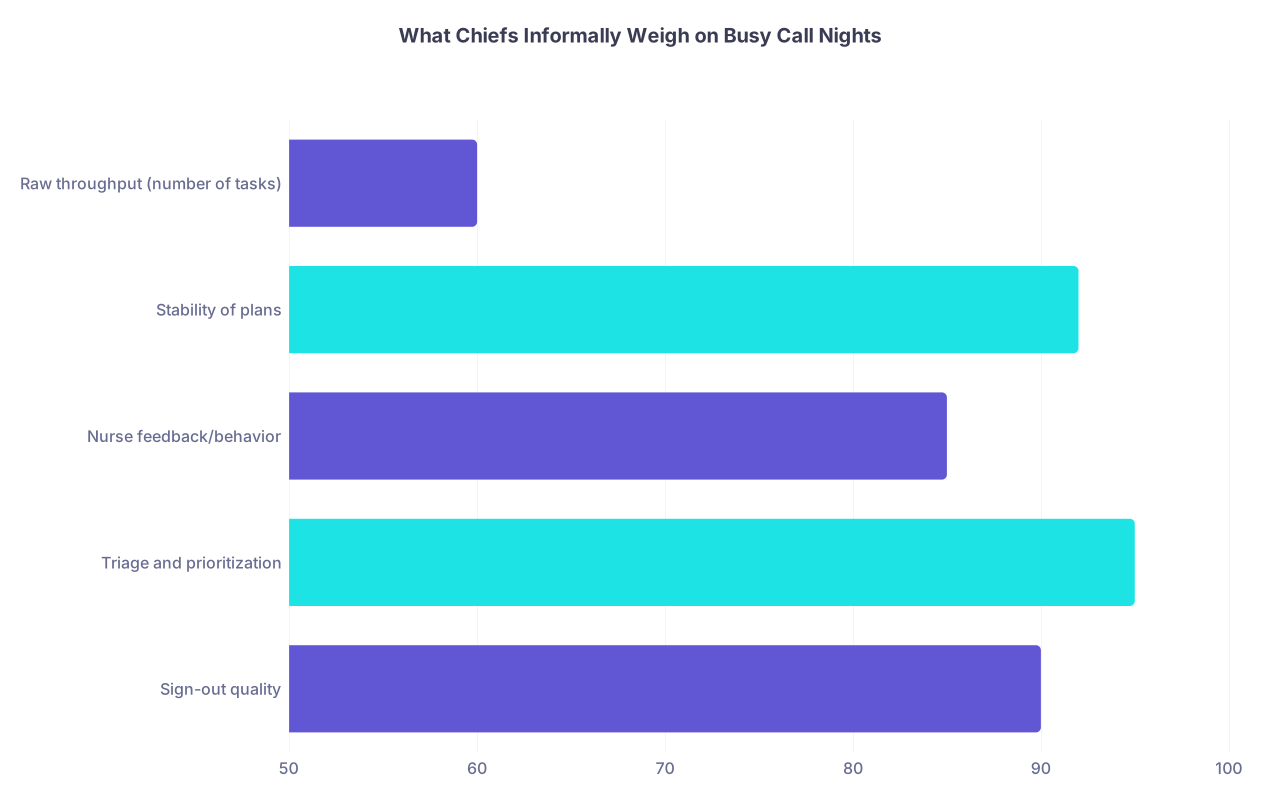
| Category | Value |
|---|---|
| Sign-out quality | 90 |
| Triage and prioritization | 95 |
| Nurse feedback/behavior | 85 |
| Stability of plans | 92 |
| Raw throughput (number of tasks) | 60 |
A Quick Reality Check: Efficiency vs. Exploitation
You might be thinking: “So I just become hyper-efficient so the system can squeeze me harder?”
Different issue.
Efficiency on call is not about being a martyr. It’s about three things:
- Protecting patients from your chaos.
- Protecting your own future opportunities.
- Making your nights slightly less hellish over time.
You can be efficient and say “no” to unsafe volumes. You can be efficient and call the attending at 1 a.m. when you’re at the edge of safe coverage. Chiefs actually respect that a lot more than they admit publicly.
What they do not respect is:
- Chronic disorganization wrapped in “I’m just so busy.”
- Emotional meltdowns used as justification for sloppy work.
- A pattern of nights where every patient you touch becomes the day team’s problem to untangle.
You’re in residency; the workload won’t suddenly get humane. But your experience of that workload can improve dramatically if you build the habits chiefs quietly reward.

| Step | Description |
|---|---|
| Step 1 | Page or admission |
| Step 2 | Immediate stabilization |
| Step 3 | Brief focused exam |
| Step 4 | Call senior early |
| Step 5 | Initial plan and orders |
| Step 6 | Document key events |
| Step 7 | Update nurse with plan |
| Step 8 | Move to next task |
| Step 9 | Clean orders and sign out |
| Step 10 | Sick or stable |
| Step 11 | 5 to 7 am window |

FAQs
1. What if my call nights feel awful, but my chiefs say I’m “doing fine”?
That usually means two things. First, you’re probably harder on yourself than they are, which is common among high-achieving residents. Second, you may be performing better externally than it feels internally. Chiefs judge what they see: timely actions, solid sign-outs, reasonable triage. If they say you’re fine but you still feel overwhelmed, ask a senior or chief to shadow parts of a call and give targeted feedback. You might have one or two small habits (documentation timing, how you respond to pages) that would make the whole night feel less brutal without changing your visible performance.
2. How do I know if nurses actually see me as efficient?
You’ll never get a formal note saying “efficient.” The signs are more subtle. If nurses start paging you before things get really bad, they trust you. If they ask you your preference on borderline decisions (“Do you want me to give another neb?”), they trust your judgment. If they complain less to the senior when you’re on, that’s another quiet endorsement. You can also ask a nurse you get along with: “What makes overnight residents easier to work with from your side?” Their answers will be uncomfortably honest—and extremely useful.
3. Is speed actually important, or can I just be thorough and slower?
On nights with normal volume, you can afford to be slower and more thorough. On real disaster nights, being too slow becomes unsafe. Chiefs are not grading you on raw speed, they’re grading you on appropriate speed. Can you get faster for the right things—sick patients, active decompensation—while still being reasonably thorough? If you’re consistently the last person finishing notes, the last to leave in the morning, and always behind on admits, chiefs will mark you as inefficient, even if your notes are beautiful.
4. How do I balance asking for help vs. looking incompetent?
Ask for help early for sick or unclear cases, not for every minor decision. When you call your senior, lead with a concise summary and your proposed plan: “I have a 65-year-old with suspected sepsis from pneumonia, BP 88/50, HR 120, O2 90% on 4 liters. I’ve given 2 liters, started vanc/zosyn, ordered blood cultures, and called RT. I think they need a transfer to the MICU.” That doesn’t look incompetent; it looks efficient and appropriately cautious. Calling with “the BP is low, what do you want to do?” at 3 a.m. after nothing has been started—that’s what makes chiefs lose confidence.
Key points to walk away with: chiefs judge efficiency on call by your triage, your plans, and the shape of your sign-out, not how miserable you say you were. They watch how nurses act around you more than what anyone writes. And the residents who quietly build fast, safe patterns for common problems are the ones who get remembered as “strong on nights” and pulled into the best opportunities.