
The third month of internship will break you if you do not have real systems in place. Not vibes. Not good intentions. Systems.
By Month 3, sheer adrenaline has worn off. The novelty is gone, the EMR no longer feels like hieroglyphics, and your attendings stop saying “Well, you’re new.” At this point you are expected to function. Consistently. Safely. Under pressure.
This is where people either build structure or burn out.
Let’s walk through exactly what you should have locked in by the end of Month 3—month-by-month, then week-by-week—and what to fix this week if you’re behind.
Month 1–3 Overview: How Your Systems Should Evolve
First, zoom out. Here’s the trajectory you should be on.
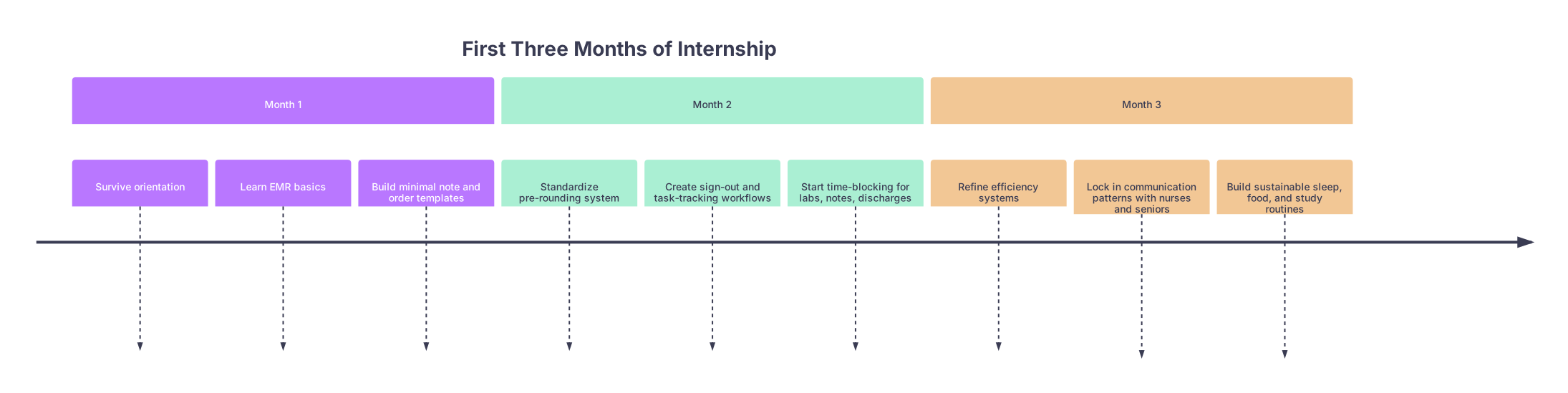
By the end of Month 3, you should have:
- A reliable pre-rounding and data-capture system
- A standardized cross-cover and sign-out system
- Battle-tested task-management and “never forget” system
- A fast, safe note and order system
- A realistic sleep–food–commute rhythm
- A learning and exam-prep system that survives night float and wards
If any of these are missing, Month 4–6 will feel like drowning.
System 1 (By Week 4): Pre-rounding & Information Capture
By the end of Month 1, you should not be wandering room-to-room hoping you remember what to check. You need a pre-rounding checklist that lives in your pocket or your phone.
What you should have by now
By Month 3, your pre-round process should be:
- Time-boxed (you know how many minutes per patient, realistically)
- Structured (same order of data every time)
- Fast enough that you’re not still pre-rounding at 9 a.m.
Your data capture should be standardized:
- Same shorthand
- Same order in your sign-out sheet or rounding list
- Same spot for “to-do” items per patient

Concrete setup (if you do not have this yet)
This week, you should:
Pick your capture tool
- Paper list you print daily
- EMR patient list with custom columns
- Notes app or OneNote on your phone (HIPAA-safe if allowed)
Standardize your pre-rounding order per patient:
Always in the same sequence:- Vitals and trends (last 24 hr, look for fevers, tachycardia, desats)
- I/Os (and net over 24 hr)
- Labs (with your “autocheck” labs highlighted—electrolytes, CBC, etc.)
- Imaging/procedures in last 24–48 hr
- Overnight events (nurse notes, tele strips if relevant)
- New consults or recommendations
Create a 1-line “status snapshot” per patient on your list:
- Example: “PNA day 3, on ceftriaxone/azithro, weaning O2, f/u sputum, PT/OT”
At this point, you should be able to walk into the room with a plan already in your head, not while you’re still flipping through the chart.
If pre-rounding is still chaos by Month 3, fix this before you touch anything else.
System 2 (By Week 6): Cross-cover & Sign-out That Actually Protects You
Bad sign-out is how you end up getting screamed at at 2 a.m. for something that should’ve been anticipated.
By 6–8 weeks, you should have:
- A standard sign-out structure
- A “if X then Y” plan documented for common issues
- A fast way to update sign-out during the day
| Element | What You Should Be Doing By Month 3 |
|---|---|
| One-liner | Diagnosis, hospital day, current major problem |
| Anticipatory | Specific “if X then Y” instructions |
| Overnight plan | Clear NPO/tele/PRN meds/parameters |
| Dispo status | Expected disposition and barriers |
| Code status | Explicit, up-to-date, not “I think full” |
Your sign-out script (by Month 3)
Every patient sign-out should hit these in order:
ID + story in a breath
“Mr. Jones, 68, COPD and CHF, here with HFrEF exacerbation, day 4.”Current status / active issues
“On 2 LNC, down from 4, still volume up, diuresing with IV lasix 40 BID.”What could go wrong tonight
“At risk for hypotension with more diuresis” is useless by itself. Instead:- “If SBP < 90, hold lasix, give 250 cc LR, and page night senior.”
Specific overnight asks
Examples:- “Recheck BMP at 2 a.m.; if K < 3.5, give 40 mEq PO and recheck in AM.”
- “Blood cultures pending; if positive, page night senior.”
If by Month 3 your sign-outs still sound like a rambling progress note, you’re setting up your cross-cover (or yourself on nights) to fail.
System 3 (By Week 8): Task Management & “Never Forget” System
By Month 3, trying to “remember it all” should be dead. That is amateur hour.
You need:
- A reliable capture system (where every task lands instantly)
- A clear visual priority system
- A planned sweep time to reconcile what’s left before you go home
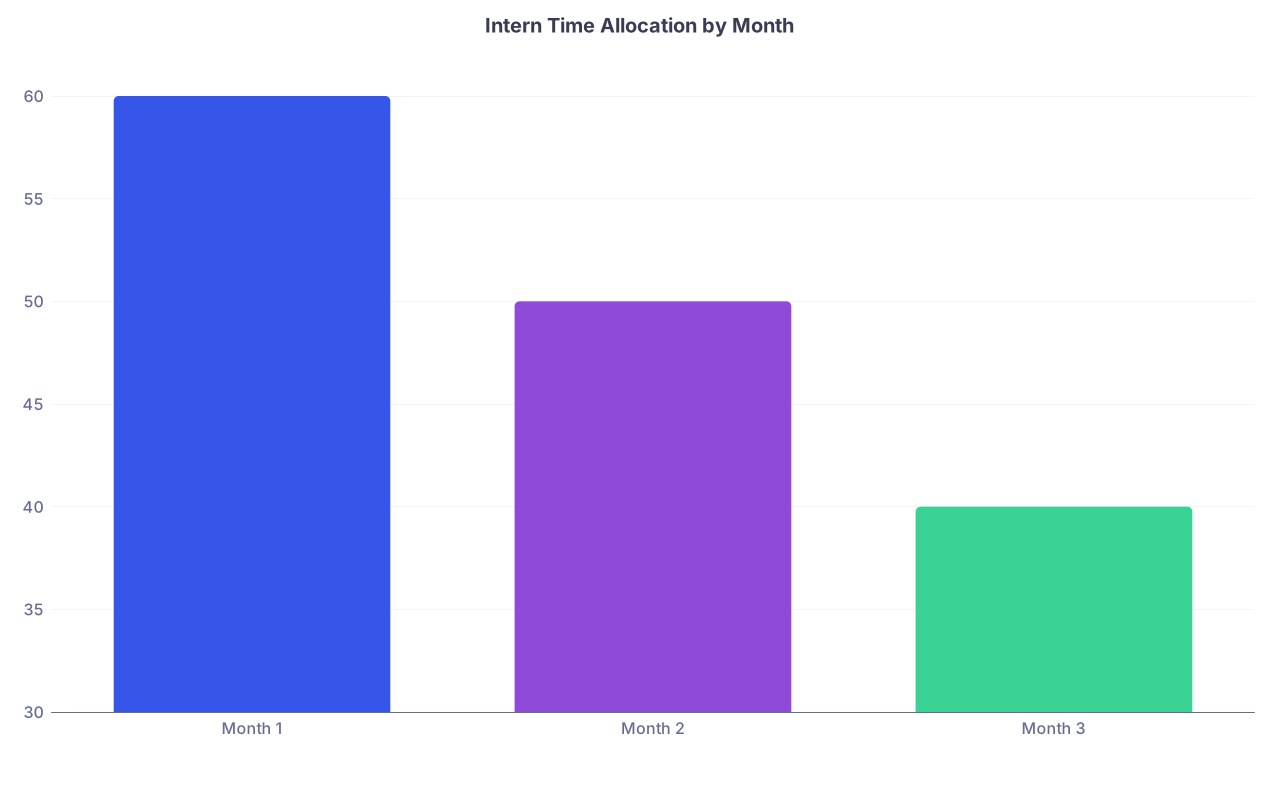
| Category | Value |
|---|---|
| Month 1 | 60 |
| Month 2 | 50 |
| Month 3 | 40 |
(Think of that as “percent of your brain wasted on just trying not to forget stuff” going down as systems improve.)
What this should look like by Month 3
At this point, you should:
- Have one primary task list for the day (not 4 scraps of paper + 3 sticky notes)
- Use a simple visual priority code:
- Circle = must do before rounds
- Star = must do before 5 p.m.
- Box = can move to tomorrow if needed
- Do 2–3 structured “task sweeps”:
- After rounds
- Mid-afternoon
- Before you sign out
Example workflow (the one I’ve seen actually work):
- Each patient on your list gets a mini to-do section.
- During rounds, you add tasks immediately in that space.
- When you sit down, you quickly rewrite them into a master list by urgency.
- Before sign-out, you:
- Check each patient
- Cross off completed tasks
- Move truly non-urgent items to tomorrow’s list
- Add anything undone but important into sign-out
If, by Month 3, you’re still saying “Oh, I forgot to place that order” more than once a week, your system is not good enough.
System 4 (By Week 10–12): Efficient Notes & Orders
By Month 3, your notes and orders should not be what’s keeping you late. If they are, this is fixable—but only with deliberate systems, not by “typing faster.”
You should have by now:
- Templates or dot phrases for:
- H&P
- Daily progress note
- Discharge summary
- Common consult notes (if your specialty uses them)
- Pre-built order sets and favorites in the EMR:
- Common admission order sets (PNA, CHF, DKA, COPD)
- Standard DVT prophylaxis
- Diets, code status, nursing communication orders

Time expectations by Month 3
Rough but realistic targets:
- Progress notes: 3–7 minutes each for stable patients
- Discharge summary: 15–20 minutes if you keep it updated daily
- New admission note: 30–45 minutes tops once you have a template
Your process should look like this:
- During pre-rounding, you mentally outline your note:
- “Assessment: improving CHF, needs diuresis; Issues: K, O2, dispo”
- After rounds, you rapid-fire draft all A/P sections first while the plan is fresh.
- Then you go back and fill in subjective/objective—copy-paste where appropriate, but edit aggressively.
- For discharges:
- Add a 1–2 line daily update to the hospital course section while the patient is still admitted.
- On discharge day, you’re just summarizing and cleaning up, not reconstructing 7 days from memory.
If you’re staring at a blank note at 4 p.m. with 8 patients left, the problem isn’t “notes take time.” The problem is you don’t have a repeatable structure.
System 5 (By Month 3): Communication Rhythms With Nurses and Seniors
By the third month, your face is no longer new. Nurses know you. Your seniors know whether you answer your pager. Your reputation is forming whether you like it or not.
You need:
- A predictable way nurses can reach you (and trust you’ll respond)
- A clear hierarchy for when you call your senior vs attending
- A standard script for calling consults and escalations

| Step | Description |
|---|---|
| Step 1 | Notified of issue |
| Step 2 | Assess at bedside immediately |
| Step 3 | Call senior |
| Step 4 | Order initial labs and interventions |
| Step 5 | Review chart and talk to nurse |
| Step 6 | Monitor and set check-back time |
| Step 7 | Vitals unstable or concern for sepsis |
| Step 8 | Still concerned |
By Month 3, you should already be doing this
- Answering pages within 5–10 minutes unless you are literally in a code or procedure.
- When you call your senior:
- You have vitals, meds, labs, and your proposed plan ready.
- You don’t just say “What do you want to do?” You say, “Here’s what I’m thinking—does this make sense?”
- For consults, you follow a standard pattern:
- Why is the patient here?
- Why are you calling them?
- What have you already done or ruled out?
- What specific question do you want answered?
If by Month 3 you’re still avoiding calling your senior because you “don’t want to bother them,” you’re setting yourself up for missing something serious. Bother them.
System 6 (By Month 3): Sleep, Food, and Commute Routines That Are Not Self-Destructive
By this point, everyone is tired. The difference is that some people are predictably tired and functional, and others are randomly wrecked by every schedule change.
You need:
- A default sleep routine for:
- Normal day shifts
- Pre-call / post-call
- Night float
- A food plan that doesn’t depend on “maybe I’ll find something in the cafeteria”
- A commute rhythm that builds in a buffer
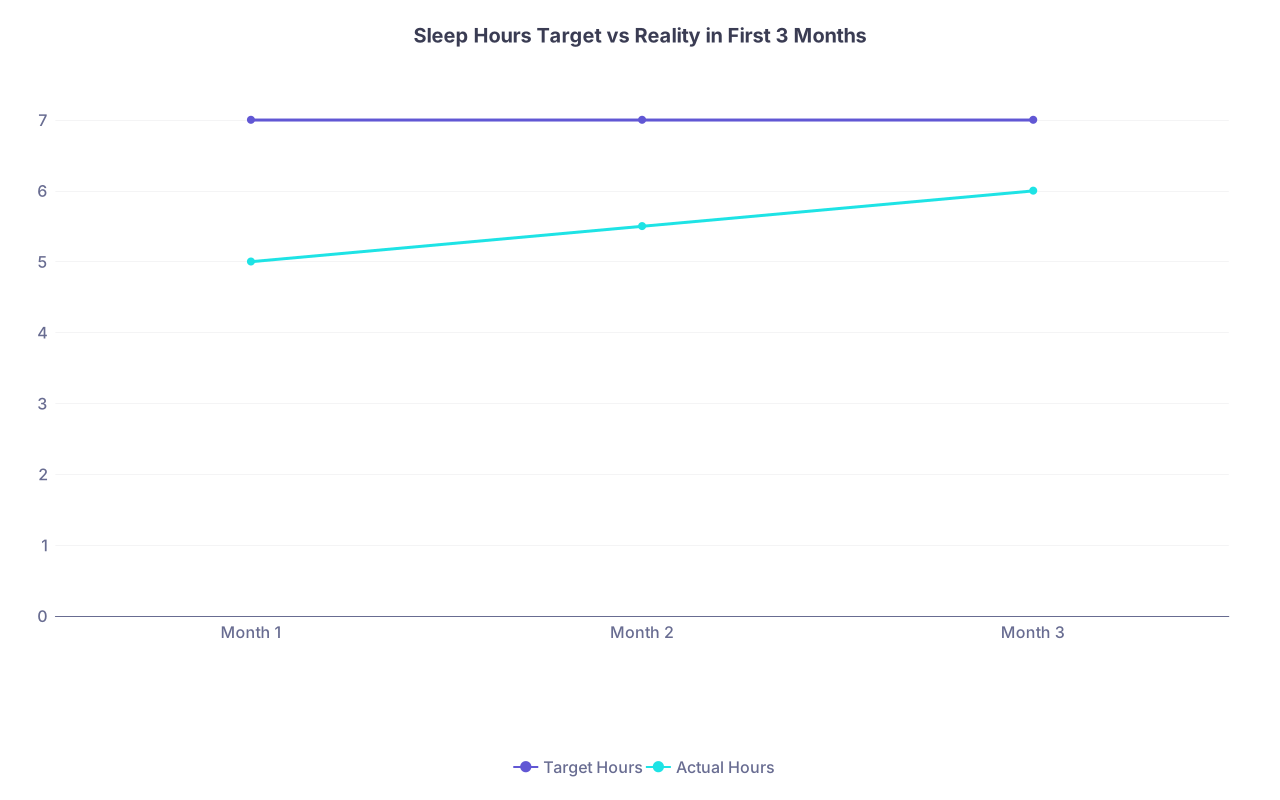
| Category | Target Hours | Actual Hours |
|---|---|---|
| Month 1 | 7 | 5 |
| Month 2 | 7 | 5.5 |
| Month 3 | 7 | 6 |
By Month 3, your routines should look something like:
Day shift pattern
- Fixed bedtime window (e.g., 10:30–11:30 p.m.)
- Alarms that give you 30 minutes to get out the door, not 7
- Backup alarm across the room on brutal rotations
Post-call pattern
- Decide in advance: 3–4 hour nap vs full sleep shift
- No heroic “I’ll just power through” when you are clearly not safe to drive
(If you’re nodding off in sign-out, you nap before driving home. Non-negotiable.)
Food baseline
- You always have:
- One shelf-stable “I could eat this at 3 a.m.” item in your bag (bars, nuts, etc.)
- One water bottle that actually gets refilled
- You know exactly where and when food is available in your hospital (and when the cafeteria closes, which you learned the hard way once).
- You always have:
If you’re 3 months in and still skipping 1–2 meals a day “because work,” you’re sabotaging your own attention span and mood. You are not special enough to function well on coffee alone.
System 7 (By Month 3): Learning & Exam-Prep That Survives the Chaos
By Month 3, “I’ll study when things calm down” is exposed as a lie. Things never calm down. You have to build studying into the chaos.
You need:
- A realistic question target per week (not per day)
- A regular protected micro-block for learning (even 20 minutes)
- A method to capture “I should look this up later” during the day

By Month 3, your learning system should look like:
Weekly Q-bank goal
- Example: 75–100 questions per week
- Broken into:
- 10–15 questions three weeknights
- 20–30 questions on a lighter weekend day
Micro-learning slots
- 10 minutes after lunch before you look at your phone
- 15 minutes on the train or bus
- A single topic a day: “Today I’ll review hyponatremia management.”
Capture questions during the day
- On your list, add a tiny “?” next to topics to review.
- After sign-out, you pick one and spend 5–10 minutes reading an UpToDate or guideline summary.
- That one topic sticks far better than half-asleep reading at midnight.
If by Month 3 you haven’t opened your question bank “since orientation,” you’re already behind. Not fatally. But enough that you need to build a system now.
Week-by-Week: What To Fix If You’re Behind
Say you’re midway through Month 3 and half of what I just said is not happening. Here’s how to triage it over 3–4 weeks.
Week 9–10: Foundation
Focus on:
- Pre-rounding system
- Task management
At this point you should:
- Build/print a standardized patient list and stick with it for the entire week.
- Use one consistent symbol system for tasks.
- Practice doing a full patient pre-round in 5–7 minutes and time yourself.
Week 10–11: Safety & Communication
Focus on:
- Sign-out quality
- Escalation scripts
At this point you should:
- Rewrite your sign-out template and get feedback from a senior.
- For every overnight event you hear about in the morning, ask:
- “Did I anticipate this?”
- “Could I have written a better plan?”
Week 11–12: Efficiency & Sustainability
Focus on:
- Notes & orders
- Sleep-food-study routines
At this point you should:
- Build or steal good templates from co-interns or seniors.
- Decide on a weekly Q-bank number you can actually hit.
- Lock in your bedtime and wake-time for the next 2 weeks and protect it.
If You Only Do One Thing Today
Pick one system that’s currently failing you the most—pre-rounding, sign-out, tasks, notes, or sleep.
Then:
- Spend 15 minutes today rewriting that system on paper:
- What tool you’ll use
- What steps you’ll follow
- When you’ll review and adjust it
- Put that paper in your white coat pocket.
- Tomorrow morning, test it on your very first patient.
At this point you should not be hoping things “get better with time.” They won’t. Systems are the only reason Month 3 doesn’t break you.