
It is 5:00 p.m. Your shift ends at 6:00 p.m.
You just got paged about a low potassium, a nurse is asking about discharge instructions, and your co-resident just said, “Hey, can you sign out in like 15?” Your brain is fried, your note backlog is ugly, and you are trying to remember if that GI bleed patient ever got typed and crossed.
This hour can either be controlled, deliberate, and safe. Or chaotic, sloppy, and dangerous. I have watched both versions. You want the first.
Here is a minute-by-minute, structured way to run the final 60 minutes of your shift so your sign-out is clean, your patients are covered, and your night float does not curse your name.
Big Picture Timeline: The Last 60 Minutes
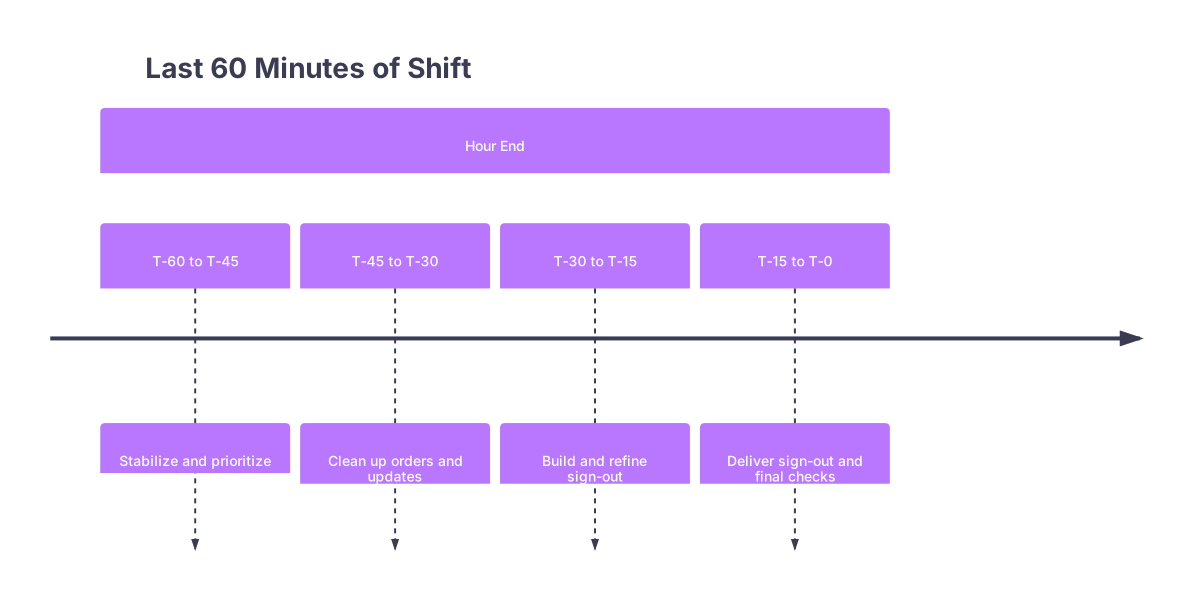
| Period | Event |
|---|---|
| Hour End - T-60 to T-45 | Stabilize and prioritize |
| Hour End - T-45 to T-30 | Clean up orders and updates |
| Hour End - T-30 to T-15 | Build and refine sign-out |
| Hour End - T-15 to T-0 | Deliver sign-out and final checks |
Think of the last hour as four blocks:
- 60–45 minutes left: Stabilize and prioritize
- 45–30 minutes left: Clean up and commit to a plan
- 30–15 minutes left: Build and sharpen your sign-out
- 15–0 minutes left: Deliver sign-out and last safety checks
At each point, you should be doing very specific things. And not doing others.
T–60 to T–45 Minutes: Stabilize and Prioritize
At this point you should stop pretending you can “just quickly finish everything.” You cannot. You need triage.
1. Do a Rapid Situation Scan (3–5 minutes)
Sit down. Open your patient list. Scan it top to bottom.
Ask yourself, very bluntly:
- Who can crash in the next 12 hours?
- Who is new to me or to the service today?
- Who has active diagnostic uncertainty (we do not know what is going on)?
- Who has a time-sensitive test or treatment pending this evening?
Create three mental (or written) buckets:
- Unstable / High-risk
- Potential problems
- Truly stable / Boring but alive
If you want it in a quick structure:
| Bucket | Examples |
|---|---|
| Unstable / High-risk | Pressor changes, rising O2 needs, active GI bleed |
| Potential problems | New fever, rising creatinine, borderline labs |
| Stable | Post-op day 3 doing well, awaiting SNF |
2. Quick Bedside or Chart Recheck of Top-Risk Patients (10 minutes)
For your top 2–4 high-risk patients:
- Re-open vitals, I/Os, last nursing notes
- Check most recent labs and imaging results
- If needed and feasible, physically see them now
At this point you should:
- Clarify goals of care if unclear (if you are punting this to night float, you are doing it wrong)
- Place any obvious missing orders:
- PRNs for pain, nausea, fever, insomnia
- Parameters for holding BP meds, insulin
- Overnight labs that absolutely must happen
If a patient feels “wobbly” to you, assume they will wobble more overnight. Your job now is to:
- Preempt problems
- Write a clear “if X happens, do Y” plan for your sign-out
T–45 to T–30 Minutes: Clean Up and Commit to a Plan
This is the most abused block. People waste it finishing pretty notes or tinkering with wording. That is not your priority.
3. Lock in Orders and “Overnight Strategy” (10–12 minutes)
For each high-risk / potential problem patient, you should now:
Finalize key orders
- Adjust oxygen or diuresis plans that were half-baked
- Place overnight labs with actual reasoning (not “daily labs” laziness)
- Clarify diet / NPO / holds for midnight procedures
Write brief plan updates in the chart only if:
- Major change in status happened
- You changed code status or goals of care
- You gave verbal instructions to nursing that the night team must know
Do not start full narrative masterpieces. Write tight, focused addenda when needed.
- Respond strategically to pages
- Safety issues? Answer now.
- Clarifications you can answer in 20 seconds? Answer now.
- Non-urgent “can you renew PT order” nonsense? If safe, route to oncoming team with clear sign-out note.
4. Decide What You Will Not Finish Today (2–3 minutes)
Harsh truth: you will leave things undone. The difference between good and bad residents is that good ones:
- Know exactly what they are leaving
- Make that transparent in sign-out
- Set up the night float not to be blindsided
At this point you should:
- Make a short list: “Tasks I am explicitly handing off”
- Follow up blood cultures
- Reassess pain regimen
- Call family with CT result
Write it down. Do not trust memory.
T–30 to T–15 Minutes: Build and Sharpen Your Sign-Out
Now you stop trying to “do” and start preparing to hand off. If you are still placing random orders and starting new tasks at T–20, you are doing this wrong.
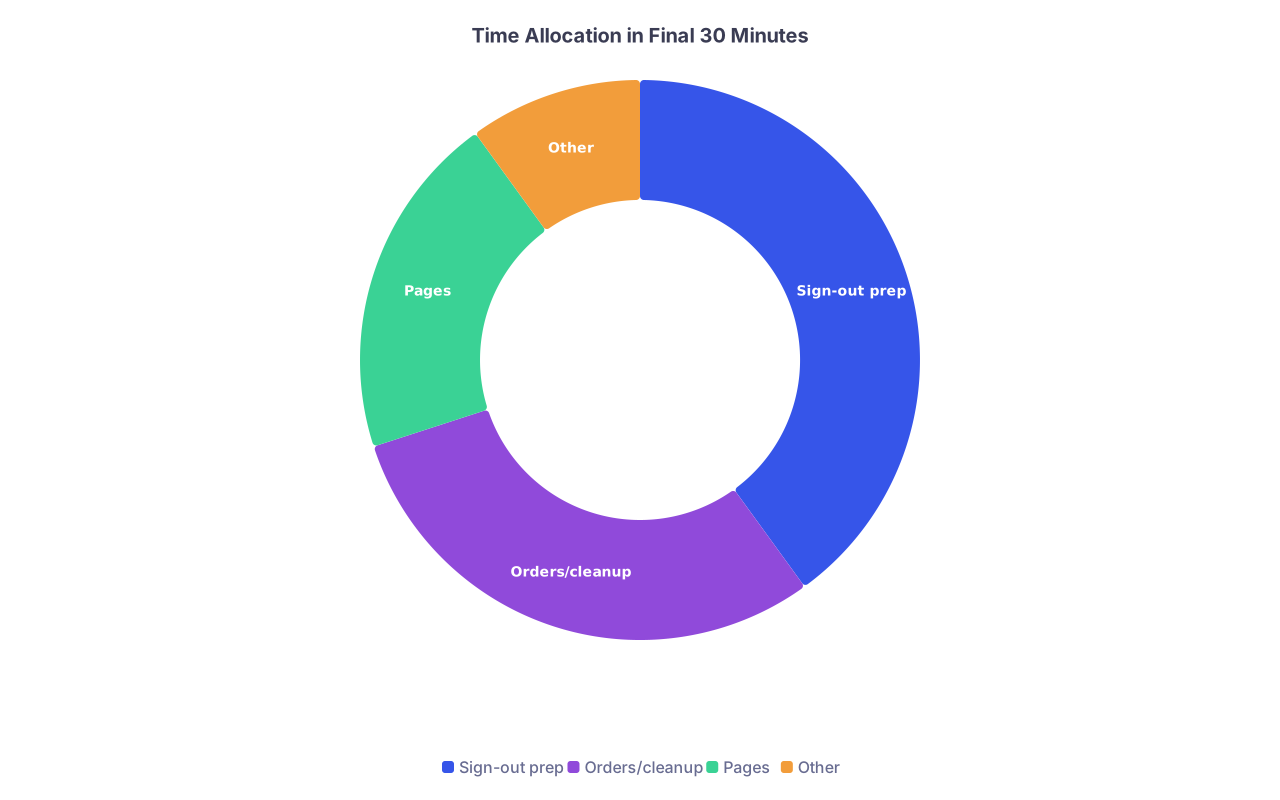
| Category | Value |
|---|---|
| Sign-out prep | 40 |
| Orders/cleanup | 30 |
| Pages | 20 |
| Other | 10 |
5. Build a Structured Sign-Out for Each Patient (10 minutes)
Use a standard framework. I do not care which, as long as you are consistent. A simple one that works on any service:
5-S Framework:
- Status – Sick or stable? Level of concern.
- Story – Why they are here (one sentence).
- Summary of last 24 hours – What changed today.
- Steps pending – Tests, consults, procedures.
- Sleep plan / Safety plan – What to wake you for (or not wake).
Example for a borderline GI bleed patient:
- Status: “Medium concern. Not ICU-level but can worsen; watch vitals / Hgb.”
- Story: “Admitted today with melena and Hgb 6.9; suspected upper GI bleed.”
- Summary last 24 h: “Got 2 units PRBCs, now Hgb 8.1. On PPI drip. MAP >65, no active hematemesis.”
- Steps pending: “GI scoped this afternoon; biopsies pending. AM CBC at 4 a.m.”
- Sleep/Safety: “Call if SBP <90, HR >110, or if melena worsens or new hematemesis. If massive bleed, activate rapid response and page GI fellow on-call.”
At this point your sign-out document (paper, spreadsheet, or EMR tool) should already have:
- Updated code status
- Isolation status
- Allergies
- Attending / service
- Contact numbers if weird (outside consultant, SNF, etc.)
You should not be discovering code status for the first time at sign-out. That is amateur hour.
6. Flag the “Watch Closely” Patients Explicitly (3–5 minutes)
Create a visual or textual flag in your sign-out:
- Asterisk, bold, separate section, or literal label: “HIGH RISK”
For each flagged patient, your sign-out must include:
- What you are worried about
- What the early warning signs look like
- Exact thresholds that trigger calls or escalation
- First steps the night team can take before waking the attending
Example:
- “High risk for delirium – if acutely confused, first check O2, glucose, and bladder scan. Has history of urinary retention. If no obvious cause, consider low-dose haldol, avoid benzos, and page primary.”
This is how you prevent 3 a.m. chaos.

T–15 to T–0 Minutes: Deliver Sign-Out and Final Safety Checks
Now you talk. This is the part people remember: whether your sign-out felt tight, thoughtful, and trustworthy—or rambling and dangerous.
7. Run a Structured, Out-Loud Sign-Out (10–12 minutes)
Set expectations:
- Sit down with the oncoming team
- Close random screens, silence non-urgent distractions if possible
- Say: “Let us go from sickest to most stable” or “Let us follow the board order”
For each patient:
- Give the Status upfront: “Sick / watcher / stable.”
- Tell the Story in one sentence.
- Mention any active problems (not the 20 chronic ones).
- Mention what you actually did today that matters.
- State what might happen overnight and what you want them to do first.
Do not:
- Read the EMR out loud
- Digress into every lab abnormality since 2019
- Apologize 10 times for being behind
Do:
- Own the key issues
- Be explicit about uncertainty (“We do not know if this is CHF or pneumonia yet; here is the plan overnight…”)
8. Confirm Understanding and Clarify “If-Then” Plans (3–5 minutes)
This is where safer teams separate from unsafe ones.
For your high-risk patients, you should ask:
- “If her blood pressure drifts into the 80s, what is the first thing you will check?”
- “If his pain is uncontrolled, what would you start with?”
If they look confused, that is on both of you. Rephrase.
Also:
- Clarify workload expectations: “These three discharges are tomorrow; no overnight work expected unless something changes.”
- Highlight landmines: “Mom is very anxious and calls frequently; family conversation is scheduled with attending tomorrow.”
If there are complex social or behavioral dynamics, the night float deserves a heads-up. Getting blindsided at 2 a.m. by a combative patient with a long history in your ED is brutal and unnecessary.
A Concrete Checklist: The Final 60-Minute Flow
You wanted a structured checklist. Here is one you can literally print and tape above your workstation.
| Time Block | Key Actions |
|---|---|
| T-60 to T-45 | Scan list, identify high-risk, see sickest |
| T-45 to T-30 | Finalize critical orders, decide handoffs |
| T-30 to T-15 | Build sign-out with clear priorities |
| T-15 to T-0 | Deliver sign-out, confirm plans, last checks |
Service-Specific Tweaks (Because ICU ≠ Wards ≠ ED)
Different environments need slightly different emphasis.
ICU End-of-Shift Focus
Emphasize:
- Vent settings and trends
- Pressor changes with dose ranges
- Lines, drains, tubes, and access issues
- Sedation and analgesia plans overnight
Your “if-then” statements here should be very explicit:
- “If MAP drifts below 65 and still oliguric after 250 mL bolus, titrate norepi up by 0.02 increments and call fellow if >0.2 required.”
Inpatient Ward Focus
Emphasize:
- Unstable vitals trends on borderline patients
- New admissions with unclear diagnoses
- Discharge-critical tasks that might spill into overnight
Be very clear which issues can wait until morning:
- “Renal consult placed; no overnight actions needed unless UOP worsens.”
ED Handoff Focus
- Emphasize:
- Disposition plan: “Admit to X if Y; discharge if Z.”
- Critical follow-up tests (CT, trop trend, repeat lactate).
- Which consultants have already been called and what they said.
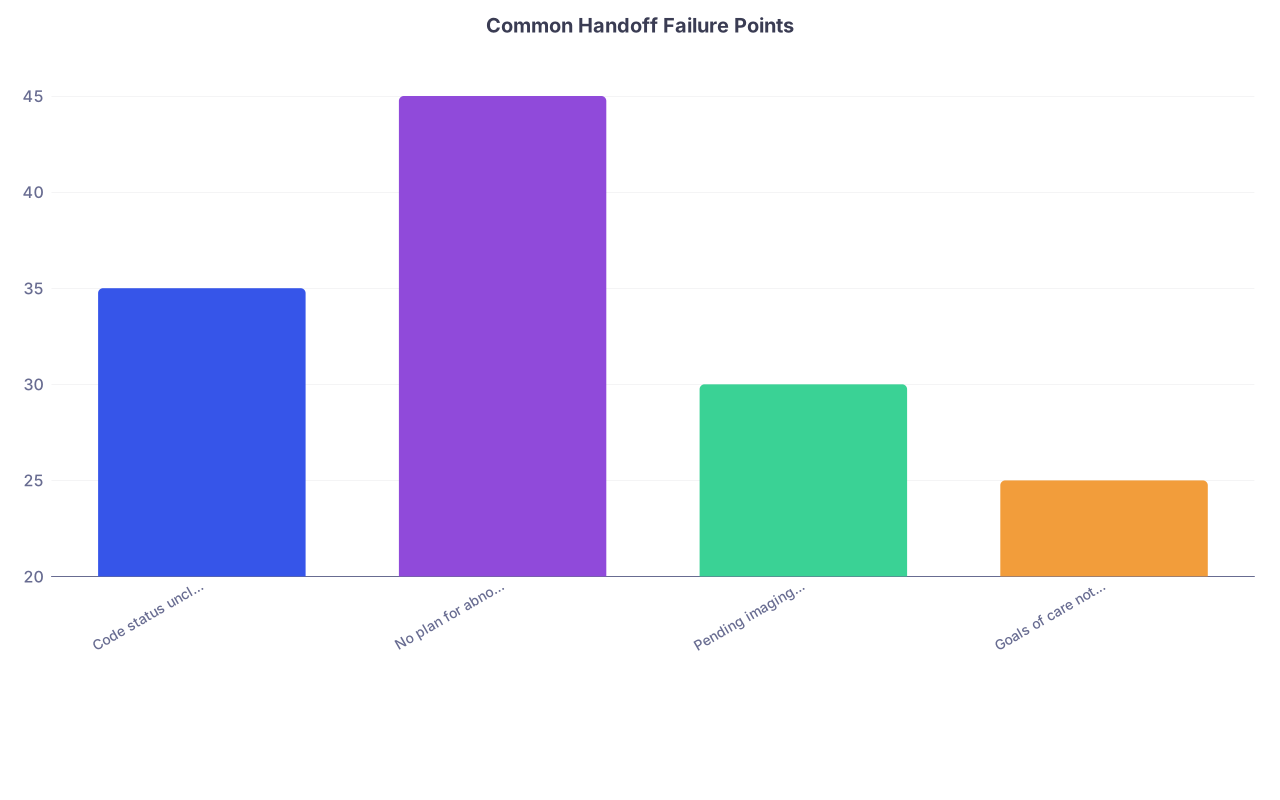
| Category | Value |
|---|---|
| Code status unclear | 35 |
| No plan for abnormal labs | 45 |
| Pending imaging not mentioned | 30 |
| Goals of care not addressed | 25 |
These are the failures that come back to haunt you. They are all preventable with a structured final hour.
Micro “Last 5 Minutes” Checklist
You have signed out. You want to run out the door. Take five more minutes. It saves you later.
At this point you should:
- Re-open your pager / messaging system
- Ensure nothing urgent is sitting unread
- Re-open your patient list
- Confirm all stat / urgent orders are actually signed
- Check your incomplete notes
- Tag any truly essential documentation you must finish post-shift
- Say a clear goodbye
- “I am leaving now. Night team has sign-out. Page them for new issues.”
Then log out of the EMR. Physically leave your workstation. If you hover, nurses will keep treating you as the primary even though sign-out is done.
FAQ (Exactly 3 Questions)
1. What if an unstable situation blows up in the last 15 minutes and derails this whole plan?
Then your priority is patient safety, not your neat checklist. Communicate clearly with the oncoming team: “I am still primary on this crashing patient; let me hand over the rest of the list to you first, then we will manage this together.” Rapid, focused sign-out on the stable group, then both of you handle the crisis. Afterward, the oncoming team owns documenting and ongoing care. Do not try to manage the entire crisis alone while the night float sits idle and uninformed.
2. How detailed should I be for very stable, low-risk patients?
Minimal but competent. One or two sentences are enough: reason for admission, current status, and any overnight expectations. Example: “POD3 from uncomplicated cholecystectomy, pain controlled, tolerating diet, no drains. No expected overnight issues; call only for new fever, hypotension, or uncontrolled pain.” Over-detailing stable patients wastes time and dilutes attention from high-risk ones.
3. My seniors all give chaotic, unstructured sign-outs. Do I really need to be this formal?
Yes. Bad habits at your program do not make them good habits. I have seen near-misses and actual harms from sloppy handoffs: wrong code status, missed critical labs, duplicated or omitted meds. A structured final hour does not slow you down; once it becomes reflexive, it speeds you up because you are not reinventing your process every evening. You do not need permission to be the organized one on your team.
Action step for today:
Before your next shift ends, create a simple three-column note (paper or EMR): “High risk,” “Watchers,” “Stable.” At T–60, force yourself to sort your list into those three columns. That one act will sharpen every other part of your sign-out.