
You’re standing in a cramped workroom at 6:52 pm. Day team is desperate to go home. Night float just walked in with coffee and a thousand-yard stare. Three pagers are going off. Someone mumbles, “Okay, let’s sign out,” and what follows is a blur of half-sentences, initials instead of names, and a lot of “they’re fine, just check labs.”
You nod along.
You absolutely did not catch everything.
If you keep doing sign-out like that, you will get burned. Not “might.” Will.
I’ve watched residents repeat the same dangerous sign-out errors year after year, like a tradition nobody remembers to question. Some of these mistakes lead to near-misses. Some lead to codes. A few end up in M&M with everyone pretending they didn’t see the train wreck forming days earlier at evening sign-out.
Let’s stop you from being the next cautionary tale.
1. Vague “Stable” Patients Who Are Actually Landmines
The laziest, most common sin: “They’re stable, nothing to do overnight.”
Really? Nothing?
Here’s where people screw this up:
- Calling a patient “stable” because their vitals are normal this minute
- Ignoring the trajectory (trending up creatinine, creeping oxygen needs, new confusion)
- Failing to mention the “if X happens, then Y” plan
A “stable” patient at 5 pm can be a rapid response at 1 am. I’ve seen a patient on 3L nasal cannula post-pneumonia labeled “stable” with “no issues” who hit 10L HFNC and MICU transfer four hours later. Night resident had no idea their O2 needs had been climbing all day.
You avoid this mistake by outlawing the word “stable” unless you immediately back it up with specifics.
Bad sign-out:
- “Mr. K is stable, COPD exacerbation, nothing to do.”
Safe sign-out:
- “Mr. K, 72, COPD exacerbation. On 3L NC, was on 2L this morning; sats 90–92%. ABG at 4 pm okay. If he needs more than 4L or RR > 28, please get ABG and page me / consider ICU eval. Not yet on HFNC.”
Notice the difference? You described the direction of the problem and what to watch for, not just the current snapshot.
Rule: Never say “stable” without:
- Current vitals/oxygen requirement in actual numbers
- How that compares to this morning or admission
- What specific change should trigger a call or action
If you can’t do that, you don’t understand the patient well enough to hand them off safely.
2. The Drive-By Handoff: “I’ll Just Email You…”
Another chronic error: treating sign-out like an optional side quest instead of a critical patient safety procedure.
The classic forms:
- Leaving written sign-out and ducking out early (“I put everything in Epic.”)
- Doing a rushed “hallway handoff” while walking to the elevator
- Assuming “they can read the chart if they need to”
Charts are not handoffs. Progress notes are not sign-out. And that three-line summary you typed into the sign-out tool at 1 pm doesn’t magically update itself after the 4 pm decompensation.
I’ve watched a night resident walk into a shift thinking a patient was “watching AKI, BID BMPs,” only to discover the patient had anuria for 6 hours, new K of 6.2, and nephrology consult placed after the sign-out note was updated. None of that was spoken at handoff. Nobody checked.
Do not make these mistakes:
- Leaving before a live verbal sign-out happens
- Assuming written sign-out is enough
- Changing major plans in the afternoon and not updating both the sign-out and the night resident
Your mental model should be: if it changed the plan or risk profile after noon, it needs to be said out loud at sign-out.
Non‑negotiables:
- Face-to-face or at least voice handoff (in person or phone)
- You, logged in, with your list open
- Them, not actively answering a page, actually listening

| Step | Description |
|---|---|
| Step 1 | Prepare updated list |
| Step 2 | Meet night team |
| Step 3 | Discuss sick patients first |
| Step 4 | Discuss tasks and contingencies |
| Step 5 | Clarify questions |
| Step 6 | Update orders or notes if needed |
If you catch yourself saying “it’s in the note,” that’s a red flag. That sentence has preceded a lot of bad nights.
3. Hiding the Sick Patient in the Middle of the Pack
This one is subtle but deadly: you sign out your list in bed number order or alphabetical order, and your truly sick patient ends up third or fourth, buried between “HTN, home tomorrow” and “social admit.”
I’ve literally watched a day resident talk about ten “doing fine” patients before casually mentioning:
“Oh, and Mr. J in 812 had chest pain this afternoon, troponin pending, but he’s probably okay.”
That is insane.
If someone could require rapid response, code, or ICU transfer tonight, they go first. Every time. No exceptions.
Here’s the mental model:
- Sick / unstable / could crash
- High-risk pending results (new troponin, CT head, CT-PE, post-op bleed risk)
- Dispo issues / social stuff / “please refill meds”
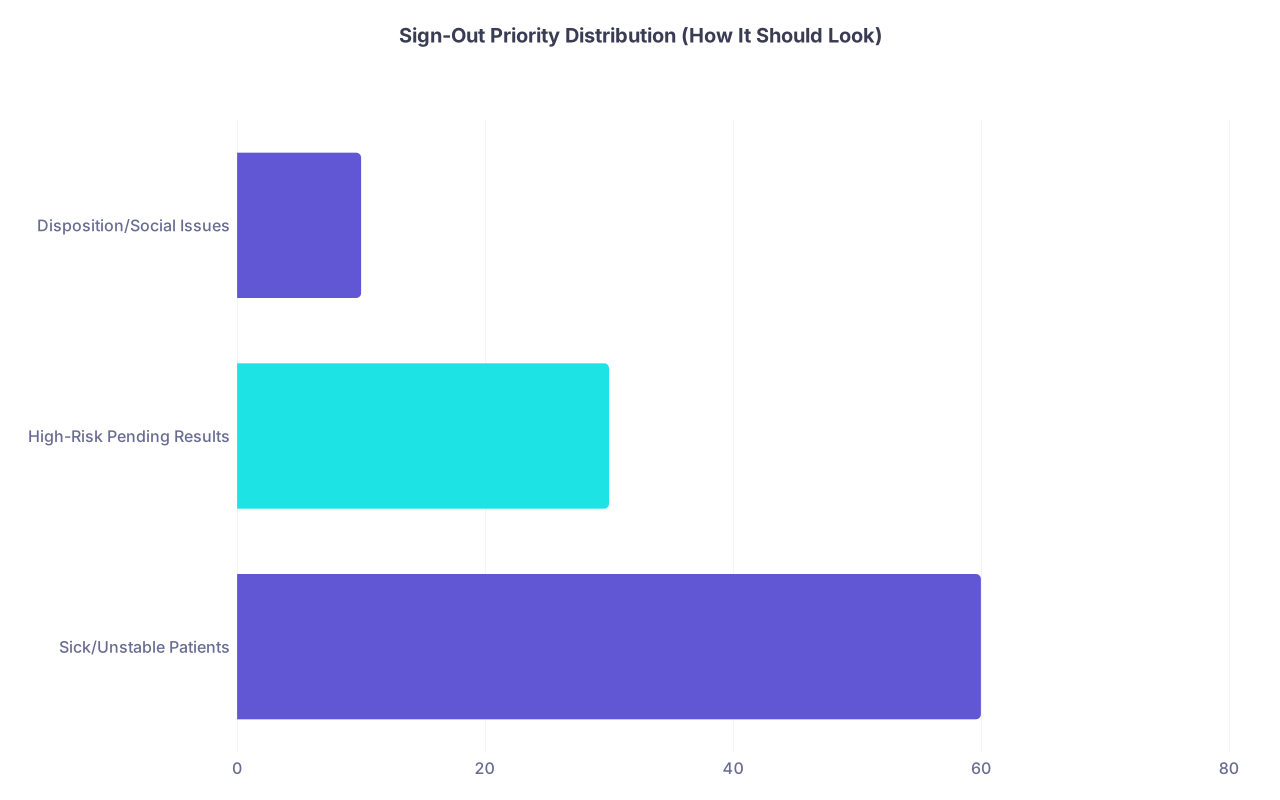
| Category | Value |
|---|---|
| Sick/Unstable Patients | 60 |
| High-Risk Pending Results | 30 |
| Disposition/Social Issues | 10 |
If the night team walks away knowing only one thing from your sign-out, it should be exactly which patients are most likely to ruin their sleep.
Don’t let your sign-out sound like a census report. Order it by risk, not by room number.
4. No “If-Then” Plans (Forcing Night Float to Guess Your Brain)
The next major failure: you describe what happened, but you don’t describe what should happen next if things change.
Example of bad sign-out:
- “She’s been hypotensive all day, we gave fluids, keep an eye on her.”
Keep an eye…for what? How low? For how long? What should trigger action?
Residents do this constantly. They give context with no operational plan. At 3 am, context is useless if the person on call has no clue what you’d actually want done.
Better version:
- “She’s been 90s/50s all day, asymptomatic. We gave 1L LR with minimal response. If MAP < 60 or new AMS, give another 500 LR, repeat lactate, and page ICU fellow.”
Notice the pattern:
- Define the concerning parameter
- Define the threshold that should trigger action
- Define the first action to take
- Define when to escalate / call for help
This is not about micromanaging the night team. It’s about not forcing them to reconstruct your thought process at 2 am when they’ve never met the patient.
If you can’t articulate even a basic if‑then plan for your higher‑risk patients, that’s the mistake. It means you haven’t actually worked through the clinical scenario yourself.
5. Garbage “To-Do” Lists That Guarantee Missed Tasks
Here’s a classic: a sign-out “to-do” list that looks like it was written by someone on their third night of no sleep.
Common screwups:
- Bundling critical and trivial tasks together with no hierarchy
- Writing “check labs” without saying why or what to do about them
- Leaving orphan tasks: “follow up imaging” with no indication of timing or contingency
- No differentiation between “must do” and “nice to do if time”
Then you’re annoyed in the morning when night float didn’t do your “important” task, because it was buried between “reorder home melatonin” and “print PT note.”
Fix this by being explicit and ruthless about prioritizing.
| Style | Example |
|---|---|
| Dangerous | “Check labs, follow up CT, replete K” |
| Safe | “1) MUST: Recheck K at 2 am; if <3.5, replete per protocol. 2) IMPORTANT: Follow up CT chest result; if PE, start heparin. 3) LOW: If time, clarify dispo with daughter.” |
| Dangerous | “Keep an eye on blood pressure” |
| Safe | “Monitor BP q4h; if SBP < 90 or MAP < 60, give 500 LR and call cross-cover.” |
| Dangerous | “Follow up cultures” |
| Safe | “Follow up BCx; if positive with gram negatives, start cefepime and page me.” |
Your overnight list should answer three things for each item:
- What exactly needs to be done?
- By when or under what condition?
- What should they do with the result?
If any of those are missing, you’re setting up the night team to either skip it or guess.
6. Assuming “Everyone Knows This Patient” (They Don’t)
Massive assumption error: you think because the patient has been in the hospital for 12 days, everyone knows their story, so you skip half the background.
They don’t know. Or they forgot. Or this is the third night resident in a row.
So you say: “You know Mrs. L — same issues, chronic train wreck,” and move on. The new cross-cover has never seen her, just arrived from another service, and now is expected to manage her sepsis, chronic pain, and family drama with zero useful context.
I’ve seen errors where night residents:
- Re-started meds that were intentionally held
- Overrode carefully negotiated code status discussions
- Ordered unnecessary tests that had already been done twice this admission
All because nobody gave a lean but complete one-sentence frame.
You don’t need a novel, but you do need a tight anchor sentence:
- “Mrs. L is a 65-year-old with decompensated cirrhosis and recurrent GI bleeds, admitted 10 days ago for variceal bleeding, now stable from that but being treated for hospital-acquired pneumonia.”
Then the current problem:
- “Main issue tonight is pneumonia—on day 3 of zosyn, O2 down from RA to 2L, we’re watching for worsening respiratory status.”
One sentence for who they are. One for why they’re here now. Then today’s problem.
If you open with “You know this patient,” you’re already doing it wrong.
7. Ignoring Code Status and Goals of Care in Sign-Out
This one bites hard.
I’ve seen:
- A DNR/DNI patient coded overnight because the covering resident had no idea
- A full-code elderly patient with metastatic cancer repeatedly scanned, intubated, and sent to ICU when the primary team had been planning a family meeting for comfort care but never mentioned it in sign-out
- A patient with partial code (no intubation) treated as full code because nobody clarified what “do everything but…” actually meant
If your sign-out doesn’t include code status and any active goals-of-care issues for complex patients, you’re creating chaos.
Bare minimum for higher-risk patients:
- “Code status: DNR/DNI, confirmed with family yesterday.”
- Or: “Currently full code, but family meeting scheduled tomorrow; if major deterioration tonight, please call the family and us before aggressive escalation if at all possible.”
You’re not locking in a binding contract; you’re giving the night team a heads up that there’s nuance here.
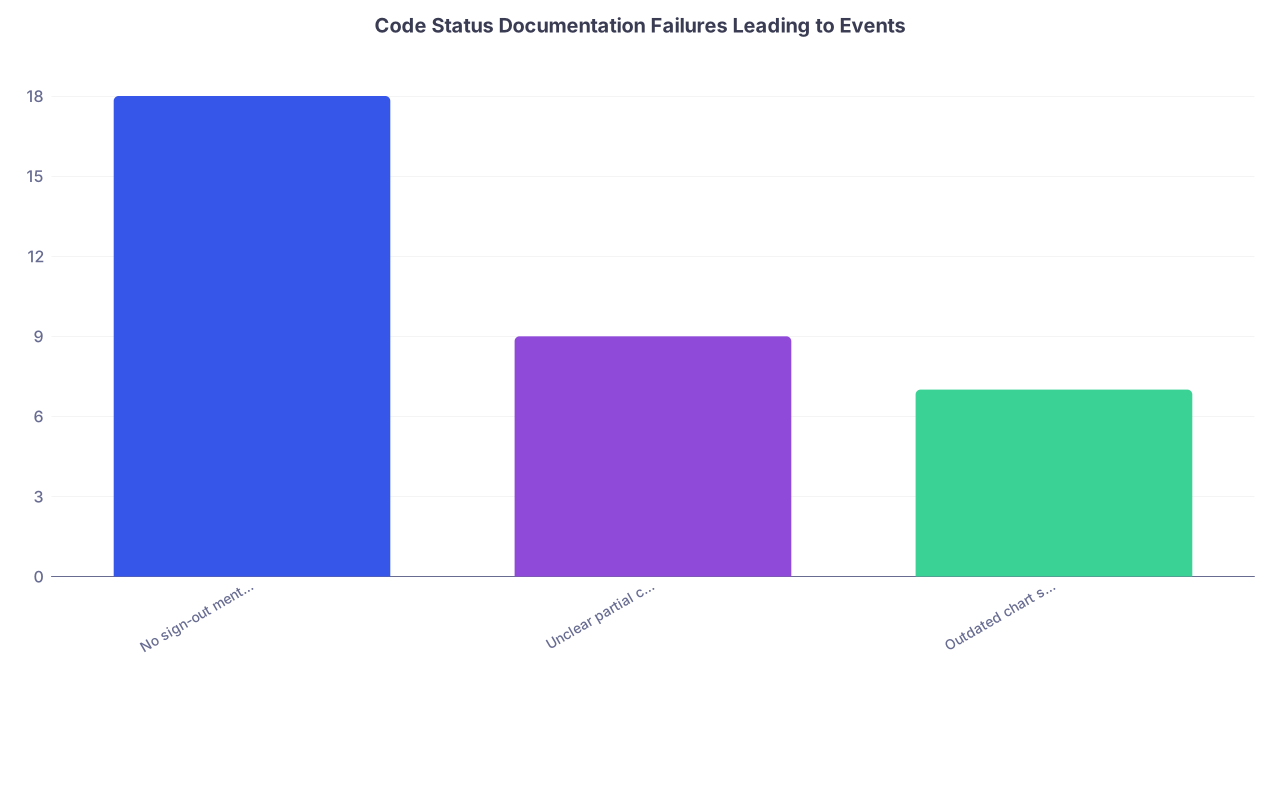
| Category | Value |
|---|---|
| No sign-out mention | 18 |
| Unclear partial code | 9 |
| Outdated chart status | 7 |
If someone is at real risk of crashing tonight and their code status is at all complicated, that belongs in your sign-out. Every time.
8. Overloading Night Float With New, Non-Urgent Work
This is the “garbage shift” mistake: you dump tasks on night float simply because you ran out of time, not because they need to be done at night.
Examples:
- “Please finish med rec on three new admits — I didn’t get to it.”
- “Follow up this outpatient record; family said PCP faxed something.”
- “Can you call the SNF to check if they’ll accept her tomorrow?”
None of this is night work. It’s your unfinished day work.
Here’s what happens: they either don’t do it (and you’re furious) or they try, get buried, and miss actually important stuff like a new fever, rising lactate, or lab derangements.
Use a simple filter:
If it:
- Changes acute management tonight
- Needs to be done before 7 am to prevent delay in care
- Involves active instability or high-risk monitoring
Then it’s appropriate night float work.
If it’s:
- Pure dispo
- Pure documentation cleanup
- A non-urgent clarification that can wait until 8 am
Do not hand it off as if it’s urgent overnight business. Write yourself a task. Put a bold note in the chart. But do not disguise your procrastination as sign-out.
9. Skipping Closed-Loop Communication
You say something like:
- “Please recheck Hgb at 2 am. If <7, transfuse 1 unit.”
Night resident nods, you move on. No one repeats it back. No one confirms what threshold, what consent status, if type & screen is current.
Fast forward:
Hgb comes back 6.7. Nurse pages night resident. Night resident hasn’t seen transfusion consent or an active type & screen, and can’t find your plan. Blood doesn’t start until 5 am. Patient gets symptomatic.
Big chunks of sign-out fail not in what was said, but in what was misunderstood.
You don’t need to run a military briefing, but at least for your top 2–3 risky patients, force a quick echo:
- “So for Mr. R: you’ll recheck K at 2 am, if >5.5 start insulin/D50 and call ICU fellow — does that sound right?”
And let them say it back. Out loud. Not just “yeah.”
It feels awkward at first. Do it anyway. The one time it catches a misunderstanding, you’ll realize why airlines do this obsessively.
10. Treating Sign-Out as a Chore Instead of a Clinical Skill
Last big mistake: acting like sign-out is the annoying thing between you and going home, instead of a procedure with just as much risk as placing a central line.
Because when you view it as a chore:
- You don’t prep your list before sign-out
- You forget who’s sickest until someone asks
- You give zero thought to if‑then plans
- You sign out from memory, which is usually wrong by 7 pm
When I watch strong senior residents, they do something very different:
- Update sign-out during the day as plans change
- Mark their sickest and highest-risk patients with some visual signal (stars, bold, color)
- Slow down for those patients, even if that means breezing through the “totally fine going home tomorrow” crowd in 5 seconds each
- Pause after each big plan and ask, “Any questions on this one? They might be rough tonight.”
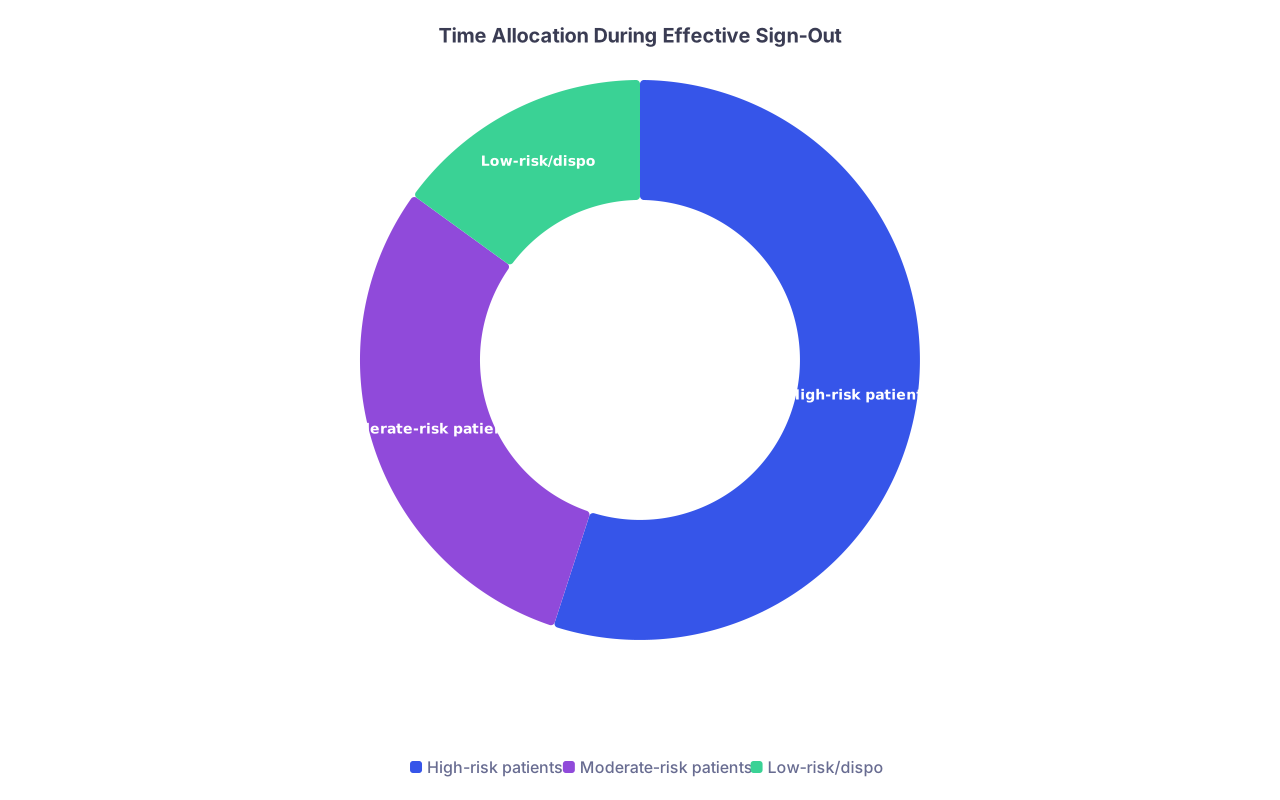
| Category | Value |
|---|---|
| High-risk patients | 55 |
| Moderate-risk patients | 30 |
| Low-risk/dispo | 15 |
You don’t need a formal sign-out curriculum to fix your handoffs. You do need to treat them as dangerous if done badly. Because they are.
11. A Simple, Safe Sign-Out Structure (That You Actually Stick To)
If your sign-out is chaos, steal this skeleton and do not “improve” it until you can execute it reliably.
For each patient, in roughly this order:
Who they are & why they’re here
- “Mr. A, 68, CHF exacerbation, admitted yesterday with shortness of breath.”
Today’s key events / changes
- “Diuresed with 80 IV lasix, net –1.8L, weaned from 4L to 2L.”
Current risk / trajectory
- “Still on 2L, RR 22, borderline; could worsen overnight.”
If‑then plan for the night (if any)
- “If he needs >4L or RR > 28, please get CXR, repeat BNP, and page me / consider ICU consult.”
Explicit tasks
Code status / special considerations (for higher risk)
- “Full code, discussed today and confirmed.”

If you can’t say those six pieces in under a minute for a complex patient, you either don’t know the patient well enough or your mind is cluttered with useless detail.
Start with your sickest 2–3. Make sure those are rock solid. Then move down the risk ladder.
12. Hidden Cultural Traps That Make You Worse at Sign-Out
One last set of landmines nobody warns you about:
Peer pressure to be fast
Everyone’s tired. People sigh if you take 20 extra seconds. Ignore it. You’re not reciting poetry. You’re transferring liability and responsibility. Nobody remembers the sign-out that took 5 minutes longer. They remember the one that ended in a code.False confidence in “the system”
“But the EMR has alerts, nurses will call, labs will flag!” Great. Until an alert gets ignored, a nurse is covering three extra patients, or the lab is delayed. Sign-out exists exactly because systems are imperfect.Hierarchy nonsense
Interns scared to push back on seniors who do sloppy handoffs. Seniors assuming interns can “figure it out.” This is how mistakes survive. If you don’t understand a plan, ask. If your senior’s sign-out is hot garbage, clarify right then: “Wait, I didn’t catch what you want me to do if his BP drops.”

- Documentation vs communication confusion
You think because you documented beautifully, you signed out well. Wrong. Those are related but separate skills. The note is for the chart. Sign-out is for the human who has to make decisions at 3 am.
13. How to Know Your Sign-Out Is Actually Getting Better
You’ll know you’re fixing these mistakes when:
- Night float pages you less for “what did you want me to do with this?” and more for “this happened, I followed your plan, anything else you’d add?”
- Your sickest patients are the ones night float mentions first in the morning — and they already knew those were your sickest going in
- Fewer “uhhh we didn’t know that was an issue” moments on rounds when reviewing overnight events
- Nurses start saying things like, “Your sign-out for Mr. X really helped us last night when he started to tank.”

If you aren’t seeing any of that, assume you’re still making some of the mistakes above. Ask your night colleagues directly: “What in my sign-out is unclear or unhelpful?” You’ll get brutally honest feedback if you show you actually care.
The Bottom Line: What You Cannot Afford to Screw Up
Keep this tight:
- Do not hide risk. Your sickest and highest-risk patients must be obvious, detailed, and first.
- Do not be vague. “Stable,” “keep an eye,” and “check labs” are useless without numbers, thresholds, and actions.
- Do not treat sign-out as paperwork. It is a clinical procedure with real morbidity attached to how well or badly you do it.
You’ll make plenty of mistakes in residency. Don’t let a sloppy, preventable sign-out be the one that haunts you.