
Senior residents who reliably leave on time are not “lucky” or on “easy rotations.” They’re running a completely different playbook than the rest of the team—and most of it’s invisible if you only watch the surface.
I’ve watched this from the attending side and from the resident side. The same pattern every year: a few seniors seem strangely unhurried at 4:30 pm while everyone else is drowning, rewriting notes, finishing orders, and getting guilt-tripped into staying late. Those seniors are not necessarily smarter. They simply understand the hidden workflow game that nobody formally teaches you.
Let me show you what they’re actually doing.
The First Secret: They Redefine “Workday” in Their Heads
The residents who stay late think the workday starts at sign-out and ends when tasks are done.
The seniors who leave on time quietly flip that.
Their “workday” actually starts the second they step onto the floor in the morning. From that moment, they’re already building toward an efficient sign-out. Every interaction, every click, every scribble is aimed at one question:
“How do I make 4–5 pm boring?”
That’s the whole game.
The ones who stay late? They let the day happen to them. They preround, see patients, write notes, answer pages, then “start wrapping things up” around 4 pm. Which is already too late. By then, they’re buried under a pile of unsigned notes, unplaced orders, and vague plans.
Good seniors front-load. They move “wrap-up work” into the late morning and early afternoon so that by 3–4 pm, the only things left are true surprises: a new admission, a rapid response, a bad lab. Not six unresolved “oh yeah, I still need to…” items.
Here’s the unglamorous truth: leaving on time is 80% about what you do between 9 am and 1 pm, not 4–6 pm.
How They Structure the Day (When No One’s Looking)
Let me walk you through what a typical day looks like for a senior who consistently gets out around the scheduled time.
Not the version they tell on rounds. The real version.
1. Pre-rounding With a Purpose, Not to “Collect Data”
Juniors (and overwhelmed seniors) walk into rooms to get vitals, “interval history,” and exam data, then figure out the plan later.
Efficient seniors do it differently. They:
- Skim overnight events and vitals before walking into rooms.
- Walk in already holding a rough mental plan: “Probably DC fluids, push diuresis, tighten insulin, wean O2 if able.”
- Use the encounter to confirm or adjust that plan, not build it from scratch.
So by the time they finish the first pass:
- They already know 80% of what the day’s orders and plans will be.
- They’re not sitting at 11:30 am staring at the screen “thinking through” what to do for each patient from zero.
I’ve sat in workrooms where at 11:45 one intern is still going “Okay, what’s the plan for 504 again?” while the strong senior has already:
- Placed all obvious housekeeping orders.
- Lined up consults.
- Messaged case management about potential discharges.
They don’t “save” thinking for later. They think now.
2. The 10–11 am Crush: Where Seniors Quietly Win the Day
Between 10–11:30 am is where the hidden separation happens.
Bad day pattern: residents are still finishing prerounds, answering random nurse pages, and starting one note, then getting pulled into a family meeting, then back to a note, then a random social work question. Total fragmentation. Nothing actually gets finished.
Good seniors treat 10–11:30 am like money.
This is usually what they target in that window:
- All “no-brainer” orders placed (fluids, diuretics, sliding-scale adjustments, obvious imaging).
- Key pages sent to consultants with tight, focused questions.
- Likely discharges identified and discharge work started, not delayed.
They also start notes early. Yes—real seniors start writing skeleton notes late morning, not at 3 pm.
They’ll quickly template:
- Assessment/Plan bullet points for each problem.
- A short “story” line for new patients.
- Copy forward the structure but adjust the thinking, not the fluff.
By lunch, their notes aren’t perfect, but they’re 60–70% done. What’s left is just cleaning up and updating with midday data.
Everyone else? Hasn’t typed a single line yet. So at 4 pm, they’re writing complete notes, not finalizing.
3. The Hidden Tool They All Use: The Real-Time Task List
The biggest difference I see as faculty: the residents who leave on time never “keep it in their head.” That’s amateur hour.
They run a living, breathing task list that’s brutal in its simplicity. No fancy app needed—index card, folded patient list, OneNote, doesn’t matter. But the structure is always something like this:
| Column | Purpose |
|---|---|
| Patient Name | Who |
| Must-Do Today | Non-negotiable tasks |
| Nice-To-Do | If time allows |
| Pending | Waiting on labs/consults |
It looks deceptively simple, but used correctly, it’s lethal.
Here’s how the insiders actually use it:
- Every time a nurse pages with a request that is not emergent, it becomes a written task, not an immediate action.
- Every time a consultant suggests “follow-up labs this afternoon,” it goes in Pending—not a vague mental note.
- Every time they think, “I should check that CT when it’s back,” they write it down with a time.
And multiple times a day, they ruthlessy re-triage that list.
You’ll hear them say quietly to themselves:
“Is anything on here actually going to hurt someone if it waits for night float?”
That’s the calculus. Not “does it feel unfinished?” but “is it unsafe?”
Residents who stay late treat everything as ASAP. Seniors who leave on time draw a sharp line between urgent, important, and nice-to-have.
The Consult and Page Game: Where Hours Get Wasted
If you watch a strong senior and a struggling intern handle pages side-by-side, it’s painful. The intern reacts to every page like it’s a code. The senior runs triage.
Here’s the ugly truth: you’re not supposed to instantly respond to every non-urgent page. You’re supposed to respond appropriately.
Let me tell you how seniors actually do this behind the scenes.
They Batch Non-Urgent Pages
Efficient seniors mentally bucket incoming pages into three categories:
- Immediate – airway, breathing, circulation, mental status change, uncontrolled pain, clear safety issue.
- Important but not emergent – med reconciliation, family update, “can we change this med to PO,” “needs bowel regimen,” insulin tweak.
- Clerical / minor – “patient wants snack order changed,” “needs sleeping med,” “IV pump kept beeping, but it’s fixed now.”
They’ll respond to group 1 immediately. For group 2, they often say:
“Got it, I’m tied up with a patient now. I’ll circle back in the next hour. If anything changes or worsens, page again.”
Then they add it to their task list and hit multiple similar tasks at once between other work.
Group 3? Often gets addressed during the next routine patient check-in or handed off at sign-out if truly minor.
You know what attendings and nursing leadership care about? That urgent issues are addressed quickly and that communication is clear. They aren’t timing your response to non-urgent pages down to the second.
But juniors act like they’re being graded for sprinting to every bedside for a senna order.
They Control the Narrative With Consultants
The other massive time sink is messy consults.
Bad pattern: you call a consult with a five-minute rambling presentation, vague question, then spend the rest of the afternoon dealing with follow-up pages because the consultant doesn’t understand what you want.
Good seniors prep the consult in 60–90 seconds before dialing:
- One-line snap summary (“65-year-old with decompensated cirrhosis, now with acute kidney injury”).
- The specific question (“We’re asking about starting terlipressin vs albumin challenge alone and if you think this is HRS.”).
- What’s already been done (“Already gave 1.5g/kg albumin, held diuretics, no contrast, stable blood pressures.”).
Then when the consultant gives recommendations, efficient seniors:
- Ask clearly: “What absolutely has to happen today before 5 pm, and what can reasonably wait until tonight or tomorrow?”
- Clarify follow-up: “If labs are back at 6 pm, okay to have night float implement recs?”
This is the piece no one tells you: it is totally acceptable to frame timing, as long as you’re not compromising safety. Consultants will often volunteer, “If it’s after 5, the night team can just page our on-call with the labs.”
Seniors who leave late never ask that question. So they trap themselves into “I need to stay to follow up that 6 pm BMP for nephrology.”
Notes, Orders, and Discharge: The Trifecta That Eats Your Evening
Every single program director I know quietly watches for this skill: can you get the core work done by mid-afternoon.
Not “do you leave at 4.” But can you have the day’s thinking and planning finished by then.
Here’s how the residents who can consistently do that structure their work.
Notes Are a Tool, Not a Creative Writing Exercise
Seniors who leave on time do not obsessively polish notes. They’re accurate, concise, and structured. That’s it.
Their approach usually looks like this:
- Use a standard internal structure for common problems (CHF, COPD, DKA, sepsis) with premade phrases they adapt.
- Draft Assessment/Plan sections first, early in the day, while their thinking is fresh.
- Fill in subjective/objective data later, often in small chunks between tasks.
I’ve seen smart interns blow 30 minutes “massaging” an HPI nobody will read carefully. Meanwhile, the senior has banged out four solid notes in that time.
If you want to leave on time, your standard for notes has to shift from “perfect narrative” to “clear, defensible, and fast.” Tradition dies hard here, but honestly, attendings and coders care far more about clarity and key elements than your elegant prose.
Orders Are Placed “Upstream,” Not After Rounds
Another trick: seniors anticipate common orders before rounds formally start.
For example, on a typical medicine service, they’ll:
- Pre-emptively order morning BMPs on the right patients without waiting to be told.
- Hold or adjust diuretics if patient came in hypotensive overnight, pending exam.
- Queue but do not sign non-urgent but likely-needed orders (yes, you can load them, review on rounds, then click sign).
Then on rounds, when an attending says, “Let’s increase lasix and repeat BMP at 3,” they’re not building that from zero. They already have half the work lined up.
Residents who stay late often spend from 2–4 pm just catching up on orders that could have been queued or decided on between 9–11 am.
Discharges Start Before Anyone Mentions “Discharge”
Let me tell you what good seniors say on rounds by 10 am:
“Two likely discharges today: 504 and 511. I’ve teed up meds, PT signed off, and I flagged case management. Just need your blessing.”
Every year, I watch interns “discover” a possible discharge at 2 pm, start paperwork at 3, and finally wheel the patient out at 6:30.
Senior trick: anyone who might be a discharge in the next 24–48 hours gets a slow-motion runway:
- Discharge summary started the day before.
- Med rec drafted early; confirm details later.
- Follow-up appointments requested in the morning, not at 4:30 pm.
Most hospitals are glacial with case management and pharmacy. If you wait until afternoon, you’ve already lost.
Take a look at where the time actually goes for residents who stay late vs those who leave on time:
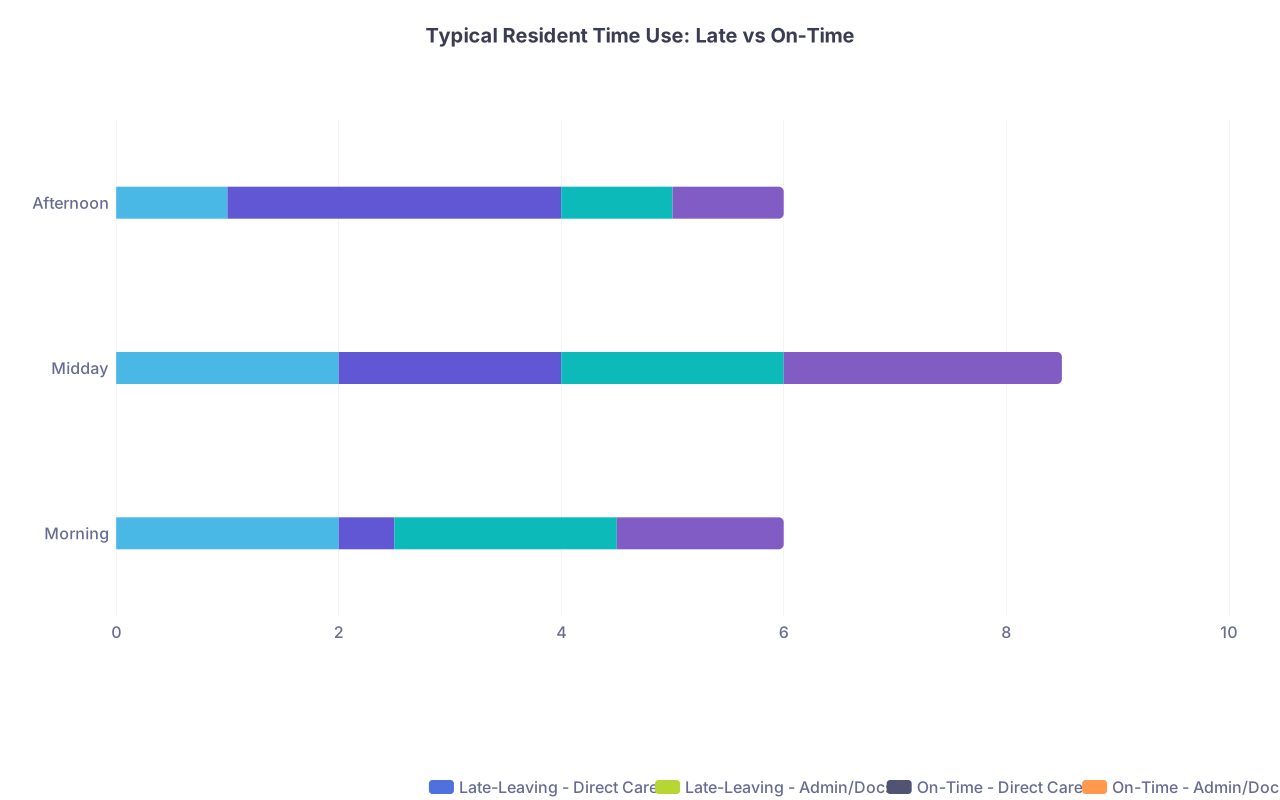
| Category | Late-Leaving - Direct Care | Late-Leaving - Admin/Docs | On-Time - Direct Care | On-Time - Admin/Docs |
|---|---|---|---|---|
| Morning | 2 | 0.5 | 2 | 1.5 |
| Midday | 2 | 2 | 2 | 2.5 |
| Afternoon | 1 | 3 | 1 | 1 |
The ones leaving on time have shifted their documentation/admin load earlier in the day. Same total hours. Different distribution.
The Social Engineering Piece Nobody Admits Out Loud
Workflow isn’t just clicks and orders. It’s people.
Seniors who leave on time are not always the most clinically brilliant, but they almost always do the following three social things extremely well.
1. They Train Their Team (Up and Down)
Watch a good senior in July. By the end of the first week, their team knows:
- How they like sign-outs structured.
- What actually needs a page vs what can wait 15–30 minutes.
- Which routine questions the intern or medical student can answer without dragging the senior in.
They’ll say things like:
“If it’s vitals stable and the question is about nausea, pain, or sleep, page the intern first. If anything feels off with airway, breathing, mental status, or hypotension, page me directly and overhead if needed. I want you to err on the side of safety—but I don’t want you waiting on me for basic stuff you can handle.”
Upwards, they manage attendings too. They clarify expectations early:
“My goal is to have the team largely wrapped by around 4–4:30. Are there particular things you always want done before then?”
That does two things: it shows initiative and subtly sets a shared “end of day” reference point.
2. They Say “No” Without Saying “No”
The residents who always get stuck late have one common trait: they say yes to everything without boundaries.
Strong seniors protect their time without being jerks. You might hear:
- “I can’t sit for a full family meeting at 4:30, but I’m happy to spend ten minutes now going over the basics and then have night float follow up if they have more questions.”
- “I’d love to go deep into medication education with them—can we loop in pharmacy this afternoon? I have to finish time-sensitive discharges right now.”
They don’t blow people off. They redirect. They set limits. They trade depth for safety and clarity when the clock is ticking.
The quiet truth: the hospital will always ask for more than you can reasonably give in a 10–12 hour day. If you never put a boundary anywhere, the system will happily eat your entire life.
3. They Use Sign-Out as a Weapon, Not a Guilt Session
Weak teams treat sign-out as a confession: everything that didn’t get done is framed as failure.
Strong seniors see it as a handoff of care, not of virtue. If it’s safe for night float, it’s fair for night float.
Here’s what their sign-out style looks like:
- Clear, concise problem-based lists.
- Explicit “to-do tonight” vs “FYI, no action unless change.”
- No apologizing for reasonable deferrals.
They’ll say:
“Labs in 603 are pending, ordered for 5 pm. If the sodium comes back under 122, call nephrology on-call. Over 122, just document and we’ll adjust in the morning.”
Not:
“I’m so sorry, I didn’t have time to follow the sodium, you might need to…”
The first is clean and respectful. The second is just dumping emotional baggage on the night team.
You want night float to trust your sign-out, not resent you. Clarity and safety get respect. Excess apologizing reads as disorganization.

| Step | Description |
|---|---|
| Step 1 | Arrive and Review Overnight |
| Step 2 | Pre-round with Provisional Plans |
| Step 3 | 10-11 AM - Place Orders and Call Consults |
| Step 4 | Late Morning - Draft Notes and Identify Discharges |
| Step 5 | Afternoon - Clean Up Tasks and Finalize Notes |
| Step 6 | 3-4 PM - Re-triage Task List |
| Step 7 | Focused Sign-out with Clear To-dos |
| Step 8 | Leave On Time Unless True Emergency |
That’s the skeleton. Most seniors who leave on time run some version of this, even if they don’t articulate it.
How You Actually Start Doing This Tomorrow
This isn’t theory. You can start shifting your day on the next shift.
If you’re drowning right now, do not try to overhaul everything. Start with three moves.
Start a ruthless task list today. Everything not emergent goes there. Re-triage it three times a day: late morning, early afternoon, pre–sign-out. Ask the question: “Does night float need this done, or do I just feel bad deferring it?”
Move your notes earlier. Force yourself to write the A/P for every patient by noon, even if it’s ugly. Clean it up later. You’ll hate it the first few days. Then you’ll notice how much less brain-dead you feel at 4:30 when you’re not starting notes from zero.
Decide your likely discharges early. Before 11 am, name your 0–2 realistic discharges. Start the paperwork then, not “later when things calm down” (they never do).
Everything else—consult scripting, page triage, social boundaries—will layer on as you get comfortable.
FAQ (exactly 3 questions)
1. Won’t attendings think I’m lazy if I consistently leave on time?
No. Attendings think you’re lazy when you cut corners on patient care, miss follow-ups, or seem disengaged. If your notes are done, plans are clear, discharges move smoothly, nurses trust you, and night float isn’t calling about unfinished business, most attendings do not care if you walk out at 4:45 or 6:15. In fact, a lot of us quietly respect the residents who show they can handle the work efficiently. The ones we worry about are the perpetually frantic, not the ones who are organized enough to leave.
2. How do I balance helping my co-residents with protecting my own time?
You’re not a bad teammate for having boundaries. The senior residents everyone admires help strategically. They’ll jump into a crashing patient, a new septic admission, or a messy family meeting. But they won’t unthinkingly adopt every “can you help me finish my notes” request at 5:30. The line I like is: “I have 20 minutes before I need to go. What’s the highest-yield thing I can do for you?” That way you’re helpful without being endlessly absorbent.
3. Is this even realistic on brutal rotations like ICU, trauma, or nights?
On those rotations, leaving “on time” might still mean long days. The game changes from “out at 5” to “not hemorrhaging unnecessary extra hours.” The same principles still apply: front-load tasks, batch pages, start notes earlier, identify discharges early in the day, and run a ruthless task list. You may not walk out at the scheduled minute, but you’ll shave 30–90 minutes off most days and, more importantly, you’ll feel less out of control. And that sense of control is what keeps you from burning out halfway through the month.
Key points, stripped down. Residents who leave on time:
- Front-load their thinking, documentation, and orders into the late morning and early afternoon.
- Run a real-time, written task list and ruthlessly separate “must-do today” from “safe to defer.”
- Use sign-out, boundaries, and social engineering to protect their time without compromising safety.
That’s the hidden playbook. Start small, pick a couple tactics, and you’ll feel the difference within a week.