
What is the tiny thing you do between 4:45 and 5:15 a.m. that guarantees you are always the last one to show up for pre-rounds?
You probably think the problem is “I just need to move faster.” No. The problem is usually five or six small, predictable mistakes that you repeat every single morning. And they stack. That is how you end up scrambling onto the unit at 6:32, trying to pretend you “were just in the stairwell.”
Let me walk through the most common pre-rounding errors I have seen residents make—over and over—until it cost them reputation, evaluations, and at least one awkward “we need to talk about timeliness” meeting with the PD.
Error #1: Starting Chart Review Too Late (and in the Wrong Order)
You know this one. You open Epic at 5:40 a.m. for 7:00 a.m. rounds with 10–12 patients and somehow still think, “This is fine.”
It is not fine.
The biggest upstream mistake: no fixed time for first chart login and no strict order for review.
Here is what people mess up:
- Rolling out of bed and checking messages first instead of opening the EMR.
- Starting with the most complicated patient, getting sucked into the rabbit hole of notes, imaging, and consults.
- Clicking into every single note from the last 24 hours like you are writing a book chapter, not pre-rounding.
Your job before seeing the patient is simple: answer a tight set of questions, fast.
For each patient, you need:
- Overnight events? Code, rapid, new pressors, new O2, called nurse, agitation.
- New vitals trends? Fever, soft pressures, tachycardia, desats.
- New labs/imaging? Hgb drop, Cr change, Na swing, lactate, trops, new CXR/CT.
- New orders/consult recommendations?
That is it for pre-rounds.
What not to do at 5:30 a.m.:
- Reading entire progress notes from every consultant.
- Scrolling back 3–4 days of notes “for context.”
- Building a full assessment and plan for every problem before seeing the patient.
If you are always late, flip this:
- Set a non-negotiable EMR start time (e.g., 4:45 or 5:00 a.m. depending on census).
- Run the list in a fixed sequence: from sickest to least sick, but in the same physical order you will walk the unit so you do not double back.
- Give yourself a time cap: ~2–3 minutes per stable patient, 5 for the complex one. Use a timer the first week. Yes, seriously.
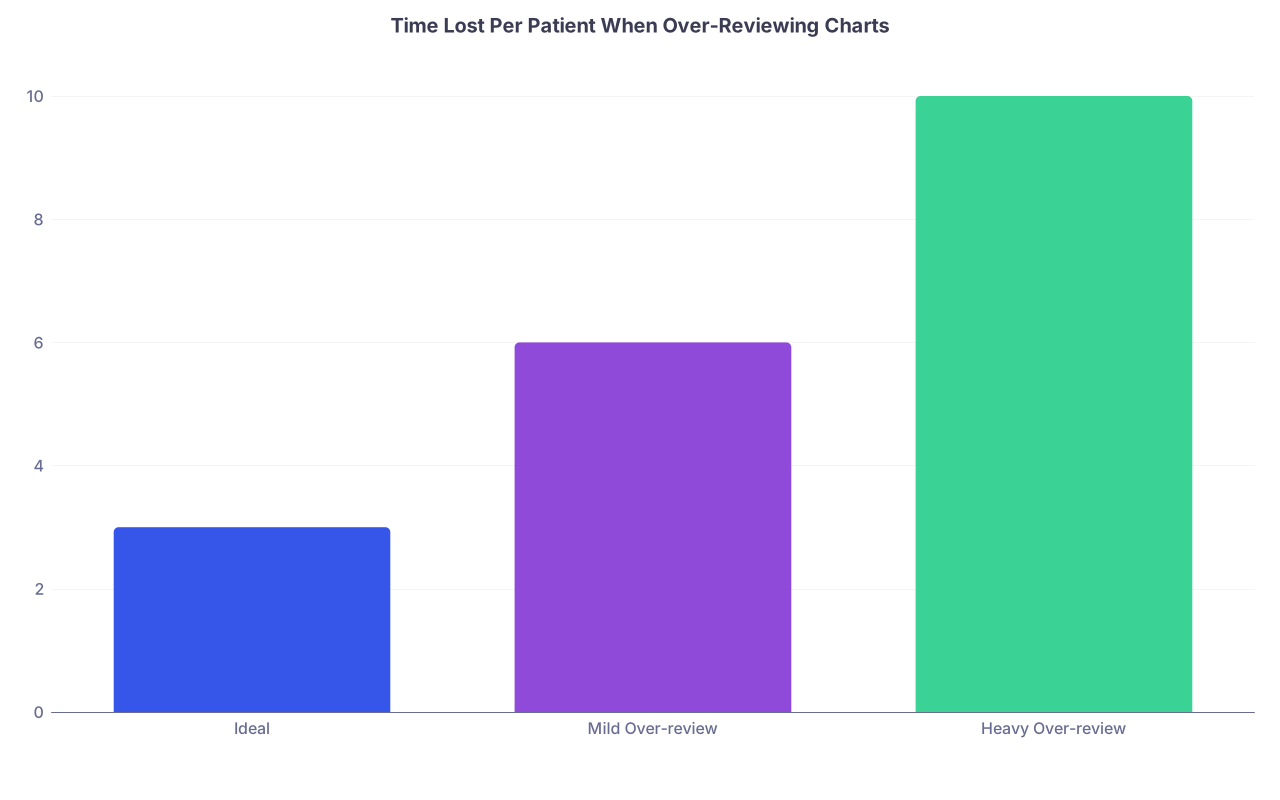
| Category | Value |
|---|---|
| Ideal | 3 |
| Mild Over-review | 6 |
| Heavy Over-review | 10 |
Those extra 3–7 minutes per patient? On a 12-patient list, that is 36–84 minutes. That is why you are late.
Error #2: Not Preparing Your List the Night Before
The resident who prints their list at 5:40 a.m. every day is the same one who “mysteriously” never finishes pre-rounds on time.
Common night-before mistakes:
- Leaving “clean up” work (discharges off list, new admits added) for the morning.
- Not updating room numbers or service changes after sign-out.
- Not pre-building task columns (labs to check, follow-ups, imaging pending).
So your pre-round actually starts with 10–15 minutes of admin chaos while the lab results are already rolling in.
Fix this the night before, or pay for it in the morning.
Here is what a disciplined night-before routine looks like:
- Clean your list:
- Remove discharges and transfers.
- Confirm room numbers and locations.
- Mark:
- New admits.
- Likely discharges for the next day.
- Pre-mark must-check items:
- Key labs (Hgb, Cr, Na, K, lactate, troponin, etc.).
- Imaging that is supposed to result overnight.
- Consult notes you must read in the morning (but do not read them yet).
Then all you do in the morning is update data into a structure that is already there. No thinking. Just filling in blanks.

If you skip this, you will waste your clearest mental time (those first 45–60 minutes) on nonsense formatting and re-organization instead of clinical work.
Error #3: Examining Patients in a Random, Inefficient Path
The resident who power-walks the unit multiple times every morning? That is the one who is late.
Pre-rounding is not just about speed. It is about route design.
Common path mistakes:
- Bouncing between floors because “I want to see my favorite patient first.”
- Seeing the patient farthest from the workroom first, then walking back and forth to the same hallway three times.
- Ignoring that some patients will never be awake or cooperative at 5:30 a.m. (e.g., delirious, sundowning, heavy sedatives overnight) and wasting time trying.
Design your route like a delivery driver, not a tourist.
Smart path rules:
- Cluster patients by:
- Floor
- Wing
- Room number sequence
- Within each cluster:
- See the highest-acuity or most likely-to-crash patient first.
- Do a single directional sweep whenever possible:
- Down one side of the hall, back on the other.
- Then move to the next floor.
You should not be hitting the same hallway three different times for three different “quick checks.” That is 5–10 minutes lost just walking.

| Step | Description |
|---|---|
| Step 1 | Log into EMR |
| Step 2 | Quick overnight review of all patients |
| Step 3 | Finalize route by location |
| Step 4 | Start with sickest cluster |
| Step 5 | One directional sweep of first floor |
| Step 6 | Second floor cluster |
| Step 7 | Return to workroom to update notes |
| Step 8 | Be ready 5-10 min before rounds |
You want your steps to be boringly predictable. “I always start in 5 South, then 5 North, then 4 South. Every. Single. Time.”
Error #4: Doing Full Notes During Pre-Rounds
This is one of the most destructive habits I see interns and junior residents develop.
You walk into a room, talk to the patient, listen to lungs, check edema. Then you sit there in the room or right outside it and try to finish the entire note. Or worse, start working on the full assessment and plan, problem by problem.
By patient three or four, you are already behind.
Morning pre-rounding has one primary purpose:
Collect targeted, essential data and confirm overnight changes so you can speak intelligently during attending rounds.
It is not the time to:
- Type full HPI/interval histories.
- Perfectly craft every problem’s assessment.
- Reconcile every single medication.
During pre-rounds your documentation should be:
- A skeleton:
- Key overnight events.
- Focused exam updates.
- Any urgent issues requiring action before attending rounds.
- Written in shorthand:
- Abbreviations you understand.
- Quick bullets, not full sentences.
Bullet-style example for a stable CHF patient on your list during pre-round:
- “No CP, no SOB; slept ok”
- “O2 2L -> 1L; sats 94–96%”
- “Lungs: ↓ crackles; LE edema improving”
- “Wt -1.2kg; net -1.5L / 24h”
- “Plan ideas: cont diuresis, repeat BMP, maybe ambulate PT today”
That is what you need in the morning. The polished note can come after rounds when you have attending input.
If you are doing full-subsection documentation pre-rounding, you are building a second job into your morning.
Error #5: Ignoring “Prep Time Before Rounds” as a Fixed Requirement
Some residents think “Rounds at 7:30” means they can pre-round until 7:28.
This is why they are always unprepared, flustered, or late.
Rounds at 7:30 really means:
- You need to be:
- Back at the workroom or conference room by 7:15–7:20.
- With your list updated.
- Labs and vitals checked.
- Your sickest patients mentally prioritized.
- Chair pulled out. Pen ready. Not out of breath.
Build a fixed buffer window. Non-negotiable.
If your attending says “We start at 7:30,” translate that as:
- Latest time you should still be in a patient room: 7:00–7:10.
- Latest time for chart-only work: 7:15–7:20.
What people do instead:
- Try to squeeze in “one last quick exam” at 7:18.
- Realize at 7:23 they did not check morning labs on the septic patient.
- Sprint back, late and half-prepared.
You can recover from one late day. You will not recover from the reputation of being “the one who is always almost ready.”
Error #6: Over-Examining Stable Patients, Under-Examining Sick Ones
There is a weird irony in residency: people spend 5 minutes auscultating clear lungs on the stable post-op day 4 patient and 30 seconds breezing through the unstable septic shock patient because “I do not want to wake them up too much.”
This is how time misallocation ruins your morning.
Here is where people mess up:
- Spending extra minutes on:
- Chatting with pleasant, stable patients who like you.
- Super-detailed musculoskeletal exams for issues that are unchanged.
- Repeating a neuro exam that has been stable x3 days just “because.”
- Rushing through:
- Patients on pressors.
- Patients with new overnight changes (fever, hypotension, arrhythmias).
- Patients with pending ICU transfer or step-down downgrade.
Think about risk and yield:
- Low-risk, stable patient:
- Quick confirmatory exam (mental status, lungs, heart, edema, pain, wounds).
- 1–2 minutes max if nothing changed.
- High-risk or changed patient:
- Slower, thorough, focused exam.
- Maybe 4–6 minutes, but planned and purposeful.
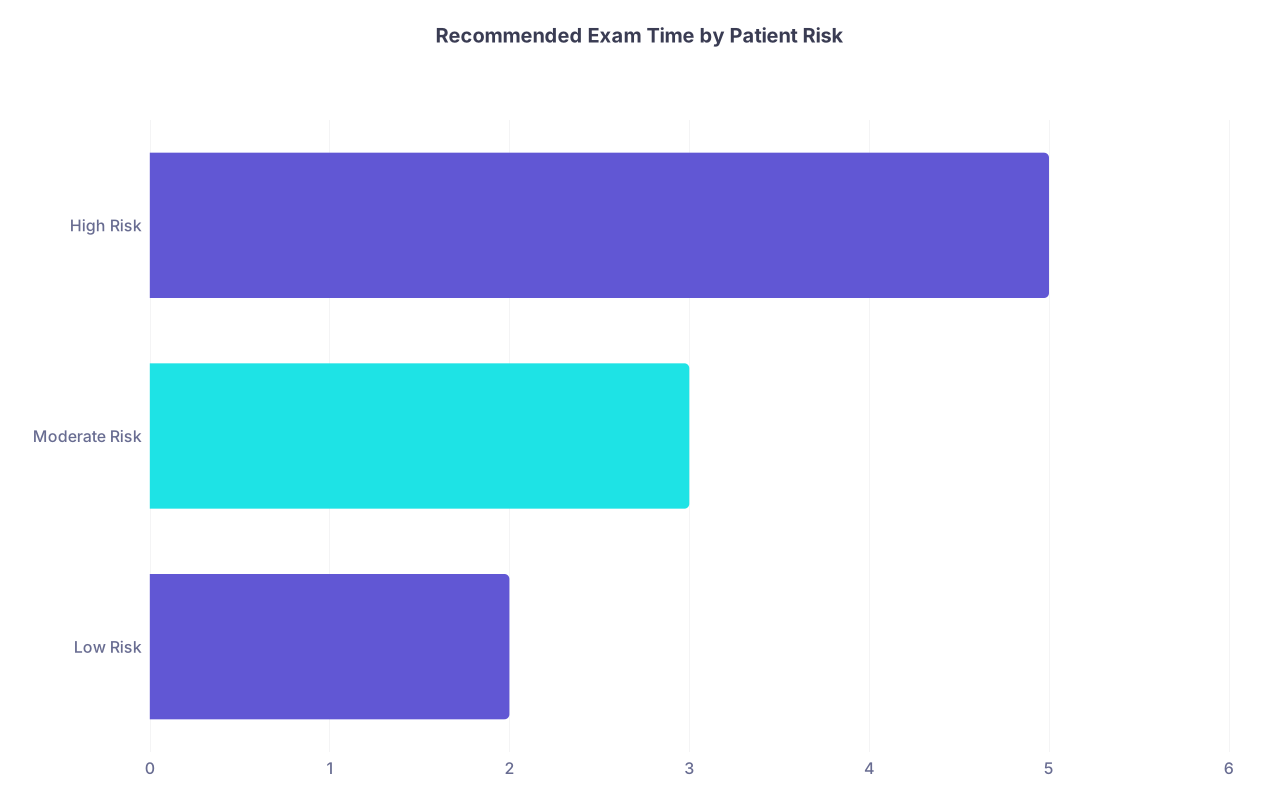
| Category | Value |
|---|---|
| Low Risk | 2 |
| Moderate Risk | 3 |
| High Risk | 5 |
Do not make the mistake of prioritizing comfort over importance. The patient who can chat about the football game will always “feel easier” than the obtunded patient on the vent. But your minutes belong to the second one.
Error #7: Pre-rounding Without a Standard “Mini-Script”
Another big source of delay: thinking from scratch at every bedside.
You walk into the room and wing it. You ask random questions. You forget half of what you need. Then you remember something important in the hallway and go back. That is two minutes gone. Times multiple rooms.
Stop improvising the basic pre-round structure.
Have a standard 60–90 second script for each patient type that you rarely deviate from.
For a typical medicine floor patient:
- Brief intro/wake-up: “Good morning, I am Dr. X, one of the residents. I just want to see how your night went.”
- Overnight: “Any pain, shortness of breath, trouble sleeping? Any new symptoms?”
- Targeted questions depending on main problem (chest pain, cough, GI symptoms, neuro changes).
- Quick, focused exam:
- Mental status/orientation.
- Heart, lungs.
- Edema.
- Abdomen if relevant.
- Lines, drains, catheters, wounds if relevant.
For a very stable patient, that can be under 2 minutes. No rambling. No small talk unless you are magically ahead of schedule (you probably are not).

If you walk in with no mental script, you will wander. And wandering is the enemy of punctuality.
Error #8: Not Adjusting Your Plan for a High Census Day
The resident who tries to pre-round the same way whether they have 7 patients or 18 is the one who is perpetually drowning.
You must scale your pre-rounding strategy to census and acuity. People do not, and that is why they are always behind when the list explodes.
On a heavy day:
- You cannot:
- Do mini-lectures to patients.
- Have long “supportive” conversations with every family at 6 a.m.
- Re-read the entire chart for each patient.
- You must:
- Identify the 3–5 “red star” patients who get deeper time.
- Be brutally efficient with the rest.
Have two modes:
- Standard mode (reasonable census):
- Normal script.
- 2–3 minutes per stable patient, 4–6 for complex.
- High-census mode:
- Shortened script.
- 60–90 seconds for straightforward, unchanged patients.
- Save any “education / deep counseling” moments for later in the day.
| Total Patients | Stable Pts Time | Complex Pts Time | Buffer Needed |
|---|---|---|---|
| 8–10 | 2–3 min | 4–6 min | 10–15 min |
| 11–14 | 1.5–2 min | 4–5 min | 15–20 min |
| 15+ | 1–1.5 min | 4–5 min | 20–25 min |
If your behavior does not change when the list grows, do not be surprised when your lateness does.
Error #9: Underestimating “Micro-Distractions” Between Patients
You know what really kills you? Not the one big delay. The string of tiny ones.
Examples I have watched residents repeat:
- Checking your phone after every patient “just in case”.
- Chatting at the nursing station for 3 minutes x 5.
- Answering non-urgent pages immediately instead of batching.
- Getting pulled into side tasks:
- “Can you just quickly reconcile these meds?”
- “Can you just talk to this family now?”
- Saying yes to every “quick thing” without triaging.
If you do not consciously protect your pre-round time, the hospital will steal it from you.
Set rules for yourself:
- Phone:
- Silent or Do Not Disturb during the core pre-round block.
- Check only at predefined points (e.g., after finishing a floor).
- Nursing interactions:
- “I will be quicker if I see all of them now, then circle back for detailed discussions after rounds. Anything emergent I should know before I see the rest?”
- Pages:
- Scan for red-flag issues (hypotension, hypoxia, chest pain).
- Batch non-urgent callbacks for a 10-minute window after pre-rounds, before main rounds.
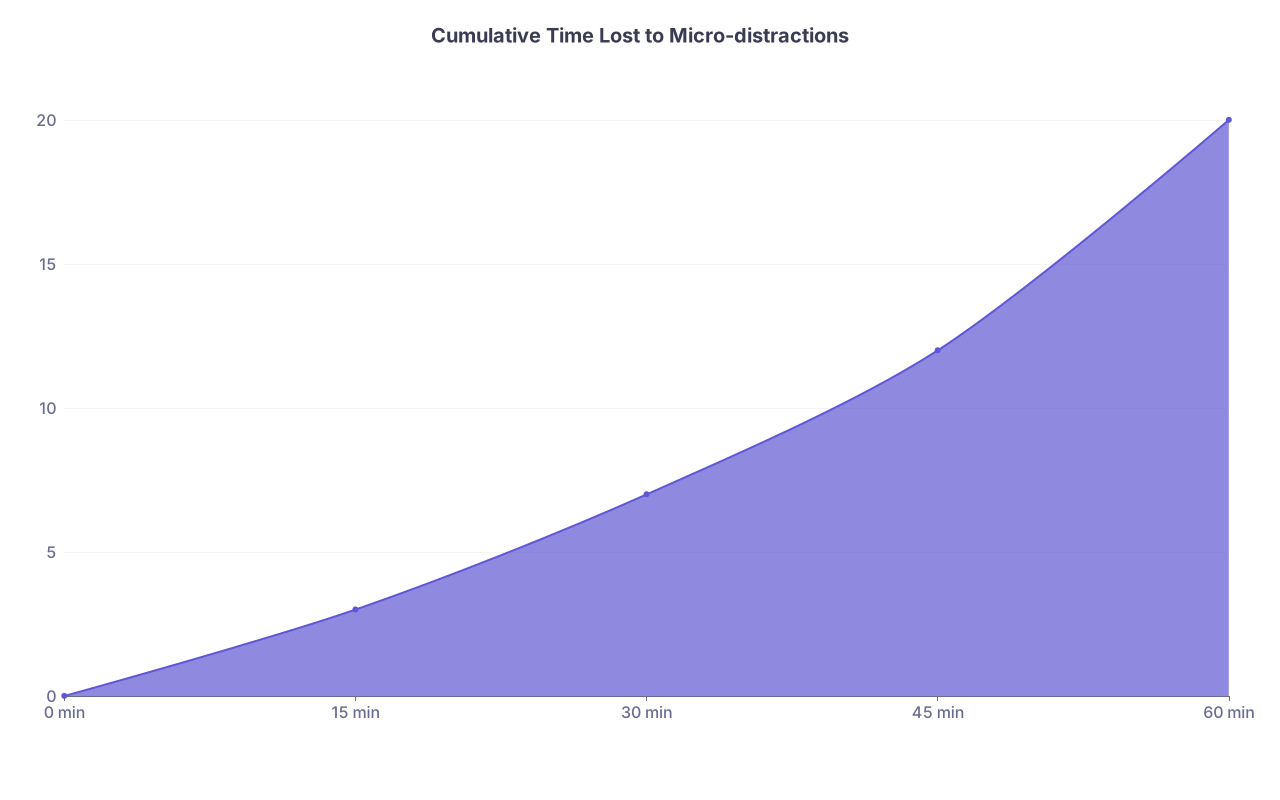
| Category | Value |
|---|---|
| 0 min | 0 |
| 15 min | 3 |
| 30 min | 7 |
| 45 min | 12 |
| 60 min | 20 |
Those “harmless” 1–2 minute interruptions are why you end up 10–20 minutes behind schedule by the end of the list.
Error #10: No Hard Cutoff for “I Am Not Going to See Everyone”
Let me be blunt: on some disaster days, you will not pre-round on every patient. The mature resident recognizes this early and manages it. The disorganized one realizes it too late and just… shows up to rounds incomplete and embarrassed.
The worst move: pretending you will somehow “catch up” with magical speed.
Better move:
- As soon as you realize:
- Time to rounds – required time per remaining patient = impossible.
- You:
- Decide which 1–2 lowest-risk, least-changed patients will not get a full bedside pre-round.
- Review their overnight data in the chart thoroughly.
- Be transparent with your senior: “I did not get to see X and Y yet, but I know their overnight events and labs. I will see them immediately after rounds.”
You will be judged less for missing a pre-round on a low-risk patient than for being chronically late and flustered. But only if:
- It is the rare exception, not the rule.
- You own it and have the data.
FAQs
1. What is a realistic wake-up time for pre-rounding as an intern?
Depends on your commute and census, but most residents who are consistently on time are logged into the EMR 60–90 minutes before rounds start. If rounds are at 7:30, that usually means you are at the hospital and logged in by 6:00 at the latest, often earlier on high-census days. Telling yourself you can “do it all” in 30 minutes with 12 patients is fantasy.
2. Should I ever write full notes before attending rounds?
Only in very specific scenarios: a pending ICU transfer, a patient with active deterioration, or when you know the attending wants something documented early (like a goals-of-care discussion that already happened). For the average stable floor patient, writing the complete note before hearing the attending’s updated plan is inefficient and a major time sink. Use skeleton notes pre-round, complete notes after rounds.
3. How do I handle a nurse who wants to discuss a non-urgent issue with every patient during pre-rounds?
Set a clear but respectful boundary. Something like: “I want to make sure I am on time for rounds so we can actually address everything thoroughly. If there is anything urgent or safety-related, tell me right away. For the rest, can we batch them and go over them right after rounds?” Most experienced nurses respect time constraints when they see you are actually reliable and not just blowing them off.
4. What if my attending always shows up early or unpredictably and that makes me late?
You cannot control an attending who shows up at 7:15 for 7:30 rounds. You can control being ready by 7:10. Build your buffer assuming worst-case consistency from them, not best-case. If the attending truly starts earlier than the scheduled time every single day, ask your senior: “To be on time for Dr. X, what time do you usually try to be fully ready?” Match that. Do not rely on the official schedule. Rely on reality.
Key points to remember:
- You are not late because you are “slow.” You are late because of repeated structural errors in how you organize pre-rounds.
- Fix the upstream problems: start earlier, prep your list at night, standardize your scripts, and protect your buffer time.
- Ruthless prioritization is not optional in residency. It is the only way to be both on time and safe.