
The hidden reason you are leaving the hospital two hours late is almost never “the system.” It is your charting habits.
You are not lazy. You are not slow. But if you do charting wrong in residency, it will quietly bleed hours from every day, crush your sleep, and make you resent a job you might otherwise enjoy. I have watched good interns burn out not because of codes, not because of call, but because they were always “finishing notes.”
Let me walk you through the charting pitfalls that steal your time, one click at a time—and how to stop making them.
1. The Biggest Trap: Saving All Your Charting for the End of the Day
This is the classic rookie mistake. “I will just remember and write it all later.” You will not. And you will pay for it.
Here is what actually happens when you batch everything to 4–7 p.m.:
- Details get fuzzy, so you spend extra time reading back through labs, notes, and orders to reconstruct what you already did.
- Your notes become vague and generic, which makes tomorrow’s you hate today’s you.
- You stay late every single day, because you have turned charting into a second shift.
I have seen interns “start notes” at 6 p.m. on a 6-patient day. They look shocked when they are still there at 8:30.
The time sink is not just the writing. It is the re-thinking.
What to do instead
Do not make your brain do the same work twice. Implement real-time or near-real-time charting:
- Write the HPI and assessment/plan right after seeing each new patient whenever humanly possible.
- For established patients, adjust yesterday’s plan while you are reviewing morning labs, not 8 hours later.
- Use “note skeletons” (more on this later) pre-built before rounds, so you are mostly filling in blanks throughout the day.

| Step | Description |
|---|---|
| Step 1 | Pre-round |
| Step 2 | Update note skeletons |
| Step 3 | See patient |
| Step 4 | Edit A&P within 5-10 min |
| Step 5 | Run rounds |
| Step 6 | Finish remaining details midday |
| Step 7 | Sign notes by mid-afternoon |
If you are consistently starting most of your notes after 4 p.m., you are doing double work. That will break you by winter.
2. Over-Documenting Like a Med Student Trying to Impress
Residency is not Step 2 CS. No one hands out points for writing a 6-paragraph HPI on a stable CHF follow-up or for retyping the CBC and BMP into the note.
The mistake: writing for an imaginary attending grader instead of for three real audiences:
- Future clinicians who must understand what you were thinking.
- Coders/billing who need enough specificity for appropriate reimbursement.
- Medico-legal protection so it does not look like you ignored something important.
Everything else is fluff.
Common over-documentation time-wasters:
- Repeating normal findings in paragraph form (“Cardiovascular: RRR, normal S1/S2, no murmurs, gallops, or rubs…”) instead of using structured exam where your system allows it.
- Pasting entire past medical history and social history into every daily note.
- Re-describing the same chronic issues in full detail every single day when nothing changed.
- Writing a novel in the plan section that re-explains basic pathophysiology to your future self.
You are not writing UpToDate. You are documenting care.
How to tighten it up without cutting corners
Aim for “clear, concise, defensible.”
- HPIs: Focus on what changed, what you did, and what you are worried about. Yesterday’s stable, unchanged chronic back pain does not need its own paragraph.
- ROS: Stop expanding boilerplate “10-point ROS negative” into sentences unless there is a reason.
- Physical exam: Document what matters for that day and that problem. Do not fake or copy forward a full normal neuro exam if you did not do it.
- Problem list: Prioritize. Top 3 problems get detailed plans. The rest can be brief but direct.
If your daily note for a stable patient is consistently longer than your admission H&P, something is wrong.
3. Abusing “Copy & Paste” and Smart Phrases
Copy-forward is the most dangerous time-saver you will ever touch. Used properly, it saves your sanity. Used poorly, it can bury you—or worse, get you in real trouble.
I have seen:
- “No SOB” copied forward in a patient on high-flow O2 and visibly dyspneic.
- “No central line in place” auto-populated on a patient with a fresh internal jugular line placed that morning.
- A note that still said “chest pain workup pending” four days after the CT chest was done and the PE ruled out.
Every one of those errors took longer to fix than it would have to document accurately from the start. Some led to complaints. A few led to formal reviews.
The pitfall is relying on copy-paste so much that you stop reading your own notes.
Safe rules for reuse
You can reuse, but do not recycle blindly:
- Never copy the assessment and plan without re-reading every single problem.
- Any time you copy an HPI, force yourself to write at least 1–2 fresh sentences that describe today.
- Build smart phrases that insert blanks you must complete (“CTA ____ showed ____”). This forces a mental check-in.
- If your EHR has auditing features, assume someone can and will see your copy-paste patterns.
Copy-forward should feel like editing a draft, not hitting “submit” on yesterday’s work.
4. Writing Notes for the Wrong Reader
Another subtle time sink: writing as if you are submitting a paper to JAMA instead of updating a cross-cover colleague at 2 a.m.
Your daily notes are not primarily for your program director, your PD’s boss, or some abstract “legal review in 2035.” They are, mostly, for:
- Tomorrow’s team.
- Night float / cross-cover.
- The consultant reading quickly to see what is going on.
- You, three days from now, asking “Why did I do that?”
If your note does not answer these questions quickly, you are wasting time:
- What happened in the last 24 hours?
- What is the active problem list, in order of priority?
- What is the concrete plan for each problem?
- What are we watching for?
Young residents get stuck writing long prose that no one wants to read. Then they spend extra time cleaning up that prose.
How to refocus
Shift your mental audience:
- Write the first line of your A/P as if it will be read during sign-out: “[Problem] – [Status today] – [Next step].”
- Use short, direct sentences instead of long pseudo-academic ones.
- For complex patients, consider a one-line overview: “This is a 68-year-old with decompensated cirrhosis, septic shock now off pressors, and worsening renal function.”
You are allowed to write like a clinician, not like an English major.
5. Ignoring Your EHR’s Power Tools
Residents love to suffer manually. Many never learn the system they are forced to live in.
If you are still:
- Manually typing medication lists.
- Searching for “CBC” every time instead of building a “basic labs” favorite.
- Scrolling through dozens of panels every note instead of rearranging your workspace.
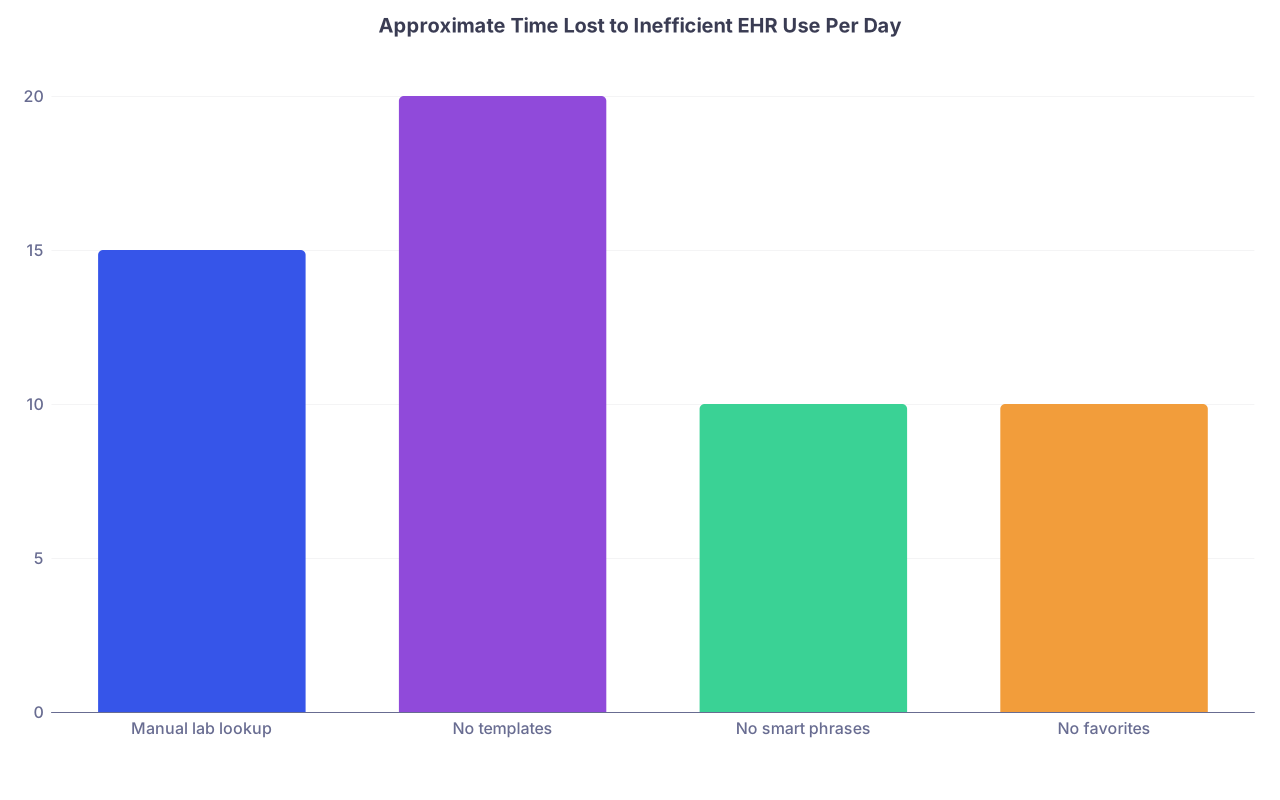
…you are volunteering to lose an hour a day.
| Category | Value |
|---|---|
| Manual lab lookup | 15 |
| No templates | 20 |
| No smart phrases | 10 |
| No favorites | 10 |
These are conservative estimates. Over a month, that is days of your life.
Minimum EHR competence you cannot skip
Within your first month on a service, you should:
- Create a basic H&P template and a daily progress note template for that specialty.
- Build smart phrases for common problems: “CAP,” “CHF exacerbation,” “DKA,” “post-op day X.”
- Save favorites for:
- Your standard admission orders.
- Pain regimens.
- Rescue meds.
- Common lab bundles (e.g., “CBC, BMP, Mg, Phos”).
- Learn the hotkeys for:
- Jumping between patients.
- Opening notes.
- Placing orders.
If you do not know how to do these things, ask a PGY-2 who is efficient. There is always one. They will show you in 10 minutes what will save you 10 hours this month.
6. Turning Charting into Perfectionism Theater
Here is the uncomfortable truth: some residents use charting as a socially acceptable way to procrastinate or to avoid leaving.
Signs you are doing this:
- You “polish” phrasing in notes long after all clinically important content is there.
- You obsess over formatting, indentation, or whether you used “however” twice.
- You rewrite sentences three times to make them sound more academic.
- You feel weird going home “too early,” so you slow your pace subconsciously.
Perfectionism masquerades as “thoroughness.” What it really does is convert a 10-minute note into a 30-minute performance.
Your notes must be accurate. They do not have to be beautiful.
Dead-simple standard to follow
Ask yourself:
- Does this note clearly communicate what happened and what the plan is?
- Are there any obvious gaps that would confuse another provider or look negligent?
- Are diagnoses, severity, and key decisions explicitly documented?
If yes, stop typing. Sign the note. Move on.
You are training to be a physician, not a medical copywriter.
7. Not Front-Loading the Work Before Rounds
Another pattern that guarantees late nights: showing up to rounds with no pre-built notes.
Residents who do this spend their mornings:
- Scribbling plans on scraps of paper.
- Half-listening on rounds because they are trying to remember each patient’s labs.
- Then, at 2 p.m., staring at a blank note with nothing but an old sign-out sheet to guide them.
Of course charting feels slow. You are recreating your entire clinical reasoning from scratch.
A better pre-round system
The night before or early morning:
- Open each patient’s note for tomorrow and:
- Copy forward yesterday’s note or load your daily template.
- Update the problem list order based on current acuity.
- While pre-rounding:
- Update vitals, objective data, and brief overnight events.
- During or right after rounds:
- Edit the plan directly in the note as the attending speaks.
- Add key phrases so your A/P is essentially done by late morning.
Then your “charting” in the afternoon is mostly finishing touches and signing, not heavy lifting.

| Step | Description |
|---|---|
| Step 1 | Night before |
| Step 2 | Load templates |
| Step 3 | Reorder problems |
| Step 4 | Morning pre-rounding |
| Step 5 | Fill objective data |
| Step 6 | Edit plan during rounds |
| Step 7 | Sign majority by mid-afternoon |
Residents who do this consistently often leave on time without cutting corners. It is not magic. It is preparation.
8. Letting Inbasket and Messages Hijack Your Flow
Another silent killer: constantly interrupting yourself to check messages, inbasket results, or chat pings.
Each time you break from a note to answer something low-urgency, you lose context. Then you spend time re-reading your own half-written sentence just to remember what you were doing.
Fragmented attention is slow attention.
Protect your focus
Treat charting like any other cognitive task:
- Batch inbasket review to specific times (e.g., right after lunch, or after rounds).
- When you are in “note mode,” stay in it for a defined block (even 15–20 minutes uninterrupted is better than 60 minutes of constant switching).
- Use quick, structured replies instead of 4-sentence essays in secure chat. If it needs detail, pick up the phone.
You do not have to be instantly available for every non-urgent message. Train your co-residents and nurses gently: you will respond, but not necessarily in 30 seconds unless it is obviously urgent.
9. Not Using Templates and Checklists for High-Volume Tasks
Some services will drown you in certain note types: discharge summaries, admission H&Ps, or post-op notes.
If you treat each one as a unique, handcrafted product, you will drown with them.
I have watched new interns type full, free-text discharge instructions for every COPD patient. By week four they look like they have aged a year.
Build reusable structures early
For any note type you do more than a few times a week, you should create:
- A template in your EHR.
- Or, at minimum, a skeleton text you can paste and customize.
For example, a discharge summary template may include:
- Reason for admission (blank).
- Hospital course by problem.
- Key labs/imaging results.
- Pending labs/studies at discharge.
- Follow-up appointments and who is responsible.
- Medication changes with bullet points: “Started,” “Stopped,” “Dose changed.”
Same with admission H&Ps: have sections and prompts ready so you do not forget key elements and do not reinvent structure every time.
This does not mean cookie-cutter care. It means you reserve your brain power for clinical thinking, not formatting.
| Template Type | Where It Saves Time |
|---|---|
| Admission H&P | Medicine, Surgery, Cards |
| Daily Progress Note | All inpatient rotations |
| Discharge Summary | Medicine, Surgical services |
| Common Diagnoses A/P | ICU, ED, Wards |
| Procedure Notes | Lines, taps, paracentesis |
10. Confusing “Document Everything” with “Document Smart”
Yes, you must protect yourself legally. Yes, coding matters. But residents swing the wrong direction and start stuffing notes with irrelevant noise “just in case.”
Examples:
- Rewriting medication lists in full every day instead of using the med list section.
- Putting a 10-line family history in every progress note.
- Including full vital sign trends when you could simply document the pattern and relevant extremes.
This bloats your notes and makes them harder to use in court, not easier. Lawyers and experts want clarity, not volume.
What actually matters medico-legally
You protect yourself more by documenting:
- Your differential diagnosis.
- Your rationale for key decisions (why you ordered or did not order something; why you did or did not escalate).
- Discussions with patients or families about risks, benefits, and preferences.
- Responses to abnormal findings or events (“Called rapid response, transferred to ICU,” etc.).
Each of those can be a line or two, not a paragraph. But skipping them to instead document every normal system exhaustively is the wrong trade.
11. Refusing to Learn from the Efficient People Around You
Final and very human mistake: assuming your misery is inevitable because “everyone is drowning.” They are not.
Every program has:
- The intern who consistently leaves on time without dumping work.
- The senior who writes clean, high-yield notes quickly.
- The fellow who somehow replies to messages, runs a service, and still has time to teach.
They are not superheroes. They just learned good habits and ruthlessly killed bad ones.
If you are constantly the last person out of the hospital, do not just accept it as your fate. Ask for help. But ask targeted questions:
- “Can you show me how you build your daily notes?”
- “What parts of the chart do you ignore unless needed?”
- “What do you do during rounds so that notes are mostly done by afternoon?”
- “Which parts of your notes are copy-forward versus typed fresh?”
Watch them write one note from start to finish. You will notice small moves—hotkeys, pre-filled text, real-time editing—that you can steal.
| Category | Value |
|---|---|
| Month 1 | 120 |
| Month 2 | 90 |
| Month 3 | 70 |
| Month 4 | 60 |
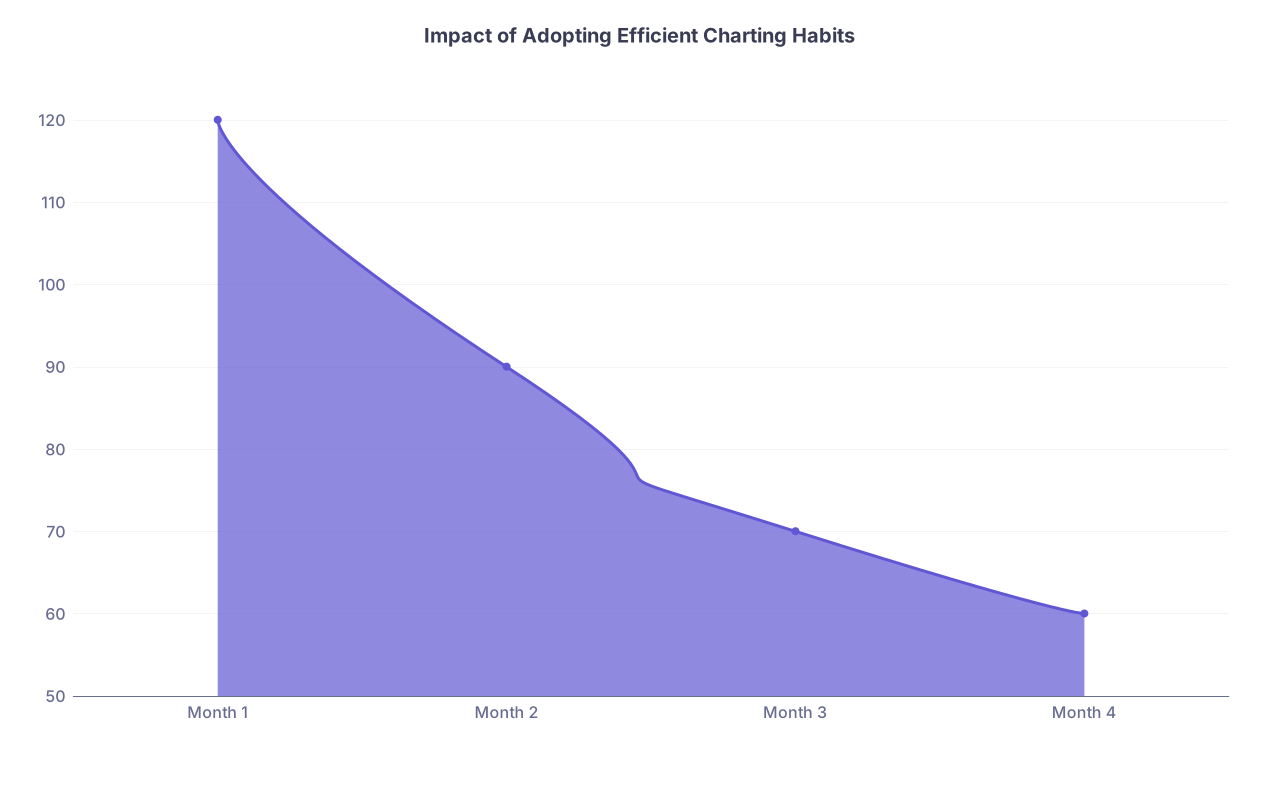
That “minutes per note” drop is not hypothetical. I have seen interns cut their time nearly in half over a few months by aggressively copying efficient habits.
The Bottom Line: Stop Donating Hours to Your EHR
If you remember nothing else, remember this:
- Do not push all your charting to the end of the day. You will always stay late.
- Use your EHR intelligently—templates, smart phrases, favorites, and pre-built notes are not optional if you value your time.
- Your notes must be clear, accurate, and defensible; they do not need to be perfect essays. Prioritize clinical reasoning and plans over flourish and fluff.
Residency will still be hard. But you do not need to make it harder by letting charting quietly steal hours from your life, every single day.